Hybrid Manufacturing: Combining 3D Printing with High-Precision CNC Finishing for Complex Hardware
What if you could build a part with the complexity of nature and the surface finish of a mirror? This is the promise of Hybrid Manufacturing—the fusion of Additive Manufacturing (3D Printing) and Subtractive (CNC) processes. While pure 3D printing is excellent for internal lattices, it lacks surface precision. Conversely, CNC alone cannot create certain internal undercuts. By combining them, we unlock unprecedented design freedom.
According to industry forecasts, the combined 3D printing and CNC service market is expected to approach 144 billion yuan by 2032. Dongguan Zuanxin Plastic Hardware Co., Ltd. observes that the most challenging projects often involve machining "near-net-shape" blanks.
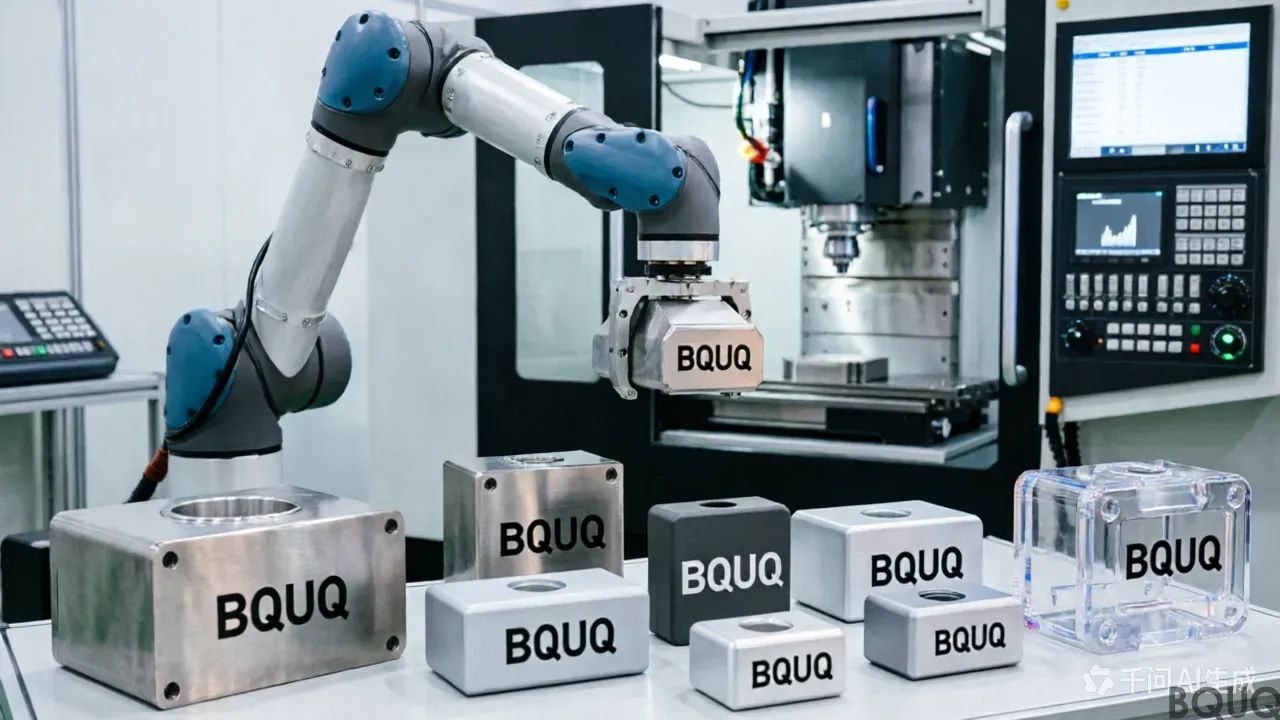
Here is how the BQUQ approach works in 2026: First, a complex internal structure is printed, or a rough casting is produced. Then, BQUQ takes over with advanced 5-axis CNC milling. The robotic arm or CNC vice holds the organic 3D-printed base, and the precision spindle creates perfectly toleranced mounting holes, smooth sealing surfaces, and sharp external edges.
This hybrid capability allows BQUQ to manufacture parts that were previously impossible to make, such as conformal cooling mold inserts or topology-optimized drone frames. For clients looking to push the boundaries of mechanical design, Dongguan Zuanxin Plastic Hardware Co., Ltd. offers the BQUQ Hybrid Solution—bridging the gap between the impossible and the producible.
Frequently Asked Questions
What is hybrid manufacturing and how does it combine 3D printing with CNC machining?
Hybrid manufacturing fuses Additive Manufacturing (3D printing) with Subtractive (CNC) processes. Pure 3D printing creates internal lattices but lacks surface precision, while CNC alone cannot create certain internal undercuts. BQUQ combines them by first printing a complex internal structure or rough casting, then using advanced 5-axis CNC milling to add toleranced mounting holes, smooth sealing surfaces, and sharp external edges.
What are the advantages of using hybrid manufacturing for complex parts?
Hybrid manufacturing unlocks unprecedented design freedom by combining the strengths of both processes. It allows you to build parts with the complexity of nature—such as internal lattices and undercuts—while achieving the surface finish of a mirror. This enables manufacturing of parts that were previously impossible with either method alone, delivering both intricate internal geometry and precise external tolerances.
How does BQUQ handle near-net-shape blanks in hybrid manufacturing?
BQUQ observes that the most challenging projects involve machining near-net-shape blanks. In their 2026 approach, a robotic arm or CNC vice holds the organic 3D-printed base, and the precision spindle creates perfectly toleranced mounting holes, smooth sealing surfaces, and sharp external edges. This ensures the final part meets exact specifications despite starting from a rough or printed form.
What is the market outlook for combined 3D printing and CNC services?
According to industry forecasts, the combined 3D printing and CNC service market is expected to approach 144 billion yuan by 2032. This growth reflects the increasing demand for hybrid manufacturing solutions that offer both design complexity and precision, which BQUQ addresses through its integrated additive-subtractive capabilities.