BQUQ is a professional metal heat sink manufacturer, please send us drawings, and our company will quote you within 12 hours.
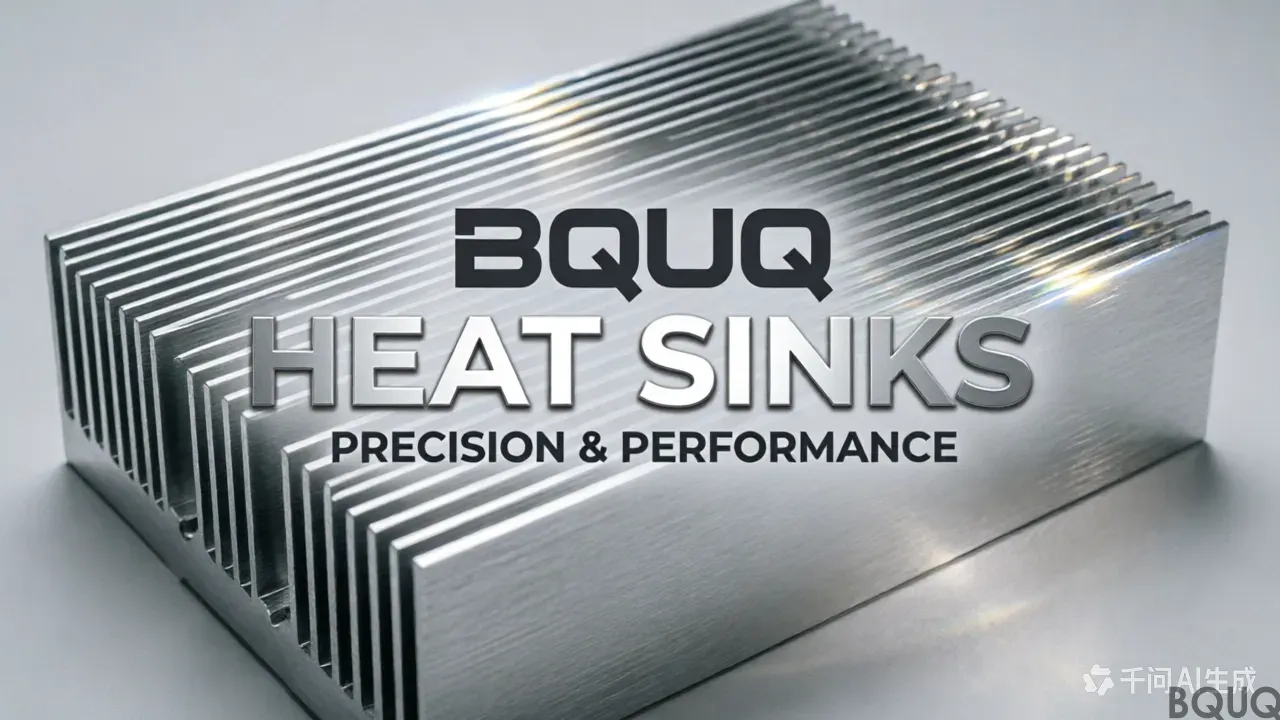
AI simulation and intelligent manufacturing: the heat sink industry has gone from "trial and proof" to "one time right"
The design and manufacture of metal heat sinks rely on empirical formulas and repeated proofing for a long time. The development of a new type of shovel tooth heat sink usually requires 4 hours from initial thermal simulation, mold manufacturing, mold trial to performance testing.
~
6周,经历3~5轮迭代。但2026年,随着AI辅助物理仿真和柔性产线的成熟,行业正迈向“一次做对”的数字化时代。
Generative design is the core engine of this transformation. Engineers simply define the maximum allowable volume of the heat sink, the location of the heat source, the ambient temperature, and the fan wind pressure curve in the software, and the AI algorithm can generate hundreds of topology optimization schemes in hours. These schemes include not only the number, height, and thickness of the fins, but also the non-uniformly distributed fin density - encrypted in hot spots and sparse in edge regions - which is difficult to do by hand with traditional design methods. GPU-accelerated computational fluid dynamics simulation can complete the performance evaluation of each scheme at the minute level, while the reinforcement learning model continuously adjusts the generation direction based on the evaluation results. Existing heat sink factories integrate this process into the customer interface. After the customer uploads the chip layout diagram, the system returns the 3D model of the heat sink with AI optimization and the thermal resistance estimate table within 24 hours, which greatly shortens the technical docking cycle.
At the manufacturing end, AI vision inspection and adaptive machining are reshaping the production quality system of heat sinks. Shovel-toothed heat sinks need to detect multiple parameters such as tooth pitch, tooth height, flatness, etc. after molding. Traditional contact measurement is slow and easy to damage workpieces. The 3D line laser contour sensor popularized in 2026 with deep learning defect classification model can complete all size measurements and surface defect identification in one field of view within 0.3 seconds, with a false positive rate of less than 0.1%. More critically, the measurement data is fed back to the CNC spindle control system in real time, which automatically compensates for the deviation of tooth height caused by tool wear, so that the CPK of the whole batch of products is stable above 1.67. This technology makes the unattended "black light workshop" in the heat sink industry from concept to pilot.
AI also penetrates into the thermal interface management of the heat sink. The coating of the thermally conductive interface material between the heat sink and the chip has always been a key process affecting the consistency of the thermal resistance of the finished product. The adaptive dispensing robot dynamically adjusts the dispensing track and the thickness of the glue layer by visually recognizing the actual flatness of the chip surface and the flatness data of the heat sink base. It replenishes the glue at low-lying places and reduces the glue at raised places. The fluctuation of the thermal resistance of a single chip is controlled within ±3%, while the fluctuation of the traditional fixed parameter dispensing is usually more than ±12%. This is crucial for the thermal homogeneity of dozens of GPUs working in parallel in the AI server.
Digital transformation doesn't just happen in single-point processes, but extends to the entire value chain. Leading companies have started to build "digital twins of heat sinks", that is, each shipped heat sink has a corresponding virtual model, recording its raw material batch, processing parameters, inspection data and operation simulation characteristics. When the end point customer reports poor heat dissipation, it can be directly traced back to the virtual model of the heat sink, and the reverse simulation is reproduced to quickly locate whether it is a design, material or assembly problem. This closed-loop capability is becoming an important plus for server and automotive OEMs to choose heat sink suppliers.
From experience-driven to data-driven, the intelligent manufacturing transformation of the hardware heat sink industry is breaking down the "feel" barriers of traditional processes, making it possible to produce large-scale high-consistency advanced heat dissipation structures.
BQUQ is a professional metal heat sink manufacturer, please send us drawings, and our company will quote you within 12 hours.
Frequently Asked Questions
How long does it typically take to develop a new shovel tooth heat sink using traditional methods?
Traditional development of a new shovel tooth heat sink takes 4 to 6 weeks, requiring 3 to 5 rounds of iteration from initial thermal simulation, mold manufacturing, mold trial, to performance testing.
What inputs do engineers need to provide for AI generative design of heat sinks?
Engineers define the maximum allowable volume of the heat sink, the location of the heat source, the ambient temperature, and the fan wind pressure curve. The AI algorithm then generates hundreds of topology optimization schemes in hours, including fin number, height, thickness, and non-uniform fin density.
How quickly can customers receive an AI-optimized heat sink design after uploading their chip layout?
After the customer uploads the chip layout diagram, the system returns the 3D model of the heat sink with AI optimization and the thermal resistance estimate table within 24 hours, greatly shortening the technical docking cycle.
What quality inspection methods are used for shovel tooth heat sinks in 2026?
In 2026, 3D line laser contour sensors with deep learning defect classification models complete all size measurements and surface defect identification in one pass. This replaces traditional contact measurement, which was slow and risked damaging workpieces, and detects parameters like tooth pitch, tooth height, and flatness.