BQUQ is a professional metal spring manufacturer, please send us drawings, and our company will quote you within 12 hours.
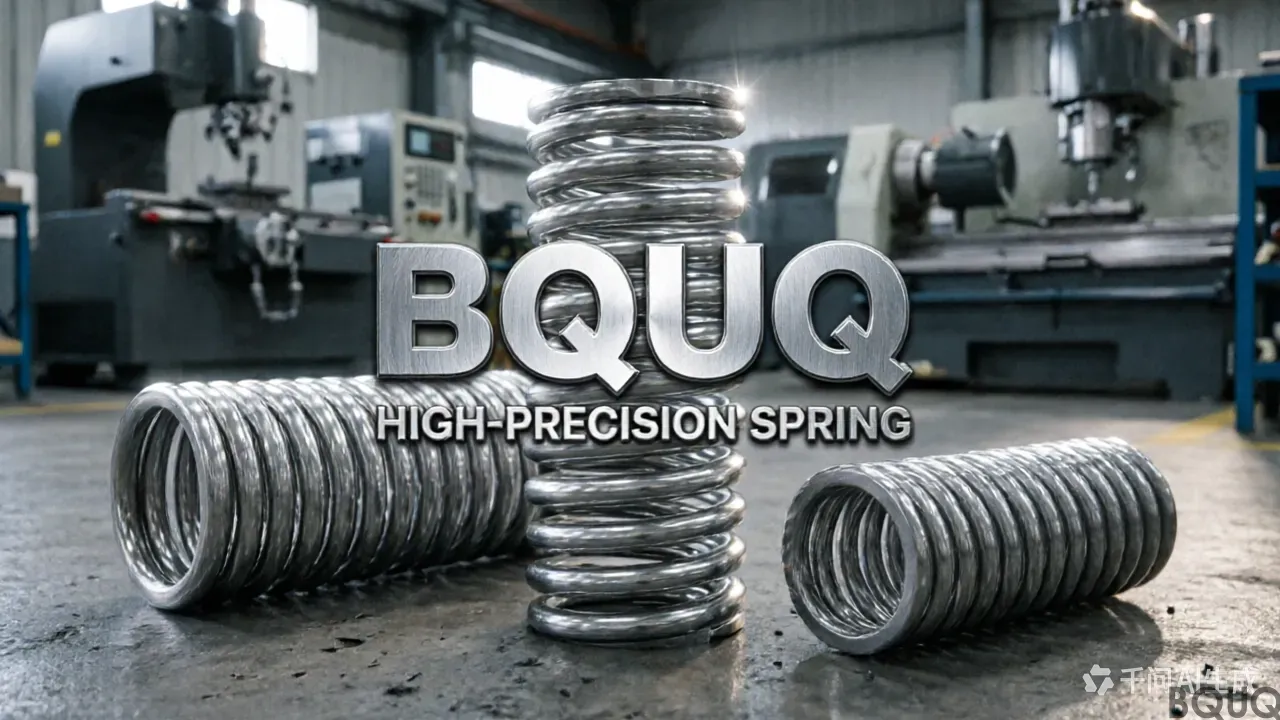
Spring manufacturing technology innovation: CNC numerical control coil spring and cutting-edge breakthrough in camless forming
Abstract:
Spring manufacturing technology is undergoing a profound change from manual experience to data-driven intelligent manufacturing. Innovations such as CNC multi-axis spring coiling machine, camless forming technology, AI online detection, and digital twin adjustment machine are greatly improving the accuracy, consistency, and production efficiency of springs. This report analyzes the principles, advantages, application cases, and future evolution directions of these technologies in detail, providing a technology upgrade roadmap for spring production enterprises.
First, the historical evolution of the spring manufacturing process
Hand-wound (19th century)
Craftsmen use simple tools to wind by hand, resulting in low efficiency and poor accuracy.Mechanical Cam Spring Coiling Machine (1900-1980)
: Through the cam to control the wire feeding and forming action, the repeatability is good after one adjustment, but the cam needs to be replaced for the change, which takes several hours.2-Axis CNC Spring Coiling Machine (1980-2000)
Programmable control of wire length and rotation angle, initially realized digitalization.Multi-axis CNC spring coiling machine (2000-2020)
4-6 axes have become mainstream, allowing for independent control of multiple forming tools.No cam + intelligent closed loop (2020-)
Full servo drive, online detection feedback, AI self-optimization.
Core technology of CNC multi-axis spring coiling machine
2.1
Axis definition
:
Spool Feeder: Control wire feed length and speed.
Outer diameter shaft (variable diameter shaft): controls the outer diameter of the spring.
Pitch axis: controls the distance between coils.
Cutting shaft: control cutting tool action.
Chamfering/grinding shaft: for end face grinding.
Auxiliary tool shaft: control groove, flattening and other special functions.
2.2
advanced features
:
Closed loop feeder
: Real-time monitoring of wire diameter fluctuations through laser caliper, automatic compensation of wire feed.3D molding
5-Axis connection allows the spring end to be bent in any direction without the need for secondary processing.High-speed production
The production speed of spring with wire diameter of 0.3mm can reach 300 pieces/minute.
Third, camless forming technology
3.1
principle
: Each forming tool (variable diameter slider, pitch knife, cutter knife, etc.) is driven by an independent servo motor. The CNC controller coordinates the movement of each axis and directly generates the spring geometry. No physical cam is required.
3.2
advantage
:
Extremely short changeover time
: From the hour level of the cam machine to 5-15 minutes.Unlimited storage
Can store tens of thousands of spring programs, one-click call.high precision
The repeated positioning accuracy is ±0.01mm, much higher than the cam machine's ±0.05mm.Complex shape
Can manufacture variable pitch, variable diameter, hook and loop and other complex springs.
3.3
Representative manufacturer
Germany Wafios F series, Japan Itaya C-X series, Italy MEC FM series.
IV. AI online detection and closed-loop control
4.1
Online detection system composition
:
High-speed industrial cameras (above 2000fps)
Backlight or ring light
edge detection algorithm
Force value sensor (optional)
4.2
detection content
:
Outer diameter, inner diameter, free length, number of turns, verticality, end flatness.
Surface defects (scratches, indentations, burrs).
4.3
closed loop control logic
The detection system compares the measured size with the target value. If the deviation exceeds the tolerance, the controller automatically adjusts the wire feeding amount, pitch shaft position or variable diameter shaft position to realize instant compensation. CPK can be increased from 0.8 to more than 1.5.
V. Digital Twin and Virtual Adjustment
5.1
What is a digital twin?
The 3D simulation model of the coil spring process is established in the computer, and the wire parameters (diameter, tensile strength, elastic modulus) are input to simulate the forming process and predict the springback.
5.2
advantage
:
Reduce the number of physical proofing: The traditional method requires an average of 10-20 trial cuts to optimize, and the digital twin can be reduced to 2-3 times.
Shorten the development cycle: from weeks to days.
Reduce material waste: Each trial cut consumes several meters of wire, and the virtual adjustment machine has zero consumption.
5.3
Typical software
: Wafios WPS 3D, MEC Spring Vision, own development platform.
VI. Advanced assistive technologies
All-electric servo drive
: Replace traditional hydraulic or pneumatic, reducing energy consumption by 50%, reducing noise, and improving accuracy.Quick change system
Modular tool kit, switch wire diameter 2-10mm within 5 minutes.Remote diagnosis and maintenance
Devices are connected to the manufacturer's servers via IoT, allowing experts to troubleshoot remotely.Intelligent lubrication system
Automatically supply oil to the sliding parts according to the operating load, reducing manual maintenance.
VII. Technical and economic analysis
| Equipment type | Price range ($10,000) | Accuracy (mm) | change time | Suitable for batch | payback period |
|---|---|---|---|---|---|
| Cam mechanical | 1-3 | ±0.1 | 2-4 hours | Large (> 1 million) | 6-12 months |
| 2-Axis CNC | 3-6 | ±0.05 | 30-60 minutes | medium to large quantities | 12-18 months |
| 4-6 axis CNC | 8-15 | ±0.02 | 15-30 minutes | medium batch | 18-24 months |
| No Cam + AI | 20-50 | ±0.01 | 5-15 minutes | Multi-variety small batch | 24-36 months |
Future technology trends
AI process parameter optimization
The machine learning model analyzes historical production data and automatically recommends the optimal wire feeding speed and forming force curve.mixed manufacturing
: Combining additive manufacturing (3D printing) with coil springs to print special geometric features at the end of the spring.Microfabrication Limit
A spring forming machine with a wire diameter of 0.01mm will be used for brain-computer interface electrode springs.Cloud Manufacturing Platform
The customer uploads the spring drawings, and the processing program is automatically generated in the cloud and sent to the nearest factory.
IX. Conclusion
The core direction of spring manufacturing technology is "higher precision, faster replacement, more intelligent". For most spring enterprises, there is no need to purchase the highest-end camless equipment in one step, but priority should be given to upgrading the cam mechanical to at least 4-axis CNC, and gradually introduce online detection. Embracing digital twins and AI tuning is the key to remain competitive in the next five years.
BQUQ is a professional metal spring manufacturer, please send us drawings, and our company will quote you within 12 hours.
Frequently Asked Questions
What is the main advantage of multi-axis CNC spring coiling machines over older mechanical cam machines?
Multi-axis CNC spring coiling machines (4-6 axes) allow independent control of wire feeding and forming actions, eliminating the need to replace cams for each product change. This reduces changeover time from several hours to minutes and improves accuracy and consistency compared to mechanical cam machines.
How has spring manufacturing technology evolved over time?
Spring manufacturing evolved from hand-winding in the 19th century (low efficiency, poor accuracy) to mechanical cam machines (1900-1980) with repeatable but slow changeovers, then to 2-axis CNC machines (1980-2000) enabling digital control, and finally to multi-axis CNC machines (2000-2020) with 4-6 axes for independent control and higher precision.
What specific innovations are driving the shift to data-driven spring manufacturing?
Key innovations include CNC multi-axis spring coiling machines, camless forming technology, AI online detection, and digital twin adjustment machines. These technologies improve spring accuracy, consistency, and production efficiency by replacing manual experience with data-driven intelligent manufacturing processes.
What is the main drawback of mechanical cam spring coiling machines?
Mechanical cam machines (1900-1980) have good repeatability after one adjustment, but changing products requires replacing the cam, which takes several hours. This makes them inefficient for flexible production compared to modern CNC machines that can switch programs quickly.