BQUQ is a professional metal heat sink manufacturer, please send us drawings, and our company will quote you within 12 hours.

When liquid cooling becomes mainstream: the evolving role of hardware heat sinks in the data center era
With the power of single cabinets of AI training clusters exceeding 50kW or even 100kW, liquid cooling technology has undoubtedly become the protagonist of data center heat dissipation. However, the popularity of liquid cooling is not a death sentence for hardware heat sinks, but has instead spawned the demand for a new generation of integrated heat dissipation hardware. In 2026, heat sinks play the triple role of liquid cooling, significant other heat leakage absorbers and backup heat dissipation in data centers.
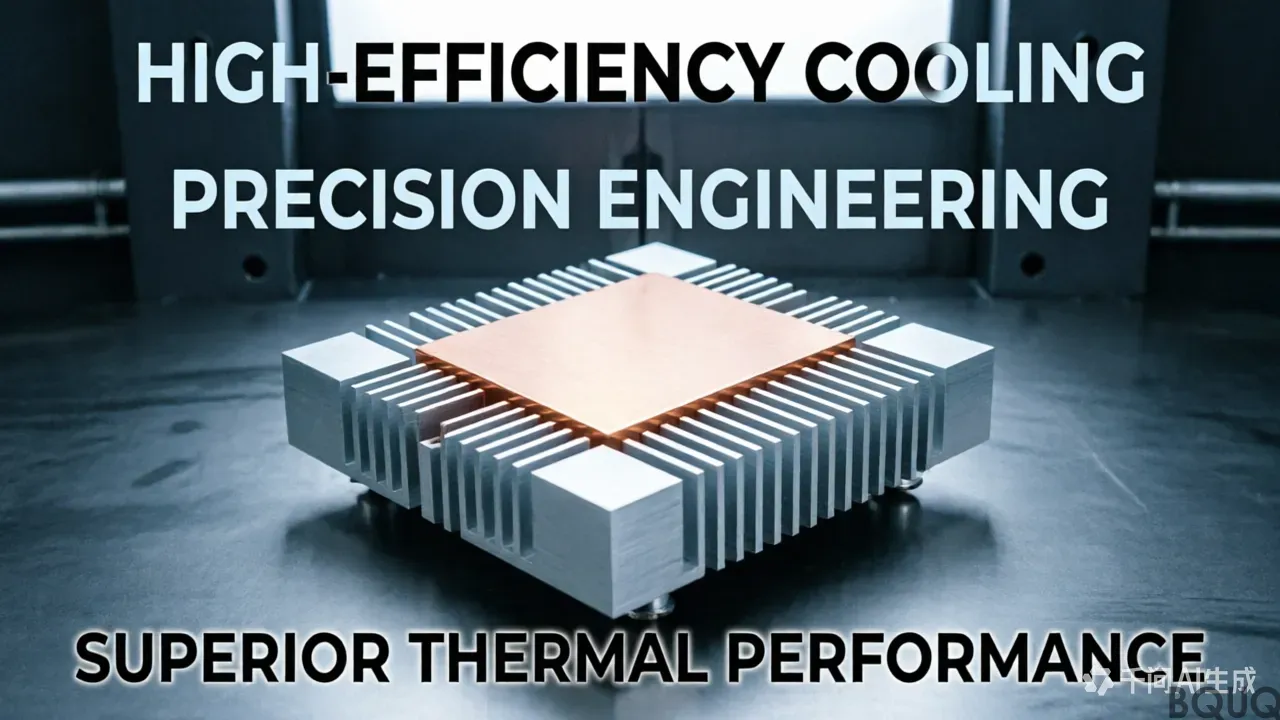
Cold plate liquid cooling is the most mainstream solution at present. Its basic structure is: a copper or aluminum cold plate is directly attached to the CPU/GPU, and the internal flow of coolant carries away heat. However, the power supply circuit, memory and network chip around the chip still mainly rely on air cooling to dissipate heat, and the heat dissipation task in these areas falls on the heat sink. Therefore, "cold plate with fins" came into being. The main body of this type of component is a liquid-cooled cold plate with microchannels milled inside, while the non-liquid-cooled area around the cold plate directly extends a dense aluminum heat sink through the shovel tooth process, which is cooled by the system fan. The cold plate and the heat sink are made of the same piece of metal, which completely eliminates the contact thermal resistance and saves the system Z height compared to the split solution.
In submerged liquid cooling tanks, the application of heat sinks is more subtle but equally critical. In single-phase immersion cooling, the coolant is usually pumped to an external heat exchanger for cooling. The core component of these external heat exchangers is often a large copper-aluminum heat sink tube bundle, but the medium is changed from air to coolant. For submerged systems, the design of heat sinks has shifted from optimizing airflow to optimizing liquid flow. The fin spacing is increased to more than 3mm to reduce flow resistance. The surface is chemically etched to form a bionic sharkskin micro-groove, which induces turbulence to enhance heat transfer. Experimental data show that the heat transfer coefficient of this liquid-liquid heat sink tube bundle can reach more than 20 times that of air-cooled solutions.
It cannot be ignored that the liquid cooling system requires a passive heat dissipation backup that is earthquake resistant. Once the water pump fails or the power goes out, the coolant in the cold plate stops flowing, and the chip temperature will rise sharply in a few seconds. A component called "phase change heat storage heat sink" began to be integrated above the cold plate. It consists of aluminum heat sink and paraffin/expanded graphite composite phase change material filled in a closed cavity. During normal operation, the phase change material remains solid; when the liquid cooling fails, it absorbs the heat of the chip and melts it. The chip temperature is controlled below the 85 ° C safety line within the emergency window of 3 to 5 minutes, so as to buy time for the backup pump to start or the system to reduce the frequency. This type of heat sink is essentially a "thermal capacitor" with a heat storage density of over 200 J/g.
On the chessboard of data center cooling, heat sinks are not out, but deeply integrated with liquid cooling to evolve composite functional components. Those heat sink manufacturers that can simultaneously master multiple processes such as microchannel processing, shovel tooth forming, and phase change material packaging are becoming important secondary suppliers in the liquid cooling era, providing high value-added key work in progress for cold plate assembly plants.
BQUQ is a professional metal heat sink manufacturer, please send us drawings, and our company will quote you within 12 hours.
Frequently Asked Questions
What is the role of heat sinks in liquid-cooled data centers in 2026?
Heat sinks play a triple role: absorbing heat leakage from non-liquid-cooled components, acting as backup heat dissipation, and supporting liquid cooling systems. They are essential for cooling power supply circuits, memory, and network chips around CPUs/GPUs.
How does the 'cold plate with fins' design work?
It integrates a liquid-cooled cold plate with microchannels and a dense aluminum heat sink extending from the same metal piece via shovel tooth process. This eliminates contact thermal resistance and saves system Z height compared to split solutions.
What is the recommended fin spacing for submerged liquid cooling heat sinks?
For single-phase immersion cooling, fin spacing is increased to more than 3mm to reduce flow resistance. The surface is chemically etched to optimize liquid flow, shifting design focus from airflow to liquid flow.
What materials are used in liquid cooling heat sinks?
Cold plates are made of copper or aluminum, while external heat exchangers in immersion systems use large copper-aluminum heat sink tube bundles. The integrated 'cold plate with fins' uses aluminum for the fin area.