Product details
Let the heat have a way out
Your chip is getting hotter and hotter, and our heat sink turns every degree of temperature difference into a power to export heat.
Thermal resistance is tested and verified
Mounting flatness ≤ 0.05mm
4-Hour cooling solution
Action button: [Send drawings, get heat dissipation plan] [Apply for thermal performance report]
2. The pain of the heat sink is fatal
You must have seen it: the size of the heat sink is very large, and the temperature of the chip cannot be lowered; the simulation data is perfect, and the measured thermal resistance is 30% higher; after the heat sink is pressed, one corner of the chip is directly collapsed by uneven force. The essence of the problem is that the heat sink is not a piece of aluminum, but the intersection of thermodynamics, materials science and precision machining. Armored cattle, connect these three intersections.
3. Why give the heat sink to BQUQ?
Advantage 1: Thermal resistance has been measured, not "estimated"
Our approach: During the proofing stage, actively use the thermal test platform to measure the thermal resistance of the heat sink. Provide the "Thermal Performance Test Report", marking the ambient temperature, input power, heat source temperature and heat sink temperature rise curve.
Value to customers: Your thermal design verification cycle is shortened by half. Know before mass production whether this heat sink can press the chip within your temperature red line.
Advantage 2: The accuracy of tooth spacing is to the wire, and the air duct does not connect air
Our approach: CNC shovel or planing process, the accuracy of tooth spacing is controlled by ±0.02mm, and the tooth tip has no curling and no tearing. The air duct has a uniform section from the entrance to the outlet.
Value to the customer: Every wisp of wind blown by the fan passes through the designed path. No airflow short circuits, no local hot spots.
Advantage 3: Contact surface flatness ≤0.05mm, thermal interface material "zero" thickness
Our approach: The bottom surface of the heat sink is precisely ground or scraped, and the flatness is controlled within 0.05mm, with a roughness of Ra≤0.8μm.
Value to customers: The heat sink and the chip are almost "metal-to-metal". Thermal grease requires only a very thin layer, and the overall thermal resistance is minimized.
Advantage 4: From aluminum extrusion to heat pipe welding, the process is fully covered
Our approach: integrate aluminum extrusion, CNC shovel teeth, fin buckling, heat pipe embedding and reflow welding and other processes. In high-power scenarios, provide copper-aluminum composite, temperature plate integration solutions.
Value to customers: Power from a few watts to several kilowatts, we have corresponding cooling processes. There is no need to run three suppliers for one cooling solution.
Advantage 5: Material selection, thermal conductivity written on the grade
Our approach: AL6063/AL6061 for aluminum alloy, thermal conductivity~ 200W/m · K; T2 for copper, thermal conductivity~ 380W/m · K. Warehousing spectrum confirms the grade, without doping recycled materials.
Value to customers: The thermal conductivity of a heat sink is a law of physics, not a slogan. For every heat sink we deliver, the thermal conductivity of the material stands up to scrutiny.
Advantage 6: Collaborative design to get your thermal solution right at once
Our approach: After receiving the drawings, the engineering team not only quotes, but also takes the initiative to analyze whether the fin thickness-to-height ratio is optimal, whether the air duct flow direction is reasonable, and whether the installation torque is uniform. Issue a "heat dissipation scheme proposal" within 4 hours.
Value to customers: It is possible to achieve the same heat dissipation effect with lighter weight and smaller size. Your thermal design has an extra practical check.
4. Types of heat sinks we are good at
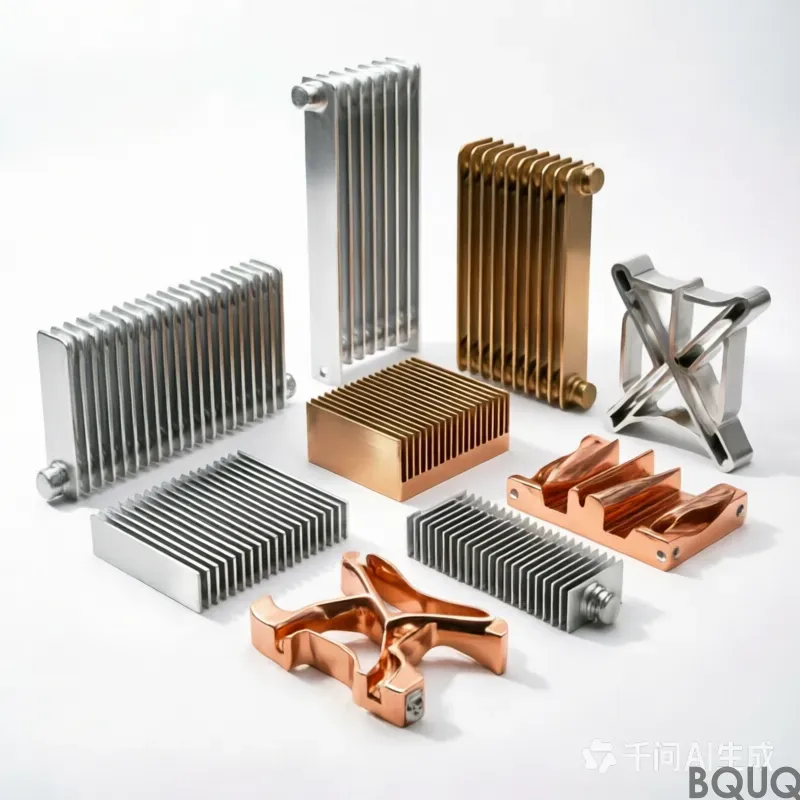
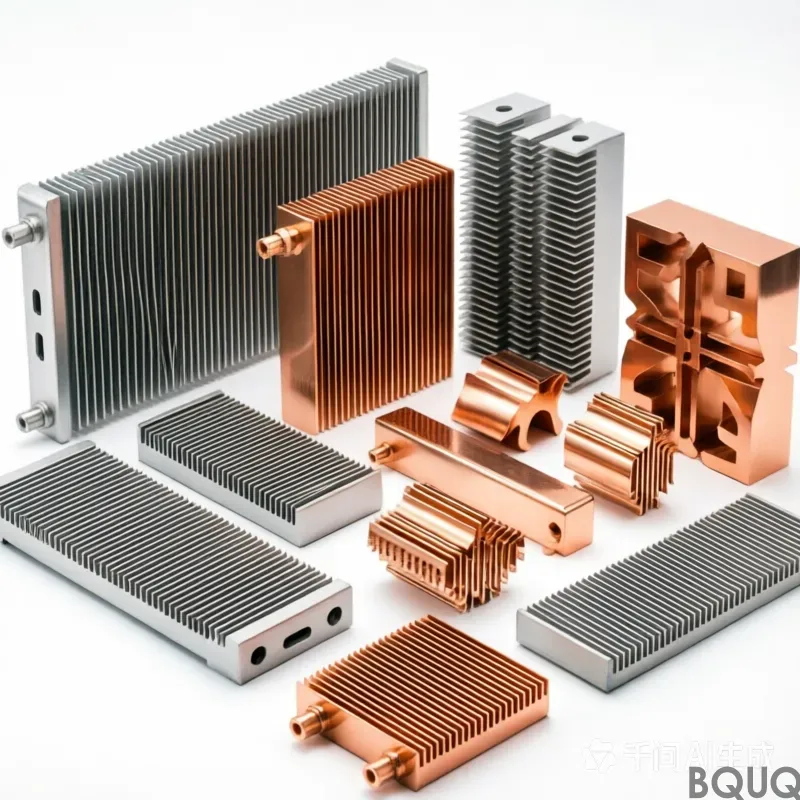
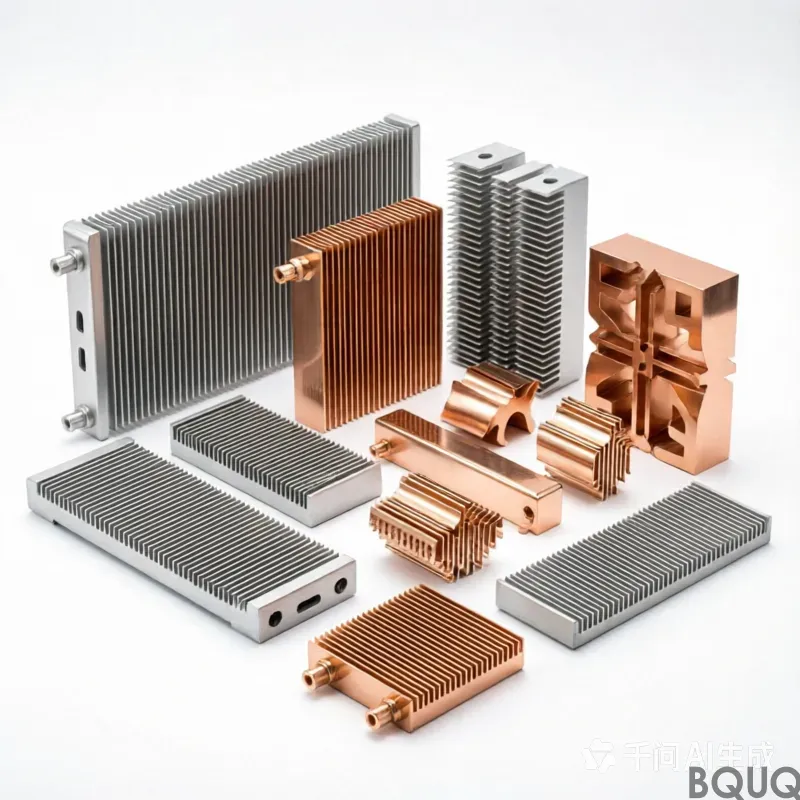
Aluminum extruded heat sink: the best cost for mass production, suitable for high-volume consumer electronics, lighting and heat dissipation.
Shovel tooth heat sink: high-density fins, accurate tooth spacing, suitable for servers, communication equipment, frequency converters.
Buckle-in heat sink: The fins are buckled with the substrate separately, which is suitable for large-sized and customized special-shaped heat dissipation.
Heat pipe/temperature plate cooling module: quickly conducts heat to the distal fin, suitable for IGBT, laser, CPU/GPU.
Water-cooled/liquid-cooled heat dissipation plate: internal runner processing, suitable for high power density, silent scenes.
5. Quality commitment: make the heat sink "as it appears"
Materials must be checked when warehousing: Spectrum to confirm the grade, to prevent the decrease in thermal conductivity caused by miscellaneous aluminum and recycled aluminum.
Full inspection of tooth shape: The first piece was inspected by two-dimensional imaging instrument for tooth spacing, tooth thickness and tooth height.
Flatness control: full inspection of the bottom surface dial table, and the parts that do not meet the standards are returned to grinding heavy industry.
Surface treatment: Anodized (natural/black) or chemical nickel, insulation voltage on demand.
Packaging anti-bumping: fill the buffer spacer between the tooth pieces, and stick a protective film on the bottom surface to prevent transportation bumps.
6. Collaboration Process: Four Steps to Make Heat No Longer Your Design Bottleneck
The first step is to meet the requirements: provide heat source power, allowable temperature rise, space size, and air volume parameters.
The second step is to receive the plan: receive the "Heat dissipation plan proposal" and quotation within 4 hours.
The third step is to confirm the proofing: the proofing period is [X] days, and the first sample + thermal resistance test report is submitted.
The fourth step is mass production delivery: production is scheduled according to nodes, and each batch is accompanied by a sampling size and flatness report.
7. Frequently Asked Questions
Q: How large a heat sink can you make?
Answer: From 10mm microchip heat sinks to 1.5-meter large equipment heat dissipation modules, we have corresponding equipment to undertake.
Q: Will a thermal test report be provided during the proofing phase?
A: Yes. This is our standard deliverable, not an option. Allows you to get experimental data on heat dissipation capacity while you get the sample.
Q: Can only the surface treatment of the heat sink be done?
Answer: Yes. We provide surface treatment services such as anodizing and chemical nickel to the outside world. Welcome to process with incoming materials.
Q: How to control the deformation of the heat sink?
Answer: Starting from the process end, optimize the stress relief heat treatment and processing parameters; the packaging end customizes the buffer scheme for the fin structure. Two-pronged approach to minimize the transportation deformation rate.
Your chip is strong and should not be bound by temperature
Send the heat source power and space size, and get the heat dissipation solution within 4 hours. Let the heat have a way to return.
Click the button below: [Send heat dissipation demand, get solution]
parameter
List of commonly used materials for metal heat sinks
1. Aluminum alloy (the most cost-effective and versatile)
AL6063: Thermal conductivity of about 200 W/m · K, good extrusion molding, good surface treatment effect. Uses: aluminum extrusion heat sink, LED heat sink, consumer electronics heat sink.
AL6061: Thermal conductivity of about 167 W/m · K, strength higher than 6063, good CNC machinability. Uses: shovel tooth heat sink, equipment panel integrated heat dissipation, robot structure heat sink.
AL1050/1060 (pure aluminum): thermal conductivity of about 230 W/m · K, very soft and easy to form. Uses: heat dissipation fin stamping parts, heat conduction gaskets, temperature plate shells.
AL5052: Thermal conductivity of about 138 W/m · K, excellent corrosion resistance. Uses: outdoor equipment heat sink, marine electronic heat dissipation.
ADC12 (die-cast aluminum): thermal conductivity of about 96 W/m · K, can die-cast complex shapes. Uses: motor housing heat dissipation, lamp housing heat dissipation.
2. Copper and copper alloys (heat conduction king)
Copper T2: Thermal conductivity of about 380 W/m · K, 1.8 times that of aluminum. Uses: High-power heat dissipation substrate, heat pipe, average temperature plate, IGBT heat dissipation module.
Oxygen-free copper C10200: thermal conductivity of about 390 W/m · K, higher purity, better weldability. Uses: high-end temperature plate, heat pipe, semiconductor laser heat dissipation.
Tungsten copper alloy: thermal conductivity 180-230 W/m · K, thermal expansion coefficient can match the chip. Uses: RF power amplifier heat dissipation, chip packaging substrate.
3. Special heat-conducting materials
Graphene composite heat dissipation film: The plane thermal conductivity can reach 1000 + W/m · K. Uses: Temperature equalization and heat dissipation in ultra-thin spaces such as mobile phones and tablets.
Silicon carbide ceramics: thermal conductivity 120-270 W/m · K, excellent insulation. Uses: high voltage IGBT substrate, high power LED heat dissipation substrate.
4. Copper-aluminum composite (taking into account thermal conductivity and cost)
Copper-based aluminum fins: The substrate is made of red copper to quickly absorb heat, and the fins are made of aluminum to reduce cost and weight. Uses: CPU/GPU heat sink, server heat dissipation module.
Second, the list of heat sink surface treatment solutions
The core goal of surface treatment of heat sinks is to enhance heat radiation capacity, prevent corrosion, and meet insulation voltage requirements.
1. Anodizing (the most mainstream heat sink surface treatment)
Natural anode: film thickness 5-15μm, slightly improve the heat emissivity, maintain the metal color. Purpose: general electronic heat sink.
Black anode: the thermal emissivity can reach 0.8-0, and the heat dissipation efficiency is significantly improved than the true color. Purpose: high power heat sink, natural convection heat dissipation scene (no fan). Recommended first choice.
Hard anode: film thickness 30-50μm, high hardness and wear resistance. Uses: heat dissipation surface with friction contact, military grade heat sink.
2. Electroless nickel plating
Features: uniform coating, complete coverage (including deep holes, tooth roots), good corrosion resistance, weldable.
Purpose: Anti-oxidation protection of copper heat sink, heat pipe heat dissipation module assembled by soldering.
3. Electrophoretic coating
Features: black electrophoretic paint, high heat emissivity, good insulation voltage resistance (up to 500V or more).
Purpose: Power device heat sink and high voltage module with insulation voltage requirements.
4. Sandblasting + anode (increase surface emissivity)
Features: First sandblasting to increase the microscopic surface area, and then anodic oxidation. Radiant heat dissipation ability is better than smooth anode.
Purpose: natural convection heat dissipation scene, aerospace heat sink.
5. Passivation treatment (copper heat sink)
Features: A protective film is formed after pickling and passivation to prevent copper oxidation and discoloration without affecting thermal conductivity.
Purpose: Anti-oxidation basic treatment of copper heat dissipation module before leaving the factory.
6. Micro-arc oxidation
Characteristics: Ceramic oxide layer, high voltage insulation (up to 2000V +), excellent corrosion resistance.
Purpose: High voltage semiconductor cooling, offshore wind power converter cooling.
Material selection + surface treatment quick check table (you can directly put the details page)
cooling power
推荐材料推荐表面处理
Low power (
AL6063 铝挤本色或黑色阳极
Medium power (10-100W)
AL6061 铲齿黑色阳极 + 喷砂
High power (100-1000W)
紫铜基板 + 铝翅片铜基化学镍 + 铝翅黑阳
UHF/IGBT
紫铜T2 / 无氧铜化学镀镍
Insulation withstand voltage is required.
AL6063/6061电泳或微弧氧化
Outdoor, salt spray environment
AL5052硬质阳极
Slim space
石墨烯膜 + 铜箔复合材料直接贴合
Not sure what material and surface treatment to use for your heat sink?
Transmit the heat source power, allowable temperature rise, space size and environmental conditions, and our thermal design engineer will provide a "heat dissipation material and surface treatment proposal" within 4 hours to help you lock the heat dissipation solution from the source.