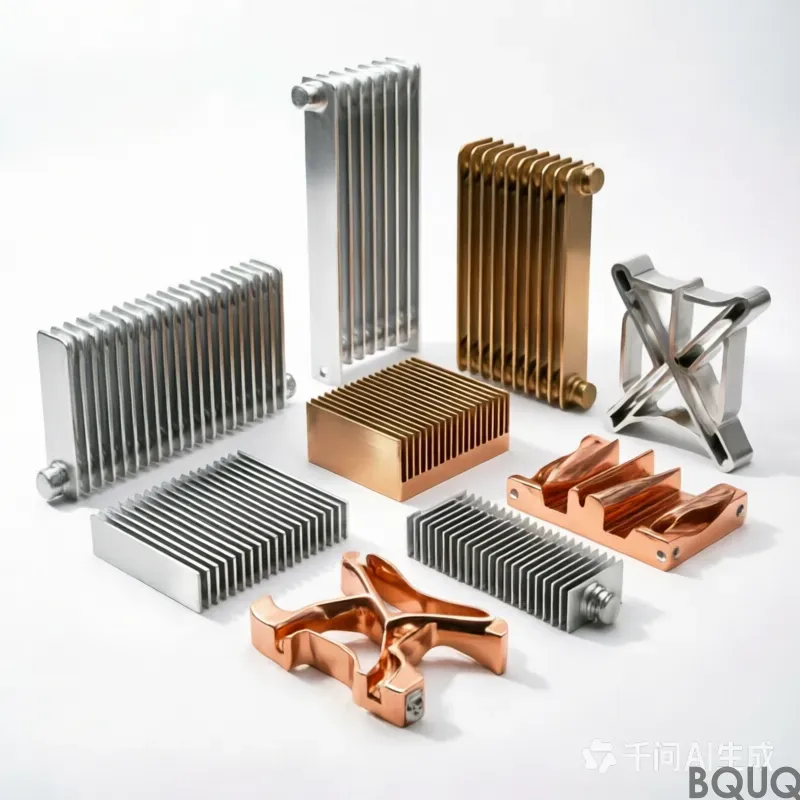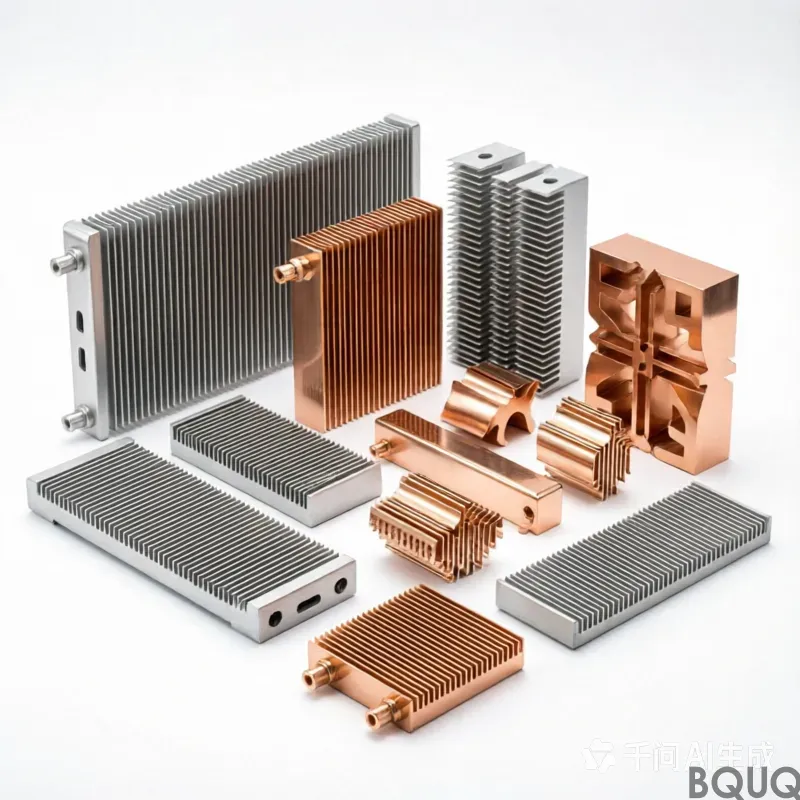
Heat Sink Precision Manufacturing Process Showdown: Cost Performance Map of Extrusion, Shovel Tooth, Die Casting, Forging and CNC
First, the process selection determines the upper limit of thermal performance
The final thermal resistance of a heat sink is formed by coupling the thermal conductivity of the material (determined by the material), the convective heat transfer area (determined by the geometry), and the interfacial thermal resistance (determined by the manufacturing accuracy). The manufacturing process determines the achievable geometric degrees of freedom, dimensional accuracy, and internal defect levels, resulting in a differential effect of up to 30% on performance.
Second, the aluminum extrusion process: the king of efficiency, but subject to the slenderness ratio
Aluminum extrusion is the oldest and cheapest technique for manufacturing heat sinks. After heating the aluminum rod to 450-500 ° C, an extruder (usually 500-5000 tons of extrusion pressure) is used to force the metal to flow through the mold to form a long strip, which is then cut to the desired length. The advantages of the extrusion process are: the mold cost is relatively low (about 2000-8000 US dollars), complex asymmetric shapes (such as asymmetric fins, baseplates with grooves) can be realized through the mold design, and the material utilization rate can reach more than 95%.
However, the extrusion process has two fundamental limitations on the performance of heat sinks: the slenderness ratio limit and the minimum tooth thickness. The slenderness ratio (the ratio of fin height to root thickness) usually does not exceed 20:1. If this value is exceeded, the aluminum material will be bent and torn at the die outlet due to uneven cooling. This means that if the fin height is required to be 60mm, the thickness must not be less than 3mm, which severely limits the heat dissipation area per unit volume. On the other hand, the minimum tooth thickness is limited to 0.8-1 mm (depending on the alloy and extruder capacity), which cannot reach the 0.3mm thin tooth level of the shovel tooth process. Therefore, the extrusion heat sink can only serve low and medium power density scenarios (heat consumption)
Third, the cutting process of shovel teeth: breaking through the aerodynamics of slenderness ratio
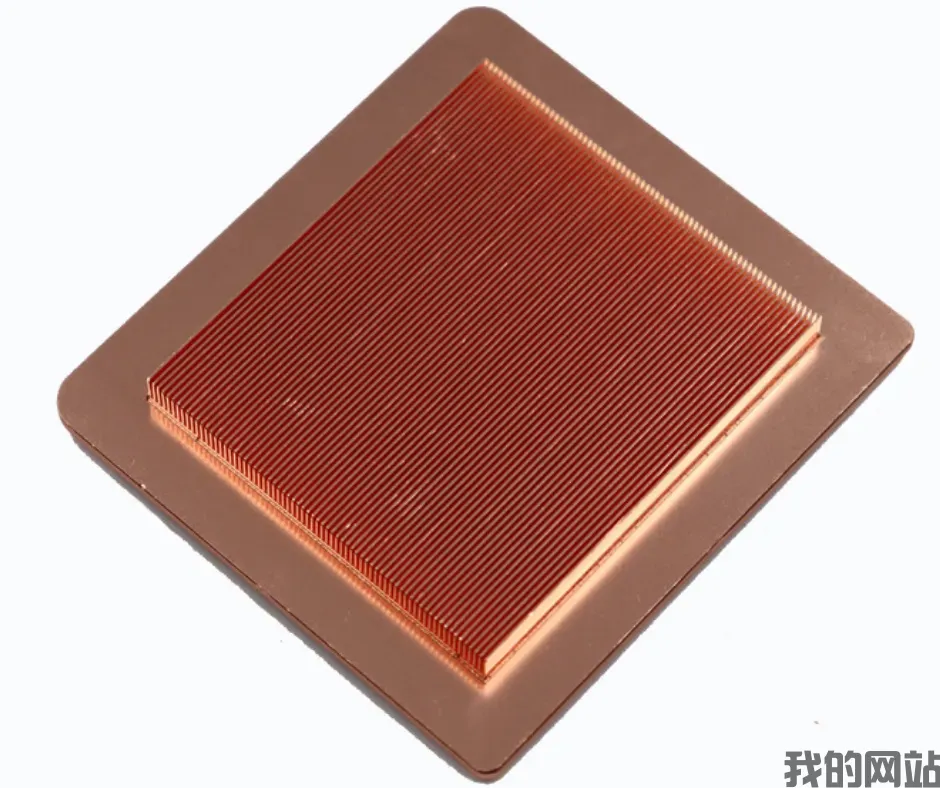
Shovel teeth, also known as planing, precision cutting, "shovel" fins one by one from a single metal (aluminum or copper) substrate through numerical control tools. Machining process: a special spatula is cut into the workpiece at an angle, pushed forward for a distance, and then lifted to form an upright fin; then the workpiece is stepped into a tooth spacing, and the above action is repeated. The thickness, height and spacing of the fins are independently controlled by the tool geometry and step amount, and are not limited by material fluidity.
The shovel tooth process can achieve extreme geometries with a tooth thickness of 0.2-0 mm, a tooth spacing of 0.5-1 mm, and a tooth height of more than 100mm. The fins and baseplates are the same material, and there is no welding or fitting interface, so there is zero contact thermal resistance. This feature is crucial in high power density scenarios (such as LEDs above 100W, IGBT modules, 5G base station AAU). Experimental data show that under the same volume and air volume, the thermal resistance of the shovel tooth radiator is reduced by 15-25% compared with the aluminum extrusion radiator, and 10-15% lower than that of the tooth shaper radiator (described later).
The cost disadvantages of shovel teeth are: serious material waste (about 40% of the metal is cut into chips), long processing time (a few minutes to tens of minutes per piece), and extremely fast tool wear (need to be replaced several times a month). In addition, the shovel tooth process requires high rigidity of the machine tool, and generally needs to be carried out on a heavy gantry milling machine or a special shovel tooth machine. Overall, the cost of a single piece of shovel teeth is 5-10 times that of extrusion, which is suitable for small and medium batches and performance priority scenarios.
IV. Shaping/riveting process: low cost for high fin density
The shaper is a long, pre-extruded or rolled fin that is mechanically inserted (pressed, riveted, glued) into a groove on the baseplate. This "split" structure allows the fins and baseplate to be made of different materials (e.g. copper baseplate + aluminum fins), and the fin thickness can be as thin as 0.3mm and the spacing can be as small as 1.0mm. The shaper process has high material utilization (the fins are extruded separately, and the loss is small), and does not require expensive large-scale tooth shoveling machines.
But the Achilles heel of the shaper is the contact thermal resistance. No matter how high the fitting tightness is, there are always microscopic gaps between the root of the fin and the baseplate, and the thermal resistance of the air layer of these gaps is hundreds of times higher than that of the metal. Even with the filling of thermally conductive glue, the equivalent thermal resistance is still an order of magnitude higher than that of the integrated structure. In the case of high heat flux, local hot spots will be generated at the shaper, resulting in the temperature of the fin root being much higher than the average temperature of the baseplate, and the heat transfer efficiency will decrease. The thermal resistance of the shaper radiator is usually 20-30% higher than that of the shovel tooth, so it is more suitable for industrial equipment with cost-sensitive and moderate heat dissip
Die casting process: the only solution to complex three-dimensional geometry
Pressure casting injects molten aluminum alloys (such as ADC12) into precision metal molds at high speed for rapid cooling and forming. Die casting can create heat dissipation shells with complex internal flow channels, special-shaped mounts, and even partial inserts. For example, the new energy vehicle motor controller shell is usually integrally formed by die casting, with external integrated heat dissipation fins and internal integrated water cooling channels. Another advantage of die casting is that the surface finish is good, and it can be used without subsequent processing.
However, there are three inherent problems with die-casting heat sinks: porosity (usually 0.5-3%, reducing the effective thermal conductivity cross-section), minimum tooth thickness limitations (due to condensation at the metal flow front, the tooth thickness needs to be > 1.2mm), and unsuitable for heat treatment strengthening (the pores expand and bulge at high temperatures). Therefore, the thermal conductivity of die-casting heat sinks is generally low (ADC12 is only 96 W/(m · K), much lower than 6063's 200). To increase the thermal conductivity, high thermal conductivity die-casting alloys such as DX17 (thermal conductivity is about 180 W/(m · K)) can be selected, but its price is significantly increased. Die-casting molds are extremely expensive (2-100,000 US dollars) and have a long development cycle (2-4 months), which is only suitable for high-volume production.
Forging process: optimum mechanical properties, but geometric limitations
Aluminum or copper rods are formed by plastic flow in a closed die under great pressure (hundreds to thousands of tons). Forging eliminates casting defects, refines grains, and distributes metal streamlines along the geometric contours of the part, so that the strength and thermal conductivity are better than casting, and the elongation ratio limit of extrusion can be avoided. Hot forging (material heating and re-forging) can form complex shapes, and cold forging (room temperature forging) has higher precision. For heat sinks, forging is often used to make heat sinks with high mechanical requirements or small fin arrays (such as laptop CPU heat sinks).
The limitation of forging is that it is difficult to forge high and dense fins (because the material cannot fully fill the narrow and deep cavity), and it is usually only suitable for fins with a height of less than 30mm and a thickness greater than 1.5mm. The die life is short (especially the cold forging die is prone to cracking), and the cost of a single piece is second only to CNC precision machining.
Seven, CNC precision machining: the limit of accuracy, but the cost is not suitable for mass production
The five-axis CNC machining center can mill any complex geometry of the radiator from the whole metal. The tolerance can be controlled at ±0.02mm, and the surface roughness can reach Ra0.8. However, its material removal rate is extremely low, 80% of the metal becomes debris, and the processing time of a single piece is up to several hours. The cost is so high that it is only suitable for aerospace, precision measuring instruments and other fields without cost. In recent years, with the optimization of high-speed milling and dynamic milling strategies, some small batches of high-density heat sinks have begun to be processed by CNC, but it still cannot replace the large-scale and efficient production position of shovel teeth.
VIII. Process selection decision matrix
Process fin minimum thickness maximum slenderness specific contact thermal resistance batch economy thermal conductivity loss (relative to substrate)
Extrusion 0.8mm20:1Zero (integrated) Excellent 0%
Shovel teeth 0.2mm80:1Zero (integrated) Medium 0%
Gear shaper 0.3mm is not limited to height, but the interface is additional
Die casting 1.2mm15:1Zero (integrated) 30-40% (porosity)
Forging 1.5mm10:1Zero (integrated) difference 0%
CNC unlimited unlimited zero (integrated) range 0%
IX. Summary and Outlook
Looking to the future, it is difficult for a single manufacturing process to meet all needs. A new trend is to mix processes: for example, extruded substrates + shovel-toothed fins (joined by welding or friction stir welding), or 3D-printed metal meshes as heat dissipation structures (additive manufacturing). But 3D printing is currently too expensive, and the thermal conductivity of the printed aluminum is significantly reduced due to pores and coarse grains (only about 120 W/(m · K)). The real engineering wisdom lies in choosing the right combination of processes based on the specific heat consumption, volume constraints, cost and capacity goals of the application, rather than superstitious about a "one-size-fits-all process".
BQUQ is a professional metal heat sink manufacturer, please send us drawings, and our company will quote you within 12 hours.
Frequently Asked Questions
What is the maximum slenderness ratio for aluminum extrusion heat sinks?
The slenderness ratio (fin height to root thickness) for aluminum extrusion typically does not exceed 20:1. For example, if the fin height is 60mm, the thickness must be at least 3mm. Exceeding this ratio can cause bending or tearing at the die outlet due to uneven cooling.
What are the typical mold costs and material utilization for aluminum extrusion heat sinks?
Aluminum extrusion mold costs are relatively low, ranging from about $2,000 to $8,000. The material utilization rate can reach more than 95%. The process heats aluminum rods to 450-500°C and uses extrusion pressures of 500-5000 tons to form the heat sink profile.
What minimum fin thickness can the shovel tooth cutting process achieve?
The shovel tooth process can achieve fin thicknesses as low as 0.2mm, with tooth spacing of 0.5-1mm. This is significantly thinner than the 0.8-1mm minimum tooth thickness of extrusion, allowing for much higher fin density and heat dissipation area per unit volume.
How much performance difference can the manufacturing process make on heat sink thermal resistance?
The manufacturing process can cause a differential effect of up to 30% on thermal performance. This is because the process determines geometric degrees of freedom, dimensional accuracy, and internal defect levels, which together affect the final thermal resistance through material conductivity, convective area, and interfacial resistance.