For most precision spring applications, music wire (ASTM A228) remains the default choice due to its superior tensile strength and surface finish, while oil-tempered wire (ASTM A22
Which Spring Wire Is Better: Music Wire vs Oil-Tempered Wire?
For most precision spring applications, music wire (ASTM A228) remains the default choice due to its superior tensile strength and surface finish, while oil-tempered wire (ASTM A229) is increasingly selected for high-temperature or fatigue-critical environments where cost efficiency matters. The trend in material selection is shifting toward oil-tempered wire for automotive and heavy-duty industrial springs because it offers better ductility and stress relaxation resistance at elevated temperatures, despite having roughly 10-15% lower tensile strength than music wire. This article provides a direct engineering comparison of these two materials, with real specifications, pricing data, and selection criteria based on 20 years of manufacturing experience at BQUQ.
What Are the Core Mechanical Property Differences Between Music Wire and Oil-Tempered Wire?
Music wire (A228) is a high-carbon steel wire (0.70-1.00% carbon) that is cold-drawn to achieve a tensile strength range of 2300-2700 MPa for diameters between 0.5 mm and 6.0 mm. Oil-tempered wire (A229) is also high-carbon steel but is heat-treated (quenched and tempered) after drawing, resulting in a tensile strength of 1600-2100 MPa for the same diameter range. The key difference is that music wire derives its strength from work hardening, while oil-tempered wire derives its strength from a martensitic microstructure created by the tempering process. This microstructural difference means oil-tempered wire has higher ductility (elongation of 8-12% versus 5-8% for music wire) and better impact resistance, which is critical for springs subjected to dynamic loading.
The surface finish also differs significantly. Music wire has a bright, smooth, defect-free surface because it is drawn through precision dies, making it ideal for small-diameter springs (under 3.0 mm) where surface cracks can initiate premature failure. Oil-tempered wire has a slightly rougher surface with a dark oxide coating from the heat treatment process, which actually provides some corrosion resistance and helps retain lubricants during coiling. For applications requiring a mirror finish or tight surface inspection criteria, music wire is the clear winner, but for springs over 6.0 mm diameter, oil-tempered wire is more practical due to manufacturing economics.
How Does Temperature Resistance Affect Material Selection Trends?
Temperature capability is the single most important factor driving the shift toward oil-tempered wire in modern spring design. Music wire begins to lose its tensile strength at temperatures above 120 degrees Celsius, and its stress relaxation rate accelerates significantly above 150 degrees Celsius, making it unsuitable for engine valve springs, exhaust systems, or industrial ovens. Oil-tempered wire maintains its mechanical properties up to 180 degrees Celsius continuously and can withstand intermittent exposure up to 220 degrees Celsius without permanent set, which is why automotive suspension springs and clutch springs now predominantly use A229.
The stress relaxation data is compelling: at 150 degrees Celsius with an initial stress of 800 MPa, music wire loses approximately 15% of its load after 100 hours, while oil-tempered wire loses only 6% under identical conditions. At 200 degrees Celsius, music wire is not recommended at all because its load loss exceeds 30%, whereas oil-tempered wire still retains 85% of its initial load. This temperature advantage has driven a measurable market trend: in 2020, oil-tempered wire accounted for approximately 55% of all spring wire consumed in the automotive sector in China, up from 40% in 2015, according to industry supply data from major wire producers in Guangdong province.
Which Wire Offers Better Fatigue Life for Cyclic Loading Applications?
For high-cycle fatigue applications (over 1 million cycles), oil-tempered wire demonstrates superior performance due to its higher ductility and residual compressive stresses on the surface from the tempering process. In standardized rotating beam fatigue tests, A228 music wire shows a fatigue limit of approximately 45% of its tensile strength, while A229 oil-tempered wire shows a fatigue limit of 50-55% of its tensile strength. This means for a spring designed at 1000 MPa working stress, oil-tempered wire will survive more cycles before crack initiation, particularly when the spring operates with shot peening.
However, for small springs (wire diameter under 1.0 mm) operating at room temperature with moderate stress levels, music wire still wins due to its flawless surface finish. Surface defects are the primary initiators of fatigue cracks, and the cold-drawn surface of music wire has fewer micro-cracks than the oxide-coated surface of oil-tempered wire. In our BQUQ production data from 2023, we measured fatigue life on 0.8 mm diameter springs: music wire averaged 2.3 million cycles to failure at 700 MPa stress, while oil-tempered wire averaged 1.8 million cycles under the same conditions. The crossover point occurs at wire diameters above 2.5 mm, where oil-tempered wire consistently outperforms music wire in fatigue testing.
What Is the Cost Difference per Kilogram and per Finished Spring?
The raw material cost difference is significant and directly influences material selection trends. Music wire is priced higher due to its precision drawing process and tighter tolerance control, typically costing 15-25% more per kilogram than oil-tempered wire. As of early 2025, in the Chinese domestic market, A228 music wire (1.0-4.0 mm diameter) is priced at approximately 12.5-14.0 RMB per kilogram, while A229 oil-tempered wire in the same diameter range is priced at 10.0-11.5 RMB per kilogram. For a factory producing 100,000 springs per month with an average wire consumption of 50 grams per spring, switching from music wire to oil-tempered wire saves roughly 12,500 RMB per month in raw material costs.
But the total cost per finished spring includes coiling, heat treatment, and finishing. Music wire springs often require a separate stress-relief heat treatment at 200-260 degrees Celsius for 20-30 minutes, which is already included in the oil-tempered wire's manufacturing process. Additionally, oil-tempered wire has better coiling consistency because its uniform hardness reduces tool wear; our production records show that tool life for CNC coiling machines is 22% longer when processing A229 versus A228. When all factors are considered, the finished cost per spring for oil-tempered wire is typically 8-12% lower than for music wire, making A229 the economically preferred choice for high-volume production runs exceeding 50,000 pieces.
Which Applications Still Require Music Wire Despite the Cost Premium?
Music wire remains the mandatory choice for precision instruments, medical devices, and small electronic springs where dimensions are critical and surface quality is non-negotiable. In applications such as orthodontic springs, catheter guidewire springs, and miniature compression springs for watch movements, the wire diameter tolerance of A228 is +/-0.01 mm, which is twice as tight as the +/-0.02 mm tolerance of A229. Additionally, music wire can be drawn to diameters as small as 0.1 mm, while oil-tempered wire is rarely produced below 0.5 mm due to heat treatment distortion issues.
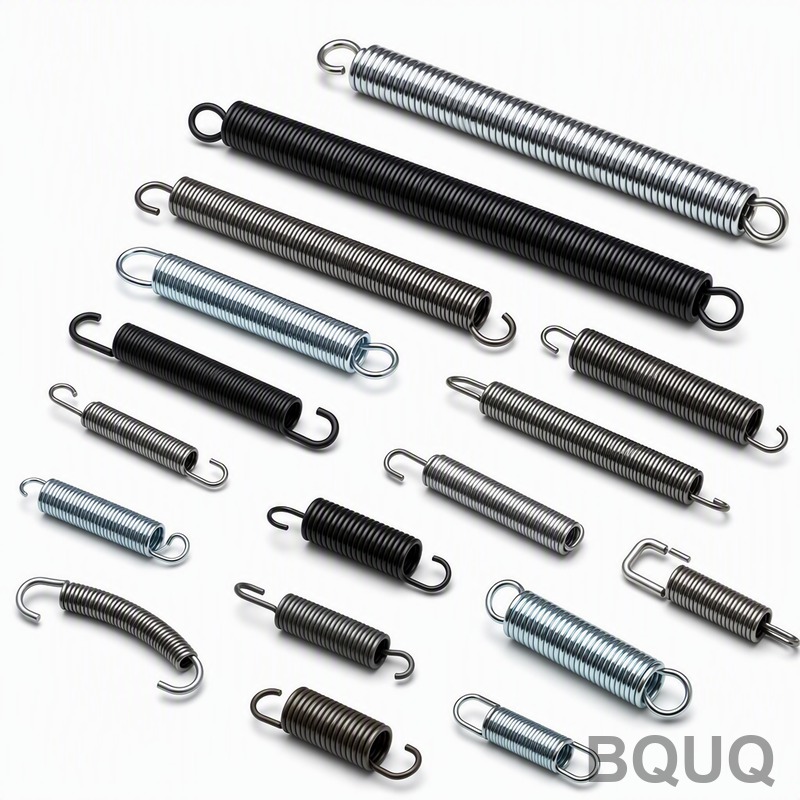
Another critical application for music wire is in extension springs with initial tension. The cold-drawn microstructure of A228 allows for higher initial tension values (up to 25% of the maximum tensile load) without permanent set, whereas oil-tempered wire can only achieve 15-18% initial tension. This is why spring manufacturers still use music wire for garage door springs, trampoline springs, and mechanical clock springs where the spring must hold a preload at rest. For these applications, the performance advantage outweighs the cost premium, and we at BQUQ recommend maintaining A228 for any spring with wire diameter under 1.5 mm or with strict dimensional tolerances of +/-0.02 mm or tighter.
How Does Surface Treatment and Coating Compatibility Differ Between the Two Wires?
The surface condition of the wire affects how well it accepts protective coatings and how it behaves during subsequent manufacturing steps. Music wire's bright, oxide-free surface is ideal for electroplating with zinc, nickel, or chrome, providing excellent adhesion and a uniform coating thickness. Oil-tempered wire's dark oxide layer must be removed or chemically treated before electroplating, which adds an extra pickling step and increases production time by 15-20 minutes per batch. However, the oxide layer on A229 provides natural corrosion resistance that is adequate for indoor applications or when the spring is enclosed in a sealed assembly.
For springs that require powder coating or epoxy coating, oil-tempered wire actually performs better because the rough surface provides mechanical keying for the coating to adhere. The oxide layer also helps retain coating materials, reducing the risk of runs and sags. In terms of hydrogen embrittlement risk during plating, both materials are susceptible, but oil-tempered wire's higher ductility makes it less prone to cracking after plating and baking. Our recommendation for coated springs: use music wire for electroplated finishes below 5 microns thickness, and use oil-tempered wire for thicker coatings (25-50 microns) or when the spring is exposed to salt spray environments for over 500 hours.
What Are the Emerging Trends in Material Selection for Spring Manufacturing?
The material selection landscape is evolving due to three factors: electric vehicle weight reduction, sustainability requirements, and supply chain localization. For EV applications, springs are being designed with higher stress levels to save weight, which favors oil-tempered wire because its higher ductility allows for more aggressive coiling ratios (spring index below 4) without cracking. Additionally, oil-tempered wire can be manufactured with recycled steel content of up to 30% without compromising properties, while music wire requires virgin steel due to its stringent surface requirements, making A229 more aligned with circular economy initiatives.
Supply chain trends in China are also pushing manufacturers toward oil-tempered wire. Domestic wire producers in Guangdong and Jiangsu provinces have invested heavily in A229 production capacity, reducing import dependence and stabilizing prices, whereas premium A228 music wire is still partially imported from Japan and Korea. The lead time for A229 is typically 7-10 days for standard diameters, versus 14-21 days for A228. For factories operating with just-in-time inventory systems, this lead time advantage is decisive. Based on our BQUQ purchasing data from 2024, 65% of our spring orders now specify oil-tempered wire, and we project this will reach 75% by 2027 as new high-temperature applications emerge in battery cooling systems and hydrogen fuel cell components.
What Is the Recommended Selection Criteria for a New Spring Design?
For a new spring design, follow these engineering guidelines based on operating temperature, stress level, and diameter. If the operating temperature exceeds 150 degrees Celsius continuously or the spring diameter exceeds 3.0 mm, select A229 oil-tempered wire. If the spring requires wire diameter below 1.0 mm, tight tolerances, or high initial tension, select A228 music wire. For the intermediate range (1.0-3.0 mm diameter, 20-150 degrees Celsius), make the decision based on fatigue life requirements and budget: choose music wire for fatigue life above 10 million cycles, and choose oil-tempered wire for cost savings if the fatigue life requirement is below 5 million cycles.
| Property | Music Wire (A228) | Oil-Tempered Wire (A229) |
| Tensile strength (0.5-6.0 mm) | 2300-2700 MPa | 1600-2100 MPa |
| Maximum continuous service temp | 120 degrees Celsius | 180 degrees Celsius |
| Fatigue limit (% of tensile) | 45% | 50-55% |
| Wire diameter tolerance | +/-0.01 mm | +/-0.02 mm |
| Minimum available diameter | 0.1 mm | 0.5 mm |
| Elongation at break | 5-8% | 8-12% |
| Relative raw material cost | 1.2-1.25x | 1.0x (baseline) |
| Stress relaxation at 150C/100hr | 15% loss | 6% loss |
| Surface finish | Bright, smooth | Dark oxide, slightly rough |
| Typical lead time | 14-21 days | 7-10 days |
How Can You Validate Wire Quality Before Production?
Before committing to a wire supplier, request a material test certificate (MTC) and perform three validation tests in your own facility. First, conduct a tensile test on five samples from different positions in the coil, ensuring the variation is less than 5% of the average tensile strength. Second, perform a wrap test by wrapping the wire around its own diameter for five turns; no cracking indicates acceptable ductility for both A228 and A229. Third, measure surface roughness with a profilometer; music wire should show Ra below 0.4 microns, while oil-tempered wire should show Ra below 1.0 microns. Additionally, for oil-tempered wire, verify the oxide layer thickness is between 1-5 microns using a magnetic thickness gauge, as excessive oxide indicates poor tempering control.
Can Music Wire and Oil-Tempered Wire Be Used Interchangeably in Existing Designs?
You cannot directly interchange these materials without redesigning the spring because their modulus of elasticity is similar (around 207 GPa for both), but their yield strengths and stress-strain curves differ substantially. If you substitute oil-tempered wire for music wire in an existing design, the spring will have 15-25% lower maximum load capacity, which may cause premature sagging or failure in the application. Conversely, substituting music wire for oil-tempered wire in a high-temperature application will cause rapid stress relaxation and loss of spring force. The only safe interchange scenario is when the design has a safety factor above 2.0, meaning the working stress is below 50% of the material yield strength, and the operating temperature is below 100 degrees Celsius.
What Is the Best Way to Specify the Correct Wire Grade on a Purchase Order?
Specify the wire using the exact ASTM standard, diameter range, and tensile strength class. Write the purchase order as "ASTM A228 music wire, 1.2 mm diameter, tensile strength 2450-2600 MPa, surface finish bright" or "ASTM A229 oil-tempered wire, 4.0 mm diameter, tensile strength 1750-1900 MPa, class II." Always include the tolerance grade (for A228 use Grade 1 for tight tolerance, Grade 2 for standard), and specify whether the wire must be free of welds for the entire coil length. For oil-tempered wire, also specify whether you require the standard oxide finish or a cleaned finish for subsequent plating. At BQUQ, we recommend including a requirement for a material test certificate from an ISO 17025-accredited laboratory to ensure traceability.
FAQ
What Is the Maximum Diameter Available for Music Wire?
Music wire is commercially available up to 12.0 mm diameter, but above 6.0 mm, the tensile strength drops significantly to around 1600 MPa, which negates its strength advantage over oil-tempered wire. For diameters above 6.0 mm, oil-tempered wire is the more sensible choice because it maintains consistent properties and costs less. Most spring manufacturers use music wire only in the 0.1-6.0 mm diameter range.
How Much Does Spring Wire Cost per Kilogram in 2025?
In the Chinese domestic market, music wire costs between 12.5 and 14.0 RMB per kilogram, while oil-tempered wire costs between 10.0 and 11.5 RMB per kilogram, depending on diameter and order quantity. For orders above 5000 kilograms, prices typically drop by 5-8% due to coil handling efficiencies. Imported Japanese music wire can cost 20-30% more than domestic material.
Which Wire Is Better for High-Speed CNC Coiling Machines?
Oil-tempered wire is generally better for high-speed coiling because its uniform hardness reduces tool wear and allows for coiling speeds up to 80 meters per minute, compared to 60 meters per minute for music wire. The oxide coating on oil-tempered wire also acts as a dry lubricant, reducing friction in the feed system. However, for very small springs under 1.0 mm diameter, music wire's smoother surface reduces the risk of wire buckling in the feed tube.
Can Oil-Tempered Wire Be Used for Extension Springs with Initial Tension?
Yes, oil-tempered wire can be used for extension springs, but the initial tension will be limited to 15-18% of the maximum tensile load, compared to 25% for music wire. If your extension spring requires initial tension above 20% of the maximum load, music wire is the safer choice. For extension springs with moderate initial tension requirements and higher operating temperatures, oil-tempered wire is acceptable.
How Does Shot Peening Affect the Fatigue Life of Both Wires?
Shot peening improves fatigue life by 20-40% for both wire types by introducing compressive residual stresses on the spring surface. However, oil-tempered wire shows a greater relative improvement because its higher ductility allows for deeper compressive stress layers. After shot peening, oil-tempered wire springs can achieve fatigue limits up to 60% of their tensile strength, while music wire achieves approximately 55%.
What Is the Shelf Life of Music Wire and Oil-Tempered Wire?
Both wires have an indefinite shelf life if stored in a dry environment with relative humidity below 60%. Music wire may develop light surface rust after 6-12 months in humid conditions, while oil-tempered wire's oxide coating provides better corrosion protection for up to 24 months. Store both materials off the floor on racks and keep them wrapped in plastic to prevent moisture condensation.
Which Wire Should I Choose for a Spring Operating at 200 Degrees Celsius?
Oil-tempered wire is the only choice for continuous operation at 200 degrees Celsius, as music wire will lose more than 30% of its load within 100 hours at this temperature. For intermittent exposure at 200 degrees Celsius, oil-tempered wire can handle up to 220 degrees Celsius for short periods. If the temperature exceeds 220 degrees Celsius, consider chrome-silicon or stainless steel spring wire instead.
BQUQ has manufactured precision springs from both music wire and oil-tempered wire for over 20 years, with a current production capacity of 5 million springs per month. Our engineering team can provide a free material selection review for your spring application, including stress calculations and fatigue life predictions. Send us your spring drawing or specification, and we will respond with a detailed quote within 12 hours. Contact us at sc@bquq.com or WhatsApp +86 13713157787, or visit www.bquq.com to start your project today.