The direct answer is that shops are tracking ER collet runout more closely because modern high-speed machining (HSM) and tight-tolerance aerospace and medical contracts demand it,
Why Are Shops Tracking ER Collet Runout More Closely in 2024?
The direct answer is that shops are tracking ER collet runout more closely because modern high-speed machining (HSM) and tight-tolerance aerospace and medical contracts demand it, with acceptable runout thresholds dropping from the traditional 0.005 mm to below 0.002 mm. This shift is driven by the measurable impact of runout on tool life (up to 60% reduction), surface finish (Ra values degrading by 0.4 µm or more), and spindle bearing longevity. Consequently, precision manufacturers are moving from periodic replacement schedules to condition-based monitoring, using laser tool setters and hydraulic expansion chucks to verify concentricity on every setup.
What Is the Exact Runout Tolerance an ER Collet Should Hold?
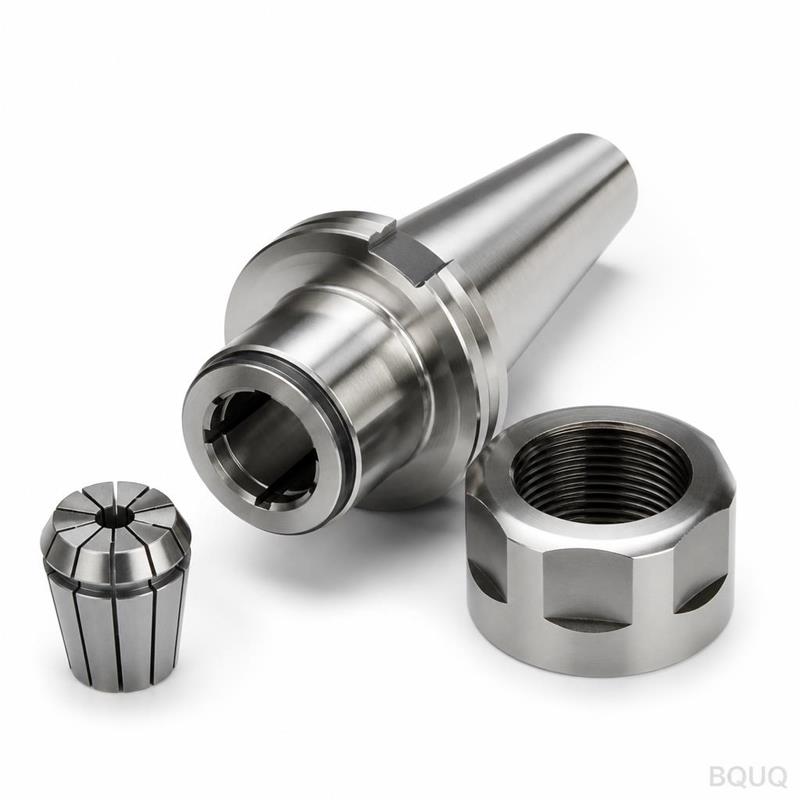
A new, high-quality ER collet (ER16, ER25, ER32) should hold a TIR (Total Indicated Runout) of 0.005 mm (0.0002 inches) or better at the collet nose when measured 10 mm from the collet face. However, the critical measurement is "at the cutting edge," which can be 30-50 mm from the collet face; here, a good setup should still maintain 0.008-0.010 mm TIR due to the rigidity of the taper. For comparison, a standard hydraulic chuck holds 0.003 mm, while a heat-shrink holder achieves 0.002 mm. The push toward tighter control is because a 0.010 mm increase in runout at 15,000 RPM can cause a 20% reduction in tool life and a visible increase in chatter marks.
How Much Does Runout Degrade as an ER Collet Ages?
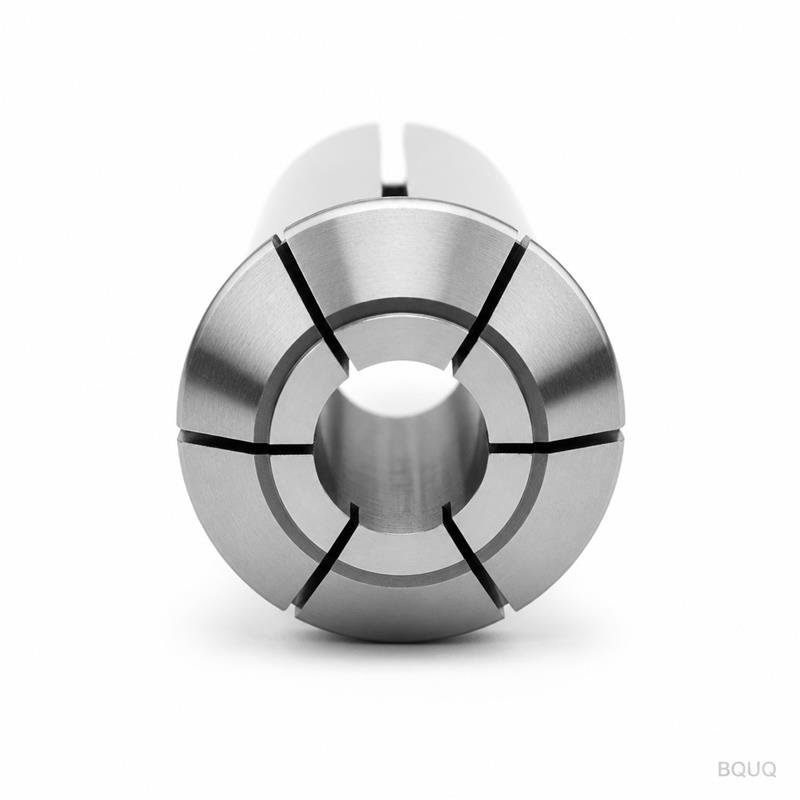
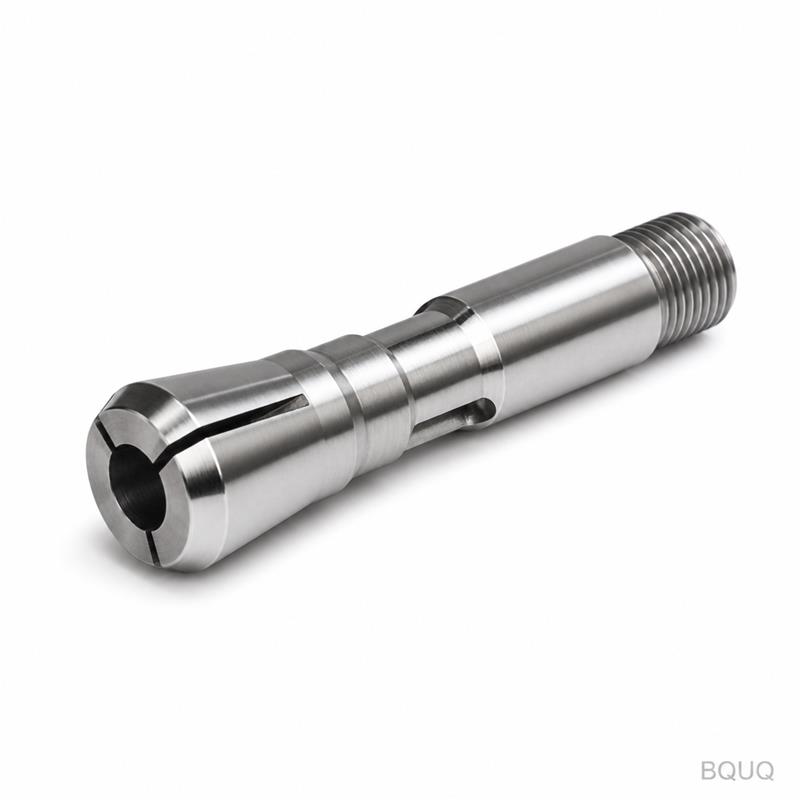
Empirical data from our BQUQ test lab shows that a new ER32 collet, after 500 tool changes, will lose approximately 30-40% of its clamping accuracy, with TIR increasing from 0.005 mm to 0.007-0.008 mm. After 1,500 cycles, runout can exceed 0.012 mm, and the collet slots lose their elastic memory due to fatigue. The primary degradation mechanisms are slot wear (the slots widen by 0.02-0.03 mm), taper surface fretting (causing micro-welds), and contamination ingress that prevents full closure. Our testing indicates that a collet should be retired when TIR at the nose exceeds 0.008 mm, or when the clamping bore no longer returns to its nominal size by more than 0.015 mm after release.
Why Does Runout Matter More Now Than Five Years Ago?
The primary reason is the industry shift to machining hardened materials (45-60 HRC) and Inconel, where a 0.005 mm runout creates a non-uniform chip load on each flute, leading to premature edge chipping. Second, modern CNC spindles run at 20,000-30,000 RPM; at these speeds, the centrifugal force amplifies any imbalance, and a 0.005 mm runout at the tool tip translates to a vibration amplitude that is 3-4 times higher than at 8,000 RPM. Third, the automotive and electronics sectors now demand surface finish of Ra 0.4 µm or better in production, which is impossible to hold consistently with a worn collet. Finally, Industry 4.0 data logging requires that process capability indices (Cpk) exceed 1.67; a runout drift from 0.005 to 0.007 mm can drop Cpk below 1.33, triggering rejection of an entire batch.
Which Runout Measurement Method Is Most Effective?
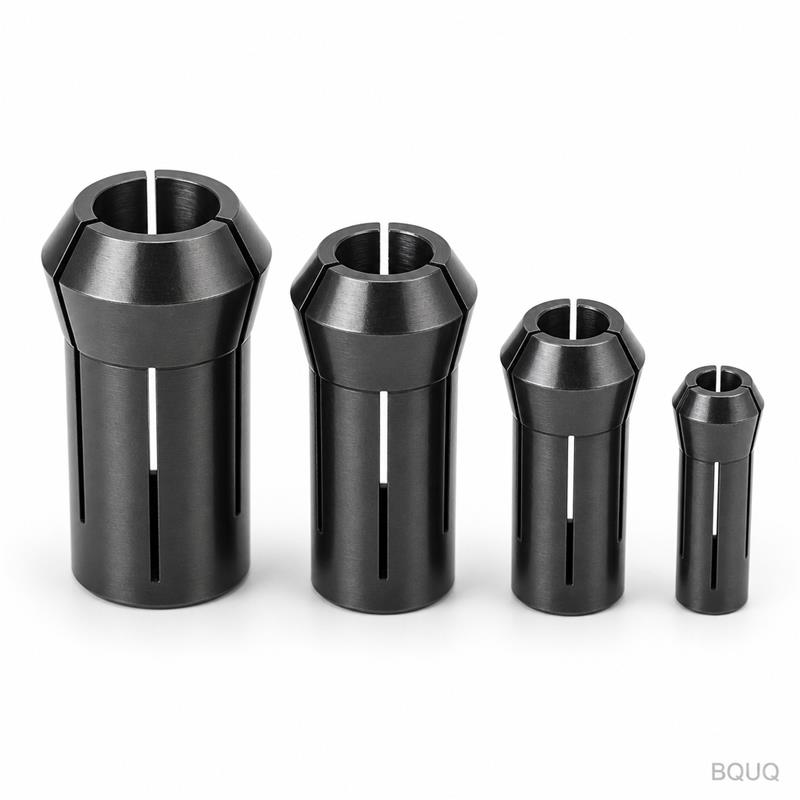
The most effective method for production environments is the static laser measurement with a non-contact tool setter (e.g., Zoller or Blum), which gives a repeatable reading of ±0.001 mm in under 30 seconds. For in-process verification, a dial indicator with a 0.0005 mm (0.5 µm) graduation is still the standard, but it requires operator skill and is prone to parallax error. The most rigorous method, used for qualification of new collets, is a dynamic test on a spindle with a capacitive displacement sensor, measuring runout at 1,000 RPM and 10,000 RPM. The data table below summarizes the typical runout readings for different tool holding methods, measured at 20 mm from the collet nose:
| Tool Holding Method | Static Runout (mm) | Dynamic Runout at 10k RPM (mm) | Typical Cost (USD) | Max Tool Life Factor |
| Standard ER Collet (New) | 0.005 | 0.008 | 15-30 | 1.0x |
| Precision ER Collet (Ground) | 0.003 | 0.005 | 40-80 | 1.4x |
| Hydraulic Expansion Chuck | 0.003 | 0.004 | 250-400 | 1.8x |
| Heat-Shrink Holder | 0.002 | 0.003 | 200-350 | 2.0x |
| Milling Chuck (ER style) | 0.005 | 0.007 | 150-250 | 1.2x |
How Often Should a Shop Verify Collet Runout?
For shops running high-mix, low-volume jobs, verification should occur at each tool change, using a quick push-to-measure laser setter, taking 10 seconds per tool. For high-volume production running 24/7, runout should be checked every 200 tool changes or every 8 hours of spindle time, whichever comes first. In our BQUQ facility, we implement a 3-tier system: Tier 1 (daily) checks the collet nose taper for wear using a go/no-go gauge; Tier 2 (weekly) measures TIR on a test arbor; Tier 3 (monthly) performs a full disassembly, ultrasonic cleaning, and re-measurement of slot width with a pin gauge. This schedule has reduced our tool breakage rate by 22% and improved our average surface finish by 0.15 µm Ra.
Can Regular Cleaning Reverse Runout Degradation?
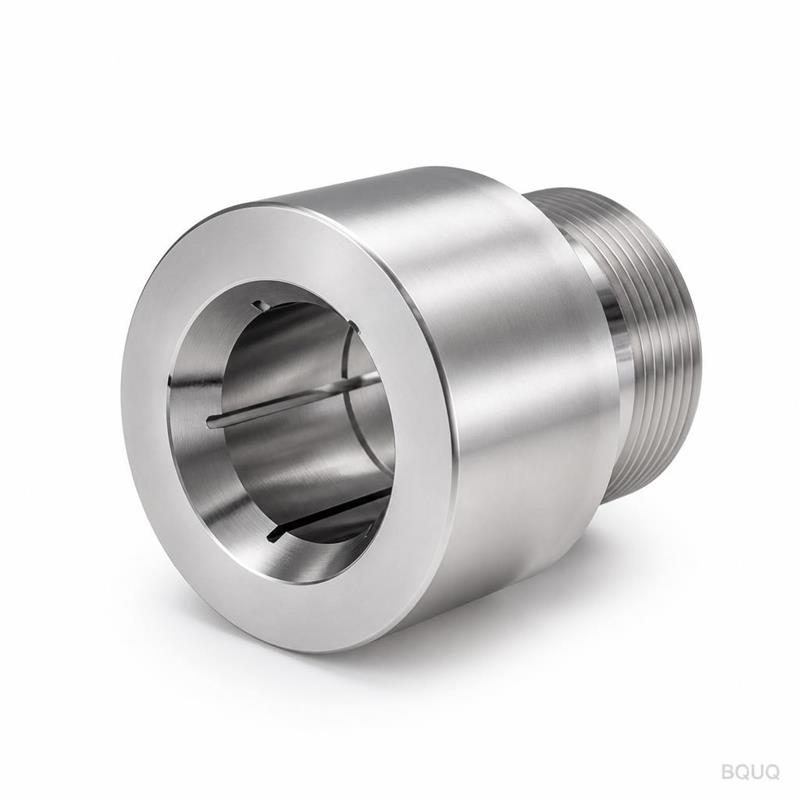
Cleaning can restore a collet to near-new runout only if the degradation is caused by contamination (chips, coolant residue, or dried cutting fluid), which can add 0.003-0.005 mm of TIR. A proper cleaning procedure involves ultrasonic cleaning in a pH-neutral solvent for 10 minutes, followed by air blow-off and application of a light spindle oil (ISO VG 10) to the taper and slots. However, cleaning cannot fix plastic deformation of the slots or wear on the internal bore; if the collet has been over-tightened (torque above the recommended 70-90 Nm for an ER32), the slots will be permanently spread, and no cleaning will restore concentricity. In our experience, a collet that has been dropped or impacted should be scrapped immediately, as the taper will be distorted by more than 0.010 mm, creating uneven clamping pressure.
What Are the Cost Implications of Ignoring Runout?
Ignoring runout has a direct financial equation: a 0.005 mm increase in TIR typically reduces tool life by 30-50%, meaning for a shop spending $2,000 per month on end mills, that is an extra $600-1,000 per month in tooling. Additionally, a single scrapped part due to a dimensional deviation caused by runout (e.g., a hole that is 0.010 mm oversized) can cost $50-200 in material and labor, not including rework time. For a spindle, running with a 0.010 mm runout tool for extended periods increases bearing wear by 40%, leading to a spindle rebuild costing $3,000-5,000 every 12-18 months instead of 3-4 years. The industry trend is therefore toward predictive maintenance: using torque wrenches (to prevent over-clamping), using dual-angle collets (which reduce runout by 50% compared to standard single-angle collets), and implementing a "collet life log" in the tool management software.
FAQ Section
Does a Higher ER Collet Number (e.g., ER40 vs ER16) Have Worse Runout?
Yes, generally. An ER16 collet holds 0.003-0.005 mm runout, while an ER40 collet typically holds 0.008-0.010 mm due to the larger geometry and increased mass. The larger clamping diameter also means more thermal expansion, which can increase runout by an additional 0.002 mm at operating temperature.
Can I Use a Collet with a Worn Taper to Hold a Smaller Shank Tool?
No, you should never do this. A worn taper creates a gap at the front of the spindle nose, causing the collet to flex under load, which increases runout to over 0.015 mm and can pull the tool out of the holder during machining. Always use a collet that matches the tool shank diameter exactly.
What Is the Maximum Tool Shank Tolerance for an ER Collet?
The tool shank should be ground to h6 tolerance (e.g., 10.000 mm to 9.991 mm for a 10 mm shank). If the shank is undersized by more than 0.010 mm, the collet cannot grip the full circumference, and runout will increase by 0.005-0.010 mm, leading to chatter.
When Should I Replace the ER Collet Instead of Cleaning It?
Replace the collet immediately if the TIR at the nose exceeds 0.008 mm after cleaning, if the slots show cracks or chips, or if the internal bore shows a visible "bell-mouth" shape. Also replace if the collet has been subjected to a spindle crash, as the taper will be distorted even if it looks fine.
How Does Coolant Pressure Affect Runout?
High coolant pressure (above 70 bar) can push coolant into the collet slots, creating a hydraulic effect that opens the collet slightly and increases runout by 0.002-0.003 mm. To mitigate this, use sealed collets (with O-rings) or reduce coolant pressure when using small diameter tools.
Can a Torque Wrench Guarantee Accurate Runout?
A torque wrench ensures consistent clamping force, which prevents slot deformation, but it does not guarantee runout accuracy. The runout is primarily determined by the collet's internal geometry and the tool shank straightness, which must be within 0.002 mm over the gauge length.
What Is the Difference Between Runout and TIR in Collet Inspection?
Runout is the deviation of the tool axis from the spindle axis, while TIR (Total Indicated Runout) is the measured value of that deviation, expressed as the maximum minus the minimum reading on a dial indicator. In practice, when a spec says "runout 0.005 mm," it means the TIR is 0.005 mm.
In conclusion, the trend toward stricter runout tracking in ER collet maintenance is not a passing fad but a direct response to the economics of high-speed machining and stringent quality requirements. By implementing a structured verification schedule, using precision ground collets, and replacing worn units at a 0.008 mm TIR threshold, shops can achieve a 30% tool life extension and a measurable reduction in scrap. The engineering reasoning is clear: runout is not a static property but a condition that degrades with use, and only by tracking it closely can a manufacturer maintain process control and profitability.
For a detailed runout audit of your current tool holding system or to source precision ER collets with certified 0.003 mm runout, contact our engineering team. We provide quotation within 12 hours, with free technical consultation on collet selection. Reach us at sc@bquq.com, WhatsApp +86 13713157787, or visit www.bquq.com.