Beryllium Copper Springs: Conductivity, Force and Cost
Short answer: Beryllium copper (BeCu) springs are chosen when one part must carry current and force at the same time. Alloy C17200 in spring temper typically delivers 22–28% IACS electrical conductivity with 1,100–1,400 MPa tensile strength, roughly 3–6x the conductivity of 302 stainless at comparable strength. Expect to pay 4–8x the price of music wire for the same geometry. At BQUQ, BeCu compression, extension and torsion springs are formed on the same four Dongguan production lines as our steel springs, with ±0.005 mm CNC capability on tooling and quotes returned in 12 working hours.
Why choose beryllium copper for a spring at all?
Most springs are specified for one job: store energy, return a mechanism, hold a load. Steel wins that job almost every time on cost per newton. Beryllium copper enters the conversation when the spring is also an electrical conductor, a thermal path, or a non-magnetic component.
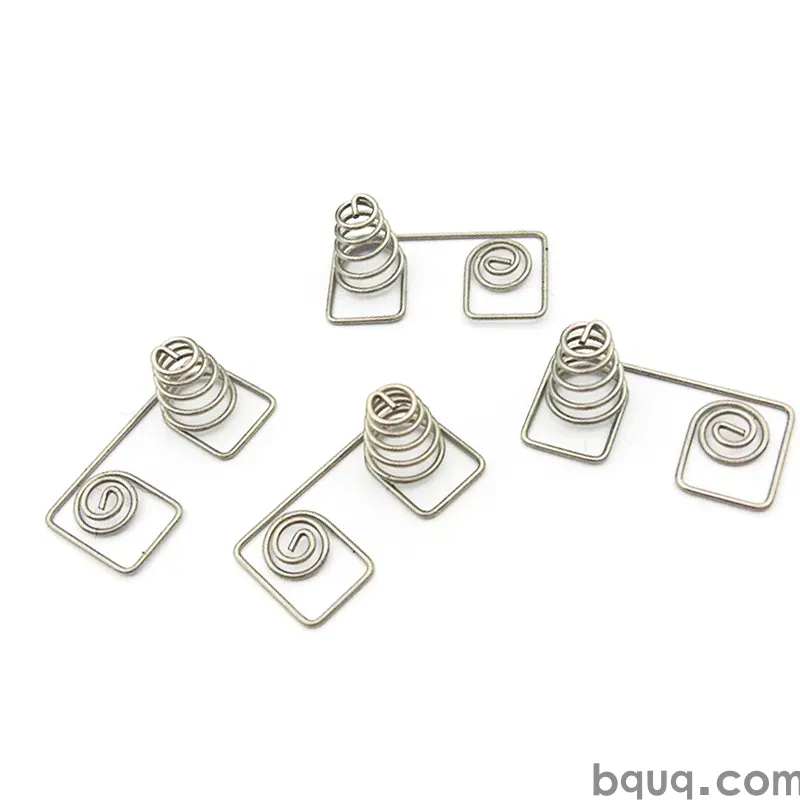
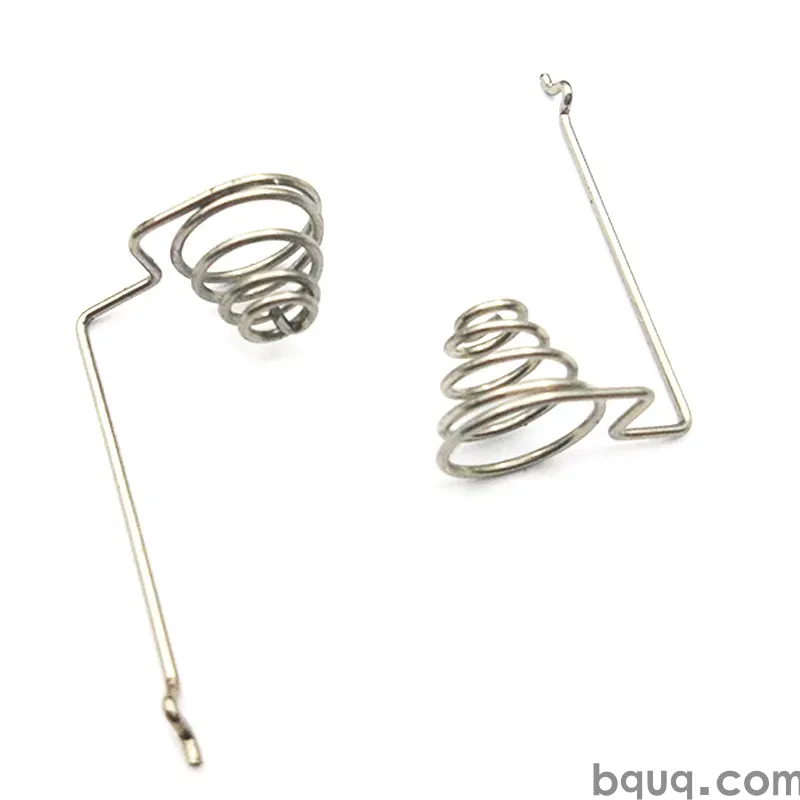
That combination shows up more often than engineers expect. Battery contact springs, EMI shielding fingers, RF ground clips, test socket probes, relay contacts, and antenna coils all need a part that pushes back mechanically and passes current without meaningful resistance. A steel spring in those positions forces a second component — a braided strap, a separate contact pad, a plated finger — which adds assembly steps, a joint resistance, and a failure point.
BeCu also holds two properties that matter in harsh environments: it does not become magnetic when cold worked, and it resists stress relaxation better than most copper alloys at moderate temperatures. For a spring that must keep 2 N of contact force after 10,000 thermal cycles, that is the whole argument.
Where BeCu springs are actually used
- Battery and power contacts — coin cell holders, pack terminals, charging pogo contacts
- EMI/RFI shielding — grounding fingers on enclosures and board-level shields
- Test and burn-in sockets — probe springs that must not add inductance or resistance drift
- RF and antenna hardware — coil forms and contact springs where magnetic materials are banned
- Aerospace and instrument mechanisms — non-sparking, non-magnetic return springs
If your application is purely mechanical and cost-sensitive, chrome silicon springs or 302 stainless will almost always be the better commercial answer.
How conductive is beryllium copper compared with other spring materials?
Conductivity is the reason BeCu exists as a spring material, so it is worth putting real numbers next to the alternatives. The table below uses typical published ranges for spring-temper material. Treat them as indicative design values, not guaranteed minimums — always confirm against the mill certificate for your specific heat and temper.
| Material | Typical conductivity (% IACS) | Typical tensile strength (MPa) | Relative spring cost | Magnetic? |
|---|---|---|---|---|
| BeCu C17200, spring temper | 22–28 | 1,100–1,400 | 4–8x music wire | No |
| BeCu C17510 | 45–60 | 750–1,000 | 5–9x music wire | No |
| Phosphor bronze C51000 | 15–19 | 600–800 | 1.5–2.5x music wire | No |
| Brass C26000 | 28–31 | 500–700 | 1–2x music wire | No |
| 302 stainless | 2–3 | 1,300–1,600 | 2–4x music wire | Slightly |
| Music wire / oil tempered | 7–10 | 1,700–2,100 | 1x (baseline) | Yes |
| 17-7PH stainless | 2–3 | 1,300–1,700 | 3–5x music wire | Slightly |
Two things stand out. First, BeCu C17200 is the only material on that list that combines high strength and useful conductivity — stainless matches the strength but is effectively an insulator at these currents. Second, C17510 trades roughly 30% of its strength for double the conductivity, which is often the right call for a contact spring carrying more than a few amps.
Conductivity versus temper
Beryllium copper is supplied in two conditions that behave very differently:
- Mill hardened (TM00, TH02, etc.) — formed after hardening, limited to gentle bends, lower final strength
- Solution annealed (TB00) — formed in the soft state, then age hardened at roughly 315–345 °C for 2–3 hours to reach full spring properties
Age hardening after forming is what lets you produce tight-radius BeCu springs that would crack if formed in the hardened temper. It also means the spring dimensions shift slightly during the heat treat — typically 0.1–0.3% shrinkage — which must be built into the tooling. This is one of the few places where springback compensation has to account for a thermal step, not just elastic recovery.
How do you calculate spring force in beryllium copper?
The mechanics are identical to steel. What changes is the modulus.
BeCu C17200 has a Young's modulus of roughly 128 GPa, against 207 GPa for music wire and 193 GPa for stainless. That is about 38% lower than steel, and it has a direct consequence: for the same wire diameter, coil diameter and number of turns, a BeCu spring is roughly 38% softer than the equivalent steel spring.
The standard compression spring rate equation is:
k = G·d⁴ / (8·D³·n)
where G is the shear modulus (approximately 48 GPa for C17200 versus 79 GPa for music wire), d is wire diameter, D is mean coil diameter, and n is the number of active coils.
| Parameter | Music wire | BeCu C17200 | Effect on design |
|---|---|---|---|
| Shear modulus G (GPa) | ~79 | ~48 | BeCu is ~39% softer |
| Young's modulus E (GPa) | ~207 | ~128 | BeCu deflects ~62% more |
| Density (g/cm³) | 7.85 | 8.25 | Slightly heavier part |
| Max service temperature | ~120 °C | ~200 °C | BeCu wins on thermal range |
| Fatigue endurance limit | High | Moderate | Steel wins on cycle life |
Practical design consequences
1. You will usually need a thicker wire or more coils to hit the same load in BeCu. Budget for a larger envelope.
2. Fatigue life is lower. Where a music wire spring might run 10⁶ cycles at 40% stress, BeCu is typically designed to 25–30% of tensile for long-life applications. If your spring cycles millions of times, BeCu may be the wrong choice regardless of conductivity.
3. Initial tension in extension springs behaves differently. Because the material is softer, the coiling stress that creates initial tension is lower, and the spring may need a tighter coiling ratio to hold the same preload. Our guide to initial tension in extension springs walks through how to specify that number rather than leaving it to the shop.
What drives the cost of a beryllium copper spring?
BeCu is expensive for three separate reasons, and buyers who understand all three negotiate better.
1. Raw material. Beryllium copper wire typically runs 4–8x the price of music wire per kilogram, and the spread widens with small diameters. Beryllium is a restricted material with a concentrated supply chain, so prices move independently of steel.
2. Processing. Solution-annealed material requires a post-forming age hardening cycle, which adds furnace time, fixturing and a dimensional verification step. Beryllium-containing dust also triggers specific handling and ventilation requirements during grinding, cutting and deburring — legitimate cost, not padding.
3. Scrap and yield. Because the material is costly, setup scrap hurts more. Small production runs of BeCu springs carry a proportionally higher setup burden than the same run in steel.
| Cost driver | Impact vs music wire | How to reduce it |
|---|---|---|
| Wire cost | 4–8x | Specify the minimum wire diameter that meets force |
| Age hardening | +15–30% of part price | Use mill-hardened temper where bend radii allow |
| Handling/ventilation | +5–15% | Keep secondary grinding operations to a minimum |
| Setup scrap | Higher absolute cost | Order the full annual volume in fewer lots |
| Plating (if required) | +10–25% | Specify only where contact resistance demands it |
When BeCu is worth it, and when it is not
BeCu pays for itself when it removes a component. If a single BeCu spring replaces a steel spring plus a copper braid plus two crimps, the material premium is usually recovered in assembly labour alone. If the spring is purely mechanical and sits next to a separate contact, you are paying 5x for nothing.
A useful rule: specify BeCu when the current path and the force path are the same part. Otherwise, default to steel or stainless.
Manufacturing considerations at the factory
Beryllium copper behaves differently on the shop floor, and a supplier who only runs steel will learn that on your dime.
- Tooling wear — BeCu is abrasive relative to its strength; form tools and coiling points need more frequent dressing.
- Springback — lower modulus means more elastic recovery after forming, so coiling arbors must be sized undersized relative to the target diameter.
- Galling — copper alloys can pick up on steel tooling; lubrication and surface finish matter more than with steel wire.
- Heat treat fixturing — age-hardened parts must be supported to prevent sag, since the material is soft at temperature.
At BQUQ, BeCu springs run on the same four production lines as our steel and stainless work, alongside CNC machining to ±0.005 mm for tooling, mandrels and fixtures. That matters because BeCu spring projects almost always need a machined arbor or a custom end-form die, and having both capabilities in one ISO9001 factory in Dongguan removes a handoff. Tooling can be cut and proven without shipping drawings between vendors.
We also keep MOQ flexible. BeCu is a material where buyers legitimately want to prototype 200 pieces before committing to 200,000, and a supplier that forces a 50 kg minimum order is not helping you validate the design.
Specifying a BeCu spring on a drawing
Include these on the drawing and you will avoid most back-and-forth:
1. Alloy and temper (e.g. C17200, TH02 mill hardened, or TB00 to be age hardened after forming)
2. Conductivity requirement in % IACS, if it is functional
3. Load at two deflections, not one — this defines the rate
4. Maximum allowable set or relaxation at operating temperature
5. Surface finish and any plating, with the reason stated
6. Whether magnetic permeability is a hard requirement
Frequently Asked Questions
Q: Is beryllium copper dangerous to handle?
A: Solid BeCu alloy is safe to handle in normal manufacturing. The health hazard comes from inhaling beryllium-containing dust or fume generated by grinding, abrasive cutting, welding or melting. Finishing operations that produce airborne particulates require proper extraction and ventilation. BQUQ processes BeCu under controlled conditions and can supply material certificates on request.
Q: Can beryllium copper springs be plated?
A: Yes, but plating is often unnecessary because the base alloy already conducts well and forms a thin protective oxide. Where plating is specified, nickel or gold over nickel are the common choices for contact resistance stability. Note that plating adds cost and can embrittle thin sections if the process is not controlled, so specify it only when contact resistance targets demand it.
Q: What is the maximum operating temperature for a BeCu spring?
A: C17200 is typically rated for continuous service up to roughly 200 °C, with stress relaxation becoming significant above that. This is a real advantage over music wire, which loses load above about 120 °C. For sustained high-temperature service, confirm the allowable stress at temperature rather than assuming room-temperature values apply.
Q: How much more expensive is BeCu than music wire?
A: For the same geometry, expect a finished part price 4–8x that of music wire. The multiplier is highest on small wire diameters and short runs, and lowest on high-volume parts where setup cost is amortised. If the BeCu spring replaces a steel spring plus a separate contact component, total assembly cost often comes out ahead.
Q: Does BQUQ make custom beryllium copper springs?
A: Yes. We produce BeCu compression, extension and torsion springs on four production lines in one Dongguan factory, with CNC tooling capability to ±0.005 mm and flexible MOQ for prototype and production volumes. Send a drawing or a load-and-deflection requirement and we will return a quote within 12 working hours.
Related Resources
- About BQUQ — ISO9001 factory in Dongguan with four production lines under one roof
- Compression springs — custom coil springs in BeCu, stainless and alloy steel
- Extension springs — including initial tension control for soft materials
- Torsion springs — leg geometry and rate calculation for non-ferrous alloys
- Technical articles — spring design, material selection and tolerance guides
- Industry trends — sourcing and supply chain notes for metal components
- Contact engineering — drawings to sc@bquq.com, quotes in 12 working hours
Authored by the BQUQ Engineering Team. BQUQ (Dongguan) runs CNC machining (±0.005 mm), metal stamping, custom springs, and heat sink production in one ISO9001 factory. Source-direct from Dongguan, China — quote in 12 hours: sc@bquq.com | WhatsApp +86 13713157787 | www.bquq.com