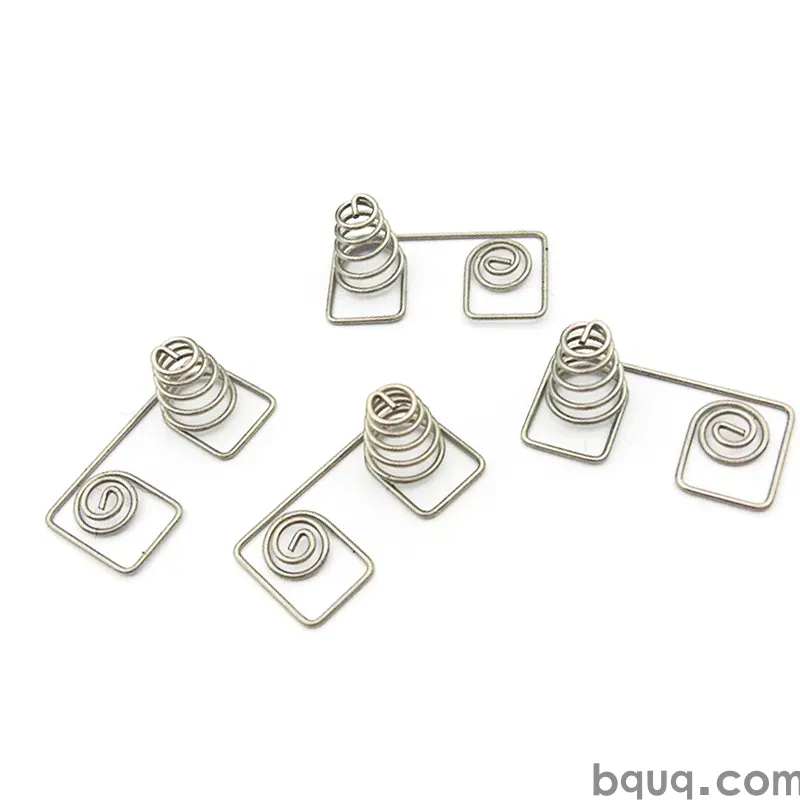
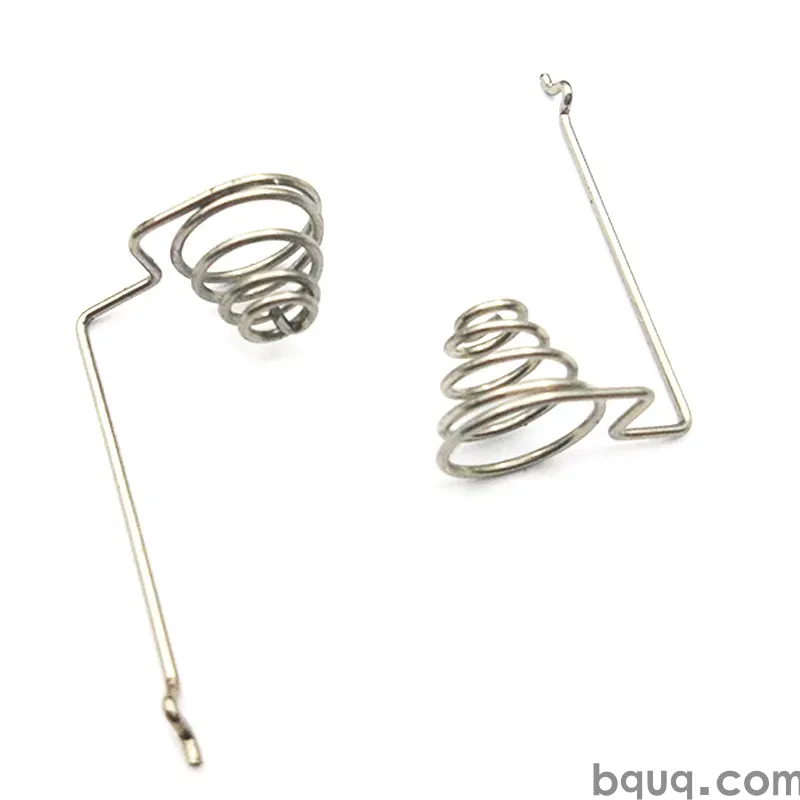
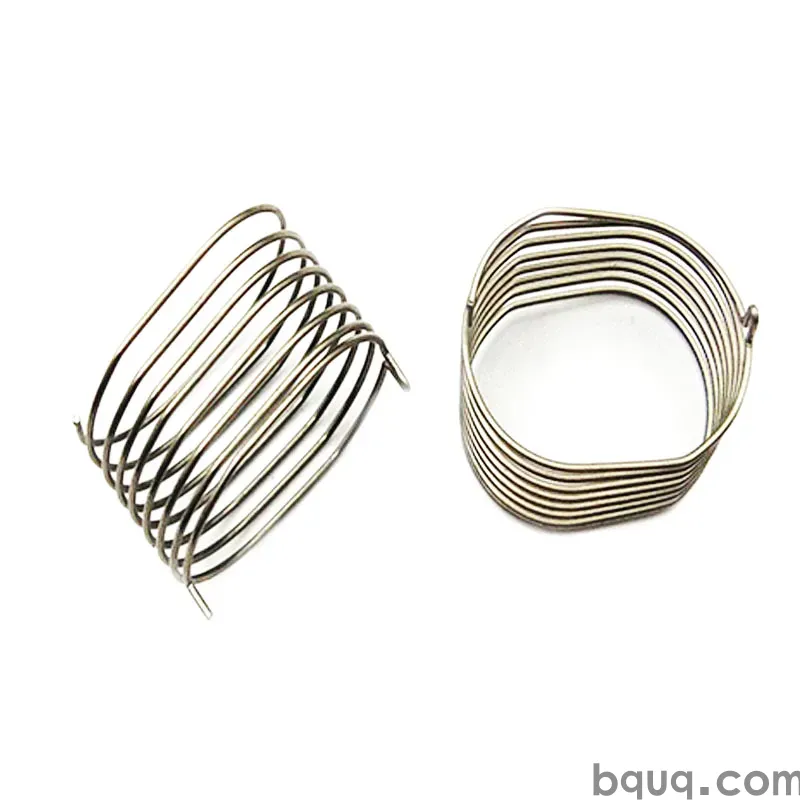
Hot wound vs cold wound springs explained: wire size limits, materials and tolerances. BQUQ, a Dongguan spring factory, makes both custom spring types.
Hot vs Cold Wound Springs: Manufacturing Limits and Material Choice
The dividing line between hot and cold wound springs is wire diameter: cold winding handles wire up to roughly 12–16 mm on standard machines, while thicker wire and bar — above about 10–16 mm — must be heated to 850–1000 °C before coiling so it bends without cracking. Hot wound springs are then hardened and tempered like real steel components; cold wound springs are made from pre-tempered wire and only stress-relieved. Material choice and tolerance expectations differ as much as the machines do.
The spring world splits into two factories that barely share tooling. On one side, CNC coilers spin hair-fine music wire and stainless at hundreds of parts per minute for electronics, appliances and automotive mechanisms. On the other, heavy-duty shops heat bars of chrome-silicon or chrome-vanadium steel until they glow, wind them around mandrels for suspension, mining and rail applications, then quench and temper the finished coil. If your spring is under about 10 mm wire, it is almost certainly a cold wound part; if it is over 16 mm, it is almost certainly hot wound. The band between is where the choice needs a conversation.
Cold Wound Springs: Speed, Precision and Pre-Tempered Wire
Cold winding forms the spring from wire that is already at final or near-final strength — music wire, oil-tempered chrome-silicon, hard-drawn steel, or stainless 302/316 are drawn and heat-treated at the wire mill, then coiled at room temperature on CNC machines. Because the wire arrives strong, the spring only needs a low-temperature stress relief, typically 230–430 °C depending on grade, to remove coiling stress. Tolerances stay tight, surfaces stay clean, and costs stay low even at prototype quantities.
| Cold wound characteristic | Typical value | Why it matters |
|---|---|---|
| Wire diameter range | 0.1 to ~16 mm | Above this the wire resists coiling |
| Stress relief temperature | ~230–430 °C typical | Removes coiling stress only |
| Load tolerance | ±10% typical | Pre-tempered wire is consistent |
| Surface finish | Wire mill finish, clean | No scale, no decarburization |
| Typical output | 10–200+ pcs/min small wire | Low unit cost at volume |
Cold winding dominates below 10 mm because the wire is cheap, the process is fast, and the tolerances suit precision mechanisms: battery contacts, touch springs, valve springs, door and latch springs. The practical ceiling is machine power — forming a 16 mm music wire at room temperature takes a heavy coiler, and above that the spring rate and required force make cold forming uneconomic or impossible.
Hot Wound Springs: Big Wire, Real Heat Treatment
Hot winding exists because thick wire cannot be bent cold. Above roughly 10–16 mm diameter, the material is heated to 850–1000 °C so it becomes plastic enough to coil around a mandrel, then the spring is quenched and tempered to develop its mechanical properties. This is genuine steel heat treatment, not stress relief: the final strength comes from the spring maker's furnace, not from the wire mill. Materials are therefore alloy steels chosen for hardenability — chrome-silicon, chrome-vanadium, silicon-manganese grades — because plain carbon wire would not harden consistently in thick sections.
| Hot wound characteristic | Typical value | Why it matters |
|---|---|---|
| Wire / bar diameter range | ~10 mm and up | Cold forming impractical below this |
| Coiling temperature | 850–1000 °C typical | Makes thick wire plastic |
| After coiling | Quench + temper | Develops final strength |
| Surface | Scale, needs cleaning | Shot blast before finishing |
| Tolerance | Looser than cold wound | Scale, heat distortion, larger wire |
Hot wound springs carry the loads of heavy industry — suspension coils, mining screens, rail buffers, large valve springs — and they tolerate looser dimensions because they are bigger and their seats are usually forgiving. Decarburization, a surface carbon loss during heating that weakens the wire skin and hurts fatigue life, is the classic hot winding defect; reputable shops control furnace atmosphere and shot blast after heat treatment, and often specify ground or shot-peened surfaces for fatigue-critical springs. The full process sequence, from coiling to tempering to testing, is covered in our spring manufacturing process guide.
Material Choice by Process
Material selection is largely dictated by the process, because the process determines what the wire has already been through. Cold wound springs use mill-processed wire whose strength is built in; hot wound springs use alloys that develop strength in the spring maker's furnace.
| Material | Typical process | Wire range | Typical service temp | Typical use |
|---|---|---|---|---|
| Music wire A228 | Cold wound | 0.1–6 mm | ~120 °C | Precision springs, electronics |
| Oil-tempered chrome-silicon | Cold wound | 1–16 mm | ~230 °C | Automotive valve and clutch springs |
| Stainless 302/316 | Cold wound | 0.1–12 mm | ~250 °C | Corrosion-resistant springs |
| Chrome-vanadium / chrome-silicon bar | Hot wound | 10 mm and up | ~250 °C | Suspension, heavy machinery |
| Silicon-manganese steel | Hot wound | 12 mm and up | ~250 °C | Rail, mining, large springs |
For most buyers the process never becomes a real choice: below 10 mm you buy cold wound because hot winding a small spring makes no sense, and above 16 mm you buy hot wound because cold machines cannot form it. In the 10–16 mm overlap zone, the decision comes down to quantity, tolerance and material availability — and honest suppliers will quote whichever route meets the print. Strength and temperature comparisons across grades are in our spring material selection guide.
What This Means for Your Purchase
A few practical consequences follow. First, expect different tolerances: cold wound springs hold the ±10% load and tight free-length tolerances typical of precision springs, while hot wound springs are dimensionally looser and are usually specified by load at height with generous tolerances. Second, ask about surface treatment for hot wound springs — shot blasting to remove scale, and peening if they cycle. Third, remember that minimum quantities differ: cold wound springs can be sampled in ones and twos on a CNC coiler, while hot wound springs need mandrels and furnace cycles, so sample costs are higher and lot sizes larger. BQUQ, an ISO9001-certified factory in Dongguan, makes compression springs, torsion springs and related spring products with cold wound lines as standard, and sources hot wound heavy springs with verified material certificates — quote within 12 working hours at sc@bquq.com or WhatsApp +86 13713157787.
Email sc@bquq.com or WhatsApp +86 137 1315 7787 with your PDF/DXF/STEP file. An engineer reviews it and replies with price, lead time and DFM notes on working days.
Frequently Asked Questions
Q: At what wire size do springs switch from cold to hot wound?
A: Roughly 10–16 mm is the transition band. Below 10 mm, cold winding is standard and cheaper; above 16 mm, hot winding is essentially mandatory because the wire cannot be formed cold. The 10–16 mm zone depends on machine capacity and material.
Q: Are hot wound springs stronger than cold wound ones?
A: Not inherently — final strength comes from heat treatment in both cases. Cold wound wire is tempered at the mill; hot wound springs are quenched and tempered after coiling. Large hot wound springs carry bigger loads mainly because the wire is bigger.
Q: Why are hot wound spring tolerances looser?
A: Heating, scale and distortion during quenching shift dimensions, and the wire itself is thicker with coarser tolerances. Designers compensate by specifying load at height with generous allowances rather than tight free lengths.
Q: Can small prototype quantities be hot wound?
A: Yes, but expect higher per-piece cost and longer lead time, since each hot wound spring needs mandrel tooling and a furnace cycle. For one-off heavy springs, machining from bar is sometimes the cheaper prototype route.
Q: Does cold wound stainless need heat treatment after coiling?
A: Only stress relief, typically 230–430 °C depending on grade — enough to relax coiling stress without softening the wire. Full hardening does not apply because cold wound stainless arrives work-hardened from the mill.
Related Articles
- spring-end-types-guide — More from the BQUQ Custom Springs engineering series.
- torsion-spring-design-guide — More from the BQUQ Custom Springs engineering series.
- spring-surface-finishing-plating-guide — More from the BQUQ Custom Springs engineering series.
Data Sources and Verification
Tolerances, cycle times and price ranges in this guide come from BQUQ production records at our Dongguan plant, where CNC machining (±0.005 mm), stamping, custom springs and heat sinks run under one roof. BQUQ is an ISO 9001:2015 certified factory; the certificate and batch inspection reports are available on request with every quotation.
Related Resources
- About BQUQ: an ISO9001-certified source factory in Dongguan running four production lines under one roof.
- Custom springs: compression, torsion and extension from the spring line — compression springs, torsion springs, extension and custom springs.
- Industry trends: manufacturing, material market, and sourcing analysis for buyers.
- Technical articles: engineering guides and process comparisons — more where this article came from.
- FAQ hub: quick answers on CNC, stamping, springs, and heat sinks.
- Case studies: real parts and real numbers from projects we engineered and delivered.
- Contact us: send your drawing and get a quote within 12 working hours.
Authored by the BQUQ Engineering Team. BQUQ is an ISO9001-certified source factory in Dongguan, China, running CNC machining, metal stamping, custom springs and heat sink lines under one roof. Send drawings to sc@bquq.com or WhatsApp +86 13713157787 for a quote within 12 working hours. www.bquq.com