Oil-Tempered Wire Springs: Heavy-Duty Applications
Short answer: Oil-tempered wire springs are the default choice when a spring must carry high static or low-cycle stress in a compact envelope — typically ASTM A229 (class I) or A230/A231-class material in the 0.5–12 mm wire range, with allowable torsional stress around 40–50% of tensile strength for static service and roughly 30–35% for cyclic service. They cost less than chrome-silicon or 17-7PH, resist relaxation better than hard-drawn wire, and are widely available. Specify them for suspension, valve, die, latch, and heavy actuator springs where deflection is modest and temperatures stay under about 120 °C. BQUQ machines and winds these springs in one ISO9001 Dongguan factory and quotes in 12 working hours.
What Is Oil-Tempered Wire, and Why Does It Dominate Heavy-Duty Springs?
Oil-tempered wire starts as medium-carbon or low-alloy steel — typically 0.55–0.75% carbon, sometimes with manganese or silicon additions. It is drawn to size, austenitized, quenched in oil, and then tempered to a controlled hardness. That final tempering step is the whole point: it converts a hard, brittle martensitic structure into a tough, springy one that can absorb repeated load without cracking.
Compare that with hard-drawn (ASTM A227) wire, which gets most of its strength from cold work. Hard-drawn is cheap and fine for light springs, but it loses load fast when it gets warm and has a lower usable stress ceiling. Oil-tempered wire trades a little cost for a much better combination of strength, ductility, and elevated-temperature stability.
The practical result is a family of materials that engineers reach for whenever a spring has to do real work:
| Grade | Typical Use | Wire Range (mm) | Notes |
|---|---|---|---|
| ASTM A229 (class I) | General-purpose compression, extension, torsion | 0.5–12 | Most common oil-tempered grade; good fatigue life |
| ASTM A229 (class II) | Higher-stress static springs | 1.0–12 | Tighter tolerances, higher minimum tensile |
| ASTM A230 | Valve and engine springs | 1.0–10 | Higher carbon, better fatigue resistance |
| ASTM A231 (chrome-vanadium) | High-temperature, high-cycle | 1.0–12 | Alloyed oil-tempered; usable to ~220 °C |
| ASTM A232 (chrome-silicon) | Severe fatigue, shock loads | 1.5–12 | Premium option, higher cost |
Those ranges are indicative — mill capabilities vary, and the exact grade you can buy at a given diameter shifts with supply. For most industrial springs, A229 class I or II covers the requirement.
When Should You Choose Oil-Tempered Over Other Spring Materials?
The decision usually comes down to three questions: how much stress, how many cycles, and how hot.
High stress in a small space
Oil-tempered wire allows torsional stress in the region of 40–50% of ultimate tensile strength for static or infrequent-cycle service. Music wire (ASTM A228) can go slightly higher in very small diameters, but it is limited to roughly 0.1–3 mm and becomes expensive and hard to source at larger sizes. Stainless grades such as 302 or 304 sit lower on allowable stress and cost more per kilogram.
If your design needs a 6 mm wire diameter carrying a 900 N load, oil-tempered is usually the only economical answer.
Moderate fatigue life
For springs cycling into the hundreds of thousands or low millions of cycles, oil-tempered wire performs well provided you keep stress within the fatigue-safe band. As a rule of thumb, design cyclic torsional stress at 30–35% of tensile strength, and keep the stress ratio (minimum stress divided by maximum stress) above about 0.2. Shot peening can raise the fatigue limit meaningfully — often 15–25% in typical industrial springs — and is a standard add-on for oil-tempered parts.
Temperature
Oil-tempered carbon grades are comfortable to roughly 120 °C. Above that, load loss accelerates and you should move to chrome-vanadium (A231) for service to about 220 °C, or to a precipitation-hardening stainless such as 17-7PH for higher temperatures with corrosion resistance. If your application runs hot, review how 17-7PH spring steel behaves at temperature before committing to a carbon grade.
Corrosion
This is oil-tempered wire's weak point. Plain carbon steel rusts. Mitigations include zinc or phosphate coating, paint, or specifying stainless instead. For outdoor or wash-down environments, a stainless grade is usually cheaper over the product lifetime than a coated carbon spring that fails at year three. Our overview of spring corrosion protection options covers coating choices in detail.
Design Rules That Keep Oil-Tempered Springs Alive
Heavy-duty springs rarely fail from a single overload. They fail from fatigue, relaxation, or buckling — all of which are design issues, not material issues.
Keep index in a workable band
Spring index (mean diameter divided by wire diameter) should generally sit between 4 and 12. Below 4, the spring is hard to wind and stress concentration at the inside of the coil rises sharply. Above 12, the spring becomes tangly, prone to buckling, and difficult to control dimensionally.
Watch solid height and clash
A compression spring that reaches solid height in service will lose load or break. Leave at least 15% travel margin between maximum working deflection and solid height for static springs, and 20–25% for cyclic ones.
Plan for relaxation
Oil-tempered springs under sustained load at elevated temperature lose load over time. Two countermeasures work well: reduce working stress, and specify a hot-set or preset operation. Presetting — compressing the spring to solid (or near solid) once during manufacture — induces beneficial residual stresses and stabilizes free length. Our note on the spring hot preset process explains what changes and what it costs.
Respect the overload ceiling
Every spring has a deflection beyond which it yields permanently. Knowing where that point sits prevents field failures. The mechanics are covered in spring overload and yield behavior, and it is worth reading before you sign off on a heavy-duty design.
Heavy-Duty Application Map
| Application | Typical Spring Type | Why Oil-Tempered Fits | Watch Out For |
|---|---|---|---|
| Vehicle suspension & chassis | Compression | High stress capacity, good fatigue life, low cost | Corrosion — coat or use alloy grade |
| Industrial valve & pump | Compression | Stable load at moderate temperature | Relaxation at sustained load |
| Die and stamping tooling | Compression, die springs | Very high static load, short travel | Solid-height clash |
| Heavy latch & lock | Torsion, extension | Compact, high torque per volume | End-condition stress risers |
| Agricultural equipment | Extension, compression | Shock tolerance, easy replacement | Abrasion and moisture |
| Exercise & fitness machines | Extension, compression | Cost-effective at high load | Cycle life — specify shot peening |
| Brake and clutch return | Extension, torsion | Fast response, consistent load | Heat from nearby friction surfaces |
For extension and torsion variants, the same material logic applies but the failure modes shift. Extension springs fail at the hook or end loop, not the body, so hook geometry matters more than coil stress. Torsion springs fail at the inside of the coil where bending stress peaks. Both are available as custom extension springs and torsion springs wound from the same oil-tempered grades.
Specifying Oil-Tempered Springs: What to Put on the Drawing
A complete spring specification prevents 90% of production disputes. Include:
- Material and grade — e.g. "ASTM A229 class II oil-tempered wire" rather than "spring steel"
- Wire diameter with tolerance, typically ±0.02 mm for precision work
- Free length and tolerance
- Outside or inside diameter — pick one as the controlling dimension, not both
- Total coils and active coils
- End condition — closed and ground, closed not ground, open
- Direction of wind — right hand unless stated
- Load at specified deflections — at least two points (e.g. load at 25% and 75% deflection)
- Surface treatment — shot peening, coating, passivation
- Operating temperature and cycle life — this drives material and stress decisions
Load-at-deflection is the single most useful line on the drawing. It lets the manufacturer adjust coil count and free length to hit your requirement rather than guessing.
How BQUQ Produces Oil-Tempered Springs
BQUQ runs four production lines in one Dongguan factory covering CNC machining, metal stamping, custom springs, and heat sink production. Spring manufacturing sits alongside the machining capability, which matters when a spring has to fit a machined pocket or a stamped retainer — tolerances can be resolved in one place instead of three.
Capabilities relevant to oil-tempered work:
- CNC machining to ±0.005 mm for spring seats, retainers, and end fittings
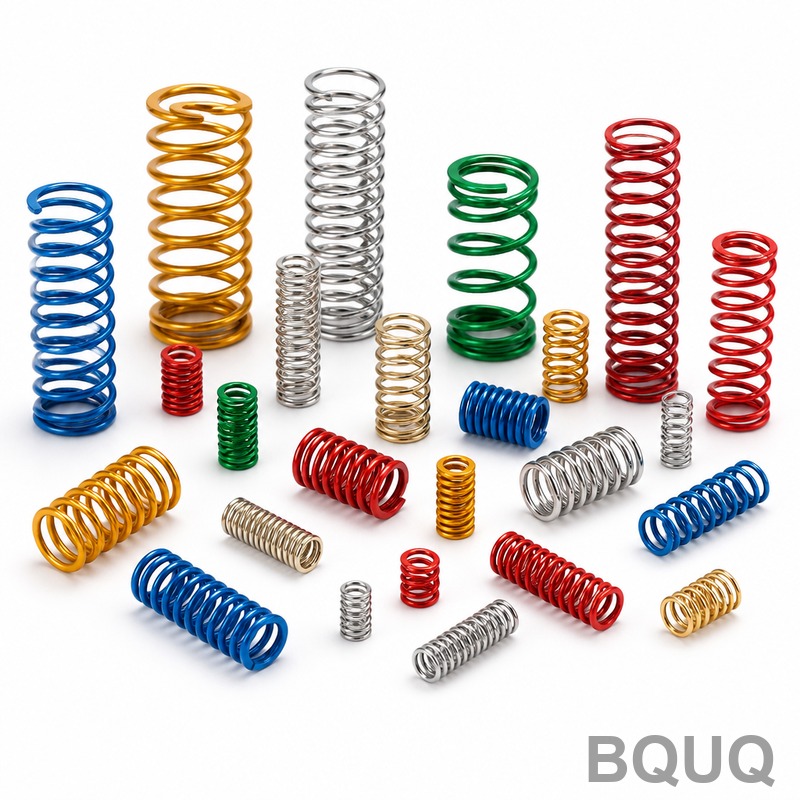
- Compression springs across the full heavy-duty size range, including custom compression springs wound from A229 and A231 grades
- In-house forming, end grinding, shot peening, and preset operations
- ISO9001 quality system with dimensional and load verification
- Flexible MOQ — prototype quantities through production volumes
- Quotes returned in 12 working hours
Because the factory is vertically integrated, a spring that needs a matching machined collar or a stamped clip does not require a second supplier and a second tolerance stack. That shortens both development time and the path to stable production.
Cost and Lead-Time Expectations
Oil-tempered wire is generally the most economical high-strength spring material. Indicative relative material costs, indexed to A229 class I at 1.0:
| Material | Relative Cost | Relative Allowable Stress | Max Service Temp |
|---|---|---|---|
| Hard-drawn A227 | 0.85 | 0.75 | ~100 °C |
| Oil-tempered A229 | 1.00 | 1.00 | ~120 °C |
| Oil-tempered A231 (Cr-V) | 1.35 | 1.08 | ~220 °C |
| Chrome-silicon A232 | 1.60 | 1.15 | ~250 °C |
| 302 stainless | 2.20 | 0.80 | ~250 °C |
| 17-7PH | 4.50 | 1.05 | ~350 °C |
Figures are indicative and move with mill pricing and order quantity. The pattern is what matters: you pay a premium for temperature capability and corrosion resistance, and oil-tempered sits at the value end of the high-strength bracket.
Lead time for custom oil-tempered springs typically runs from a few days for simple prototypes to several weeks for production runs with tooling, coating, and preset operations. Tooling complexity and coating choice are usually the biggest schedule variables.
Frequently Asked Questions
Q: What is the difference between oil-tempered and hard-drawn spring wire?
A: Hard-drawn wire gets its strength from cold working and is limited to light-duty springs with lower allowable stress and poorer heat resistance. Oil-tempered wire is quenched and tempered after drawing, producing a tougher microstructure with higher usable stress and better load stability to roughly 120 °C. Oil-tempered costs slightly more but handles real load, which is why it dominates heavy-duty applications.
Q: Can oil-tempered springs be used outdoors?
A: Not bare. Plain carbon oil-tempered wire rusts quickly in moisture. For outdoor service, specify zinc or phosphate coating plus paint, or switch to a stainless grade such as 302 or 17-7PH. Coated carbon springs work well in sheltered outdoor conditions; fully exposed, wet, or wash-down environments usually justify the higher cost of stainless.
Q: How much can an oil-tempered compression spring be compressed?
A: Design maximum working deflection to stay at least 15% short of solid height for static service and 20–25% short for cyclic service. Exceeding that risks coil clash, load loss, and premature failure. The absolute limit before permanent set depends on stress, index, and free length, so verify against the calculated torsional stress rather than a fixed percentage.
Q: Does shot peening really improve oil-tempered spring life?
A: Yes, meaningfully. Shot peening induces compressive residual stress at the wire surface, which delays fatigue crack initiation. For typical industrial oil-tempered springs, fatigue life improvements of 15–25% are commonly reported, with larger gains at high stress ratios. It is a low-cost operation and standard practice for any spring expected to see hundreds of thousands of cycles.
Q: What tolerances can BQUQ hold on custom oil-tempered springs?
A: Wire diameter is typically held to ±0.02 mm, with free length and load-at-deflection tolerances set according to spring index and end condition. BQUQ machines spring seats and retainers to ±0.005 mm on the CNC side, so the spring and its mating hardware can be toleranced as a system rather than separately. Send the drawing and we will confirm achievable tolerances in the quote.
Related Resources
- About BQUQ and our Dongguan manufacturing footprint — /about/
- Custom compression, extension, and torsion springs — /compression-springs/
- Industry trends in spring and metal component sourcing — /industry-dynamics/
- Technical articles on spring design and materials — /bquq-blog/
- Frequently asked questions on quoting, MOQ, and tolerances — /faq/
- Case studies from custom spring and machining projects — /case/
- Contact the engineering team for a 12-hour quote — /contact/
Authored by the BQUQ Engineering Team. BQUQ (Dongguan) runs CNC machining (±0.005 mm), metal stamping, custom springs, and heat sink production in one ISO9001 factory. Source-direct from Dongguan, China — quote in 12 hours: sc@bquq.com | WhatsApp +86 13713157787 | www.bquq.com