Wave springs explained by a Dongguan source factory: flat-wire design, 50% lower working height, materials and sizing. Custom springs quoted in 12 hours.
Wave Springs: Compact Axial Force Where Coils Don't Fit
Short answer: a wave spring is a flat wire ring pressed into waves that delivers axial force in roughly half the working height of a conventional coil spring — typically a 40-50% shorter installed height for the same load and travel class — which is why engineers reach for it when an assembly has a radial gap but no axial room. Multi-turn wave springs spread load through overlapping turns; single-turn wave washers handle light-deflection duties. Loads run from a few newtons to tens of kilonewtons, in materials from carbon spring steel to Inconel for service beyond 500°C.
A coil spring carries load along a helix of round wire; a wave spring carries the same class of load in a flat ring that is only as tall as its wave amplitude plus material thickness. That geometry difference is the whole value proposition. When a bearing preload, seal load, or floating-part force has to fit inside a bore or around a shaft with almost no axial allowance, a wave spring is often the only spring type that fits at all. This guide covers how wave springs are built, where they beat coil springs and Belleville washers, which material to specify, and how to size one without over-engineering the specification.
What a Wave Spring Actually Is
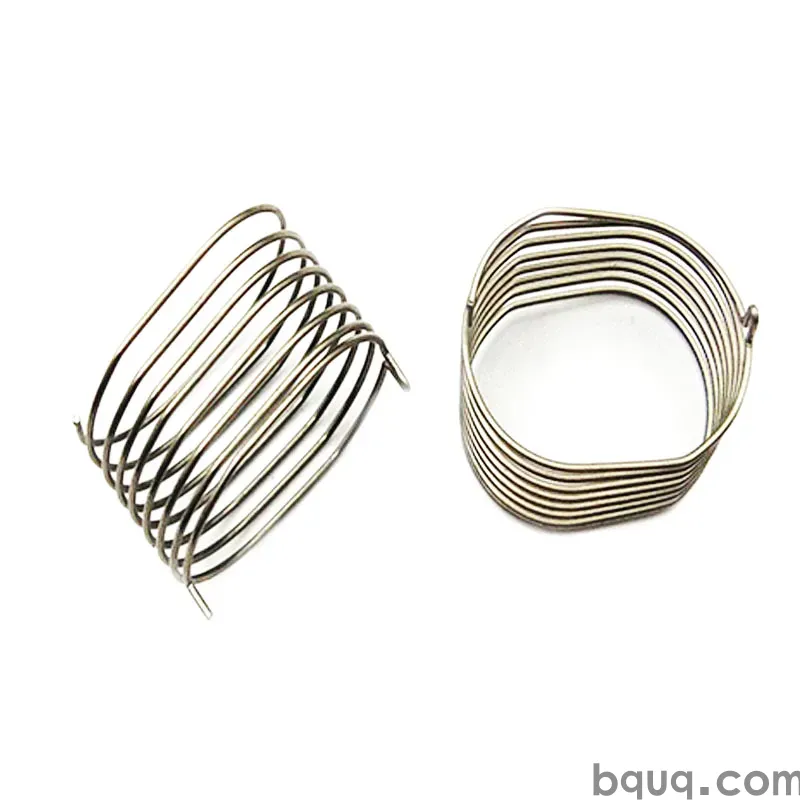
A wave spring starts as flat wire or strip, formed into a ring that waves up and down around its circumference. As the ring is compressed axially, the waves flatten and the ring resists like a spring. There are two broad families. A wave washer is a single-turn ring with one wave cycle count around the circumference, used for light loads and small deflections such as taking up play in a stack. A multi-turn wave spring winds the flat wire into overlapping turns, each with waves, so several wave sets share the load around the circumference — this is what gives the spring its higher load capacity and longer deflection range while staying short. Because the strip is wound in overlapping layers, the solid height stays close to a single material thickness times the number of layers, which is why these springs are so compact in the axial direction.
The practical consequence: for the same load, deflection, and bore size, a multi-turn wave spring typically installs in about 40-50% less axial space than a round-wire coil spring of equal performance. When axial height is the constraint in a mechanism — and it usually is — that single number decides the design.
Wave Springs vs Coil Springs vs Belleville Washers
Each compact axial-force spring has a different strength profile, and the selection logic is short once the numbers are on the table.
| Parameter | Multi-turn wave spring | Round-wire coil spring | Belleville washer |
|---|---|---|---|
| Installed height for given load | Lowest (40-50% below coil) | Baseline | Low, single disc |
| Deflection range | Moderate | Largest | Small per disc, stacks add |
| Load range | Newtons to ~100 kN | Broadest | Broad, stacking multiplies |
| Radial space needed | Annular gap only | Requires OD + clearance | Annular gap only |
| Load direction | Axial | Axial | Axial |
| Typical materials | 17-7PH, 302, carbon strip | Music wire, alloys | 51CrV4, 302 |
| Relative unit cost (custom) | Higher (flat wire + forming) | Lowest | Low |
| Best at | Tight axial space, rotating parts | General-purpose duty | Bolt preload, high loads, tiny travel |
The comparison table above is the short version of a fuller spring type selection guide; the engineering logic for choosing among wave, coil, and disc forms depends on the same variables every spring selection depends on — space envelope, load, travel, frequency, and environment.
Materials and Temperature Limits for Wave Springs
Flat spring strip is available in the same performance families as round spring wire, and the choice usually comes down to temperature, corrosion, and fatigue environment.
| Material | Max continuous service temp | Corrosion resistance | Relative cost | Typical use |
|---|---|---|---|---|
| Carbon spring steel strip (1075/1095) | ~120-150°C | Poor, needs plating | 1× baseline | Indoors, general mechanisms |
| 302/304 stainless | ~250-300°C | Good | ~2× | Humid or wash-down duty |
| 17-7PH stainless | ~370°C | Good | ~3-4× | Aircraft actuators, high fatigue |
| Inconel X-750 | ~500-600°C | Excellent | ~8-12× | Turbine, high-temperature assemblies |
For most commercial mechanisms — gearboxes, clutch packs, bearing preloads, valve systems — 302 stainless or carbon strip with plating covers the need at reasonable cost. If the spring sits near an engine, motor winding, or hot fluid, step to 17-7PH first and reserve Inconel for the cases where 17-7PH relaxes. The strip thickness on wave springs commonly falls between 0.1 mm and 1.5 mm even for quite heavy loads, because load is carried by many wave sets in parallel rather than one thick section.
Sizing a Wave Spring: Load, Deflection and Working Height
Three numbers matter in a wave spring calculation: required force at working height, allowable deflection between installed and solid height, and the bore/shaft envelope. Force grows with strip width and thickness and with the number of wave sets; deflection grows with wave amplitude and the number of turns available to flatten. A multi-turn spring behaves like several wave sets sharing the load, so specifying more turns raises capacity without raising height proportionally.
Keep two rules in mind. First, leave deflection margin: running the spring to solid height in service concentrates stress at the wave crests and shortens fatigue life, so design the working deflection to stay below the flat (solid) position with a margin, exactly as you would for a coil spring — the same fatigue logic is covered in our compression spring design guide. Second, wave springs are sensitive to wave height tolerance: a small change in formed wave height shifts the load-deflection curve noticeably, so hold the free height and material thickness tolerances realistically rather than over-tightening, which only raises cost.
When a Wave Spring Is the Right Call — and When It Is Not
Choose a wave spring when axial space is tight, the load is axial, and a radial annulus exists around a shaft or inside a bore: bearing preloads, seal energizing, clutch and brake packs, slip-ring assemblies, and anti-rattle duties in rotating components. They are especially attractive where the spring rotates with the assembly, because a compact ring is easier to balance and less prone to whip than a tall helix.
Skip it when the design needs large deflection — a coil spring gives several times the travel of a wave spring in the same diameter class — or when the load is a constant-force duty better served by a disc stack or a custom compression spring with proper end treatment. And if shock or very high cycle counts dominate, review the fatigue case before assuming a wave form will match a round-wire coil; the stress concentration at wave crests demands a generous radius and sometimes shot peening.
How to Specify and Quote a Wave Spring
A complete wave spring inquiry needs: bore diameter and shaft diameter (the annulus), force at working height (or working height at force), deflection or free height, material and environment, and expected cycles. With those, a manufacturer can recommend single-turn versus multi-turn, strip width and thickness, and wave count. Because wave springs are formed from strip rather than coiled from round wire, tooling and setup differ from conventional springs, so custom sizes carry a higher per-piece price than an equivalent coil spring; standard sizes from stock are the economical route when they fit. Our spring line covers wire and strip from 0.1 mm to 8 mm; send a drawing or the envelope dimensions to sc@bquq.com and you will have a quotation within 12 working hours, with the manufacturing route chosen by our own spring manufacturing process guide so you know exactly what you are paying for.
Verifying a Wave Spring Before Production
A wave spring design is only as good as the load it actually delivers at the working height, and wave forming introduces enough variability — wave height, strip thickness, material temper — that verification belongs in the buying process, not just on the drawing. The standard checks are a load test at the specified working height on a calibrated spring tester, a free-height and wave-height measurement, and a dimensional check of the spring against the bore and shaft envelope. Typical commercial load tolerance is about ±10% unless a tighter band is agreed and priced, and if the application needs matched springs with identical force, specify matched sets so the factory grades them accordingly. Ask for a sample or first-article report before production: it costs little, and it confirms that the delivered curve matches the one the catalog promised.
Wave springs also depend on the same process controls as any precision spring: consistent material lots, stable low-temperature heat treatment after forming, and clean edge quality on the strip, because stress concentrates at the wave crests where a scratch or burr starts a fatigue crack. When your volume justifies it, review the fatigue case with the factory before committing to tooling, since crest geometry, material choice, and peening decisions are far cheaper to make on paper than after samples are approved. A supplier that ships each batch with a measured load-at-height record — and flags material or tooling changes that would move the curve — is doing the engineering work that keeps a wave spring mechanism stable in the field.
Frequently Asked Questions
Q: What is the difference between a wave washer and a wave spring?
A: A wave washer is a single-turn ring with waves around its circumference, made for light loads and small deflections such as removing play or preloading a bearing lightly. A wave spring is usually multi-turn, with several overlapping turns of flat wire sharing the load, so it delivers much higher force and more deflection while still fitting a short axial envelope.
Q: How much space does a wave spring save compared to a coil spring?
A: For an equivalent load and deflection class, a multi-turn wave spring typically needs 40-50% less installed axial height than a round-wire coil spring. The exact saving depends on the ratio of wave amplitude to coil pitch in your design, but the 50% figure is the practical rule of thumb engineers use in early layout work.
Q: What materials are wave springs made from?
A: Carbon spring steel strip for general indoor mechanisms, 302/304 stainless for corrosion resistance to about 250-300°C, 17-7PH for high strength and fatigue up to about 370°C, and Inconel X-750 when service temperatures climb beyond that toward 500-600°C. Plating or passivation is specified according to the environment.
Q: Can a wave spring replace a coil spring in my existing assembly?
A: Often yes, when the assembly has an annular space around a shaft or inside a bore and the load is axial, because the wave spring fits the same envelope in less height. But compare deflection and fatigue first: coil springs provide larger travel, and high-cycle wave springs need careful crest design, so a direct swap is a design review, not just a part substitution.
Q: Why does a custom wave spring cost more than a coil spring?
A: Wave springs are formed from flat strip with dedicated tooling and wave-forming setups, and material is specified as strip rather than round wire, so setup and per-piece costs run higher than conventional coiling. Standard stocked sizes avoid that premium; for custom sizes the cost difference is typically moderate and often worth it when axial space is the binding constraint.
Related Resources
- Compression Spring Rate and Design Fundamentals — how rate, load, and free length interact before you choose a spring form.
- Custom spring products — compression, extension, and specialty springs from a Dongguan source factory.
- About BQUQ — an ISO9001-certified factory running spring, stamping, CNC, and heat sink lines in Dongguan.
- Contact us — send your envelope dimensions and get a spring quote within 12 working hours.
Authored by the BQUQ Engineering Team. BQUQ is an ISO9001-certified source factory in Dongguan, China, running CNC machining, metal stamping, custom springs, heat sink and collet lines under one roof. Send drawings to sc@bquq.com or WhatsApp +86 13713157787 for a quote within 12 working hours. www.bquq.com