Shot Peening Setup: Intensity, Coverage and Specs
Short answer: A production-ready shot peening spec for springs names four things — Almen intensity (typically 0.006–0.014 A for compression springs, 0.004–0.010 A for small extension springs), coverage (100% visual minimum, verified by saturation curve), media (cast steel shot S230/S170 or ceramic Z425/Z300 for stainless), and control method (Almen strip type A or N, holder, and fixture rotation speed). Intensity is set by saturation curve — the point where doubling exposure adds under 10% more arc height — not by guessing a time. Typical gains in fatigue life run 2× to 10× on steel springs, depending on material, stress ratio, and whether the surface is already decarburized or scratched.
Why Shot Peening Matters for Spring Fatigue Life
Springs fail in fatigue, not in static overload. A compression spring cycling between 30% and 60% of its tensile strength will almost always crack at the inside of the coil where tensile stress peaks — the same place where residual tensile stress from coiling, grinding, and heat treatment already sits.
Shot peening works by bombarding that surface with rounded media at controlled velocity. Each impact creates a small plastic indentation, and the surrounding elastic material pushes back, leaving a compressive residual layer typically 0.10–0.30 mm deep. Fatigue cracks initiate where tensile stress is highest; a compressive layer of 400–800 MPa (typical for peened spring steel) shifts the local mean stress negative and delays initiation.
For a spring engineer, the practical consequences are:
- Higher allowable stress for the same wire diameter, or the same stress at a smaller wire diameter (weight and cost savings).
- Longer cycle life at the same stress — commonly 2× to 10× on valve-quality steel.
- Better tolerance of surface defects, since the compressive layer suppresses small crack growth.
Peening is not a substitute for good coiling, correct stress relief, or clean wire. It amplifies a sound process; it does not rescue a bad one.
What Is Almen Intensity and How Do You Set It?
Almen intensity is a proxy measurement, not a direct stress reading. A standardized steel strip (type A, N, or C) is clamped in a holder and peened on one side. The strip curves as compressive stress builds, and the arc height is measured on an Almen gauge in thousandths of an inch (or mm).
The intensity value is the arc height at saturation. Saturation is found by the saturation curve method: peen separate strips at increasing exposure times (T, 2T, 4T, 8T...) and plot arc height against time. When doubling the time adds less than 10% more arc height, the curve has saturated, and that arc height is the intensity.
| Almen strip | Thickness | Typical use | Intensity range |
|---|---|---|---|
| Type N | 0.79 mm | Small springs, wire under 1.5 mm | 0.002–0.008 N |
| Type A | 1.29 mm | General spring work | 0.004–0.016 A |
| Type C | 2.39 mm | Heavy coil, large wire | 0.008–0.020 C |
Practical rules for spring shops:
- Match strip to wire size. Using type A on a 0.8 mm wire spring overstates what the part actually receives. Small springs are usually specified in type N.
- One setup, one saturation curve. Changing media size, air pressure, nozzle distance, angle, or wheel speed invalidates the curve.
- Record the machine parameters, not just the number. "0.010A" alone is not reproducible. The spec should list media size and type, pressure or wheel speed, nozzle diameter and distance, impingement angle, fixture rotation, and exposure time.
If a drawing says only "shot peen per SAE J442/J443" with no intensity, the shop will pick something reasonable — and you will get a part that may not match your fatigue model.
Coverage: The Number Buyers Get Wrong Most Often
Coverage is the percentage of surface area that has at least one impact. It is not the same as intensity, and it is not measured with an Almen strip.
- 100% coverage means every point on the surface shows at least one indentation. This is the normal requirement for fatigue-critical springs.
- 200% coverage means the exposure time was doubled after reaching 100%. It is a time multiplier, not a visual condition. You cannot see 200% coverage.
- Full coverage is sometimes used loosely; specify it as 100% visual with a stated verification method.
Coverage is verified by peening a test coupon of the same material and surface finish, then inspecting under 10×–20× magnification. Fluorescent tracer peening is used when visual inspection is unreliable — for example, inside tightly wound coils or on dark, oxidized surfaces.
| Requirement | What it means in the shop | Verification |
|---|---|---|
| 100% visual | Every point impacted at least once | Coupon + 10× magnification |
| 200% (2× time) | Double the 100% exposure time | Time record + coupon |
| 300% (3× time) | Triple exposure, used for extreme fatigue | Time record + coupon |
| No coverage stated | Shop default, usually 100% visual | Ask for the process sheet |
Two failure modes are common. First, over-peening: beyond about 200–300% coverage, you add cost and risk surface damage (flaking, over-peening cracks in high-carbon steel) without proportional fatigue gain. Second, shadowing: on a tightly wound compression spring, the shot cannot reach the inside of adjacent coils. The fix is to peen before final coiling where possible, rotate the part during peening, or accept a documented lower coverage in shadowed zones.
Media Selection: Steel, Ceramic, or Cut Wire
Media choice drives both the achievable intensity and the surface condition.
- Cast steel shot (S110–S330) is the workhorse for carbon and alloy spring steel. It is cheap, dense, and produces deep compressive layers. It must be screened regularly for broken particles, which cause sharp-edged damage.
- Conditioned cut wire shot has a more uniform, rounded shape and lower breakdown rate. It is preferred for critical springs and for stainless where contamination matters.
- Ceramic shot (Z300, Z425) is non-magnetic, chemically inert, and does not embed iron into stainless steel surfaces — important for corrosion-resistant spring applications. It costs more and breaks down differently, so intensity curves must be re-established.
- Glass beads produce lower intensity and are generally used for cleaning or light cosmetic peening, not fatigue-critical springs.
Media size versus intensity: larger shot at the same velocity gives higher intensity but coarser surface finish. For small springs, S170 or Z300 is typical; for heavy suspension coils, S280–S330.
Building a Shop-Ready Peening Specification
A specification that a spring supplier can actually run should contain these blocks:
1. Scope and part identification — drawing number, material, wire diameter, spring type.
2. Intensity — Almen strip type and target arc height, with tolerance (for example, 0.008–0.011 A).
3. Coverage — 100% visual minimum, or a stated multiplier.
4. Media — size, type, and condition (round, screened, no broken shot).
5. Machine parameters — pressure or wheel speed, nozzle diameter, distance, angle, part rotation, exposure time.
6. Saturation evidence — a saturation curve on file, tied to the setup.
7. Post-peening operations — stress relief temperature limits (typically below 230 °C to avoid relaxing the compressive layer), plating, coating.
8. Inspection — coupon frequency, Almen strip frequency, and record retention.
Note item 7 carefully. If a spring is peened and then baked or plated at high temperature, some of the compressive stress relaxes. Zinc plating with a hydrogen embrittlement relief bake at 190–210 °C is generally acceptable; higher-temperature processes are not. This is why the sequence — form, heat treat, peen, finish — matters and why plating and coating choices should be decided together with the peening spec.
Peening Different Spring Types
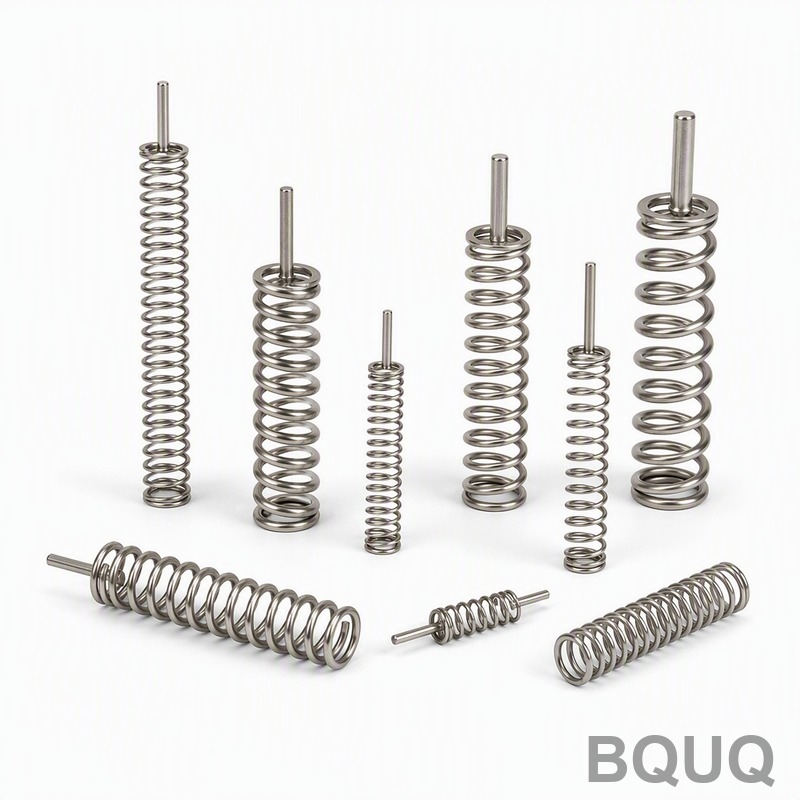
Compression springs
Peen after coiling, end grinding, and stress relief. The critical zone is the inside diameter of the active coils. Rotation of the part during peening is essential; static fixturing leaves a shadow band. Typical intensity for automotive-grade valve springs is 0.008–0.012 A.
Extension springs
The hook and the first coil are the fatigue-critical zones, and they are hard to reach. Many shops peen the body and accept partial coverage on the hook, or peen the hook from multiple angles with a smaller nozzle. Specify the hook requirement explicitly if it matters — see initial tension and hook design for how hook geometry interacts with stress concentration.
Torsion springs
Legs and the inside of the coil body are the hot spots. Because the legs are often bent after coiling, peening should follow the final bend, not precede it.
Large or heavy coils
Handled on a wheel-blast or tumble machine rather than a nozzle cabinet. Intensity is set by wheel speed and media flow rate; saturation curves are run per batch.
Process Control and Common Mistakes
| Mistake | Consequence | Fix |
|---|---|---|
| Spec says "shot peen" only | Uncontrolled, non-reproducible | Add intensity, coverage, media, parameters |
| Intensity set by time, not saturation | Over- or under-peening | Run a saturation curve per setup |
| Broken shot not screened | Sharp edges, surface damage, cracks | Screen media daily, replace at breakdown limit |
| Part not rotated | Shadowed zones, no coverage inside coils | Rotating fixture or tumble process |
| Peening before final forming | Compressive layer destroyed by bending | Peen after all forming and stress relief |
| High-temp bake after peening | Residual stress relaxed | Cap post-peen temperature, sequence correctly |
| Almen strip type mismatched to wire | Wrong intensity reported | Match strip type to part scale |
Cost, Lead Time, and Sourcing Notes
Shot peening adds a discrete operation, so it adds cost and lead time. For small springs, the operation itself is often a small fraction of unit price; the bigger cost driver is fixturing and setup for the first article. Once a saturation curve exists and the fixture is built, marginal cost per part is low.
At BQUQ, custom springs are quoted in 12 working hours with flexible MOQ, so a peening requirement can be evaluated at prototype quantity rather than forcing a large first order. Because CNC machining, stamping, spring winding, and heat sink production all run under one ISO9001 roof in Dongguan, tooling and fixture work for peening setups can be handled in-house rather than subcontracted.
For buyers, three questions to ask any spring supplier:
1. Do you run saturation curves, and can you show one for my part?
2. What Almen strip type do you use, and how often is it verified?
3. What is the maximum temperature my spring sees after peening?
If the answers are vague, the peening is probably decorative rather than engineered.
Frequently Asked Questions
Q: What Almen intensity should I specify for a compression spring?
A: For most carbon and alloy steel compression springs, 0.006–0.012 A is a workable starting range, with small wire springs specified in type N at roughly 0.003–0.007 N. The correct value depends on wire diameter, stress level, and required cycle life. Ask your supplier to run a saturation curve on the actual material and finish, then set the intensity from that curve rather than from a generic table.
Q: Is 100% coverage the same as 200% coverage?
A: No. 100% coverage means every point on the surface has received at least one impact. 200% coverage is a time instruction: you peen for twice the exposure needed to reach 100%. It is not a visibly different surface. Since coverage cannot be judged by eye at high percentages, it is verified on a coupon under magnification and recorded as exposure time in the process sheet.
Q: Can shot peening be applied to stainless steel springs?
A: Yes, but media choice matters. Cast steel shot can embed iron particles into stainless surfaces, creating sites for corrosion. Ceramic shot such as Z300 or Z425 avoids contamination and is the usual choice for stainless and other corrosion-sensitive springs. Intensity curves must be re-established for ceramic media because its density and breakdown behavior differ from steel shot.
Q: Does peening replace stress relief after coiling?
A: No. Stress relief removes residual tensile stress from coiling and forming and stabilizes dimensions; shot peening then introduces a controlled compressive layer at the surface. They are complementary steps performed in sequence. Peening a spring that has not been stress relieved leaves the underlying tensile stress in place and can produce distortion or reduced fatigue performance.
Q: How much fatigue life improvement can I realistically expect?
A: Typical gains range from 2× to 10× in cycle life for steel springs, but the number depends heavily on material, stress ratio, surface condition, and whether the part was already decarburized or scratched. Peening cannot compensate for a design that is already above the endurance limit. Treat published multipliers as indicative and validate with your own fatigue testing before committing to a stress increase.
Related Resources
- About BQUQ — ISO9001 factory in Dongguan with four production lines under one roof
- Compression springs — coiled, ground, and peened to drawing
- Extension custom springs — hook and body peening options
- Torsion springs — leg and coil-body peening for cyclic applications
- Technical articles — spring design, materials, and process guides
- Industry trends — sourcing and manufacturing signals for buyers
- Contact — send drawings for a quote in 12 working hours
Authored by the BQUQ Engineering Team. BQUQ (Dongguan) runs CNC machining (±0.005 mm), metal stamping, custom springs, and heat sink production in one ISO9001 factory. Source-direct from Dongguan, China — quote in 12 hours: sc@bquq.com | WhatsApp +86 13713157787 | www.bquq.com