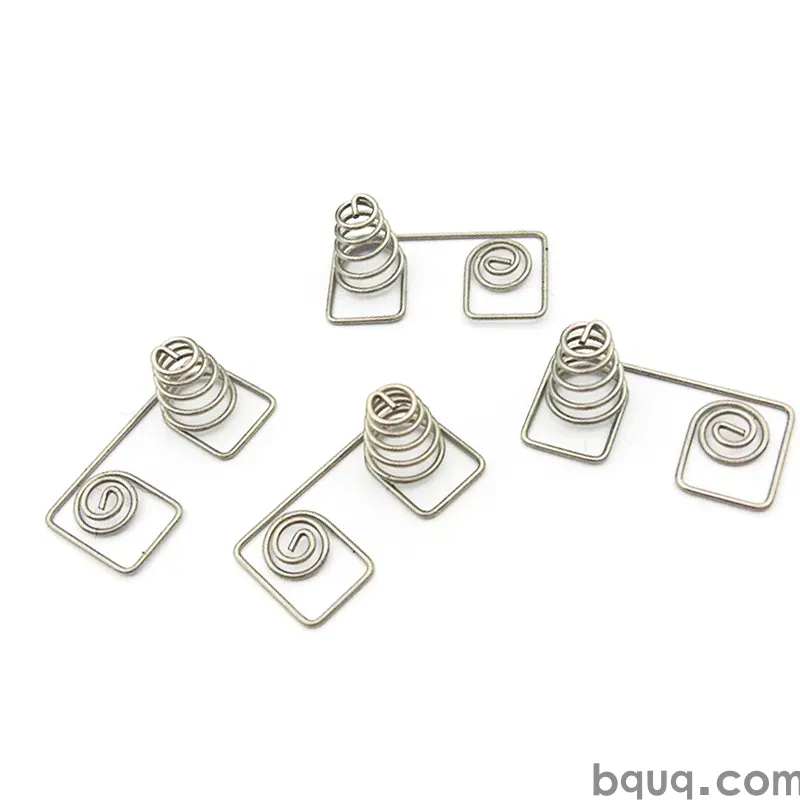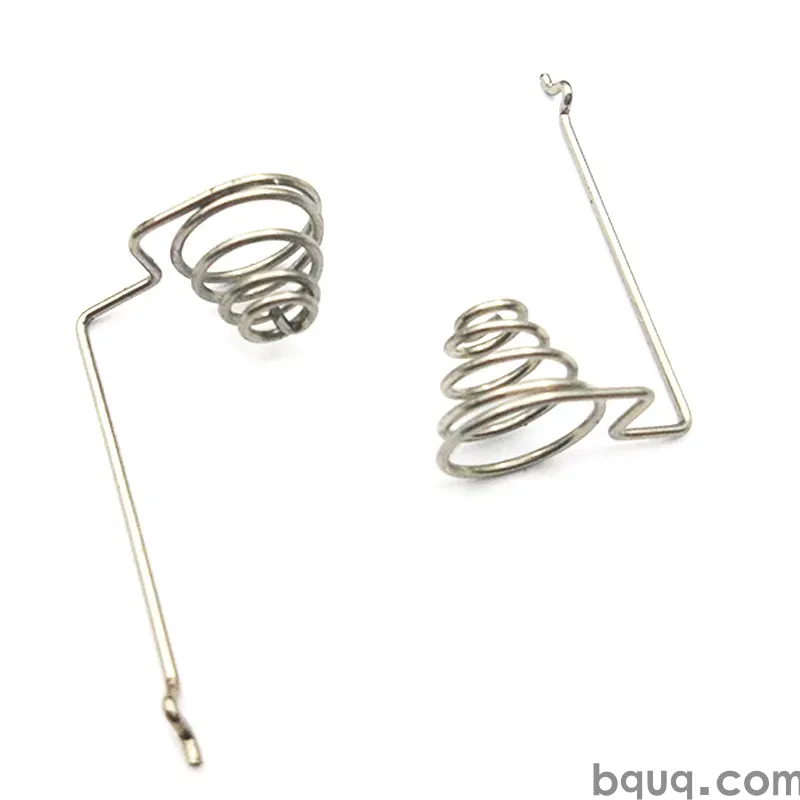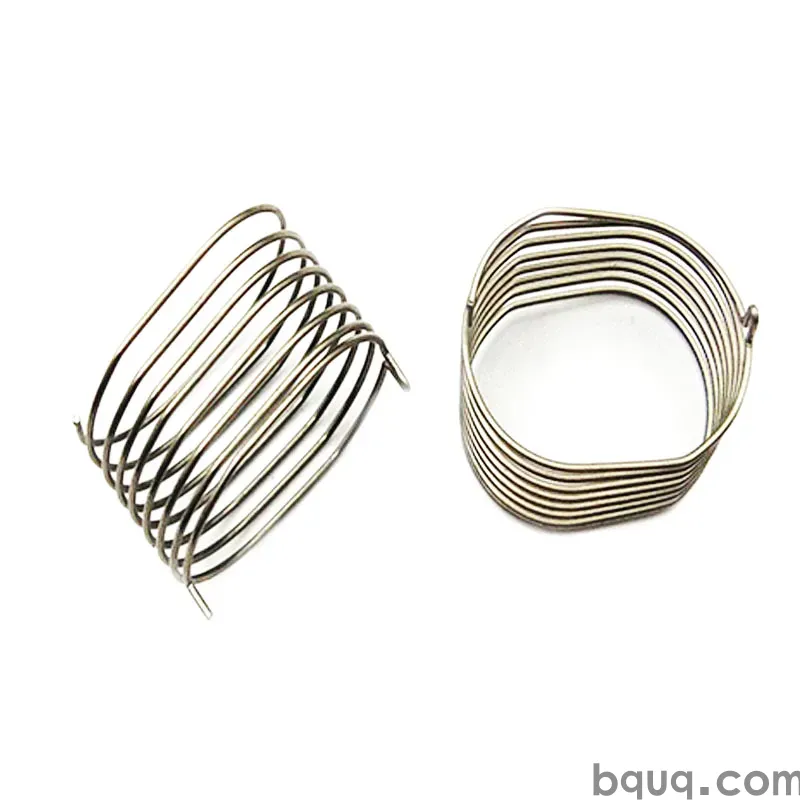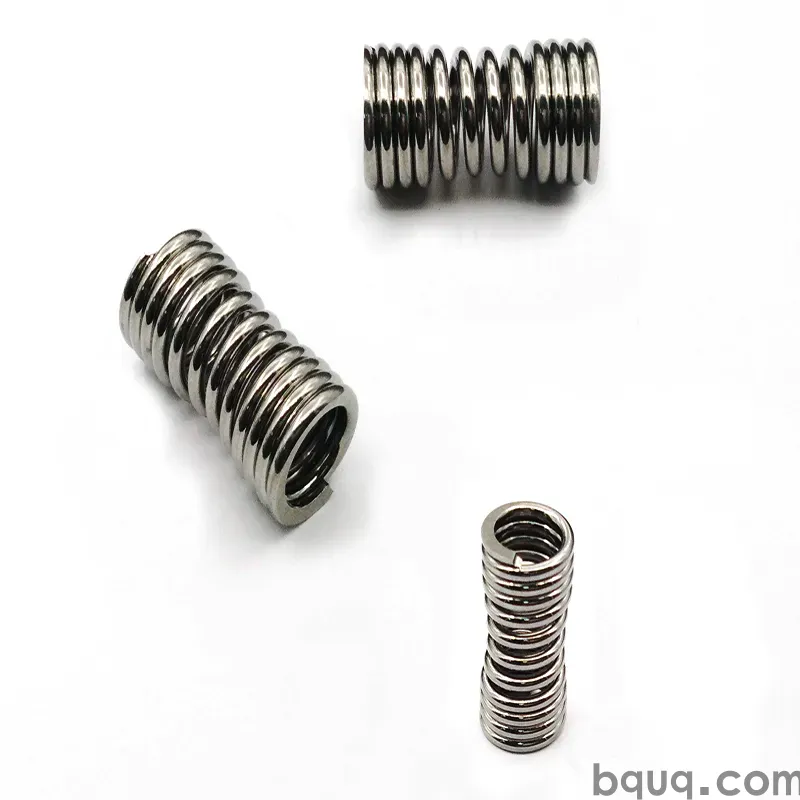
Die Springs in Injection and Stamping Dies
Short answer: Die springs are heavy-duty compression springs that store and release energy inside a tool — ejecting parts, returning strippers, preloading slides and holding cams. In injection molds they typically run 10–30% of free length in deflection and must survive 100,000 to 1,000,000+ cycles at mold temperatures up to roughly 200 °C. In stamping dies they work harder: deflections of 25–40% of free length, cycle rates in the hundreds per minute, and shock loads that dominate fatigue life. BQUQ machines and winds these springs in one ISO9001 Dongguan factory, holding ±0.005 mm on CNC features and quoting custom die springs in 12 working hours.
What exactly does a die spring do in a mold or die?
A die spring is not a general-purpose spring. It is a compression spring engineered to work inside a confined pocket, at a defined installed length, for a defined number of strokes, without losing enough force to make the tool misfeed or fail to eject.
In an injection mold, die springs usually do one of four jobs:
- Ejection return. Push the ejector plate back to its home position after the part is knocked out, so the mold can close safely.
- Stripper and plate preload. Hold a stripper plate or slide in a defined position until the mold opens or closes far enough to release it.
- Slide and lifter actuation. Drive a side-action slide, a lifter or a cam return where hydraulics would be too bulky or too slow.
- Valve and hot-runner assist. Provide a light, repeatable preload on a pin or valve gate.
In a stamping die, the same spring family appears as:
- Stripper springs — hold the strip flat while the punch enters the material, then release.
- Pressure-pad springs — control material flow in draw and form operations.
- Ejector and knockout springs — push the finished part clear of the die.
- Cam return springs — bring a cam slide back to rest every stroke.
The common thread is that the spring is a wear part. It is designed to be replaced, and the tool should be designed so that replacement takes minutes, not hours.
How is a die spring different from an ordinary compression spring?
Three things separate a die spring from a general compression spring: material, geometry and the load-deflection specification.
| Feature | Ordinary compression spring | Die spring |
|---|---|---|
| Typical wire | Music wire, 0.3–3 mm | Chrome-silicon or chrome-vanadium alloy, 3–20 mm |
| Coil form | Open pitch, round ends | Closed and ground ends, rectangular or trapezoidal wire section common |
| Deflection range | 10–25% of free length | 25–40% of free length for stamping, 10–30% for molds |
| Load tolerance | Often ±10% | Typically ±5% on rated load at a defined length |
| Colour coding | Rare | Standard (ISO 10243 style) for load class |
| Life target | Application dependent | Specified in strokes at rated deflection |
| Heat treatment | Stress relieved | Quenched and tempered, shot peened, preset (scragged) |
The rectangular wire section is the single biggest difference. A rectangular or trapezoidal wire packs more material into the same pocket diameter, so a die spring delivers far more force per millimetre of pocket than a round-wire spring of the same outside diameter. That is why mold and die designers can specify a compact spring with a high load rating rather than stacking multiple round-wire springs.
Pre-setting, sometimes called scragging, is the other quiet difference. The spring is compressed past its rated deflection once during manufacturing so that it takes a permanent set in the factory rather than in the tool. A die spring that has not been preset will lose free length in the first few hundred strokes, and the tool will lose ejection force with it.
What do the die spring colour codes actually mean?
Most die springs sold internationally follow a colour-coded load classification, commonly associated with ISO 10243. The colours describe how much the spring can be compressed relative to its free length while staying inside a safe stress range — not how strong it is in absolute terms.
| Colour code | Load class | Typical max deflection (% of free length) | Typical use |
|---|---|---|---|
| Green | Light | ~40% | Light strippers, return springs, low-force ejection |
| Blue | Medium | ~32% | General mold ejection, medium stripper load |
| Red | Heavy | ~25% | Heavy strippers, pressure pads, high ejection force |
| Yellow | Extra heavy | ~20% | High-force pads, short stroke, high cycle stamping |
| Brown / other | Super heavy | ~15% | Extreme load, very short stroke, cam return under high load |
Two practical warnings. First, the colour tells you the deflection limit, not the force — two red springs of different free lengths have very different load ratings. Second, colours are a convention, not a law. Always work from the supplier's load-deflection table at the installed length you actually use, and verify the pocket depth, bore diameter and rod diameter.
How do you size a die spring for a real tool?
Sizing is a four-step calculation, and it is worth doing properly because an undersized spring fails early and an oversized spring damages the tool.
Step 1: Define the required force at the working position
Work out the force the spring must deliver at the moment it matters — not at free length. For an ejector return spring, that is the force needed to lift the ejector plate plus friction plus a safety margin, usually 1.3–1.5×.
Step 2: Choose the installed length and stroke
Installed length = pocket depth minus the space taken by the plate, washer or rod shoulder. Stroke = the distance the spring travels during the tool cycle. Then:
Deflection % = (stroke ÷ free length) × 100
If the result is above the colour-class limit, you need a longer free length, a heavier class, or a different pocket design.
Step 3: Check the bore and rod
Die springs are usually specified by outside diameter, inside diameter and free length. The pocket bore should be a close sliding fit — typically a few tenths of a millimetre larger than the spring OD — and the rod or guide pin should be a few tenths smaller than the spring ID. Too much clearance lets the spring buckle; too little and it binds and wears the pocket.
Step 4: Check life and temperature
Life falls steeply as deflection rises. A spring rated for a million strokes at 25% deflection may manage only a fraction of that at 40%. In a hot mold, standard chrome-silicon springs lose load capacity as temperature climbs; above roughly 200 °C you should be looking at a different alloy or a different mechanism entirely.
A worked example, indicative only:
| Parameter | Value |
|---|---|
| Required force at working position | 900 N |
| Pocket bore | 25 mm |
| Available pocket depth | 80 mm |
| Required stroke | 16 mm |
| Selected spring | 25 mm OD × 12.5 mm ID × 76 mm free length, red class |
| Deflection at working position | 16 ÷ 76 = 21% |
| Red class limit | 25% |
| Verdict | Acceptable, with margin for set and wear |
What materials and finishes are used, and when do they matter?
Chrome-silicon alloy steel (often AISI 9254 or equivalent) is the default for die springs. It offers a good balance of fatigue strength, hardenability and cost, and it is the material behind most green, blue, red and yellow catalogue springs.
Chrome-vanadium steel (AISI 6150 or equivalent) is used where higher temperature resistance or better fatigue performance is needed. It costs more and machines differently, but it holds load better in hot molds.
Stainless grades appear in food, medical and cleanroom tooling, or where the mold sees condensation and washdown. They generally have lower fatigue strength than chrome-silicon, so the spring must be sized more conservatively. Our guide to spring corrosion protection covers the material and coating trade-offs in detail.
Finishes matter more than most designers expect:
- Shot peening induces compressive residual stress at the surface and is one of the cheapest ways to extend fatigue life.
- Presetting stabilises free length and load.
- Zinc or zinc-nickel plating adds corrosion resistance but can embrittle high-strength steel if the baking step is skipped.
- Powder coating or paint is common on colour-coded springs but adds thickness — check it against your bore clearance.
Heat treatment and stress relief are not optional steps. A die spring that is wound, hardened and tempered but never stress relieved will drift in length and lose load. Our article on spring stress relief explains what the process does to residual stress and why it shows up as life at the tool.
What makes die springs fail in service?
Failures are rarely mysterious. They cluster into a handful of causes.
| Failure mode | Typical root cause | Fix |
|---|---|---|
| Fatigue crack near an end coil | Deflection above class limit, or no shot peening | Reduce deflection, increase free length, specify peened spring |
| Loss of free length / load | Spring not preset, or operated above yield | Specify preset springs, recheck deflection |
| Buckling or bowing | Bore too large, no guide rod, spring too slender | Tighten bore fit, add guide rod or sleeve |
| Wear and fretting at coils | Contamination, poor bore finish, side load | Improve bore finish, add lubrication, remove side load |
| Corrosion pitting | Condensation, washdown, incompatible plating | Switch to stainless or upgrade coating |
| End coil crushing | Insufficient closed-end bearing surface | Use closed and ground ends, check pocket flatness |
The single most common cause of premature failure in both molds and stamping dies is running the spring closer to its solid height than the designer realised. When a spring is compressed to solid, the coils touch, stress spikes and the spring is effectively a rigid block. Always leave clearance between the solid height and the maximum compressed height — 10% of stroke is a reasonable rule of thumb.
How do injection mold and stamping die applications differ?
They use the same spring family but stress it very differently.
| Factor | Injection mold | Stamping die |
|---|---|---|
| Cycle rate | Low, seconds to minutes | High, tens to hundreds per minute |
| Dominant load | Steady preload, thermal drift | Shock and impact |
| Temperature | Up to ~200 °C at the cavity | Usually near ambient, local heating at the punch |
| Deflection | 10–30% of free length | 25–40% of free length |
| Life target | Often 100,000–500,000 cycles | Often 1,000,000+ cycles |
| Main failure driver | Thermal load loss, corrosion | Fatigue, buckling, wear |
| Replacement access | Often requires mold pull | Usually accessible in the press |
The practical consequence is that mold springs are usually sized for force retention over temperature and time, while stamping die springs are sized for fatigue life under shock. A spring that performs well in one application can fail quickly in the other.
Can die springs be customised, and what should the RFQ include?
Yes — and in many tools the catalogue spring is a compromise. Custom die springs let you match the pocket you already have rather than redesigning the pocket around a catalogue item. Typical customisations include non-standard free lengths, specific load at a specific installed length, alternative wire sections, stainless or chrome-vanadium material, and special end configurations.
A useful RFQ includes:
- Outside diameter, inside diameter and free length (or the pocket dimensions)
- Required load at the installed length, with tolerance
- Stroke and cycle rate
- Operating temperature and environment
- Expected life in strokes
- Material or finish preferences
- Quantity per year and per release
BQUQ runs CNC machining to ±0.005 mm, metal stamping, custom spring winding and heat sink production across four production lines in one Dongguan factory. That matters for die springs because the spring and the pocket it sits in can be made to the same drawing set, with the same tolerance stack, in the same quality system. Flexible MOQ applies, and quotes come back in 12 working hours. Our custom spring RFQ guide walks through the information that speeds up a quote.
Frequently Asked Questions
Q: How do I know which colour die spring to use?
A: Start from the deflection you need, not the colour. Calculate stroke divided by free length as a percentage, then pick the lightest class whose limit sits above that figure with margin. Green allows roughly 40%, blue about 32%, red about 25% and yellow about 20%. Always confirm the actual load at your installed length from the supplier's load-deflection table, because colour alone does not define force.
Q: Can I use a standard compression spring instead of a die spring?
A: Sometimes, if the load is light, the deflection is small and the cycle count is low. For anything with high force, high cycle count or a confined pocket, a die spring is the better choice. Rectangular-section wire packs more material into the same bore, preset springs hold their free length, and shot peening extends fatigue life. The cost difference is usually small next to the cost of a tool stoppage.
Q: What temperature can die springs handle?
A: Standard chrome-silicon die springs are typically used up to around 200 °C, and load capacity falls as temperature rises. Chrome-vanadium grades hold up better in hot molds. Above those ranges you should consider a different mechanism or a high-temperature alloy. Always ask for the load derating curve rather than assuming the catalogue rating applies at your mold temperature.
Q: How often should die springs be replaced?
A: Replace on condition, not on a fixed calendar. Inspect free length against the original specification, look for cracks near the end coils, and check for corrosion or wear marks. A spring that has lost more than a few percent of free length is already delivering less force. Building replacement into scheduled maintenance is far cheaper than a mid-production tool failure.
Q: Do you supply die springs in small quantities?
A: Yes. BQUQ works with flexible MOQ, so prototype tools and low-volume production runs can be supported alongside volume programmes. Send the pocket dimensions, the required load at installed length, the stroke and the expected life, and we will quote in 12 working hours. Custom free lengths and non-standard wire sections are routine rather than exceptional.
Related Resources
- About BQUQ and our Dongguan manufacturing footprint: /about/
- Compression springs for die, mold and industrial applications: /compression-springs/
- Torsion springs for cam, latch and return mechanisms: /torsion-springs/
- Industry trends in tooling and precision components: /industry-dynamics/
- Technical articles on spring design and manufacturing: /bquq-blog/
- Frequently asked questions about sourcing and tolerances: /faq/
- Case studies from our production lines: /case/
- Talk to an engineer: /contact/
Authored by the BQUQ Engineering Team. BQUQ (Dongguan) runs CNC machining (±0.005 mm), metal stamping, custom springs, and heat sink production in one ISO9001 factory. Source-direct from Dongguan, China — quote in 12 hours: sc@bquq.com | WhatsApp +86 13713157787 | www.bquq.com