Corrosion Protection for Springs: Coatings and Materials
Short answer: Choose the protection system before you choose the spring. For most indoor industrial springs, electroplated zinc at 8–12 µm gives 96–200 hours of neutral salt spray at a modest cost. For outdoor, marine, or automotive under-hood environments, zinc-nickel (12–15% Ni) at 8–12 µm typically reaches 720–1,000 hours, or you can specify AISI 302/304 stainless and skip coating entirely. Where the spring flexes constantly, coating adhesion and hydrogen embrittlement control matter more than thickness. BQUQ machines and forms springs in one ISO9001 Dongguan factory, with four production lines and quotes returned in 12 working hours.
Why Do Springs Corrode Faster Than Other Parts?
A spring is a corrosion amplifier. Three things happen at once.
First, springs are thin. A 0.8 mm wire has a far higher surface-area-to-volume ratio than a 20 mm machined block, so the same corrosion depth removes a much larger fraction of the load-bearing section. A 0.05 mm pit is cosmetic on a bracket and a fatigue crack starter on a spring.
Second, springs live under stress. Corrosion under sustained tensile stress drives stress-corrosion cracking, and corrosion fatigue cracks grow far faster than in air. A spring that would survive 10 million cycles dry may fail at 500,000 cycles in a damp, chloride-bearing atmosphere.
Third, springs are usually the part that traps electrolyte. Close-wound coils, end hooks, and contact points between coils create crevices where moisture sits and oxygen cannot replenish. That is why you often see a spring fail at the hook or the first active coil rather than mid-body.
The practical consequence: corrosion protection for springs is a design decision, not a finishing afterthought. Decide the environment, the stress level, and the required life, then pick material and coating together.
Material Selection: Stainless vs. Coated Carbon Steel
The first fork in the road is whether to use a corrosion-resistant alloy or a coated carbon steel.
Austenitic Stainless Steels (302, 304, 316)
AISI 302 and 304 are the workhorses of corrosion-resistant spring wire. They are non-magnetic in the annealed state (slightly magnetic after cold working), offer good fatigue performance, and need no coating in most indoor and mildly outdoor environments. Grade 316 adds molybdenum and is the default for marine, chemical, and chloride-rich settings.
The trade-off is modulus and strength. Austenitic stainless has a lower elastic modulus than carbon steel — roughly 193 GPa versus 207 GPa — so a stainless spring of identical dimensions is slightly softer. You compensate with geometry or by specifying a higher tensile grade. Stainless also costs more per kilogram, and 316 wire availability in small diameters can be limited.
Chrome-Silicon and Carbon Steels
Chrome-silicon (AISI 9254) and music wire (AISI 1085/1095) offer the highest fatigue strength per unit cost and are the standard choice for high-cycle dynamic springs. They have essentially zero intrinsic corrosion resistance, so they must be coated. This is not a disadvantage if the coating is specified correctly — a properly plated chrome-silicon spring can outperform an uncoated 304 spring in fatigue life while costing less.
Precipitation-Hardening and Specialty Alloys
For high-temperature or extremely aggressive service, 17-7PH and 15-7Mo PH stainless grades hold strength to higher temperatures than 302/304. Nickel alloys such as Inconel or Monel handle severe chloride and elevated-temperature combinations. These are specialist selections; expect longer lead times and higher unit costs.
| Material | Relative corrosion resistance | Fatigue strength | Relative cost | Typical use |
|---|---|---|---|---|
| Music wire (AISI 1085) | Poor (needs coating) | High | Low | Indoor mechanisms, plated |
| Chrome-silicon (9254) | Poor (needs coating) | Very high | Low–medium | Automotive, high-cycle dynamic |
| 302 / 304 stainless | Good | Medium–high | Medium | General outdoor, food equipment |
| 316 stainless | Very good | Medium | High | Marine, chemical, chloride |
| 17-7PH stainless | Good | High | High | High-temperature, aerospace-adjacent |
| Inconel / Monel | Excellent | Medium–high | Very high | Severe chemical, high temp |
Coating Options Compared
If you stay with carbon or chrome-silicon steel, the coating choice dominates service life.
Electroplated Zinc
The default. Zinc is sacrificial — it corrodes preferentially and protects the steel beneath even at scribes and cut ends. Typical thickness is 8–12 µm, delivering roughly 96–200 hours of neutral salt spray (ASTM B117) depending on thickness and passivation. Add a trivalent chromate passivation and you gain a further step. Zinc is inexpensive and widely available, but it is soft and can be damaged during aggressive handling.
Zinc-Nickel Alloy
Zinc-nickel with 12–15% nickel is the current benchmark for demanding applications. At the same 8–12 µm thickness it typically delivers 720–1,000 hours of salt spray, is significantly harder and more abrasion-resistant than pure zinc, and tolerates higher service temperatures. It is the common specification for automotive under-hood and underbody springs. Cost is higher than zinc, and the plating bath chemistry must be tightly controlled — this is a supplier-selection issue as much as a specification issue.
Zinc Flake (Dacromet-Type) Coatings
Zinc flake coatings are applied by dip-spin and cured. They contain no hydrogen embrittlement risk from the coating process itself, which makes them attractive for high-strength springs above roughly 1,000 MPa. They provide excellent salt spray performance and good coverage in crevices. Drawbacks: thicker build-up can affect close-wound geometry, and the coating is not conductive.
Powder Coating and E-Coating
Powder coat gives a thick, durable, decorative barrier — but it is a barrier only. Once breached, it does not protect sacrificially, and it cracks under repeated flex. Use powder coat on springs that are largely static, or on the outside of assemblies. E-coat (electrophoretic) gives thinner, more uniform coverage and better flexibility than powder, and is a reasonable choice for moderate flex plus good appearance.
Phosphate and Oil
Zinc or manganese phosphate with a light oil film is a low-cost, short-term protection for springs in dry indoor service. It provides minimal salt spray resistance and is best treated as a shipping and storage protection rather than a service coating.
| Coating | Typical thickness | Salt spray (indicative) | Flex tolerance | Hydrogen embrittlement risk | Relative cost |
|---|---|---|---|---|---|
| Electroplated zinc + trivalent passivate | 8–12 µm | 96–200 h | Good | Yes (manageable) | Low |
| Zinc-nickel (12–15% Ni) | 8–12 µm | 720–1,000 h | Good | Yes (manageable) | Medium–high |
| Zinc flake (dip-spin) | 8–15 µm | 500–1,000 h | Moderate | Low | Medium |
| Powder coat | 60–100 µm | Barrier only | Poor | None | Medium |
| E-coat | 15–25 µm | 300–500 h | Moderate–good | None | Medium |
| Phosphate + oil | 2–5 µm | < 24 h | Good | None | Very low |
Salt spray figures are indicative ranges, not guarantees. Actual performance depends on substrate, thickness control, passivation, and the specific test standard your customer requires.
How Do You Prevent Hydrogen Embrittlement?
Hydrogen embrittlement is the failure mode that catches buyers off guard. During acid pickling and electroplating, atomic hydrogen can diffuse into high-strength steel. Under sustained load, it migrates to stress concentrations and causes delayed brittle fracture — often 24 to 72 hours after assembly, with no warning and no visible corrosion.
The risk rises sharply above roughly 1,000 MPa tensile strength, which includes most high-performance chrome-silicon springs.
Controls that work:
- Bake after plating. Typically 4 hours at 190–210 °C within a defined window after plating. This must be specified and verified, not assumed.
- Prefer low-hydrogen processes. Mechanical plating, zinc flake, and shot-peened plus coated routes avoid the electroplating hydrogen source.
- Avoid over-pickling. Clean, scale-free wire and controlled acid exposure reduce hydrogen uptake.
- Specify the requirement. State the strength level and the bake requirement on the drawing so the finisher cannot default to a standard cycle.
If your spring operates under sustained load and high strength, this is the single most important line on the specification.
Design Rules That Improve Corrosion Life
Coating alone rarely solves a corrosion problem. Geometry matters.
- Avoid tight crevices. Open the pitch slightly on compression springs where possible so electrolyte drains.
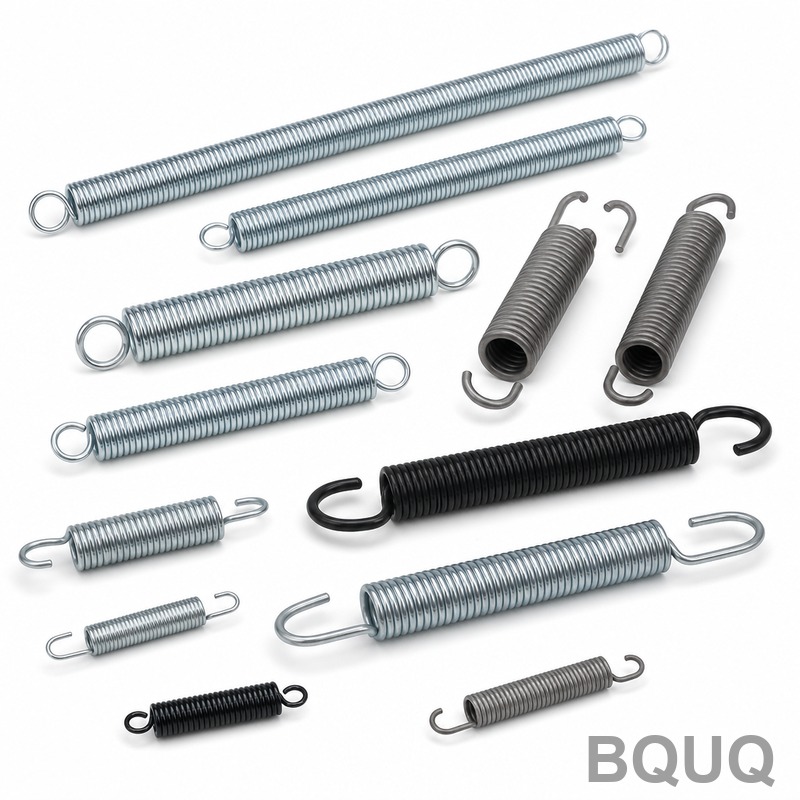
- Radius the hook transitions. Sharp inside radii on extension spring hooks concentrate both stress and corrosion attack.
- Do not mix metals carelessly. A stainless spring in an aluminum housing creates a galvanic couple; aluminum becomes the anode. Insulate or choose compatible materials.
- Allow drainage. Vertical mounting with an open end beats a horizontal pocket that holds water.
- Consider shot peening. Compressive residual stress at the surface delays corrosion fatigue crack initiation and is often cheaper than upgrading the alloy.
- Do not over-specify thickness. Excess coating on close-wound springs can bridge coils or crack at the end coils. Work with your supplier on the real geometry.
For a deeper look at how these choices play out in service, see our breakdown of common spring failure modes and the trade-offs in chrome-silicon spring selection.
Matching Protection to Environment
A practical mapping, assuming a typical industrial duty cycle:
| Environment | Recommended material | Recommended coating | Indicative target |
|---|---|---|---|
| Dry indoor, controlled | Music wire or 302 | Phosphate + oil, or none | Cosmetic protection |
| Indoor, humid or occasional condensation | Chrome-silicon | Zinc + trivalent passivate, 8–12 µm | 96–200 h salt spray |
| Outdoor sheltered | 302/304 | None, or zinc-nickel for carbon steel | 300–720 h |
| Outdoor exposed, industrial atmosphere | 304 or chrome-silicon | Zinc-nickel, 8–12 µm | 720–1,000 h |
| Marine, coastal, de-icing salt | 316 or zinc-nickel on carbon steel | Zinc-nickel or zinc flake | 720–1,000 h+ |
| Chemical / high temperature | 316, 17-7PH, or nickel alloy | Usually uncoated | Application-specific |
When wire diameter is small, corrosion allowance matters even more — see how wire diameter drives spring behavior for the geometry side of the same decision.
What to Put on the Drawing
Ambiguity in the specification is where corrosion failures are born. A complete spring drawing should state:
1. Material grade and tensile range, not just "stainless."
2. Coating type, alloy composition where relevant, and thickness range in µm.
3. Passivation or post-treatment requirement.
4. Salt spray test standard and minimum hours, if the application demands it.
5. Hydrogen embrittlement bake requirement, with temperature and duration.
6. Any cosmetic acceptance criteria — color, coverage, no exposed substrate at ends.
If you are sourcing compression, torsion, or extension springs and want the coating decision made once, correctly, BQUQ can review the drawing and propose the material and finish combination in a single quote. Start from /compression-springs/, /torsion-springs/, or /extension-custom-springs/.
Frequently Asked Questions
Q: Is stainless steel always the best choice for corrosion-resistant springs?
A: No. Stainless removes the coating step but costs more, has a lower modulus, and can be weaker in fatigue than a well-coated chrome-silicon spring. For indoor or mildly humid service, plated chrome-silicon is often cheaper and stronger. Choose stainless when the environment is genuinely aggressive, when coating coverage is unreliable, or when the part must be clean and unplated.
Q: How many hours of salt spray do I actually need?
A: Match the test to the service environment, not to a competitor's datasheet. Dry indoor service may need no salt spray requirement at all. Humid indoor and sheltered outdoor typically call for 96–200 hours. Exposed industrial and automotive underbody applications usually specify 720 hours or more. Over-specifying adds cost without adding real service life.
Q: Can you coat a spring after it is formed, or must the wire be pre-coated?
A: Forming after coating damages the coating at every bend, so the practical sequence is form first, then coat. The exception is pre-coated or painted wire used for largely decorative or lightly stressed springs. For any spring with meaningful stress, specify post-forming coating and confirm that the coater handles the geometry without bridging coils or leaving bare end coils.
Q: Does coating thickness affect spring rate?
A: Only marginally. A 10 µm coating on a 1 mm wire adds roughly 2% to the diameter, which changes rate by a few percent at most. The real risks are mechanical: thick coatings crack at high-flex regions, and excess build-up on close-wound springs can bridge adjacent coils. Keep coating thickness proportionate to wire diameter and flex amplitude.
Q: What causes a plated spring to fail within days of assembly?
A: Delayed brittle fracture within 24–72 hours of loading almost always points to hydrogen embrittlement, not corrosion. It occurs in high-strength steels when hydrogen from pickling or plating is not removed by a post-plating bake. Confirm the bake was performed to specification, or switch to a low-hydrogen process such as mechanical plating or zinc flake.
Related Resources
- About BQUQ and our Dongguan manufacturing footprint: /about/
- Spring products: compression, torsion, and extension springs: /compression-springs/
- Industry trends affecting spring sourcing and lead times: /industry-dynamics/
- Technical articles on spring design and manufacturing: /bquq-blog/
- Frequently asked questions on quoting, MOQ, and tolerances: /faq/
- Case studies from precision component projects: /case/
- Request a quote or send drawings: /contact/
Authored by the BQUQ Engineering Team. BQUQ (Dongguan) runs CNC machining (±0.005 mm), metal stamping, custom springs, and heat sink production in one ISO9001 factory. Source-direct from Dongguan, China — quote in 12 hours: sc@bquq.com | WhatsApp +86 13713157787 | www.bquq.com