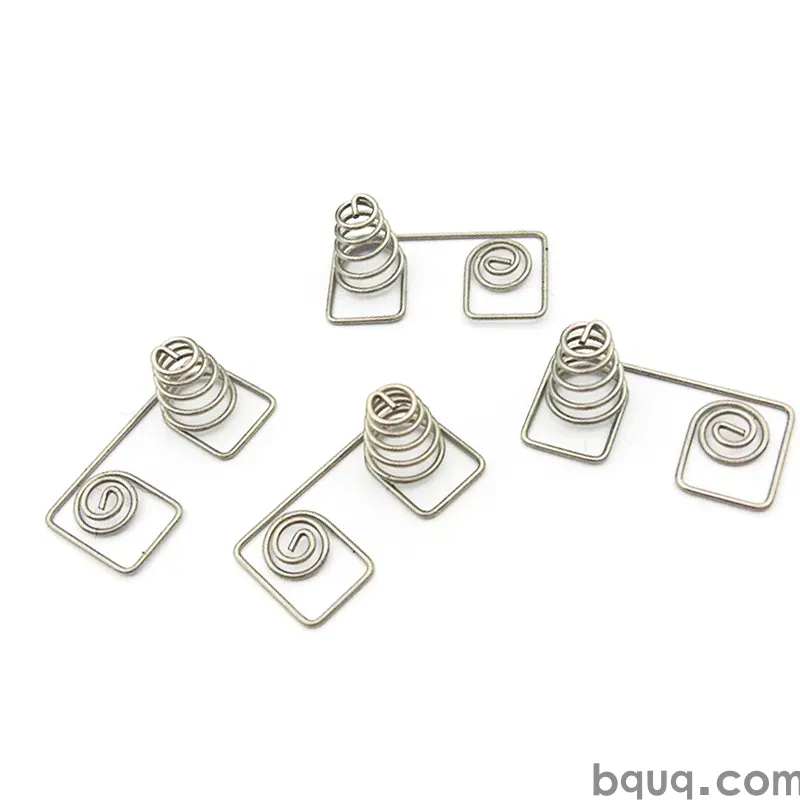
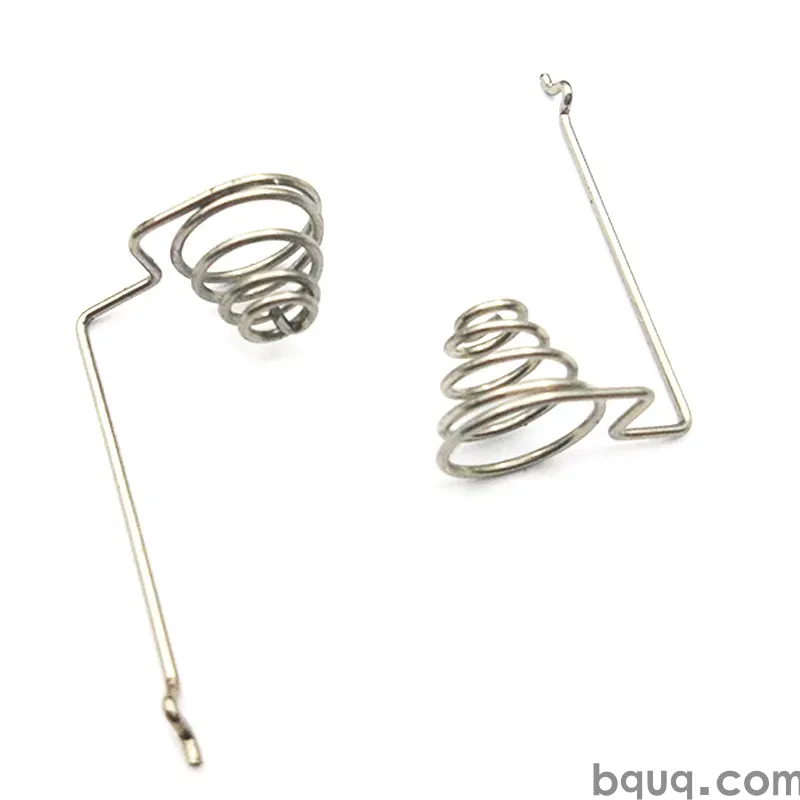
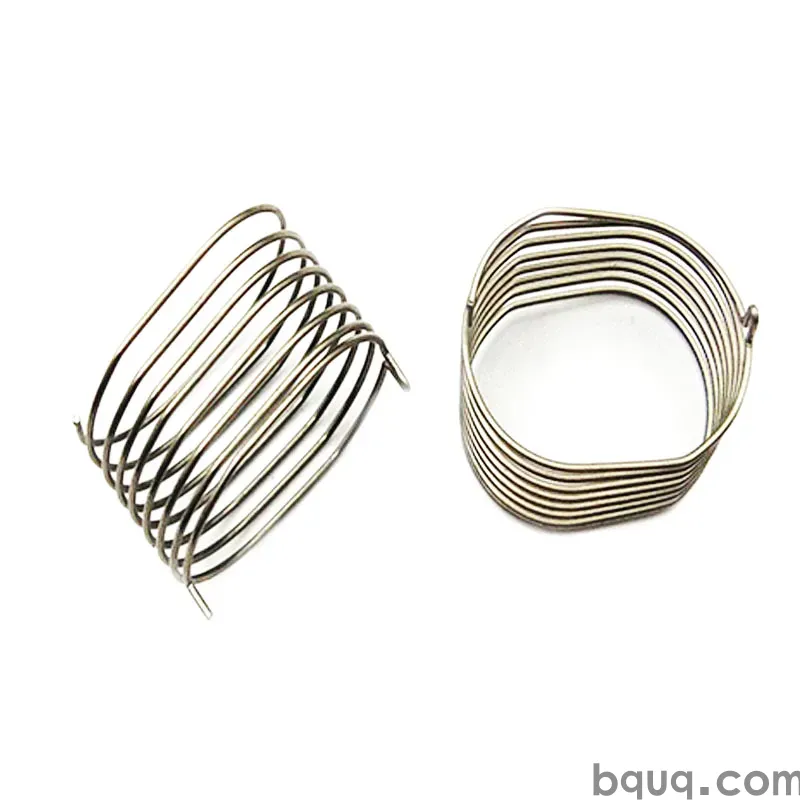
Contact springs: normal force, resistance and plating decide reliability. Alloys and finishes compared. BQUQ (ISO9001) makes them, 12-hour quotes.
Contact Springs for Electronics: Force, Life and Plating That Matter
A contact spring in electronics is judged by three numbers: normal force at the contact point (usually 30–150 gf for signal contacts), contact resistance (milliohms, not ohms), and life (10,000 to 100,000+ cycles). The material — beryllium copper, phosphor bronze or stainless — sets the force you can hold without permanent set, and the plating — gold over nickel for signals, tin for lower-cost power — sets the resistance stability over time.
Engineers spec contact springs as if they were ordinary springs, then wonder why a connector fails in the field. The difference: an ordinary spring only has to push something; a contact spring has to push something while carrying current through the pushing surface, in a humid or corrosive atmosphere, for tens of thousands of insertions. That changes the material, the finish and the failure mode completely. Force, life and plating are not three separate choices — they interact through the contact interface.
Normal Force: The Number Everything Hangs On
Contact resistance is controlled by the real area of metal-to-metal contact, and that area is created by force. Below roughly 20–30 gf of normal force, a contact's resistance becomes unstable — dust, oxide and micro-roughness dominate and the connection flickers. Above roughly 150–200 gf, insertion force multiplies across many contacts and the mating part wears. Designers pick a normal force in the usable band, then verify it holds across the tolerance stack and over life.
| Application | Typical normal force | Typical life target |
|---|---|---|
| Signal contacts, connectors | 30–100 gf | 10,000–50,000 cycles |
| SIM/memory card contacts | 40–80 gf | 5,000–10,000 cycles |
| Power/battery contacts | 150–500 gf | 5,000–20,000 cycles |
| Test sockets, high-cycle | 50–150 gf | 100,000+ cycles |
| Relay / switch contacts | 30–120 gf | 100,000–1,000,000 cycles |
Typical ranges for commercial electronics; automotive and mil-spec parts run higher and longer. Takeaway: pick the force band from the current, the environment and the cycle target, then check that the spring holds it at the extremes of manufacturing tolerance. A contact that delivers 40 gf on paper but 15 gf at the low tolerance corner is an intermittent failure waiting for a field report. Load-test production parts at the working deflection, not just free state.
Materials: Force Retention Is the Real Spec
Contact spring material choice is a fight between conductivity, strength and cost. The material must act as a spring — deliver force without taking a permanent set over life — and as a conductor. Strength and conductivity pull in opposite directions, which is why the industry keeps returning to the same three alloys.
| Material | Conductivity (% IACS) | Yield behavior | Typical use |
|---|---|---|---|
| Beryllium copper C17200 | 20–25% | Highest strength, holds force at high temp | Precision contacts, high-cycle |
| Phosphor bronze C5210 | 15–20% | Good strength, low cost, work-hardens | General connectors, springs |
| Stainless 301 (spring temper) | ~2–3% | Strong, corrosion resistant, low conductivity | Spring arms in corrosive environs |
| Brass (spring temper) | ~25–28% | Weak as a spring, cheap | Low-force terminals only |
| Titanium copper | 15–20% | High strength, better conductivity than BeCu | Higher-temperature power contacts |
Takeaway: beryllium copper is the benchmark because it holds the highest bending stress without set, which means smaller contacts for the same force. Phosphor bronze is the value choice where space allows a bigger section. Stainless is for corrosion, not conductivity — if you choose it, plan a plated current path. At high operating temperature, titanium copper and beryllium copper resist relaxation better than phosphor bronze. If the contact is stamped from strip and formed, the grain direction and bend radius relative to the strip rolling direction decide whether the bend cracks or the force holds — a die design issue, not a chemistry issue.
Plating: Where the Current Actually Flows
Bare metal oxidizes; the plating exists to keep a low-resistance surface. Nickel underplate blocks copper migration and provides a base; the topcoat carries the contact interface. Gold for signal contacts, tin for cost-sensitive power contacts, and the thickness is a life decision as much as a cost decision.
| Plating system | Typical thickness | Best for | Failure mode to watch |
|---|---|---|---|
| Gold flash over nickel | 0.05–0.2 µm Au | Low-cycle, low-cost signal | Porosity → corrosion at thin spots |
| Hard gold over nickel | 0.4–1.5 µm Au | High-cycle sliding contacts | Wear-through at high cycles |
| Selective gold | 0.4–1.5 µm Au, localized | Contacts with gold only where needed | Placement accuracy |
| Tin or tin-lead | 1–5 µm | Power contacts, battery terminals | Fretting corrosion with motion |
| Silver | 1–3 µm | High-current, low-voltage | Tarnish in sulfur atmospheres |
Takeaway: thickness is a life budget. A 0.05 µm flash gold contact may pass electrical test today and corrode through in 6 months of humid storage; hard gold at 0.5–1 µm on the wear track is what carries 10,000+ cycles. Tin contacts are cheap and fine for power, but tin frets — micro-motion grinds oxide and resistance climbs — so tin contacts must not be designed for vibration or thermal cycling motion. Whatever the plating, the base metal finish before plating matters more than the plating itself: a rough, contaminated surface plates porous. A good factory controls the pre-plate surface and tests contact resistance after plating and final forming, because forming after plating can crack the coating at the bend.
Life Testing: What "100,000 Cycles" Means on Paper
Cycle life claims mean nothing without the test conditions: the deflection range (full travel wears fastest), the normal force at test, the mating surface material, and whether the test is dry or with current. A contact tested at 0.3 mm travel may fail at 1 mm. Standard practice is to define life as the cycle count to a defined end point — a resistance threshold (for example doubling of initial resistance, or exceeding 100 mΩ) or a force loss (for example 30% below initial normal force). Ask for the end-point definition when a supplier quotes a cycle number.
The practical verification loop for a new contact spring is: prototype and measure force at working height across tolerance corners, run an insertion or deflection life test to the agreed end point, then check contact resistance and force retention on the survivors. Batch control repeats the force and resistance checks on production parts — the spring testing routine that catches a wire diameter drift before it becomes a field failure.
BQUQ makes contact springs under ISO9001 in Dongguan, with spring coiling alongside metal stamping in the same factory, which keeps force and form consistent whether the contact is coiled or a stamped-and-formed composite spring piece. Coiled contact springs run on the compression spring line; torsion-style arms on the torsion spring line. Send the drawing with the force band, cycle target and plating spec to sc@bquq.com or WhatsApp +86 13713157787 for a quotation within 12 working hours, and ask for the sample life-test report before production.
Email sc@bquq.com or WhatsApp +86 137 1315 7787 with your PDF/DXF/STEP file. An engineer reviews it and replies with price, lead time and DFM notes on working days.
Q: What is the minimum normal force for a reliable contact?
For signal-level dry circuits, keep normal force above 30 gf; below that, dust and oxide films make resistance unstable. Power contacts with higher currents generally need 150 gf or more to hold low and stable resistance under vibration.
Q: Beryllium copper or phosphor bronze for my contact spring?
Use beryllium copper where space is tight, force is high or temperature is elevated — it holds the highest bending stress without permanent set. Use phosphor bronze where cost matters and a larger section is acceptable. Both are industry-standard contact spring alloys.
Q: How thick should gold plating be on a contact spring?
For low-cycle signal use, 0.05–0.2 µm gold flash over nickel is common but porosity-limited; for high-cycle sliding contacts specify 0.4–1.5 µm hard gold on the wear area. Thicker gold buys cycles — match it to the life target, not the budget.
Q: Why does my tin-plated contact fail in a vibrating product?
Fretting corrosion. Micro-motion between tin surfaces grinds the oxide and the contact resistance climbs. Tin needs a stable, non-moving interface; for vibrating or thermally cycling joints, use gold over nickel or design a wiping motion into the contact.
Q: Can BQUQ make a contact spring that is both coiled and plated?
Yes. We coil or stamp the contact, arrange plating to your spec (selective or full, gold, tin, nickel or silver), and load-test the finished part. Because spring and stamping lines share one ISO9001 factory, force, form and finish are controlled in one place.
Authored by the BQUQ Engineering Team. BQUQ is an ISO9001-certified source factory in Dongguan, China, running CNC machining, metal stamping, custom springs, heat sink and collet lines under one roof. Send drawings to sc@bquq.com or WhatsApp +86 13713157787 for a quote within 12 working hours. www.bquq.com