Music wire, stainless 302/304, and beryllium copper C17200 for springs: strength, corrosion, conductivity, temperature, cost, and how to choose.
Spring Materials Compared: Music Wire, Stainless, Beryllium Copper
Short answer: music wire (A228) is the default — strongest for its size and the cheapest, but it rusts, so keep it indoors. Stainless 302/304 costs about 1.5–2× and trades some strength for corrosion resistance and ~250 °C service. Beryllium copper C17200 costs 5–8× but conducts electricity (20–25% IACS versus ~2–3% for stainless) and outlasts both in high-cycle flexing — the right call when the spring is also the electrical path. Rule of thumb: no moisture and no current — music wire; moisture or heat — stainless; current through the spring — beryllium copper.
Ask ten engineers which spring material they use and you will get one answer: whatever they used last time. That habit costs real money in one direction (specifying beryllium copper for a spring that should cost pennies) and real field failures in the other (music wire rusting inside a product that lives in a humid room). The honest selection process has four questions: does it carry current, does it see moisture or chemicals, how hot does it get, and how many cycles must it survive? This guide answers those with the three workhorse spring materials.
What Should You Decide First: Environment, Current, or Cost?
Run the filters in order and the material picks itself. Filter one — current: if the spring is part of the electrical path, like a touch spring or battery contact, conductivity decides and beryllium copper wins before you look at anything else. Filter two — environment: moisture, salt, cleaning chemicals, or outdoor service rules out plain music wire immediately; stainless takes over. Filter three — temperature: above ~120 °C music wire relaxes and loses its load, above ~250 °C stainless 302 creeps, and you are into exotic territory either way. Filter four — cycles and cost: if the answer is still open, price decides between music wire and stainless.
Music Wire (A228): The Default That Corrodes
Music wire is high-carbon spring steel drawn to a mirror finish — the name comes from piano strings, and it is still the strongest spring wire for its diameter that you can buy in volume. Tensile strength runs roughly 1,500–2,600 MPa depending on diameter; the thinner the wire, the stronger it gets, because drawing work-hardens it. That strength lets you pack maximum force into a minimum envelope. Cost is the baseline: call it 1.0×.
The catch is corrosion. Music wire is not stainless — in a humid warehouse, a coastal product, or anything that gets touched by fingerprints and left alone, it rusts. For indoor, dry, protected duty — the spring inside a switch, a mechanism in a consumer gadget, a latch — it is the right answer and nothing else is worth the money. If you need a little corrosion margin, music wire can be zinc or nickel plated, but plating adds cost and a plated spring is still not a stainless spring.
Stainless 302/304: The Corrosion and Temperature Upgrade
Stainless spring wire — usually 302 (A313) or 304 grades — gives up some strength to buy corrosion resistance and temperature headroom. Tensile runs roughly 1,200–2,000 MPa depending on diameter, service temperature stretches to about 250 °C, and the surface shrugs off moisture, mild chemicals, and washdowns. Cost lands around 1.5–2× music wire.
Use stainless when the product lives where it can get wet or hot: outdoor mechanisms, food equipment, medical devices that see autoclaves, marine hardware, springs near motors that run warm. One thing stainless cannot do is conduct — at roughly 2–3% IACS it is essentially an insulator for contact duty, and a stainless touch spring means the current must find another path. Stainless also work-hardens during coiling and needs stress relief after forming; that is factory process detail, but it is why you should not assume stainless springs quote at the same lead time as music wire.
Beryllium Copper (C17200): The Conductive Workhorse
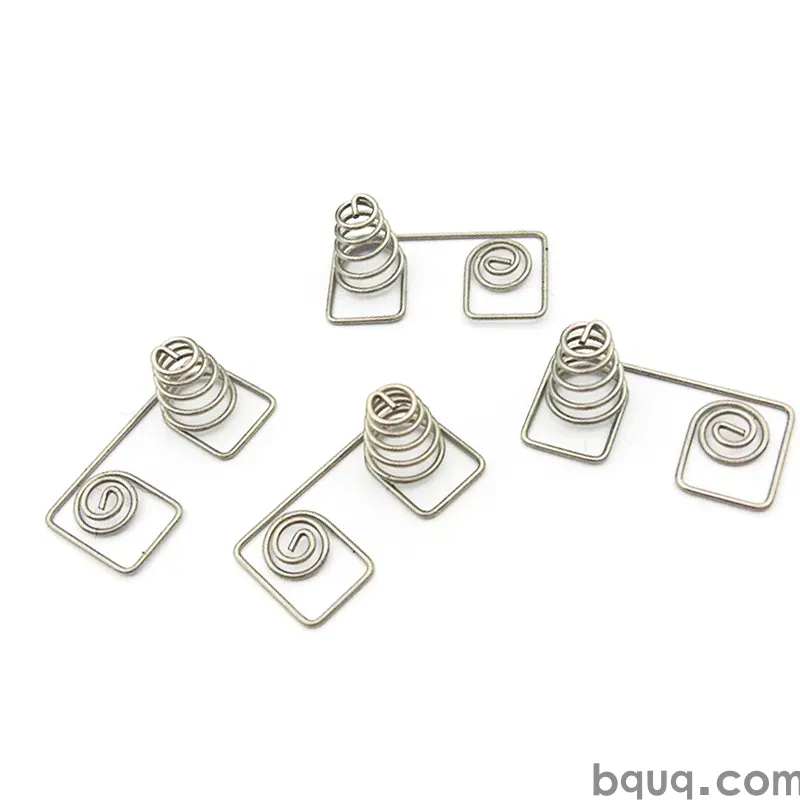
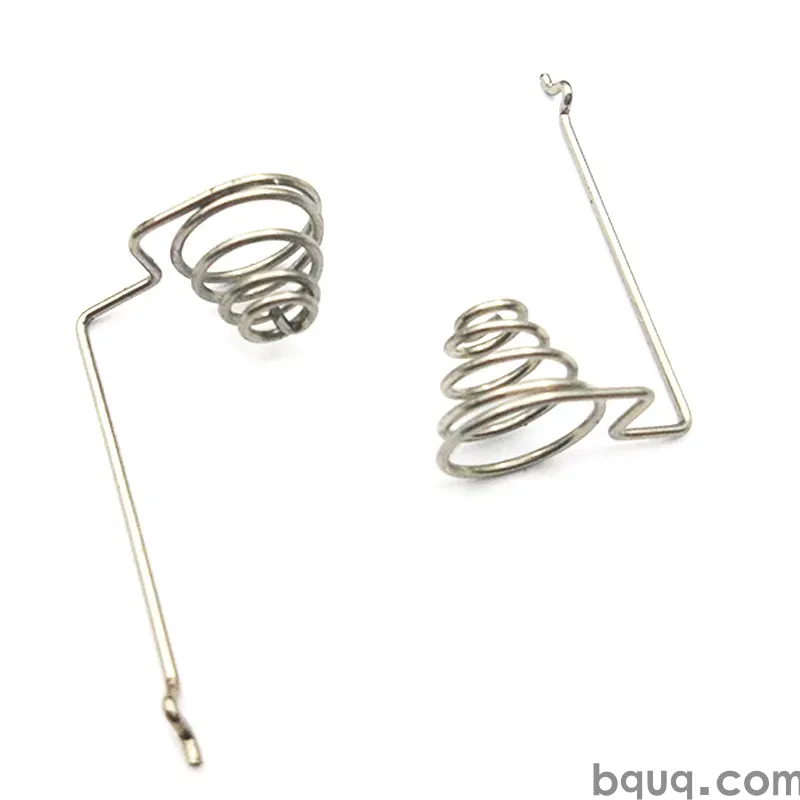
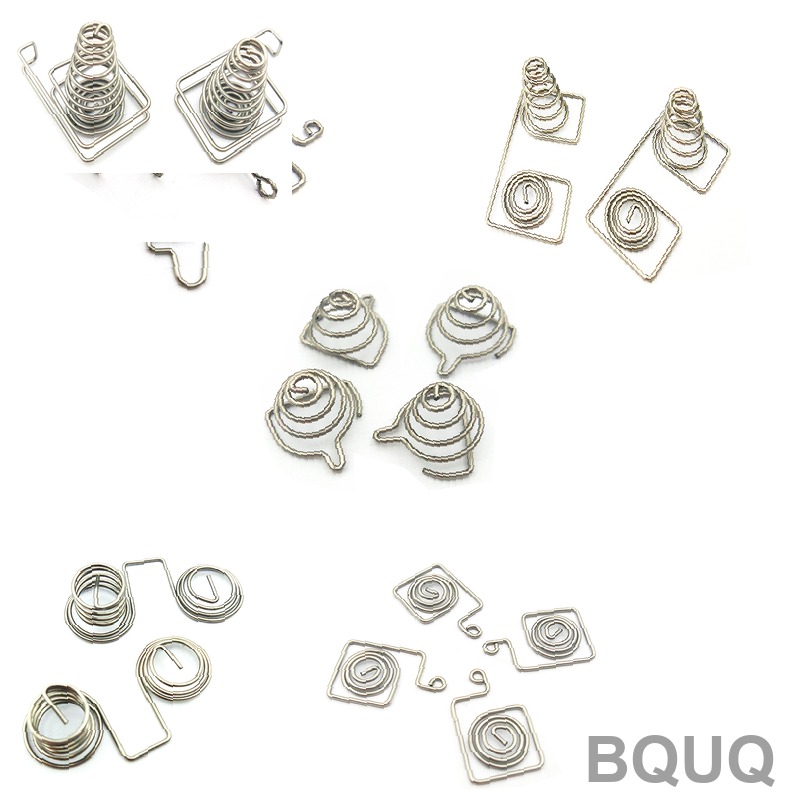
Beryllium copper is the specialty spring material that earns its price. Aged C17200 wire runs roughly 1,200–1,450 MPa tensile, which is lower than music wire but plenty for contact springs, and it brings three things steel cannot: electrical conductivity around 20–25% IACS, outstanding corrosion resistance, and fatigue behavior that keeps flexing for millions of cycles without taking a set. That combination — spring plus conductor plus long life — is why every touch spring, EMI finger contact, and battery spring worth designing uses it. Cost runs 5–8× music wire, which sounds alarming until you remember the part weighs a fraction of a gram.
There are honest limits. Beryllium copper is more expensive in raw material and slower to form; it needs age hardening after forming, and its maximum service temperature sits around 200 °C. For a pure mechanical spring that carries no current, it is over-specified — a music wire or stainless spring will do the job at a fraction of the price. Choose it for function, not fashion.
How Do the Three Materials Compare Head to Head?
| Property (typical values) | Music wire A228 | Stainless 302/304 | Beryllium copper C17200 |
|---|---|---|---|
| Tensile strength | 1,500–2,600 MPa | 1,200–2,000 MPa | 1,200–1,450 MPa |
| Max continuous service temp | ~120 °C | ~250 °C | ~200 °C |
| Corrosion resistance | Poor — rusts | Good | Very good |
| Electrical conductivity | ~7–10% IACS | ~2–3% IACS | 20–25% IACS |
| Fatigue in high-cycle flexing | Good | Good | Excellent |
| Relative material cost | 1.0× | 1.5–2× | 5–8× |
| Best at | Max force, lowest cost | Wet or hot environments | Conducting + flexing |
| Application | Recommended material | Why |
|---|---|---|
| Switch spring, indoor gadget | Music wire | Cheap, strong, dry duty |
| Battery contact spring | Beryllium copper | Conductive, constant force over cell length changes |
| Touch spring / EMI contact | Beryllium copper | Spring and electrical path in one part |
| Outdoor latch or hinge spring | Stainless 302/304 | Corrosion resistance |
| Spring in food/medical washdown | Stainless 302/304 | Cleanability, chemical resistance |
| High-temperature seal spring | Stainless (or 17-7PH above ~250 °C) | Holds load where music wire relaxes |
What Else Should You Know Before Specifying?
Plating changes the rules. A zinc- or nickel-plated music wire spring can handle moderate humidity at a fraction of stainless cost, though plating wears at contact points and adds thickness that shifts the rate slightly. If you plate, tell the factory before they coil — springs are usually coiled oversize and plated to finish, because plating on top of a finished spring distorts the geometry.
Forming and heat treatment are part of the material story. Every spring wire work-hardens as it is coiled, and the factory stress-relieves or age-hardens afterward depending on material: music wire gets a low-temperature bake, stainless gets stress relief, beryllium copper gets a full age-hardening cycle that develops its strength. That is why a BeCu spring is not a "better music wire spring" — it is a different manufacturing process with different tolerances and lead times.
Last habit worth stealing: specify the standard when you order. A228 for music wire, A313 for stainless 302, C17200 for beryllium copper — one line on the drawing kills all ambiguity about what you meant. Then the factory can quote, coil, and test against a known baseline. If you are designing the spring itself, our custom compression spring guide covers the full parameter list, and our spring rate article shows how material choice flows into the stiffness math. Whether the part ends up a compression spring or a torsion spring, we coil both in our Dongguan line, quote in 12 hours on working days, and ship samples by air in 5–7 days.
Email sc@bquq.com or WhatsApp +86 137 1315 7787 with your PDF/DXF/STEP file. An engineer reviews it and replies with price, lead time and DFM notes on working days.
Which spring type fits? (Decision tree)
| If you need... | Choose | Why |
|---|---|---|
| Axial push-back (energy stored in compression) | Compression spring | Most common, easy to spec |
| To resist pulling apart, with preload | Extension spring | Initial tension holds the joint tight |
| Torque or rotational return | Torsion spring | Torque about a leg axis |
| Very limited axial space | Wave or Belleville washer | High force in a short stack |
| Constant force over long travel | Constant-force spring | Flat strip, near-flat load curve |
| Wire under 0.5 mm | Micro spring (check limits) | Handling and tolerance risk rises |
Frequently Asked Questions
What is the best material for a compression spring?
A: Music wire A228 for most indoor mechanical springs — strongest for the size and cheapest. Switch to stainless 302/304 when moisture, chemicals, or heat above ~120 °C are involved, and beryllium copper when the spring carries current.
Which spring material is best for high temperatures?
A: Stainless 302/304 handles about 250 °C continuous, versus ~120 °C for music wire. Above 250 °C you need precipitation-hardening grades like 17-7PH or nickel alloys, which are specialist territory.
Why are touch springs made of beryllium copper?
A: A touch spring is both a spring and the electrical connection. Beryllium copper combines ~20–25% IACS conductivity with high-cycle fatigue life, so one small part delivers contact force and signal or power without a separate conductor.
Is music wire spring good enough, or should I always use stainless?
A: If the product stays dry indoors, music wire is correct and stainless is wasted money. Moisture, washdown, outdoor exposure, or heat above 120 °C pushes you to stainless. Match the material to the environment, not to habit.
How much more expensive is beryllium copper than steel?
A: Raw material runs roughly 5–8 times music wire, but contact springs weigh fractions of a gram, so the per-part difference is often cents. The real cost is justifying it — only pay for conductivity and fatigue you actually need.
Related Articles
- Custom Compression Springs: Design, Materials & Tolerances Explained — What defines a compression spring: the parameters a factory needs to quote, typical materials and tolerances, and ordering custom springs from China.
- Compression Spring Rate: The Formula and How to Use It — The compression spring rate formula k = Gd⁴/(8D³n), explained variable by variable with a worked example, measuring tips, and how to spec rate to a factory.
Data Sources and Verification
Tolerances, cycle times and price ranges in this guide come from BQUQ production records at our Dongguan plant, where CNC machining (±0.005 mm), stamping, custom springs and heat sinks run under one roof. BQUQ is an ISO 9001:2015 certified factory; the certificate and batch inspection reports are available on request with every quotation.
Related Resources
- About BQUQ: an ISO9001-certified source factory in Dongguan running four production lines under one roof.
- Custom spring products: see compression springs, torsion springs, and extension and custom springs we wind in-house.
- Industry trends: manufacturing, material market, and sourcing analysis for buyers.
- Technical articles: engineering guides on CNC, heat sinks, springs, and stamping — more where this one came from.
- FAQ hub: quick answers on CNC, stamping, springs, and heat sinks.
- Case studies: real parts and real numbers from projects we engineered and delivered.
- Contact us: send your drawing and get a quote within 12 working hours.
Authored by the BQUQ Engineering Team. BQUQ (Dongguan) runs CNC machining (±0.005 mm), metal stamping, custom springs, and heat sink production in one ISO9001 factory. Source-direct from Dongguan, China — quote in 12 hours: sc@bquq.com | WhatsApp +86 13713157787 | www.bquq.com