What defines a compression spring: the parameters a factory needs to quote, typical materials and tolerances, and ordering custom springs from China.
Custom Compression Springs: Design, Materials & Tolerances Explained
Short answer: a compression spring is fully defined by wire diameter, coil diameter, free length, active coils, end type, and material — plus the load you need at one or two working heights. Order like that and any real spring maker can quote it blind: rate, stress, solid height, everything else follows from those inputs. Typical load tolerance on a specified working height is ±10% of the stated force. We make custom compression springs — including touch springs and battery springs — in our Dongguan spring line, quote within 12 hours on working days, and take one-piece samples for testing.
A compression spring looks like the simplest machine part ever made — a helix of wire. Then it fails in your product at 50,000 cycles because nobody wrote down the working height or the number of cycles. Springs are small, cheap, and unforgiving. This guide covers the parameters that define one, the materials that suit different jobs, the tolerances you should expect, and how to order custom springs without a 40-email back-and-forth.
What Parameters Define a Compression Spring?
Every compression spring is a trade-off between seven numbers, and you only need to specify a handful for the factory to fill in the rest. The core inputs: wire diameter, mean coil diameter (or outside diameter), free length, number of active coils (or total coils), end type, material, and direction of helix if it matters. From those, the spring maker computes the spring rate, the load at any compressed height, the stress at solid height, and the natural frequency.
In practice, customers specify it two ways. Mechanical engineers send a drawing with every dimension. Product teams usually send the functional requirements: "needs to push a battery contact with 150 g force at 2 mm compression, fits in a 6 mm bore, lasts 100,000 presses." Both work. The factory's job is translating the second into the first.
| Design input | Typical value or example | Notes |
|---|---|---|
| Wire diameter | 0.2–8 mm typical range | Drives rate to the 4th power |
| Outside or mean coil diameter | 5 mm OD | Must clear the bore it sits in |
| Free length | 12 mm | Length with no load |
| Solid height | ~4 mm | Fully compressed — check your clearance! |
| Working heights | 9 mm / 6 mm | Where the loads are measured |
| Loads at working heights | 2.5 N / 6 N | The functional spec |
| End type | Closed and ground | Changes effective coils |
| Material | Music wire / stainless / BeCu | Environment decides |
| Required cycles | 100,000 | Decides stress level and presetting |
What Materials Should a Custom Compression Spring Use?
Material is the first decision because it sets what the spring can do. Music wire (A228) is the default: highest strength for its diameter, cheap, and fine indoors — but it rusts. Stainless 302/304 trades a bit of strength for corrosion resistance. Beryllium copper (C17200) brings conductivity and outstanding fatigue life, at several times the cost, for electrical contact duty.
| Material | Typical wire range | Typical max service temp | Corrosion | Relative cost | Typical use |
|---|---|---|---|---|---|
| Music wire A228 | 0.1–6 mm | ~120 °C | Poor — rusts | 1.0× | General springs, indoor products |
| Hard-drawn carbon steel | 0.5–10 mm | ~120 °C | Poor | 0.8× | Large springs, low cost |
| Stainless 302/304 | 0.1–8 mm | ~250 °C | Good | 1.5–2× | Outdoor, food, medical, washdown |
| Beryllium copper C17200 | 0.05–3 mm | ~200 °C | Very good | 5–8× | Touch springs, conductive contacts |
Service temperature and environment narrow the list fast. Above roughly 120 °C, music wire relaxes and loses load; above 250 °C even stainless 302 creeps, and you are into 17-7PH or nickel alloy territory. If the spring carries electrical current — a touch spring, a battery contact — conductivity decides: beryllium copper wins. The full comparison with strength and conductivity numbers is in our spring material selection guide.
What Tolerances Should You Expect on Springs?
Springs are not machined parts; they are formed from wire that has its own diameter tolerance, then coiled and heat-treated. Expect proportional tolerances, not the microns you get from CNC. As a typical industry baseline: ±10% on load at a specified working height is standard and repeatable; free length tolerance runs around ±1–2% or a few tenths of a millimeter, whichever governs; coil diameter can be held tight because it is set by the tooling.
| Spring characteristic | Typical tolerance | How it is controlled |
|---|---|---|
| Load at specified height | ±10% | Wire diameter selection, coiling setup |
| Spring rate | ±10% | Wire diameter and coil count |
| Free length | ±1–2% or ±0.3 mm | Coiling pitch, end grinding |
| Outside/inside diameter | ±0.1–0.3 mm typical | Mandrel and feed control |
| Squareness | ~2° max typical | End grinding setup |
The load tolerance is the one to design around. If your mechanism can accept a 10% force spread, you will pay standard prices. If you need ±5%, the factory sorts springs individually — possible, but you pay for the sorting. If your product cannot tolerate 10% variation, the problem is usually the design, not the spring: allow an adjuster, a longer travel, or a softer rate so the force window fits a normal manufacturing spread.
How Do Ends, Fatigue, and Presetting Change the Spring?
Ends matter more than most drawings acknowledge. A closed and ground end sits flat, stands square, and gives the spring a stable solid height — that is why precision springs specify it. Open ends cost less but the spring may rock or buckle under load, and the effective number of coils shifts. End type changes the rate slightly because not all coils deflect equally, which is why the spring maker needs the end type before computing load, not after.
Fatigue is where springs quietly die. A spring compressed to 50% of its maximum stress range can run millions of cycles; push it near solid and it settles or fractures quickly. If your application cycles a lot — a switch, a latch, a pump — tell the factory the cycle count and the working stroke. Options that extend life: preset (compress to solid once so the spring takes its permanent set during manufacturing, not in your product), shot peening for high-cycle duty, and keeping working stress below roughly 45% of the tensile strength for infinite-life designs. Residual stress from a sharp internal corner at a tight coil bend is usually what starts the crack.
What Applications Use Custom Compression Springs?
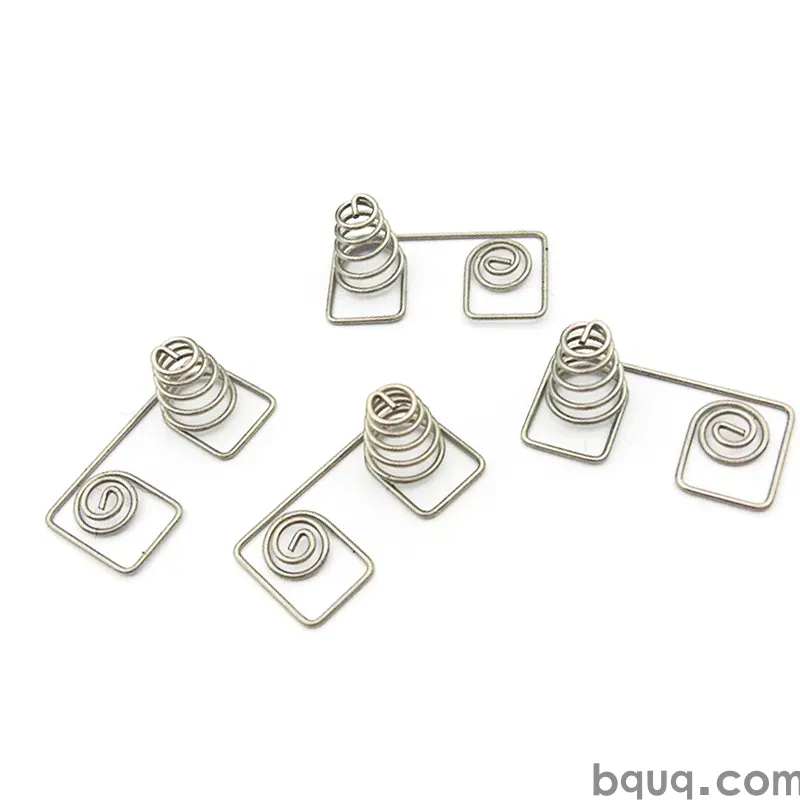
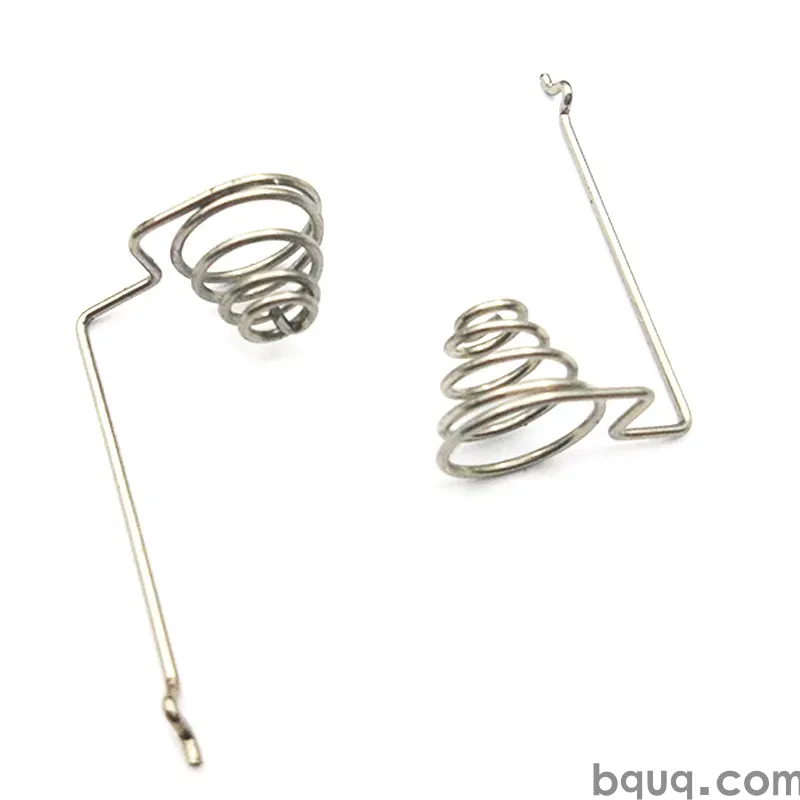
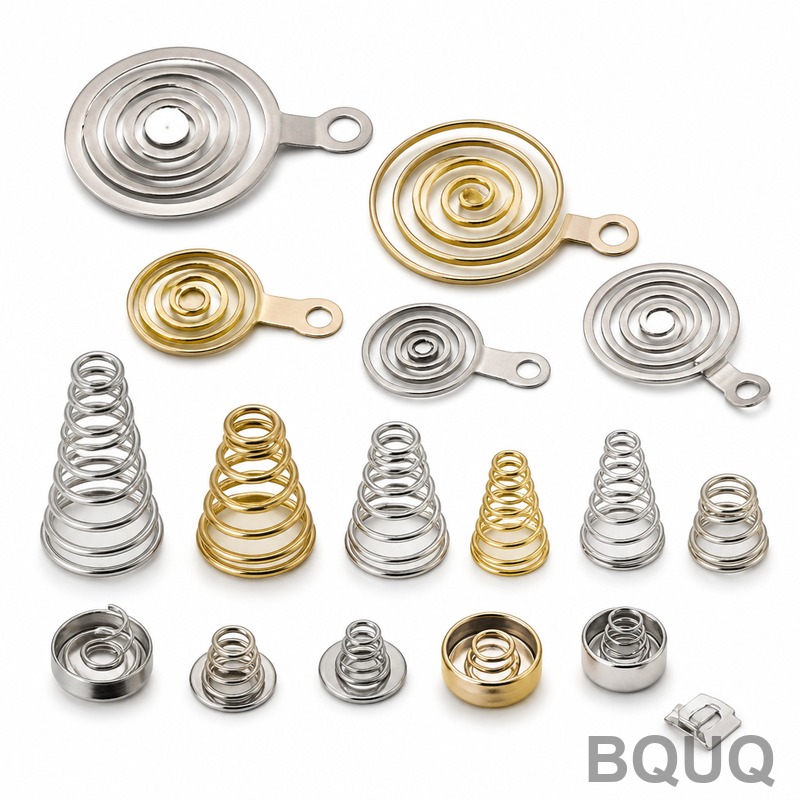
The quiet majority of custom springs do contact duty in electronics. Touch springs — small conductive compression springs that connect a button or a shield can to a PCB — are usually beryllium copper or stainless, sized 0.5–3 mm OD, and they double as the electrical path, which is why conductivity and contact force both matter. Battery springs hold cells against terminals and must deliver steady force as the battery length changes with temperature. Beyond electronics: valve springs in miniature pneumatics, latch return springs in mechanisms, probe springs in test fixtures, and the spring inside every push-button switch you have ever pressed. Our compression springs line builds them from one-off samples to millions of pieces, and when a job needs a torsion spring or a custom extension spring instead, we make those in the same plant too.
How Does Ordering a Custom Compression Spring Work?
The flow is short because the part is small. Send the spec — drawing, sketch, or a list of the parameters above, whichever you have. Engineering checks it, confirms the material and any missing numbers, and you get a quotation within 12 hours on working days. Sample springs follow quickly — one piece or a hundred, whatever you need to test — and only after you approve samples does production run. MOQ is flexible by design; the setup is the same for 100 pieces as for 100,000, so small first orders are normal. Air freight for samples runs 5–7 days from Shenzhen or Dongguan, sea freight 25–40 days for production. If you are unsure how to compute the rate your design needs, our spring rate formula guide walks through it with a worked example before you ever write to us.
Email sc@bquq.com or WhatsApp +86 137 1315 7787 with your PDF/DXF/STEP file. An engineer reviews it and replies with price, lead time and DFM notes on working days.
Which spring type fits? (Decision tree)
| If you need... | Choose | Why |
|---|---|---|
| Axial push-back (energy stored in compression) | Compression spring | Most common, easy to spec |
| To resist pulling apart, with preload | Extension spring | Initial tension holds the joint tight |
| Torque or rotational return | Torsion spring | Torque about a leg axis |
| Very limited axial space | Wave or Belleville washer | High force in a short stack |
| Constant force over long travel | Constant-force spring | Flat strip, near-flat load curve |
| Wire under 0.5 mm | Micro spring (check limits) | Handling and tolerance risk rises |
Frequently Asked Questions
What information do I need to order custom compression springs?
A: Wire diameter, coil outside or inside diameter, free length, and the load at one or two working heights. Add material, end type, and cycle requirement. Send whatever you have — a drawing, a sketch, or a spec list — and we will ask for what is missing.
What is the minimum order quantity for custom springs?
A: Flexible. Spring tooling is minimal for round wire — the coiling machine is set up per order — so one-piece samples for testing are normal, and production quantities can scale to millions.
How accurate are compression spring loads?
A: Typically ±10% of the stated load at a specified height, which is the industry standard. Tighter force windows require individual sorting and cost more. Design your mechanism for a 10% spread and you will never fight spring tolerance again.
Which material is best for a conductive touch spring?
A: Beryllium copper C17200. It conducts well, survives millions of cycles, and keeps its force at operating temperature. Stainless 302 works when conductivity is not needed and cost matters more.
How fast can I get custom springs from China?
A: Quotes return within 12 hours on working days. Samples go by air in about 5–7 days. Production batches ship by sea in 25–40 days or by air if your schedule demands it.
Related Articles
- Compression Spring Rate: The Formula and How to Use It — The compression spring rate formula k = Gd⁴/(8D³n), explained variable by variable with a worked example, measuring tips, and how to spec rate to a factory.
- Spring Materials Compared: Music Wire, Stainless, Beryllium Copper — Music wire, stainless 302/304, and beryllium copper C17200 for springs: strength, corrosion, conductivity, temperature, cost, and how to choose.
Data Sources and Verification
Tolerances, cycle times and price ranges in this guide come from BQUQ production records at our Dongguan plant, where CNC machining (±0.005 mm), stamping, custom springs and heat sinks run under one roof. BQUQ is an ISO 9001:2015 certified factory; the certificate and batch inspection reports are available on request with every quotation.
Related Resources
- About BQUQ: an ISO9001-certified source factory in Dongguan running four production lines under one roof.
- Custom spring products: see compression springs, torsion springs, and extension and custom springs we wind in-house.
- Industry trends: manufacturing, material market, and sourcing analysis for buyers.
- Technical articles: engineering guides on CNC, heat sinks, springs, and stamping — more where this one came from.
- FAQ hub: quick answers on CNC, stamping, springs, and heat sinks.
- Case studies: real parts and real numbers from projects we engineered and delivered.
- Contact us: send your drawing and get a quote within 12 working hours.
Authored by the BQUQ Engineering Team. BQUQ (Dongguan) runs CNC machining (±0.005 mm), metal stamping, custom springs, and heat sink production in one ISO9001 factory. Source-direct from Dongguan, China — quote in 12 hours: sc@bquq.com | WhatsApp +86 13713157787 | www.bquq.com