Torsion spring design explained: torque, legs, materials and configurations. BQUQ, a Dongguan spring factory, quotes custom torsion springs in 12 hours.
Torsion Springs: Design Parameters, Materials and Common Configurations
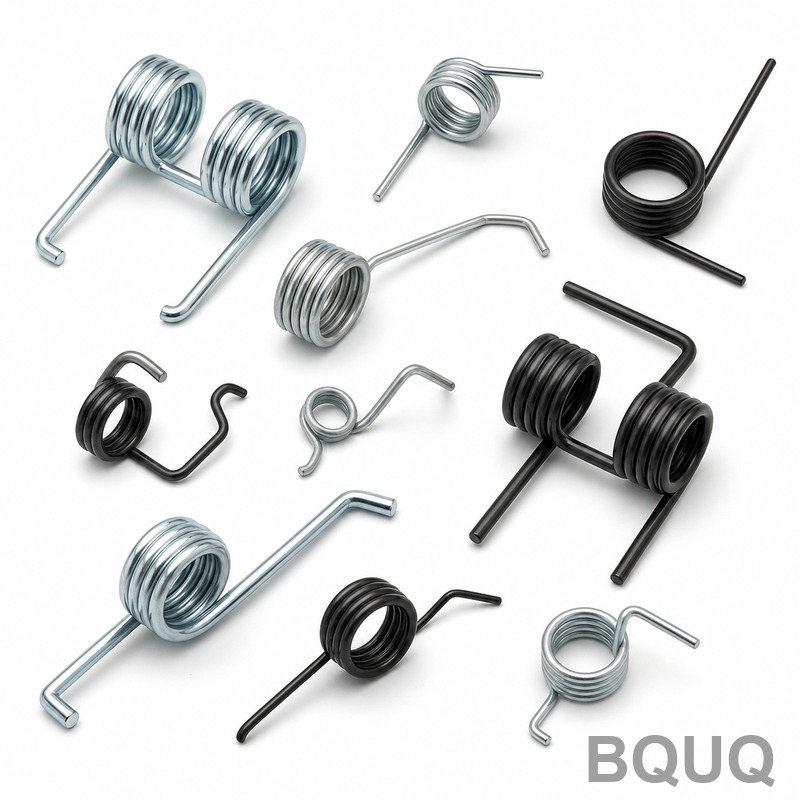
A torsion spring stores energy by twisting: the legs take the load and the coiled body bends, which is why the wire is stressed in bending rather than in torsion despite the name. Define one with four core numbers — wire diameter, body diameter, number of coils and leg geometry — plus the torque you need at a specific angle, and a spring shop can do the rest. Most field failures trace back to leg bending stress, coil interference at full deflection, or a missing clearance around the body, not to the basic coil math.
A torsion spring looks like a compression spring with arms sticking out, but the job is completely different. It rotates around its axis, pushes a latch back, closes a door, returns a lever, or lifts a printer tray. Because it works in rotation, the specification language changes: torque in N·mm or N·m instead of load in N, deflection in degrees instead of height in mm. This guide walks through how the spring actually works, the parameters that define it, materials that suit different jobs, and the common body and leg configurations you will meet on real drawings.
How a Torsion Spring Works: Torque, Angle and Lever Arm
The spring sits on a shaft or in a bore and the legs hook onto the moving part and the fixed part. When the mechanism rotates, one leg moves relative to the other and the coil body twists. The wire itself sees bending stress around the helix, so the governing material property is the elastic modulus in bending, E, not the shear modulus G that rules compression springs.
Two relationships matter every day. First, torque equals force times lever arm: if a leg is loaded with 5 N at a point 20 mm from the body centerline, the spring sees roughly 100 N·mm. Second, torque is proportional to deflection: double the winding angle and you double the torque, up to the elastic limit. The stiffness, called the spring rate, is usually quoted per degree or per radian of twist.
The rate scales hard with wire diameter — proportional to d to the fourth power — so a 10% thicker wire makes the spring roughly 46% stiffer, while adding coils or enlarging the body diameter softens it. That fourth-power sensitivity is why small design changes on paper become large changes on the load tester, and why prototypes are worth the few days they take.
| Design parameter | Typical range | What it controls |
|---|---|---|
| Wire diameter | 0.2–8 mm | Rate (d⁴), max torque, cost |
| Body OD / ID | 3–60 mm OD typical | Clearance on shaft or bore |
| Number of coils | 3–20 active | Rate, free angle stability |
| Torque at angle | Any, e.g. 80 N·mm at 90° | The functional spec |
| Max deflection | 30–270° typical | Stress and coil interference |
| Leg style | Straight, hinged, short hook | Mounting and load application |
| Wind direction | Right or left hand | Mandatory for double springs |
So a usable order can be one line: "right-hand torsion spring, 1.0 mm music wire, 8 mm ID, 6 coils, 40 N·mm at 90°, legs 15 mm long with straight ends." Everything else — body length, solid angle, stress — follows from those inputs.
Materials That Make Sense for Torsion Springs
Because the wire bends rather than twists, torsion springs can run closer to the material's bending endurance than a compression spring can to its shear limit, but material choice is driven by the same three questions: temperature, corrosion, and whether the spring carries current.
| Material | Max service temp | Corrosion resistance | Relative cost | Typical torsion spring use |
|---|---|---|---|---|
| Music wire A228 | ~120 °C | Poor — rusts | 1.0× | Indoor mechanisms, cheapest strength |
| Hard-drawn carbon steel | ~120 °C | Poor | 0.8× | Large torsion springs, low cost |
| Stainless 302 | ~250 °C | Good | 1.5–2× | Outdoor, food, washdown, medical |
| 17-7PH stainless | ~320 °C | Good | 3–4× | Elevated temperature and fatigue |
| Phosphor bronze | ~100 °C | Very good | 4–6× | Marine, non-magnetic, conductive |
| Beryllium copper C17200 | ~200 °C | Very good | 5–8× | Conductive contacts, long fatigue life |
Music wire is the default for indoor torsion springs such as hinge return springs and clothespin springs: highest strength per unit cost. Switch to stainless 302 the moment moisture, cleaning chemicals or outdoor exposure appear, and note that 302 keeps useful strength to roughly 250 °C while music wire relaxes above about 120 °C. For a spring that must also pass current or sit in salt air, beryllium copper and phosphor bronze take over. The strength, temperature and conductivity trade-offs across all spring grades are laid out in our spring material selection guide. As a design rule of thumb, for static service many torsion springs are run at up to 70–80% of minimum tensile stress at the inner coil fiber, but any cyclic duty pulls that number down sharply — details in the spring fatigue design guide.
Common Configurations: Single, Double and Special Bodies
Most torsion springs are single-body and close-wound — coils touching at zero load — which gives a compact, stable package. Open-wound bodies suit applications where coil friction at low angles matters or where the spring must be deflected past 360° in some indexing designs. Double torsion springs join two bodies with a center leg so that torque applies symmetrically on both sides of the pivot; they are common in mechanisms where space allows only one spring but the load must stay balanced, such as hatch and door counterbalance systems.
| Configuration | Typical use | Notes |
|---|---|---|
| Single body, close-wound | Door closers, levers, latch returns | Compact, most common |
| Single body, open-wound | Lower-friction mechanisms | Coils spaced at free state |
| Double torsion | Balanced pivots, hatches | Two bodies, one center leg |
| Tandem / multi-start | Wide torque at limited length | Coils in parallel share load |
| Special legs | Clip-in, hinged or crossover legs | Leg forming adds tooling cost |
Legs deserve as much attention as the body because load enters through them. Straight torsion legs are cheapest and fine when the anchor point is fixed; hinged ends reduce fretting where the leg rubs a moving part; a crossover leg can position the load line through the body axis. Whatever the style, a torsion spring's body diameter changes as it deflects — the coils can tighten or loosen by a few percent of OD depending on wind direction and leg travel — so leave radial clearance to the shaft or bore, typically 5–10% of body OD, and check the solid condition at maximum angle. Our custom torsion springs run in the same Dongguan spring line as our compression springs and extension springs, so mixed spring assemblies quote as one order.
What to Send a Factory for a Torsion Spring Quote
A drawing with body OD or ID, wire size, coil count, free leg position and leg lengths is ideal. If you only have the mechanism, send the essentials: torque at one or two working angles, the space envelope (shaft diameter and available axial length), rotation direction of the moving leg, how many cycles it must survive, and the environment. With torque, angle and envelope, an engineer will back-calculate the wire and coils, then verify stress and clearance. BQUQ, an ISO9001-certified factory in Dongguan running spring, stamping, CNC and heat sink lines, returns torsion spring quotations within 12 working hours — send drawings or sketches to sc@bquq.com or WhatsApp +86 13713157787.
Email sc@bquq.com or WhatsApp +86 137 1315 7787 with your PDF/DXF/STEP file. An engineer reviews it and replies with price, lead time and DFM notes on working days.
Frequently Asked Questions
Q: What is the difference between a torsion spring and a torsion bar?
A: A torsion spring is a coiled wire helix stressed in bending, compact and light for low-to-moderate torque. A torsion bar is a straight bar stressed in true torsion, used for very high torque like vehicle anti-roll bars. They share a name, not a stress mode.
Q: Which material should I pick for an outdoor torsion spring?
A: Stainless 302 is the usual answer: it holds strength to about 250 °C and resists rain, humidity and washdown chemicals. Music wire rusts outdoors. For salt-air or conductive duty, move to beryllium copper or phosphor bronze.
Q: Why do torsion springs fail at the leg instead of the coil?
A: Bending stress concentrates where the leg leaves the body, and any sharp bend acts as a notch. Radius the leg bends generously and avoid cold-straightening the wire at the transition. Under cyclic load, consider shot peening the body and legs.
Q: How is torque measured on a torsion spring?
A: One leg is clamped and the other deflected by a known angle, typically on a torque tester reading N·mm per degree. Torque tolerance on a specified angle is typically ±10% at a spring shop, matching common compression spring load tolerances.
Q: What lead time should I expect for custom torsion springs?
A: Simple torsion spring samples typically take 3–7 working days and production 10–20 working days at a spring factory, depending on wire size and quantity. BQUQ quotes within 12 working hours, and one-piece samples are accepted for testing.
Related Articles
- compression-spring-rate-formula — More from the BQUQ Custom Springs engineering series.
- compression-spring-buckling-guide — More from the BQUQ Custom Springs engineering series.
- hot-wound-vs-cold-wound-springs — More from the BQUQ Custom Springs engineering series.
Data Sources and Verification
Tolerances, cycle times and price ranges in this guide come from BQUQ production records at our Dongguan plant, where CNC machining (±0.005 mm), stamping, custom springs and heat sinks run under one roof. BQUQ is an ISO 9001:2015 certified factory; the certificate and batch inspection reports are available on request with every quotation.
Related Resources
- About BQUQ: an ISO9001-certified source factory in Dongguan running four production lines under one roof.
- Custom springs: compression, torsion and extension from the spring line — compression springs, torsion springs, extension and custom springs.
- Industry trends: manufacturing, material market, and sourcing analysis for buyers.
- Technical articles: engineering guides and process comparisons — more where this article came from.
- FAQ hub: quick answers on CNC, stamping, springs, and heat sinks.
- Case studies: real parts and real numbers from projects we engineered and delivered.
- Contact us: send your drawing and get a quote within 12 working hours.
Authored by the BQUQ Engineering Team. BQUQ is an ISO9001-certified source factory in Dongguan, China, running CNC machining, metal stamping, custom springs and heat sink lines under one roof. Send drawings to sc@bquq.com or WhatsApp +86 13713157787 for a quote within 12 working hours. www.bquq.com