Why compression springs bow sideways, slenderness limits and how to prevent buckling. BQUQ, a Dongguan spring factory, quotes stable custom springs.
Compression Spring Buckling: When Long Springs Go Sideways
A compression spring buckles — bows sideways and rubs against its bore or guide — when it is too long and slender for the deflection it must make. Two numbers decide it: the slenderness ratio, free length divided by mean coil diameter (L0/D), and the deflection as a fraction of free length. Keep L0/D below about 4 for a free-standing spring deflecting more than 40%, or guide the spring with a rod or sleeve, and the sideways failure mode disappears from your design.
Buckling is the failure mode engineers forget because it is invisible on the drawing: the spring looks fine in CAD, then in the product it leans against the pocket wall, wears a bright spot on the coils, loses load, and eventually breaks or scores the housing. A compression spring is a slender column, and like any column it bows sideways under load once its length-to-diameter ratio gets large relative to the compression it undergoes. The good news is that the rules are simple enough to apply before you ever order a spring, and the fix is usually free: shorten it, fatten it, or guide it.
Why Springs Buckle: The Slenderness Rule
The stability of a compression spring depends on the same physics as a column. The governing ratio is slenderness: free length divided by mean coil diameter. A short squat spring — L0/D around 2–3 — is stable even at large deflections. A long skinny spring, L0/D of 6 or more, will bow sideways at surprisingly small deflections, especially if its ends are free to tilt.
| Free length / mean dia (L0/D) | Typical behavior | Comment |
|---|---|---|
| Under 2.5 | Stable at almost any deflection | Rarely a concern |
| 2.5–4 | Stable to moderate deflection | Check above ~40% deflection |
| 4–6 | Buckles easily at high deflection | Guide or redesign |
| Above 6 | Unstable at modest deflection | Must use rod or sleeve |
End conditions matter as much as proportions. A spring sitting between flat parallel plates with closed and ground ends behaves like a column with reasonably restrained ends and can take more deflection before buckling. A spring with plain, unground ends that tilt when loaded behaves closer to a pinned column and buckles sooner. That is why the same spring can be stable in one assembly and unstable in another — the seat geometry is part of the spring design, and the spring end types guide explains how end treatment changes effective behavior.
Critical Deflection: How Much Is Too Much?
Buckling does not appear at a fixed deflection for all springs — it appears when the deflection exceeds a critical value that depends on slenderness and end conditions. As a working approximation used across spring design texts, the critical deflection of a spring with reasonably flat ends is roughly 40–50% of free length when L0/D is near 4, and it falls steeply as the spring gets more slender. For a spring with L0/D of 6, the critical deflection drops toward roughly 25% of free length, meaning a spring that deflects 30% of its length is already unstable.
| L0/D | Approx. max safe deflection (% of L0) | Result if exceeded |
|---|---|---|
| 3 | 50% or more | Bows slightly, may self-correct |
| 4 | ~40% | Lean against bore, load loss |
| 5 | ~30% | Clear buckling, wear marks |
| 6+ | ~20–25% | Immediate sideways jump |
These figures are typical engineering guidance for flat-ended springs; a specific spring on specific seats should be verified by testing. If the math says your spring sits near the edge, remember that rate and load also change with geometry — a fatter spring at the same load usually needs a different wire or coil count to keep the force target, and the compression spring rate formula guide shows how those numbers interact.
How to Prevent Buckling: Three Working Fixes
Fix one: lower the slenderness. Increase the mean coil diameter, reduce the free length by adding preload with a spacer or seat, or stack two shorter springs in series — two springs half the length each is a classic way to keep travel while staying stable. Fix two: guide the spring. Run it over a rod or inside a sleeve with a small clearance — typically 1–3 mm radial clearance on a compression spring in a bore, less for a rod guide — so even if it wants to bow it cannot go anywhere. A guided spring can be much slimmer and longer than a free-standing one. Fix three: improve the end seating. Closed and ground ends on flat, parallel seats add stability, and a shallow counterbore that captures the end coil keeps the spring vertical through its stroke.
When guiding, watch two details. The rod or bore surface must be smooth and, ideally, lubricated, because a bowing spring under load presses hard on the guide and frets both parts. And the guide must extend over the full compressed length — a spring that bows above the guide top is still a spring that bows. Spring guides are often machined parts or plastic bosses; if the housing is stamped sheet metal, the pocket depth and parallelism need the same attention as the spring itself, and a spring shop can advise on the practical clearance for your wire size.
When Buckling Is Actually Acceptable
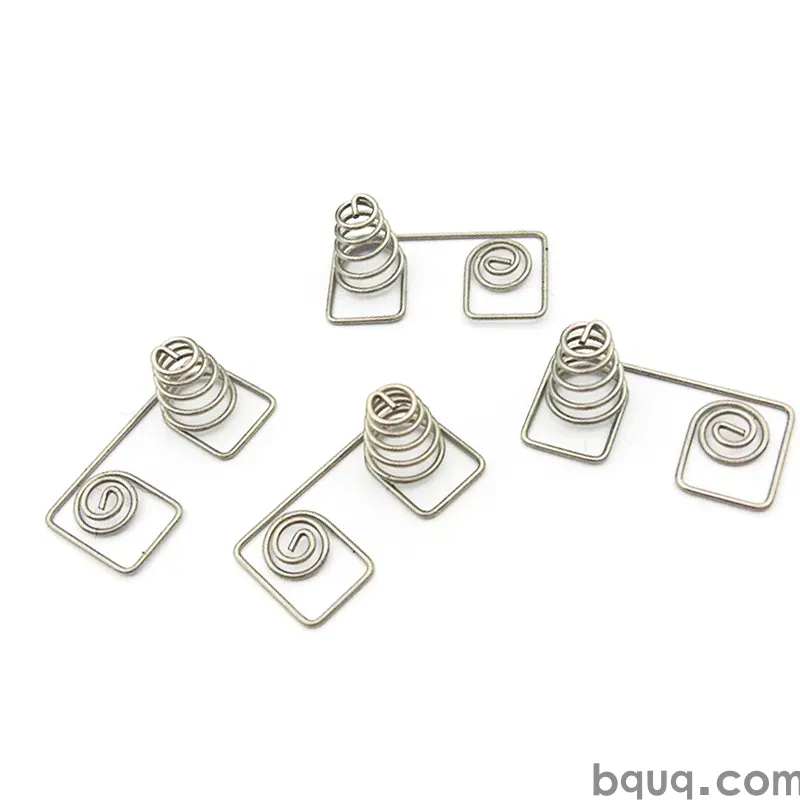
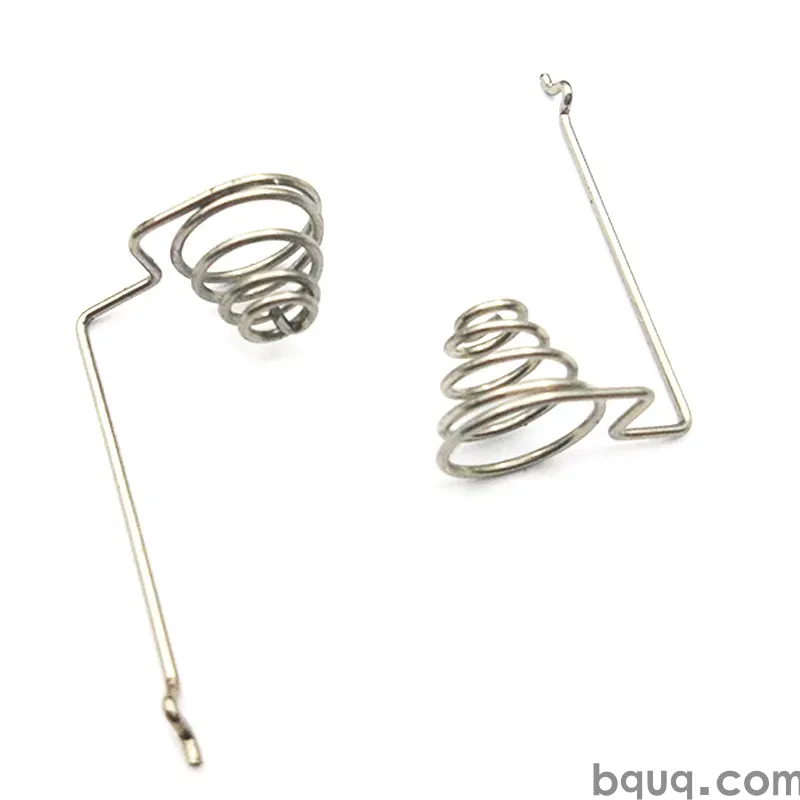
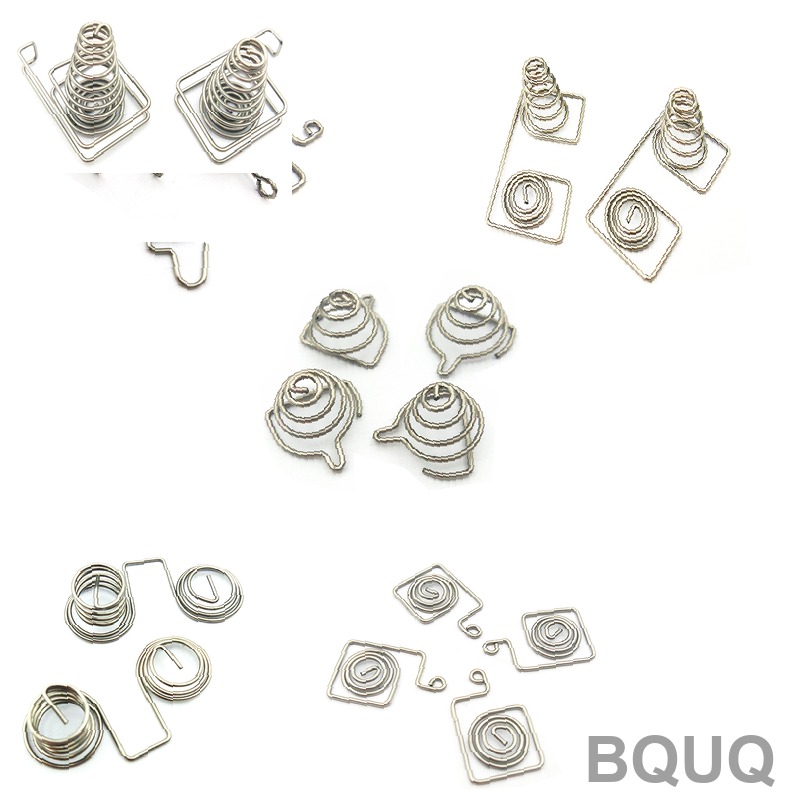
Not every bowed spring is a failure. Deliberate lateral deflection is used in some designs — springs that must press sideways against a contact or a detent rely on controlled bowing. The difference between a designed bow and a buckling failure is control: a designed bow has a defined pocket that catches the spring at a predictable position and load, and the spring is tested in that condition. If you are relying on the bow, specify the working height where the spring contacts the wall, the side force required, and test the assembly, not just the bare spring. Our custom compression springs — including touch and battery contact springs that often work in a deliberately deflected state — are made and tested on the Dongguan spring line alongside extension springs and the wider spring product range, with ISO9001 process control and 12-hour quoting. Send the assembly drawing, not just the spring print, and the engineer will flag a stability problem before it becomes a tooling problem: sc@bquq.com or WhatsApp +86 13713157787.
Email sc@bquq.com or WhatsApp +86 137 1315 7787 with your PDF/DXF/STEP file. An engineer reviews it and replies with price, lead time and DFM notes on working days.
Frequently Asked Questions
Q: How do I know if my compression spring will buckle?
A: Divide free length by mean coil diameter. If the ratio is above roughly 4 and the spring deflects more than 30–40% of its free length, it will likely bow sideways. Guide it or increase the diameter.
Q: Do closed and ground ends help prevent buckling?
A: Yes. Ground, flat ends seated on parallel surfaces keep the spring column straight longer than plain ends, which tilt as they load. End treatment shifts the effective end condition toward the stable side.
Q: What clearance should a spring have in its bore?
A: Typically 1–3 mm radial clearance for a guided compression spring, more for large diameters. Too little clearance binds; too much lets the spring bow and fret. Surface finish and lubrication on the guide matter as much as the gap.
Q: Can I replace one long spring with two shorter ones?
A: Yes, and it is the standard fix for buckling. Two springs in series, each half the free length, keep roughly the same total rate and travel while each half is stable. Use a cup or seat between them so they stay concentric.
Q: My spring leans after a few thousand cycles. What causes it?
A: Likely mild buckling plus uneven seating — one end coil is not parallel, or the pocket is not flat. Check end squareness and seat parallelism first; if those are good, the spring is probably too slender for its deflection.
Related Articles
- spring-material-selection-guide — More from the BQUQ Custom Springs engineering series.
- spring-surface-finishing-plating-guide — More from the BQUQ Custom Springs engineering series.
- extension-spring-design-guide — More from the BQUQ Custom Springs engineering series.
Data Sources and Verification
Tolerances, cycle times and price ranges in this guide come from BQUQ production records at our Dongguan plant, where CNC machining (±0.005 mm), stamping, custom springs and heat sinks run under one roof. BQUQ is an ISO 9001:2015 certified factory; the certificate and batch inspection reports are available on request with every quotation.
Related Resources
- About BQUQ: an ISO9001-certified source factory in Dongguan running four production lines under one roof.
- Custom springs: compression, torsion and extension from the spring line — compression springs, torsion springs, extension and custom springs.
- Industry trends: manufacturing, material market, and sourcing analysis for buyers.
- Technical articles: engineering guides and process comparisons — more where this article came from.
- FAQ hub: quick answers on CNC, stamping, springs, and heat sinks.
- Case studies: real parts and real numbers from projects we engineered and delivered.
- Contact us: send your drawing and get a quote within 12 working hours.
Authored by the BQUQ Engineering Team. BQUQ is an ISO9001-certified source factory in Dongguan, China, running CNC machining, metal stamping, custom springs and heat sink lines under one roof. Send drawings to sc@bquq.com or WhatsApp +86 13713157787 for a quote within 12 working hours. www.bquq.com