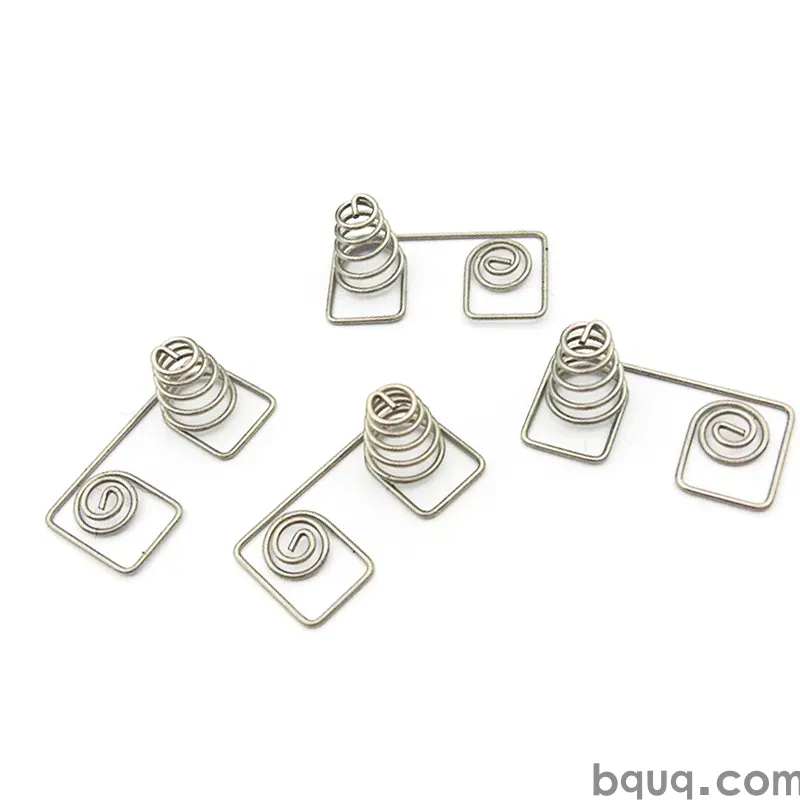
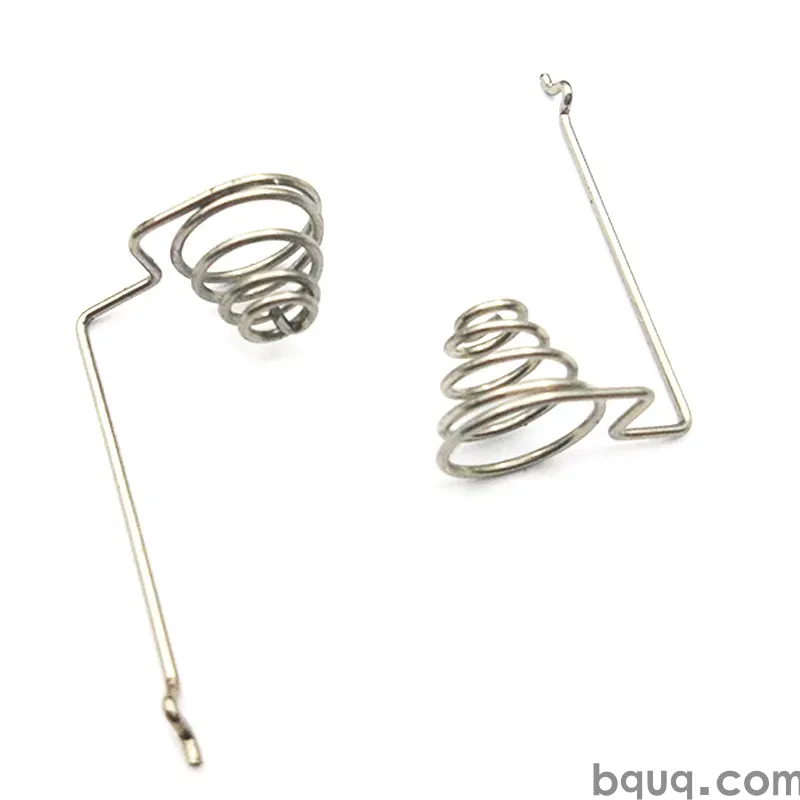
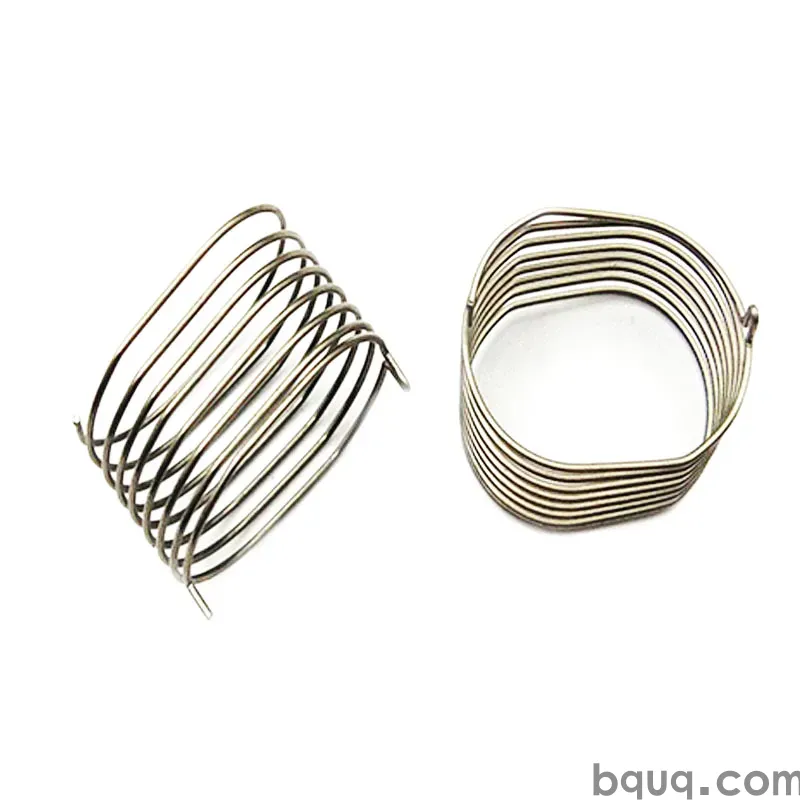
Extension spring design basics: initial tension, preload, rate and hook styles. BQUQ, a Dongguan spring factory, quotes extension springs in 12 hours.
Extension Springs: Preload, Initial Tension and Design Basics
An extension spring already resists pulling at zero extension — that built-in force is called initial tension, and it typically runs between 5% and 25% of the maximum load depending on how tightly the coils were wound. Above that preload the spring behaves like a normal linear spring: load equals initial tension plus rate times extension. Design around three numbers: initial tension, spring rate, and maximum extension, then check the hooks, because most extension spring failures happen at the loop ends, not in the body.
Extension springs pull things together: they return a clutch lever, tension a belt, balance a gate, hold a latch closed, or keep a cable taut. They are wound like compression springs but with loops or hooks at both ends, and the coils are usually close-wound with the wire twisted so that the spring holds itself together even with no load. That self-tightening is what creates initial tension, and it is the property that most surprises engineers new to tension springs: pull gently and nothing moves until you exceed the initial tension, then the spring extends smoothly and linearly.
What Initial Tension Is and Why It Matters
Initial tension is the force needed to just start separating the coils. It is built in during coiling by winding the wire tighter than the final pitch and letting it spring back, and it is expressed as a load in N or lbf, or as a percentage of the load at full deflection. Typical values depend mostly on the spring index — the ratio of mean coil diameter to wire diameter — because a tight spring index makes it easier to build in tension.
| Spring index (D/d) | Typical initial tension range | Notes |
|---|---|---|
| 4–6 (tight coils) | 20–25% of max load | High tension possible |
| 7–10 (mid range) | 10–20% of max load | Common design zone |
| 11–15 (open coils) | 5–10% of max load | Low tension, often low-cost |
| Above 15 | Near zero | Tension hard to hold |
Design logic: if your product needs a true preload before extension begins — a latch that must not rattle, a brush that must press at rest — specify a minimum initial tension. If the spring only needs to return something and the rest position does not matter, low tension is fine and cheaper to make consistently. One warning: initial tension relaxes during the first load cycles and with any heat treatment above roughly 230 °C, so do not design a mechanism that depends on the last 2% of tension. A factory can preset the spring to stabilize it — our custom extension springs are routinely load-tested after presetting so the delivered value matches the drawing.
Rate, Preload and the Load Formula
Below the initial tension point the spring is effectively rigid. Above it, extension springs obey the same linear law as compression springs: load = initial tension + (rate × extension). The rate depends on wire diameter to the fourth power, coil diameter cubed, and coil count, exactly as for compression springs — the formula mechanics are covered in our spring rate formula guide, which works for tension springs too once you add initial tension to every load figure.
| Design input | Example spec | Why it matters |
|---|---|---|
| Wire diameter | 0.8 mm | Rate to the 4th power |
| Mean coil diameter | 6 mm | Rate to the inverse 3rd power |
| Initial tension | 2.5 N | Force at zero extension |
| Spring rate | 1.2 N/mm | Load per mm of extension |
| Load at 20 mm extension | 2.5 + 24 = 26.5 N | The number your mechanism sees |
| Max extended length | 60 mm | Sets stress and solid check |
Worked example: a 0.8 mm music wire extension spring with 2.5 N initial tension and a 1.2 N/mm rate gives 26.5 N at 20 mm extension. If your product needs 20 N at 10 mm, the drawing should say so explicitly — "20 N at 10 mm extension, 25 mm free length between loop centers" — rather than leaving the factory to guess the tension. Load tolerance on a specified length is typically ±10%, the same baseline as compression springs.
Hook and Loop Styles: Where Extension Springs Actually Fail
The body of an extension spring rarely fails first; the ends do. Hooks concentrate stress at tight bends, and they carry the full load with a smaller wire section working in bending plus tension. Loop styles matter more than most buyers expect, both for fatigue life and for how the spring mounts.
| End style | Typical use | Fatigue and cost notes |
|---|---|---|
| Full loop (inline) | General purpose | Standard, moderate stress |
| Cross-over loop | Reduced stress at end | Better fatigue, slightly costlier |
| Side loop / offset | Mounting at an angle | Stress rises, use for light duty |
| Extended hook | Quick attachment | Stress concentration, not for cycling |
| Swivel / threaded ends | Rotary or high-cycle | Removes torsional unwind at ends |
Two practical rules. First, the load line should pass through the hook center — an offset load line twists the end coil and adds stress nobody calculated. Second, for any spring cycling above roughly 10,000 times, prefer cross-over loops or machine-cast ends and consider shot peening; the stress concentration at a standard hook can cut fatigue life to a fraction of the body's capability. End forming is a forming operation, so each style carries a small tooling consideration, and mixed spring orders — tension, compression and torsion bodies in one assembly — are quoted together by one factory to keep tolerances consistent.
Material Choice for Extension Springs
Extension springs use the same wire families as compression springs, with one extra consideration: the hooks need ductility so the tight bends do not crack, and the body needs strength so it does not take a set. Music wire A228 is the low-cost default indoors; stainless 302 resists corrosion and keeps load to about 250 °C; hard-drawn steel suits large, low-cost springs; beryllium copper appears where the spring must carry current or survive many cycles. Full strength, temperature and conductivity comparisons are in our spring material selection guide. Whatever the grade, specify the environment and the cycle count, because those two inputs decide whether the end loops need the premium treatment or a standard bend is enough.
Ordering: The Minimum Spec a Factory Needs
Send the working space and the function. A complete extension spring order states: free length between hook centers (or inside hooks), OD or mean coil diameter, wire diameter or rate, load at one or two extended lengths, maximum extension with the clearance limit, hook style, direction of wind if torque acts on the ends, cycles, and environment. If you have a 3D model or a dimensioned sketch, that covers most of it. BQUQ, an ISO9001-certified factory in Dongguan, China, runs custom spring production under the same roof as stamping, CNC and heat sink lines and quotes within 12 working hours — send drawings to sc@bquq.com or WhatsApp +86 13713157787 for a number you can design against.
Email sc@bquq.com or WhatsApp +86 137 1315 7787 with your PDF/DXF/STEP file. An engineer reviews it and replies with price, lead time and DFM notes on working days.
Frequently Asked Questions
Q: Why does my extension spring pull back even with no weight on it?
A: That is initial tension — the coils were wound so they grip each other at rest. The spring only starts extending once the applied force exceeds this tension, typically 5–25% of full load. It is a feature, not a defect.
Q: How is initial tension controlled in production?
A: Coiling tension and pitch set it, and it is verified on a load tester at the point the coils just separate. It can be relaxed by low-temperature heat treatment or stabilized by presetting, so state a minimum acceptable value rather than a fragile exact figure.
Q: Which hook style lasts longest under repeated loading?
A: Cross-over loops, which keep the load line closer to the wire centerline and reduce the bending stress at the end. For high cycle counts also ask for shot peening and avoid extended hooks entirely.
Q: Can an extension spring carry compression or sideways loads?
A: Not well. It is designed for axial tension only. Side loads bend the coils and hooks, cause wear and early failure. Guide the spring or change the mechanism if the load path is not straight.
Q: What tolerances are normal for extension spring loads?
A: Load at a specified extended length is typically held to ±10% at a spring factory, matching compression spring practice. Free length between hooks runs about ±1–2% or a few tenths of a millimeter, whichever governs.
Related Articles
- spring-manufacturing-process-guide — More from the BQUQ Custom Springs engineering series.
- hot-wound-vs-cold-wound-springs — More from the BQUQ Custom Springs engineering series.
- spring-fatigue-life-design-guide — More from the BQUQ Custom Springs engineering series.
Data Sources and Verification
Tolerances, cycle times and price ranges in this guide come from BQUQ production records at our Dongguan plant, where CNC machining (±0.005 mm), stamping, custom springs and heat sinks run under one roof. BQUQ is an ISO 9001:2015 certified factory; the certificate and batch inspection reports are available on request with every quotation.
Related Resources
- About BQUQ: an ISO9001-certified source factory in Dongguan running four production lines under one roof.
- Custom springs: compression, torsion and extension from the spring line — compression springs, torsion springs, extension and custom springs.
- Industry trends: manufacturing, material market, and sourcing analysis for buyers.
- Technical articles: engineering guides and process comparisons — more where this article came from.
- FAQ hub: quick answers on CNC, stamping, springs, and heat sinks.
- Case studies: real parts and real numbers from projects we engineered and delivered.
- Contact us: send your drawing and get a quote within 12 working hours.
Authored by the BQUQ Engineering Team. BQUQ is an ISO9001-certified source factory in Dongguan, China, running CNC machining, metal stamping, custom springs and heat sink lines under one roof. Send drawings to sc@bquq.com or WhatsApp +86 13713157787 for a quote within 12 working hours. www.bquq.com