RFQ for Custom Springs: Exactly What to Send
Short answer: Send six things — a drawing or sketch with the spring type, wire diameter and material, the governing dimensions (free length, OD/ID, leg or hook geometry), the load or rate at the working position, end configuration, and finish plus annual volume. If you have no drawing, send a photo with a ruler, a sample, or just the force at a given height; BQUQ quotes coil springs in 12 working hours and works from flexible MOQ, so a partial RFQ still moves. The most common quoting delay is not price negotiation — it is a missing wire diameter or an unspecified load point, which forces a round of questions before anyone can calculate a rate.
A custom spring is one of the few machined components where a single missing number can change the price by 40%. Wire diameter alone sets the rate, the stress, the coil count and the material cost. That is why the RFQ stage deserves more attention than it usually gets — most buyers treat it as a formality and then wonder why two suppliers quote numbers that differ by a factor of two.
This guide is the checklist our engineering team uses when a spring enquiry lands at BQUQ. It covers what to send, what happens if you cannot send it, and how to compare the quotes you get back.
What is the minimum information needed to quote a custom spring?
The absolute floor is: spring type, wire diameter, outside diameter, free length, and one load or rate requirement. Everything else is refinement. With those five data points, a spring engineer can calculate active coils, spring rate, stress at the working position, and whether the design is physically manufacturable in the material you named.
Below that floor, quoting becomes guesswork. A request for "a spring about 20 mm long, fairly stiff" cannot be priced responsibly because "fairly stiff" spans roughly an order of magnitude in rate.
The five-point minimum
| Data point | Example | Why it matters |
|---|---|---|
| Spring type | Compression, extension, torsion, wave, conical | Determines tooling, ends, and calculation method |
| Wire diameter | 1.20 mm | Sets rate, stress, and a large share of material cost |
| Outside or inside diameter | OD 12.0 mm | Constrains the cavity; sets the D/d ratio and buckling risk |
| Free length | 25.0 mm | Combined with solid height, defines travel |
| One load point or rate | 18 N at 18 mm | Anchors the entire design; without it, rate is undefined |
If you can add material grade, end type, finish and annual volume, you move from "quotable" to "quotable and optimised" — the supplier can propose a wire size that hits your load with less material.
Spring type first: compression, extension, or torsion?
Different spring families need different geometry on the drawing. Sending the wrong family's data wastes a round trip.
Compression springs
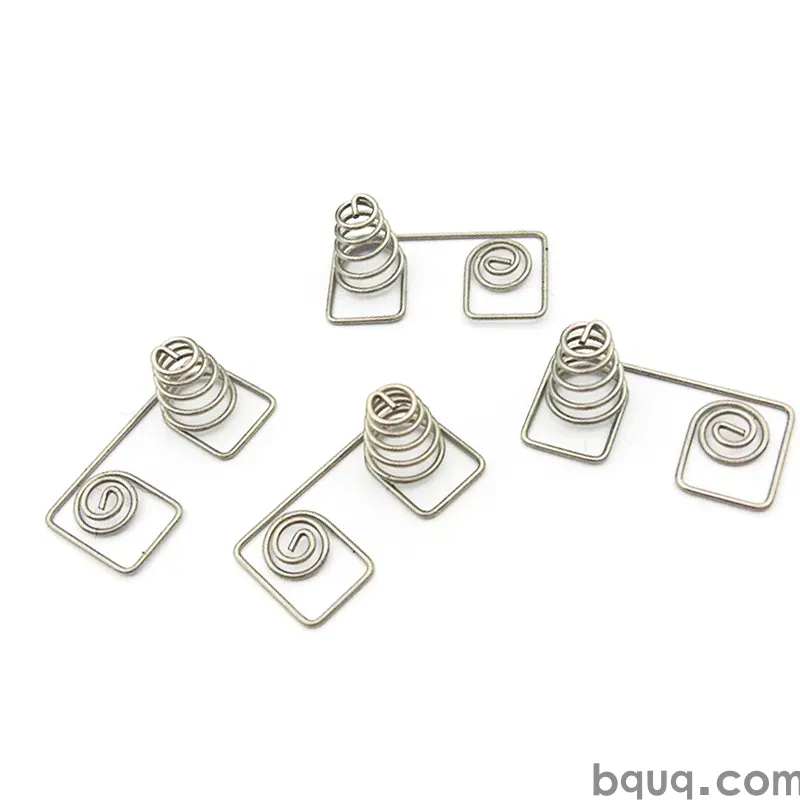
You need free length, solid height (or maximum compressed height), OD or ID, wire diameter, and load at one or two positions. End type matters: closed and ground, closed not ground, or open. Closed-and-ground ends give the flattest seating surface and the most predictable installed length, but add a grinding operation and cost.
Extension springs
Add: hook type (full loop, half loop, side loop, English hook), hook orientation relative to the body, initial tension in newtons, and maximum extended length. Initial tension is the force that holds the coils together before any load is applied — it is a real, measurable specification and it is frequently omitted.
Torsion springs
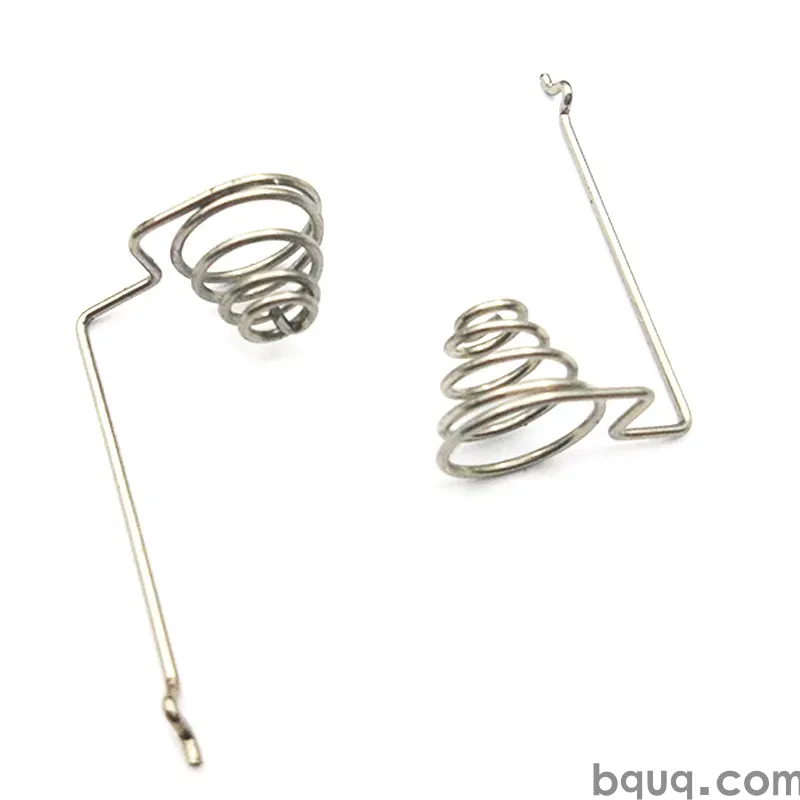
Add: leg angle in the free position, leg length and style (straight, bent, hooked), direction of wind (right-hand or left-hand), and torque at a specified rotation angle. Torsion springs also carry a diameter-reduction effect as they wind up, so state the mandrel or shaft diameter the spring sits on.
| Family | Critical extra data | Common omission |
|---|---|---|
| Compression | Solid height, end type | Solid height |
| Extension | Hook style, initial tension | Initial tension |
| Torsion | Leg angle, wind direction, mandrel dia. | Wind direction |
Which spring material should you specify?
Material choice drives corrosion resistance, temperature capability, magnetic behaviour and cost. If your application has no special requirements, music wire (ASTM A228) or oil-tempered wire is the default for compression and extension springs, and it is the cheapest path.
| Material | Typical use | Notes |
|---|---|---|
| Music wire / oil-tempered | General mechanical, low cost | Good fatigue life, needs a finish for corrosion |
| Stainless steel (302/304) | Washdown, outdoor, mild chemical | Lower modulus than carbon steel; expect a rate change |
| 17-7 PH | High stress, elevated temperature | Higher cost, better relaxation resistance |
| Phosphor bronze | Electrical contact, non-magnetic | Low conductivity applications, spring contacts |
| Inconel / Nimonic | High temperature, aggressive media | Specialty pricing and longer lead time |
Two practical warnings. First, switching from carbon steel to stainless changes the modulus by roughly 10–12%, so the same geometry produces a different rate — always re-specify the load, not just the material. Second, if the spring will be plated, tell the supplier before quoting: hydrogen embrittlement relief for high-strength steel springs is a real process step with real cost, and it must be planned, not added later.
How do you specify tolerance and load without over-constraining the part?
This is where experienced buyers separate from beginners. A drawing that specifies free length to ±0.05 mm, rate to ±2%, and load to ±1% simultaneously will either be expensive or unmanufacturable, because those tolerances interact.
A workable approach:
- Tolerance the load, not just the geometry. The function of a spring is force at a position. Give the load at the working height with a realistic band, typically ±10% for general industrial use and ±5% where the application is sensitive.
- Let free length float slightly. Free length is a consequence of coil count and pitch. If you hold load tightly, free length can usually open to ±1 mm or wider without affecting function.
- Specify squareness and parallelism only if the spring sits in a bore or between flat plates where it matters.
- State the working temperature range. Relaxation and material derating depend on it.
BQUQ machines and forms springs to ±0.005 mm on CNC-machined features where the application demands it, but for coil springs the meaningful control is load and dimensional consistency across the production lot — which is what our in-house inspection reports on. Where a spring interfaces with a machined seat, that is where the tight tolerance belongs.
What if you have no drawing and no sample?
Send what you have. In order of usefulness:
1. A sample spring, even a damaged one. We measure wire diameter, OD, free length, coil count and rate, then reverse-engineer the specification.
2. A photo with a steel rule in frame. This gets us within a family and an approximate size, enough to start a conversation.
3. The functional requirement in words: "must hold 2 kg at 30 mm compression inside a 15 mm bore, operating outdoors." That is enough for an engineer to propose a design.
4. A cavity drawing or the mating part. Often the constraint is the hole, not the spring.
Reverse-engineering a spring from a sample is routine work. The output is a specification sheet you approve before production, which also becomes the inspection basis for the lot.
For buyers consolidating a bill of materials, it helps to understand how spring MOQ works for custom runs before you commit to volumes that do not match your actual consumption.
RFQ data checklist you can copy
Use this as the body of your enquiry email. Anything you cannot answer, mark "TBD" — that is far better than guessing.
| Field | Your input |
|---|---|
| Spring type | |
| Wire diameter (mm) | |
| Material / grade | |
| OD or ID (mm) | |
| Free length (mm) | |
| Solid height (mm) | |
| Load 1: force at height | |
| Load 2: force at height (optional) | |
| End / leg / hook style | |
| Wind direction (torsion) | |
| Finish / plating | |
| Operating temperature | |
| Annual volume + first order qty | |
| Target unit price (optional) | |
| Application description |
Attach: 2D drawing (PDF or DXF), 3D model if available, sample photo, and any mating-part drawing.
How long does a custom spring quote take?
At BQUQ, a complete RFQ is quoted within 12 working hours. Incomplete RFQs take longer because of the clarification loop — typically one to two working days added.
The pattern we see is consistent: enquiries that include a load point and a wire diameter get quoted same-cycle; enquiries that specify only length and diameter come back with questions. If your schedule is tight, front-load the data.
Lead time after PO depends on whether tooling is needed and whether the wire is a stock grade. Standard wire diameters in music wire and 302 stainless are typically held or quickly sourced; specialty alloys and plated finishes extend the timeline. It is worth planning spring lead time around the material, not just the forming operation.
How should you compare spring quotes from different suppliers?
Price alone is a poor comparator because spring quotes hide assumptions. Normalise them:
- Is the load point the same? A quote at 15 mm and a quote at 18 mm are not comparable.
- Is the material the same grade and the same wire source? "Stainless" is not a specification.
- Is the finish included? Passivation, plating and stress relief are frequently excluded.
- Is tooling a one-time charge or amortised? Both are fine; know which you are looking at.
- What is the inspection basis? Ask for the load tolerance and the sampling plan.
- What is the MOQ and the price break structure?
A supplier that answers all six clearly is usually also the supplier that ships consistent parts. Our own supplier selection criteria article covers the audit questions worth asking before you place a first order.
Frequently Asked Questions
Q: Can you quote a custom spring from a photo alone?
A: Yes, for many designs. A clear photo with a ruler or caliper in frame lets us estimate wire diameter, outside diameter, free length and coil count, which is enough to propose a specification and an indicative price. Final pricing is confirmed after we measure a physical sample or you approve a drawing. Expect one clarification round.
Q: What tolerance should I put on spring load?
A: For most industrial applications, ±10% on the load at the working height is realistic and cost-effective. Where the spring controls a critical force — a relief valve, a contact force, a preload — ±5% is achievable with tighter process control and a slightly higher price. Below ±5% the cost curve rises steeply and often the real fix is a different spring type.
Q: Does material choice change the spring rate for the same dimensions?
A: Yes. Spring rate is proportional to the material's shear modulus. Stainless steel 302 has a lower modulus than music wire, so an identical geometry produces a lower rate — typically around 10% lower. Always specify the required load at the working position and let the supplier adjust geometry to suit the material, rather than assuming the rate carries over.
Q: What is the smallest quantity you will quote?
A: BQUQ works from flexible MOQ, so prototype and low-volume runs are quotable. Small quantities carry a higher unit price because setup and inspection effort is spread over fewer parts, but there is no hard floor that rules out a 50-piece trial order. Many projects start with a sample batch and scale once the design is validated.
Q: Do I need a 3D model to get a spring quote?
A: No. A 2D drawing with the dimensional and load data is sufficient, and in many cases a written specification plus a sample is enough. A 3D model helps for complex leg or hook geometry on torsion springs, but it is a convenience, not a requirement. Send what you have and we will tell you if anything is missing.
Related Resources
- About BQUQ and our four production lines in one Dongguan factory: /about/
- Compression springs, torsion springs and extension springs: /compression-springs/, /torsion-springs/, /extension-custom-springs/
- Industry trends in metal component sourcing: /industry-dynamics/
- Technical articles and engineering guides: /bquq-blog/
- Frequently asked questions on quoting, MOQ and lead time: /faq/
- Case studies from custom component projects: /case/
- Contact our engineering team: /contact/
Authored by the BQUQ Engineering Team. BQUQ (Dongguan) runs CNC machining (±0.005 mm), metal stamping, custom springs, and heat sink production in one ISO9001 factory. Source-direct from Dongguan, China — quote in 12 hours: sc@bquq.com | WhatsApp +86 13713157787 | www.bquq.com