Phosphor Bronze Springs: Conductivity and Spring Properties
Short answer: Phosphor bronze springs use copper-tin-phosphorus alloys such as C51000 (5% tin) or C52100 (8% tin), delivering roughly 15–20% IACS electrical conductivity with tensile strengths of 600–900 MPa in spring temper. That combination makes them the default choice where a spring must also carry current, resist fatigue, and survive mildly corrosive or marine-adjacent environments. They are not as conductive as pure copper and not as strong as beryllium copper or steel, but they balance both at a moderate cost. At BQUQ, phosphor bronze springs are formed on the same Dongguan lines as our steel springs, with wire diameters typically from 0.1 mm to 6 mm and quotes returned in 12 working hours.
What Is Phosphor Bronze, Exactly?
Phosphor bronze is a copper alloy family built on three elements: copper as the base, tin as the strengthener, and phosphorus as the deoxidizer. The phosphorus content is small — usually 0.03% to 0.35% — but it matters, because it scavenges oxygen during melting and improves fluidity and soundness in the cast or drawn wire. The tin is what actually raises strength, hardness, and wear resistance above what pure copper can offer.
The two grades you will meet most often in spring work are:
- C51000 ("5% A" phosphor bronze) — nominally 94.8% Cu, 5% Sn, 0.2% P. The general-purpose spring and contact grade. Good formability, good fatigue life, moderate strength.
- C52100 ("8% C") — nominally 92% Cu, 8% Sn, 0.2% P. Higher strength and hardness, slightly lower conductivity, less forgiving in tight bend radii.
There are also leaded free-machining versions (C54400) and high-tin variants, but for springs, C51000 and C52100 cover the overwhelming majority of applications.
Why "Phosphor" Matters to a Spring Engineer
Two practical consequences. First, the deoxidation means cleaner wire with fewer inclusions, which translates into better fatigue performance under cyclic loading — the whole point of a spring. Second, phosphorus slightly reduces conductivity compared with oxygen-free copper, but the trade is worth it because you get a wire you can actually draw, coil, and heat-treat consistently.
What Are the Typical Properties of Phosphor Bronze Springs?
The table below gives indicative values for C51000 and C52100 in spring temper. Treat these as typical ranges for material selection, not as guaranteed minimums for a specific lot — always confirm against the mill certificate for your order.
| Property | C51000 (5% Sn) | C52100 (8% Sn) | Notes |
|---|---|---|---|
| Electrical conductivity | 15–20% IACS | 13–16% IACS | Lower than pure copper (~100% IACS) |
| Tensile strength (spring temper) | 600–760 MPa | 700–900 MPa | Depends on temper and wire diameter |
| Elastic modulus | ~110 GPa | ~110 GPa | Roughly 55% of steel |
| Density | 8.86 g/cm³ | 8.80 g/cm³ | Comparable to copper |
| Fatigue strength (10⁷ cycles) | ~200–280 MPa | ~250–330 MPa | Strongly geometry-dependent |
| Operating temperature (continuous) | up to ~150 °C | up to ~150 °C | Stress relaxation accelerates above this |
| Corrosion resistance | Good | Good | Good in fresh water and mild marine exposure |
Two numbers deserve emphasis. The elastic modulus of about 110 GPa is roughly half that of stainless or carbon steel. That means a phosphor bronze spring of identical dimensions to a steel spring will be about half as stiff — useful when you want compliance, awkward when you assumed steel-like rates. The conductivity of 15–20% IACS is roughly 15–20% of pure copper, which is far below a busbar but perfectly adequate for signal contacts, low-current paths, and combined mechanical-electrical duties.
Conductivity in Context
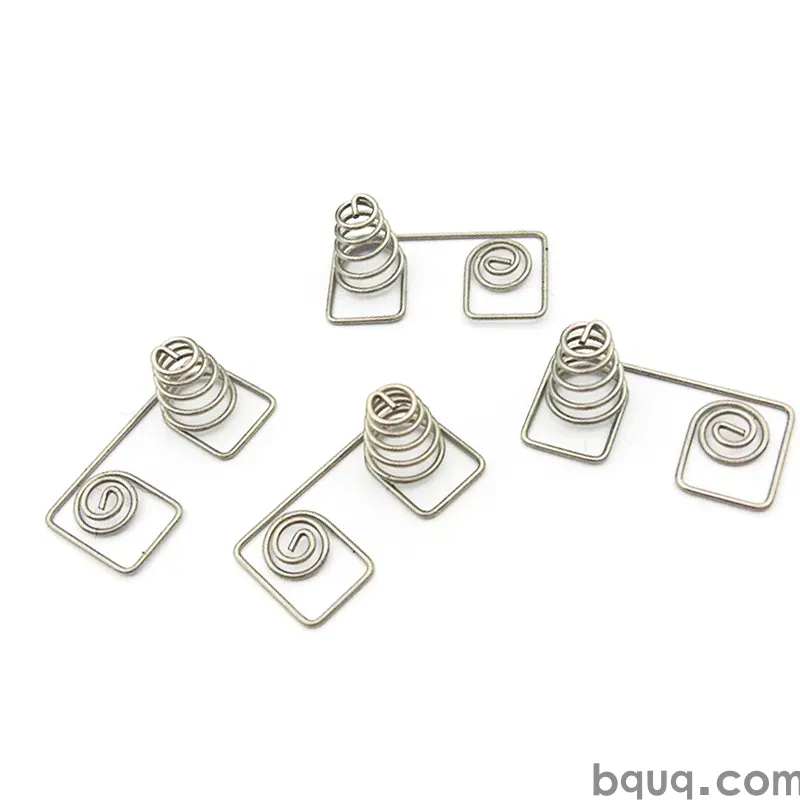
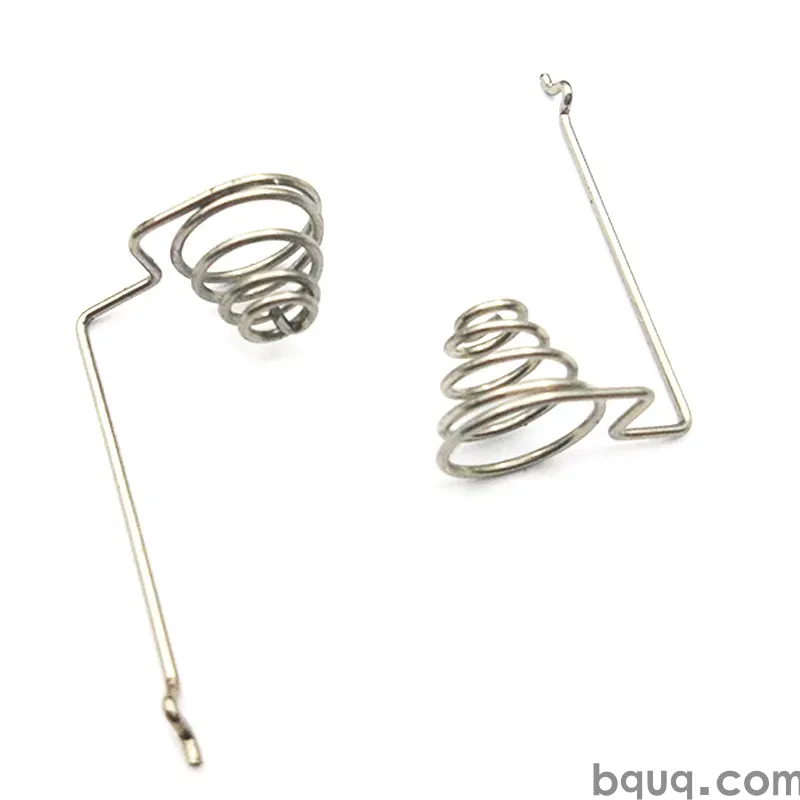
If your application is purely electrical and carries significant current, phosphor bronze is the wrong answer — you want copper or a copper alloy with much higher IACS. If your application is purely mechanical and needs maximum strength per unit volume, steel wins. Phosphor bronze occupies the middle: a spring that must pass a small current, maintain contact force, and not corrode. Typical examples include battery contacts, connector retention springs, relay leaf springs, and antenna coil forms.
How Do Phosphor Bronze Springs Compare to Other Spring Materials?
This is the question that decides most projects. The comparison below uses typical values; your specific geometry and duty cycle will shift the picture.
| Material | Conductivity (% IACS) | Tensile (MPa, spring temper) | Modulus (GPa) | Relative cost | Best for |
|---|---|---|---|---|---|
| Phosphor bronze C51000 | 15–20 | 600–760 | ~110 | Moderate | Conductive springs, contacts, marine-adjacent |
| Beryllium copper C17200 | 15–22 (aged) | 1100–1400 | ~128 | High | Highest strength + conductivity, precision contacts |
| Brass C26000 | 28 | 400–600 | ~110 | Low | Low-stress contacts, low cost |
| 302/304 stainless | ~2 | 1300–1900 | ~193 | Low–moderate | Corrosion resistance, high strength, non-magnetic |
| Music wire / oil-tempered | ~10 | 1700–2100 | ~207 | Low | Maximum strength, non-conductive duty |
The pattern is clear. Beryllium copper beats phosphor bronze on both strength and conductivity, but it costs significantly more and raises supply-chain questions in some markets, which is why many buyers still specify phosphor bronze. Our beryllium copper springs guide covers that trade in detail. Stainless steel wins on strength and corrosion but is essentially non-conductive. Brass is cheaper and more conductive but too weak for most spring duties.
When Phosphor Bronze Is the Right Call
Choose phosphor bronze when at least two of these are true:
1. The spring must carry current or maintain a defined contact resistance.
2. The environment includes humidity, salt spray, or mild chemicals.
3. You need non-magnetic or low-magnetic behavior.
4. You want a moderate spring rate from a compact geometry (helped by the low modulus).
5. You need solderability or good surface finish for a contact interface.
How Does Temper and Heat Treatment Affect Spring Performance?
Phosphor bronze springs are almost always supplied in a tempered condition — the wire is cold-drawn to a specified reduction that sets its strength and hardness. Common designations run from annealed through quarter-hard, half-hard, hard, and spring temper. For springs, you generally want hard or spring temper.
Stress Relief After Forming
Here is where many designs quietly fail. Coiling and bending introduce residual stresses. If you leave them in, the spring may relax prematurely, lose load, or crack at the inside of a tight bend. A stress-relief anneal — typically in the 200–260 °C range for 30–60 minutes, in an inert or reducing atmosphere to avoid oxidation — relieves those stresses with minimal loss of temper.
The exact time and temperature depend on the grade, temper, and wire diameter, and this is a process we tune per part rather than apply as a blanket recipe. Over-annealing softens the wire and kills load; under-annealing leaves the residual stress in place. If your spring geometry is aggressive — a low spring index with tight bends — stress relief is not optional.
Stress Relaxation at Temperature
Phosphor bronze begins to lose load at elevated temperature. Continuous service above roughly 150 °C accelerates stress relaxation, meaning the spring slowly takes a set and delivers less force over time. If your application runs hot, either derate the stress you design to, or move to a material with better high-temperature behavior. Our spring index and stress guide walks through the stress math that determines whether you are near that limit.
What Should Designers Watch Out For?
A few failure modes show up repeatedly with phosphor bronze springs.
Spring Index and Bend Radius
Spring index (mean coil diameter divided by wire diameter) below about 4 makes coiling difficult and concentrates stress on the inside of the coil. With phosphor bronze's lower modulus, designers sometimes push toward very tight indexes to get a specific rate — resist that. Keep index at 5 or above where possible, and respect a minimum bend radius of roughly 1× wire thickness for spring temper.
Galvanic Coupling
Copper alloys sit relatively high on the galvanic series. If a phosphor bronze spring is fastened against aluminum or steel in a wet environment, you have built a battery, and the less noble metal will corrode. Isolate dissimilar metals with plating, coatings, or a non-conductive barrier. Our corrosion protection overview covers the options.
Solder and Plating Interactions
Phosphor bronze solders well, which is one reason it dominates contact applications. But if you plate it — nickel, tin, gold flash — the plating process must not embrittle the wire or leave hydrogen trapped. Specify the plating and the bake-out requirement explicitly.
Set and Load Loss
Because the modulus is low, phosphor bronze springs deflect more for a given load, and any residual stress shows up as set. Always validate with a load-at-deflection test after stress relief, not just a dimensional check.
How Does BQUQ Manufacture Phosphor Bronze Springs?
BQUQ runs four production lines in one Dongguan factory covering CNC machining, metal stamping, custom springs, and heat sinks. Phosphor bronze springs are formed on the same spring lines as our steel and stainless work, which means the process controls are already in place.
Typical capabilities for phosphor bronze:
| Parameter | Typical range |
|---|---|
| Wire diameter | 0.1 mm – 6 mm |
| Compression springs | Free length up to ~150 mm |
| Extension springs | With loop, hook, or threaded ends |
| Torsion springs | Leg angles to drawing |
| Tolerance | Per drawing; ±0.005 mm achievable on CNC-machined fixtures and end features |
| Stress relief | In-house, atmosphere controlled |
| MOQ | Flexible — prototype to production |
| Quote turnaround | 12 working hours |
We quote in 12 working hours from a drawing or a clear description, and we keep MOQ flexible so you can validate a design before committing to volume. Because CNC machining, stamping, and springs sit in the same building, we can produce the mating contact, the retaining clip, and the spring as one coordinated package rather than three separate supply chains.
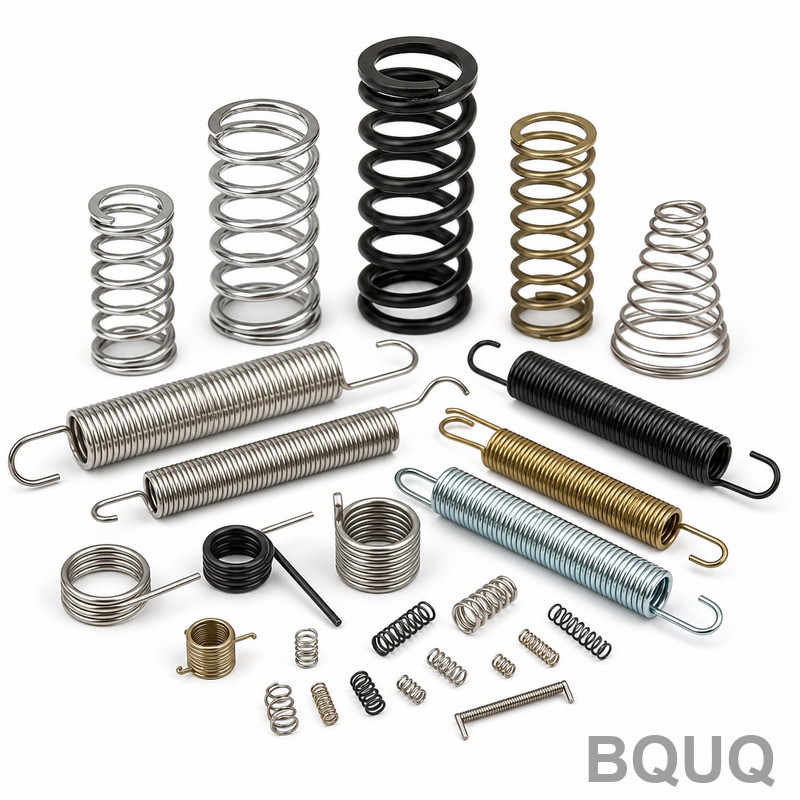
See our compression springs, torsion springs, and extension springs pages for geometry options, or send a drawing directly for a quote.
Frequently Asked Questions
Q: Is phosphor bronze a good conductor for springs?
A: It is good for a spring, not good as a conductor in absolute terms. C51000 runs roughly 15–20% IACS, versus about 100% for pure copper. That is enough for signal contacts, low-current paths, and contact force applications, but not for power transmission. If your spring must carry meaningful current, evaluate beryllium copper or a dedicated copper contact instead.
Q: What is the difference between C51000 and C52100 phosphor bronze?
A: C51000 contains about 5% tin; C52100 contains about 8%. The higher tin raises tensile strength and hardness and slightly lowers conductivity, while reducing formability. Use C51000 for general spring and contact work with tight bends; use C52100 when you need maximum strength and wear resistance and can accept a larger minimum bend radius.
Q: Do phosphor bronze springs need heat treatment after coiling?
A: Usually yes. Coiling and bending leave residual stresses that cause premature load loss and cracking at tight bends. A stress-relief anneal in the 200–260 °C range for 30–60 minutes, in an inert atmosphere, relieves those stresses with minimal temper loss. The exact cycle depends on grade, temper, and wire diameter, so it should be tuned per part.
Q: Can phosphor bronze springs be used in marine environments?
A: They perform reasonably well in fresh water and mild marine exposure, better than steel but not as well as titanium or certain bronzes. The bigger risk is galvanic corrosion when coupled to aluminum or steel in wet conditions. Isolate dissimilar metals with plating or a barrier, and validate with salt-spray testing if the application is exposed.
Q: How does temperature affect phosphor bronze spring load?
A: Continuous service above roughly 150 °C accelerates stress relaxation, so the spring gradually takes a set and delivers less force. Design to a lower working stress if you operate hot, or select a material with better high-temperature stability. Short excursions above that limit are usually tolerable; sustained operation is where load loss becomes measurable.
Related Resources
- About BQUQ and our Dongguan factory: /about/
- Custom compression, torsion, and extension springs: /compression-springs/
- Industry trends in spring and metal component sourcing: /industry-dynamics/
- Full technical article library: /bquq-blog/
- Frequently asked questions: /faq/
- Case studies: /case/
- Request a quote in 12 working hours: /contact/
Authored by the BQUQ Engineering Team. BQUQ (Dongguan) runs CNC machining (±0.005 mm), metal stamping, custom springs, and heat sink production in one ISO9001 factory. Source-direct from Dongguan, China — quote in 12 hours: sc@bquq.com | WhatsApp +86 13713157787 | www.bquq.com