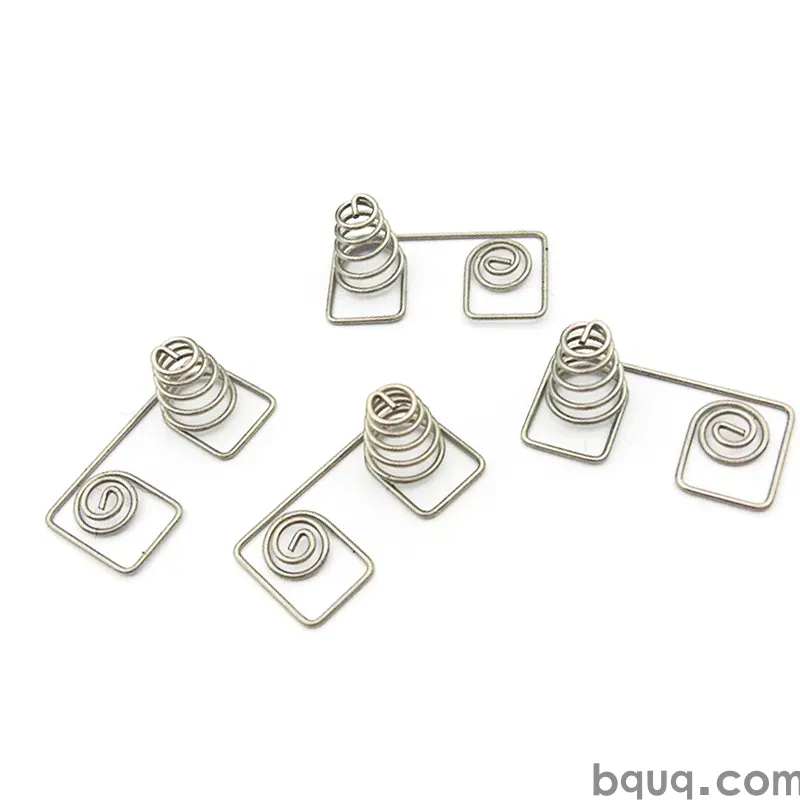
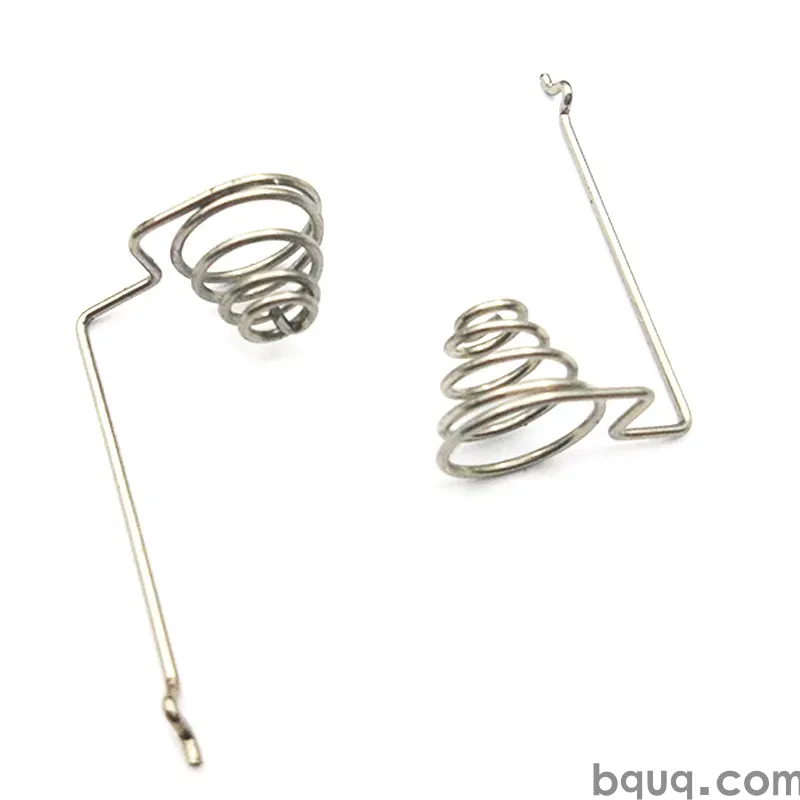
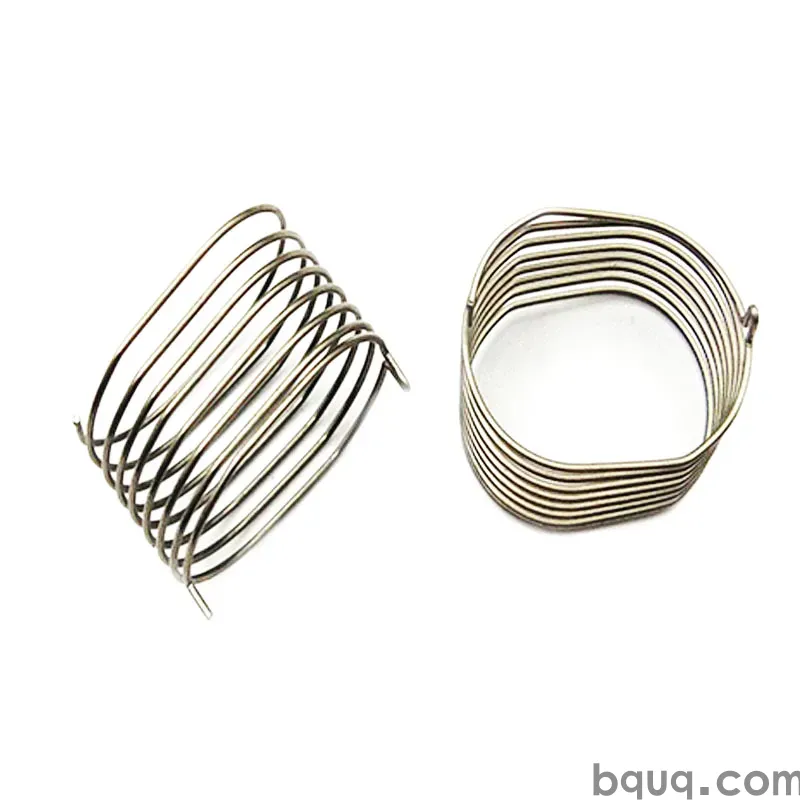
Compression spring end types compared: closed and ground, closed, plain, plain ground. BQUQ, a Dongguan spring factory, makes precision springs to spec.
Compression Spring End Types: Closed, Ground, Open and When Each Matters
Compression spring ends come in four standard treatments — plain, plain and ground, closed, and closed and ground — and the choice sets how the spring seats, how straight it stands, and how many active coils it really has. Closed and ground ends are the default for any precision or load-carrying spring: they give a flat, square seating surface, remove the coil that would otherwise tilt under load, and subtract about two coils from the active count. Plain ends are cheaper and fine for light, low-cost springs that sit in captured pockets.
The ends of a compression spring look like a small detail, yet they decide whether the spring stands straight, whether the load applies evenly, whether the spring rubs its housing, and even how the spring rate comes out. A spring with the same wire, diameter and coil count behaves differently with plain ends than with closed and ground ends, because the end coils do not contribute to the rate the same way. End type is therefore a functional specification, not a cosmetic one, and it is one of the first questions a spring maker asks.
The Four Standard End Types
Spring standards such as DIN 2095 and common engineering practice recognize four end treatments. Plain ends are simply cut wire — the helix just stops. Plain and ground ends are cut and then ground flat for a better seat. Closed ends are pressed so the last coil touches the next one, forming a flat-ish seat without grinding. Closed and ground ends are closed and then ground to a true flat, parallel surface.
| End type | Description | Active coils (approx.) | Typical use |
|---|---|---|---|
| Plain | Wire cut, no treatment | Total coils | Light duty, cheap parts |
| Plain and ground | Cut + ground flat | Total coils − 1 | Better seating, moderate duty |
| Closed | End coil pressed shut | Total − 1 to − 2 | General springs, no grinding |
| Closed and ground | Closed + ground flat | Total − 2 | Precision, fatigue, load accuracy |
The active-coil adjustments are standard design approximations: closed ends make the last coil inactive, and grinding removes a little more. If a print calls for a spring rate, the maker counts active coils from the total minus the end allowance, which is why copying a spring's visible coil count without its end type will not reproduce its rate.
What Closed and Ground Ends Buy You
Closed and ground is the workhorse spec for real engineering springs, and it earns its cost in three ways. First, seating: a ground end sits flat on its seat, so the load line passes through the spring axis instead of through one tilted coil edge. Second, squareness: grinding both ends against the body axis makes the spring stand vertical within a small tolerance — typically within 1–3° or a few degrees of squareness at rest, a key figure when the spring runs in a bore. Third, load consistency: with flat seats the spring compresses evenly, the measured load at height matches the calculation, and the end coil does not dig into the seat or the housing.
| End type | Squareness (typical) | Load consistency | Relative cost |
|---|---|---|---|
| Plain | Poor — tilts on seat | Poor | Lowest |
| Plain and ground | Moderate | Moderate | Low |
| Closed | Moderate | Moderate | Low |
| Closed and ground | Good, within ~1–3° | Best | Moderate |
The cost step from closed to closed and ground is small — one grinding operation — and it is usually the right price to pay wherever the spring carries a defined load, sits in a machined pocket, or cycles. Closed and ground ends also behave better in the stability analysis: flat ends change the effective end condition of the spring column, which is one of the reasons our compression spring buckling guide treats end type as part of the buckling calculation.
When Plain or Closed Ends Are the Right Call
Plain ends are not a mistake — they are a cost decision. A spring that is captured between two cups, guided on a rod, or loaded so lightly that seating does not matter does not need grinding. Springs in toys, low-cost mechanisms and throwaway assemblies routinely use plain ends, and the savings show at volume. Closed ends without grinding add a little stability and stop the wire end from catching on a mating part, at nearly plain-end cost, which makes them the default when a drawing says "closed ends" without a grind symbol. Plain and ground ends are rare in practice, mostly appearing where a cheap spring needs one flat seat.
The decision guide is short: ground when the spring must stand square, carry an accurate load, or resist buckling; closed when the spring needs a clean end without the grinding cost; plain when the spring is guided, captured, or truly light duty. When in doubt, closed and ground, because regrinding a tool after a field failure costs more than the grinding ever saved.
Specifying Ends on a Drawing
Write the end type explicitly and add the squareness callout if the spring runs in a bore: "closed and ground ends, squareness within 2°" is a complete spec. Where the spring seats on a machined surface, remember that the seat must be parallel too — a ground spring on a tilted seat behaves like a plain spring. Free length, solid height and the number of total coils should all be stated, since end grinding removes material and shifts solid height. If you are adapting an existing spring, note that changing end type without adjusting coil count changes the rate, and the compression spring rate guide walks through exactly how coil count feeds the rate calculation.
End type also interacts with the rest of the spring family: extension springs end in hooks rather than closed coils — the hook style carries the same design weight, and our custom extension springs article covers those ends. BQUQ, an ISO9001-certified factory in Dongguan, produces compression springs with plain, closed, ground and closed-and-ground ends across its spring product range, with end grinding and squareness checks as standard process steps. Send the drawing to sc@bquq.com or WhatsApp +86 13713157787 and get a quote within 12 working hours.
Email sc@bquq.com or WhatsApp +86 137 1315 7787 with your PDF/DXF/STEP file. An engineer reviews it and replies with price, lead time and DFM notes on working days.
Frequently Asked Questions
Q: What is the difference between closed and closed and ground ends?
A: A closed end is pressed so the last coil touches its neighbor, forming a rough flat seat. Closed and ground ends are then ground flat and parallel to the axis, giving a true square seating surface and better load accuracy.
Q: Do I need ground ends on my compression spring?
A: Ground them when the spring must stand square, hold an accurate load, or resist buckling in a bore. For guided, captured or light-duty springs, closed or plain ends save cost without hurting function.
Q: How many active coils does a closed and ground spring have?
A: As a standard approximation, subtract two from the total coil count for closed and ground ends on both ends. Closed ends subtract one to two, and plain ends leave all coils active. Count precisely for rate-critical designs.
Q: What squareness tolerance is normal for ground springs?
A: Typical production squareness for a closed and ground compression spring is within about 1–3° between the end plane and the spring axis, depending on wire size and free length. Larger and longer springs get looser allowances.
Q: Can ends be ground on a spring with plain ends later?
A: Yes, plain ends can be ground to make plain-and-ground ends, but most factories prefer to coil the spring closed first, then grind, because a closed coil gives the grinder a solid, consistent surface to work.
Related Articles
- custom-compression-springs-design-guide — More from the BQUQ Custom Springs engineering series.
- torsion-spring-design-guide — More from the BQUQ Custom Springs engineering series.
- spring-manufacturing-process-guide — More from the BQUQ Custom Springs engineering series.
Data Sources and Verification
Tolerances, cycle times and price ranges in this guide come from BQUQ production records at our Dongguan plant, where CNC machining (±0.005 mm), stamping, custom springs and heat sinks run under one roof. BQUQ is an ISO 9001:2015 certified factory; the certificate and batch inspection reports are available on request with every quotation.
Related Resources
- About BQUQ: an ISO9001-certified source factory in Dongguan running four production lines under one roof.
- Custom springs: compression, torsion and extension from the spring line — compression springs, torsion springs, extension and custom springs.
- Industry trends: manufacturing, material market, and sourcing analysis for buyers.
- Technical articles: engineering guides and process comparisons — more where this article came from.
- FAQ hub: quick answers on CNC, stamping, springs, and heat sinks.
- Case studies: real parts and real numbers from projects we engineered and delivered.
- Contact us: send your drawing and get a quote within 12 working hours.
Authored by the BQUQ Engineering Team. BQUQ is an ISO9001-certified source factory in Dongguan, China, running CNC machining, metal stamping, custom springs and heat sink lines under one roof. Send drawings to sc@bquq.com or WhatsApp +86 13713157787 for a quote within 12 working hours. www.bquq.com