Automotive Springs: Valve, Return and Sensor Springs
Short answer: Automotive springs split into three functional families — valve springs that must survive billions of high-stress cycles, return springs that must deliver repeatable force over millions of short strokes, and sensor springs that must hold a precise, stable load with almost no travel. Typical valve springs use oil-tempered or chrome-silicon wire with shot peening and hot preset; return springs often use stainless or music wire; sensor springs usually use stainless steel for corrosion resistance and low magnetic interference. BQUQ produces all three in one ISO9001 Dongguan factory, holding ±0.005 mm on CNC-machined spring-related components and quoting custom spring programs within 12 working hours.
What are automotive springs actually doing inside a vehicle?
A modern car contains hundreds of springs. Most are invisible to the buyer but every one of them is a safety-relevant or function-critical part. They fall into three broad jobs:
- Storing and releasing energy — valve springs, clutch springs, brake return springs.
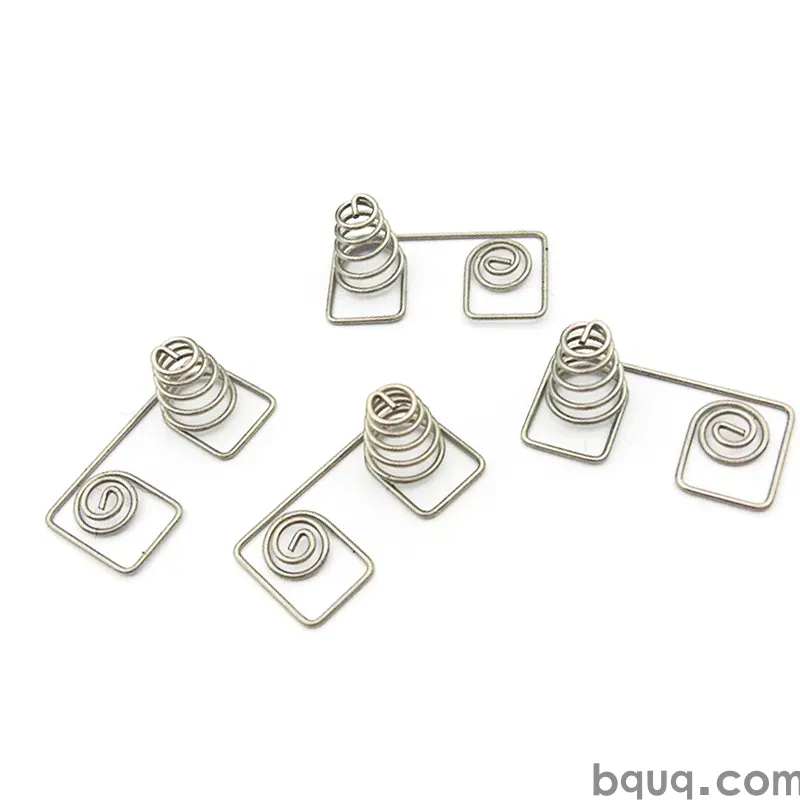
- Holding a position or preload — sensor springs, connector springs, seat and trim springs.
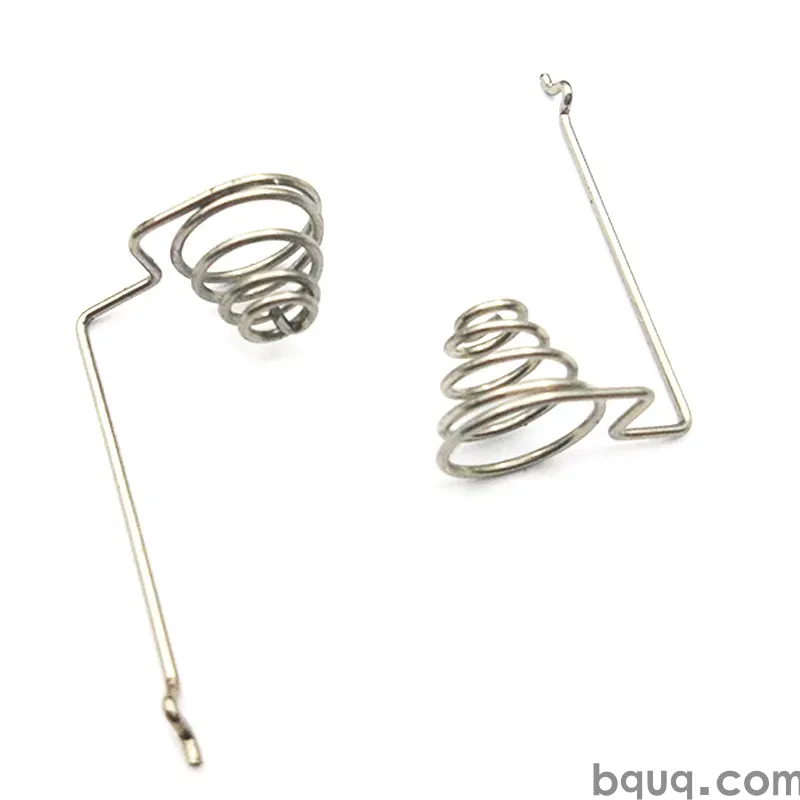
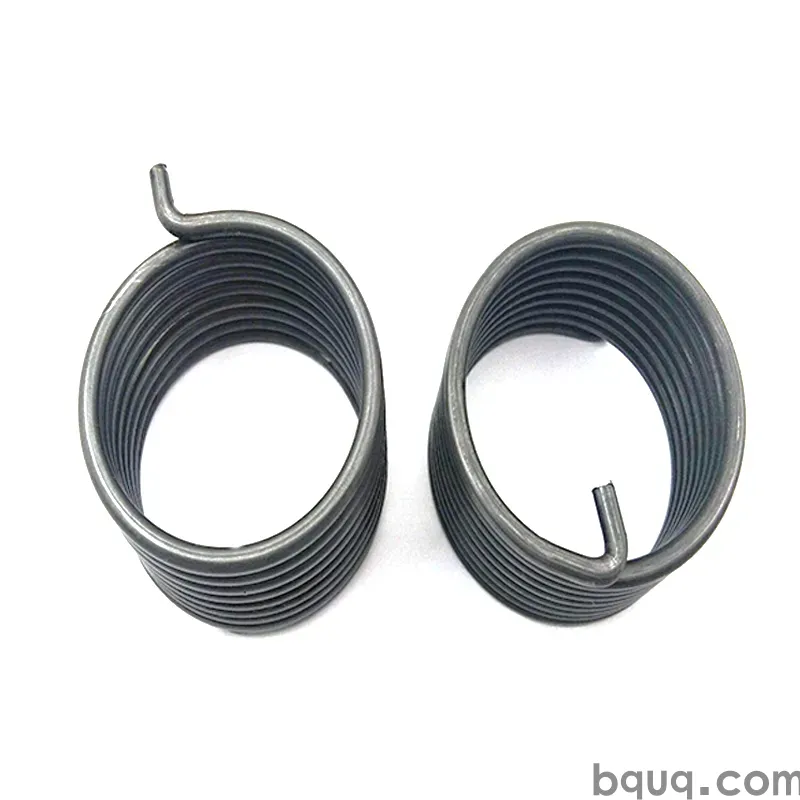
- Returning a mechanism to a known state — throttle return springs, pedal return springs, actuator return springs.
The engineering problem is different for each. A valve spring is asked to endure extreme cyclic stress at high temperature. A return spring is asked to be cheap, consistent, and reliable over a long life of small deflections. A sensor spring is asked to be dimensionally stable and chemically inert, because a drifting sensor spring becomes a drifting sensor reading.
Why the three families are specified differently
| Family | Typical wire | Load character | Dominant failure mode | Key spec driver |
|---|---|---|---|---|
| Valve spring | Chrome-silicon, oil-tempered | High stress, high frequency | Fatigue, sag, resonance | Fatigue life, rate tolerance |
| Return spring | Music wire, stainless | Low stress, many short strokes | Set, corrosion, wear | Free length, load at length |
| Sensor spring | Stainless (302/304/316) | Very low travel, static-ish | Load drift, corrosion | Load precision, material stability |
That table is the whole article in miniature. Everything below expands one row at a time.
Valve springs: the hardest working spring in the engine
A valve spring sits between the cylinder head and the retainer, closing the valve against the cam profile thousands of times per minute. At 6,000 rpm on a four-stroke engine, each valve spring cycles roughly 3,000 times per minute — about 180,000 cycles per hour of driving.
Material choice
Chrome-silicon alloy steel (often called chrome-silicon or CrSi) is the default for gasoline engine valve springs because it combines high fatigue strength with good sag resistance at elevated temperature. Oil-tempered carbon steel is used for lower-stress and lower-cost applications. For extreme-duty or high-temperature niches, specialty alloys appear, and we cover that family separately in our notes on Hastelloy and Inconel springs.
The three processes that make a valve spring survive
1. Shot peening — bombarding the surface with controlled media induces compressive residual stress, which delays fatigue crack initiation. It is the single highest-leverage process step on a valve spring.
2. Hot preset (hot setting / scragging) — the spring is compressed to a prescribed height at temperature so that the first cycles of "set" happen in the factory, not in the engine. We describe the mechanics in our article on the hot preset process.
3. Grinding and orientation — closed and ground ends give a flat bearing surface and keep the spring square under load.
What to specify on a valve spring drawing
| Parameter | Why it matters | Typical tolerance band |
|---|---|---|
| Wire diameter | Sets rate and stress | ±0.02 mm typical |
| Free length | Reference for installed height | ±0.5 mm typical |
| Load at installed height | Directly controls valve seat pressure | ±5% typical |
| Load at open height | Controls nose pressure and float resistance | ±5% typical |
| Rate (N/mm) | Slope between the two load points | ±5% typical |
| Squareness | Prevents side loading of the valve | 1.5°–2.5° typical |
| Surface condition | Fatigue initiation sites | Shot peened, no seams |
Tolerances above are indicative for production automotive springs. Tighter bands are possible but they cost money and should be justified by the engine's sensitivity, not by habit.
Return springs: cheap parts with expensive failure modes
Return springs are everywhere — throttle bodies, brake and clutch pedals, parking brake mechanisms, seat latches, door handles, actuator arms, EV charge-port covers. They are usually low-stress, but they are also usually the part nobody re-validates, which is exactly why they fail in the field.
The three real risks
- Permanent set. A return spring that is compressed to solid or near-solid during assembly loses free length and stops returning. This is a design error, not a manufacturing error, and it is the most common return-spring complaint we see.
- Corrosion. Underbody, engine-bay, and door-cavity springs see salt spray, condensation, and road chemicals. Music wire without plating will rust. Stainless or plated carbon steel is the fix.
- Wear at the ends. A return spring with an unground end rubbing on a stamped bracket will abrade both parts.
Choosing between music wire, stainless, and plated carbon steel
| Option | Corrosion resistance | Cost | Best fit |
|---|---|---|---|
| Music wire (ASTM A228) | Poor unless plated | Lowest | Dry interior mechanisms |
| Zinc or nickel plated music wire | Moderate | Low | General engine bay and cabin |
| 302/304 stainless | Good to excellent | Moderate | Exterior, humid, wash-down areas |
| 17-7PH stainless | Excellent + high strength | Higher | High-stress + corrosive combination |
For high-strength stainless return springs, precipitation-hardening grades are worth the premium; we compare them in our guide to 17-7PH spring steel.
Design rules that prevent return-spring failures
- Keep maximum working deflection below roughly 60–70% of the deflection at solid height. Higher values invite set.
- Use closed ends, and ground ends if the spring bears on a hard flat surface.
- Specify a load at a defined length, not just a free length. Free length alone does not control the force the mechanism actually feels.
- Give the spring a guide rod or a pocket bore so it cannot buckle.
Sensor springs: precision load, minimal travel
Sensor springs are the least glamorous and the most tolerance-sensitive family. They appear in pressure sensors, position sensors, pedal-travel sensors, seat-occupancy sensors, and connector contact systems. Their job is to hold a defined force against a sensing element or a moving target, with as little variation as possible across temperature and life.
Why they are specified in stainless
Three reasons dominate:
1. Corrosion resistance — sensors live in engine bays, wheel wells, and underbody locations.
2. Low magnetic permeability — 302 and 304 stainless are effectively non-magnetic in the annealed condition, so they do not disturb Hall-effect or inductive sensing.
3. Stable modulus and low creep — the load must not drift over a 15-year vehicle life.
What actually controls sensor spring accuracy
- Wire diameter tolerance. Rate scales with the fourth power of wire diameter. A 1% wire diameter error is roughly a 4% rate error. This is why sensor springs demand tighter incoming wire control than general-purpose springs.
- Coil diameter control. Rate scales inversely with the cube of mean coil diameter.
- Active coil count. Rate scales inversely with active coils — our article on active coils walks through the counting rules, which are a frequent source of RFQ mismatch.
- End condition. Closed, ground, squared ends give the most repeatable installed height.
- Stress index. A high spring index (D/d) makes the spring sensitive to small dimensional shifts. Our piece on spring index and stress explains the trade-off between index, stress, and manufacturability.
Load tolerance: what is realistic
| Application tier | Load tolerance at length | Comment |
|---|---|---|
| General return spring | ±10% | Standard production |
| Automotive body / trim | ±7% | Selected wire lots |
| Sensor / actuator preload | ±5% | Controlled wire + 100% load test |
| Precision sensor reference | ±3% | Sorted or selectively assembled |
Bands are typical and depend on geometry, wire size, and whether 100% testing is applied. A ±3% band on a small sensor spring almost always implies 100% load sorting rather than a pure manufacturing capability claim.
How BQUQ manufactures automotive springs
BQUQ is an ISO9001 precision manufacturing source factory in Dongguan, China, running four production lines under one roof: CNC machining, metal stamping, custom springs, and heat sink production. That combination matters for automotive work because a spring rarely ships alone — it ships into a bracket, a retainer, a housing, or a stamped clip.
Process flow for an automotive spring program
1. RFQ review — drawing, load points, material, surface finish, annual volume. Quotes issued within 12 working hours.
2. DFM feedback — we flag index, stress, solid-height margin, and end-condition issues before tooling.
3. Wire selection — certified lots, with diameter verification on sensor and valve spring programs.
4. Coiling — CNC spring formers for compression, extension, and torsion geometries.
5. Secondary operations — stress relief, shot peening, hot preset, end grinding, plating or powder coating.
6. Inspection — dimensional, load at length, free length, squareness, and where required, fatigue or salt-spray sampling.
7. Packaging and documentation — lot traceability, inspection reports, PPAP-style documentation packages on request.
Where the four lines combine
| Assembly need | BQUQ line | Example |
|---|---|---|
| Spring body | Custom springs | Valve, return, sensor coils |
| Mounting bracket | Metal stamping | Return spring anchor plate |
| Retainer or seat | CNC machining | Sensor spring seat, ±0.005 mm |
| Thermal management | Heat sinks | Sensor housing heat dissipation |
Sourcing the spring, the stamped bracket, and the machined seat from one factory removes the tolerance stack-up arguments that appear when three suppliers each blame the other two.
Materials and finishes for automotive spring service
| Material | Typical automotive use | Notes |
|---|---|---|
| Music wire (A228) | Return springs, clips | Lowest cost, needs plating outdoors |
| Oil-tempered (A229) | General purpose, larger coils | Good fatigue, moderate cost |
| Chrome-silicon (A401) | Valve springs, high-cycle | Best fatigue-to-cost ratio |
| Chrome-vanadium | Heavy-duty valve, suspension | Higher temperature capability |
| 302 / 304 stainless | Sensor, exterior return | Corrosion resistant, low magnetic |
| 17-7PH | High-stress + corrosive | Premium, precipitation hardened |
| Phosphor bronze | Electrical contact springs | Conductivity + spring properties |
Finishes for automotive service include zinc plating, zinc-nickel, nickel, black oxide, and powder coating. Coating thickness must be accounted for in the coil dimensions — a 15 µm coating on a 1 mm wire is a 3% diameter change and a measurable rate shift. We cover the trade-offs in our article on spring plating and powder coat.
Testing and validation: what to ask your supplier for
For automotive programs, the inspection package is usually as important as the part. A reasonable baseline request:
- Material certification with heat number
- Dimensional report on wire diameter, coil diameter, free length, and squareness
- Load at specified lengths, with sample size stated
- Hardness and, where applicable, microstructure
- Shot peening coverage verification (Almen intensity) for valve springs
- Salt spray hours for coated parts
- Fatigue or cycle testing for safety-relevant springs
Be explicit about sample size and acceptance criteria in the RFQ. "Load tested" without a stated sample size and tolerance band is not a specification.
Frequently Asked Questions
Q: What material are automotive valve springs usually made from?
A: Chrome-silicon alloy steel is the most common valve spring material because it offers a strong balance of fatigue strength, sag resistance, and cost at elevated engine temperatures. Oil-tempered carbon steel covers lower-stress engines, while chrome-vanadium and specialty alloys appear in heavy-duty or high-temperature applications. Almost all production valve springs are shot peened and hot preset to stabilise load before they enter service.
Q: Can a return spring be replaced by a stainless steel version without redesigning?
A: Not directly. Stainless grades typically have a lower modulus and different allowable stress than music wire, so a drop-in substitution usually changes both rate and load at length. If corrosion resistance is the goal, either match the spring rate by adjusting coil geometry, or keep the carbon steel design and add zinc-nickel or powder coating. Always re-check solid-height margin after any material change.
Q: Why do sensor springs need tighter tolerances than other springs?
A: Because the sensor reads the force the spring applies, so spring variation becomes measurement error. Rate depends on the fourth power of wire diameter and the cube of coil diameter, so small dimensional shifts produce large load shifts. Sensor springs are therefore built from tighter wire lots, inspected 100% for load at length where needed, and specified in low-permeability stainless to avoid disturbing magnetic sensing elements.
Q: How long does it take to get a quote on custom automotive springs?
A: BQUQ issues quotes within 12 working hours for standard custom spring RFQs submitted with a drawing, load points, material, finish, and annual volume. Prototype and sample lead times depend on tooling and material availability, while production lead times depend on volume and secondary operations such as shot peening, hot preset, or plating. Earlier DFM feedback shortens the whole cycle more than any single process step.
Q: What is the minimum order quantity for automotive springs?
A: BQUQ works with flexible MOQs, which means the practical minimum depends on wire size, tooling, and whether secondary operations are required. Small prototype and validation batches are possible, and unit pricing improves as volume rises. For automotive programs, we recommend quoting prototype, validation, and production volumes together so the process route is fixed once and does not change between phases.
Related Resources
- About BQUQ and our four Dongguan production lines: /about/
- Custom compression springs for valve, return and preload duties: /compression-springs/
- Extension and torsion spring options for return mechanisms: /extension-custom-springs/ and /torsion-springs/
- Industry trends in automotive component sourcing: /industry-dynamics/
- Full technical article library: /bquq-blog/
- Common sourcing questions: /faq/
- Customer programs and case studies: /case/
- Send drawings for a 12-hour quote: /contact/
Authored by the BQUQ Engineering Team. BQUQ (Dongguan) runs CNC machining (±0.005 mm), metal stamping, custom springs, and heat sink production in one ISO9001 factory. Source-direct from Dongguan, China — quote in 12 hours: sc@bquq.com | WhatsApp +86 13713157787 | www.bquq.com