Power chucks vs spring collets for first and second operations: grip, concentricity, distortion and selection rules. BQUQ ISO9001 Dongguan factory.
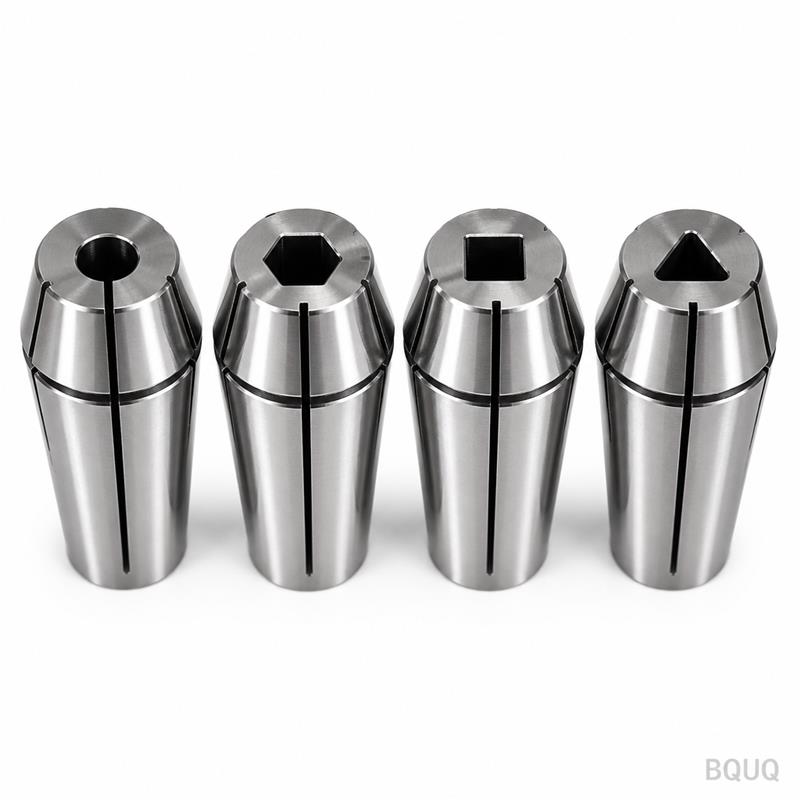
Power Chucks vs Spring Collets: First Op and Second Op
Short answer: use a spring collet when the part is round, bar-fed, thin-walled, or needs concentricity at 0.005–0.02 mm; use a power jaw chuck when the part is square, cast, forged, pre-machined, or comes in families of sizes. The classic split is exactly what the job titles say: first operation on bar stock belongs to the collet, second operation on an already-machined part usually belongs to a chuck with soft jaws — because collets grip a fixed round diameter, while second-op parts arrive with finished surfaces you cannot afford to mark.
First op and second op are not two names for the same problem; they are two different clamping problems. On first op the workholding grips raw bar and only has to hold it against the cut. On second op it grips a part that already has machined features, finished diameters, and a datum you must respect — without distorting or marking any of it. That difference drives the collet-versus-chuck decision more than any spec sheet comparison.
First Op: Bar Stock Belongs to the Collet
First operation on a turning machine usually starts from bar, and bar is round, continuous, and a known diameter — precisely the conditions a spring collet is built for. The collet wraps the full circumference, centers on the bar's own axis, and repeats within 0.005–0.02 mm on a matched bore. Feeding bar through a collet is also mechanically simple: open, feed, close, cut.
A 3-jaw power chuck on the same job holds only at three points, centers on the jaw geometry rather than the bar axis, and typically repeats within 0.03–0.08 mm on a good day. It also cannot feed bar without add-on mechanisms. For round bar work the collet wins on concentricity, on part distortion, and on simplicity. The only reason to put a chuck on first-op bar work is extreme grip demand — heavy roughing on large diameters where a 6-inch-plus chuck's grip force in the tens of kN exceeds what a collet of practical size can deliver.
Collet chucks blur the line usefully. A collet chuck mounted on a power-chuck spindle accepts collets for bar work and can switch to a jaw top for the same part family on second op, which is why many turning centers are specced with one. The concentricity you get still depends on the collet side of the system, so treat the chuck as a carrier and judge it by the collet seat's runout rather than by the jaw specifications.
Second Op: The Part Decides
Second operation grips a part that already exists: a turned shoulder, a hex head, a casting, a bracket. Two problems appear that first op never had.
Marking. The finished surfaces from first op are the very surfaces you are about to hold. A steel collet closing on a finished diameter at full force leaves grip marks. The standard answer is a chuck with soft jaws — aluminum or mild steel jaws machined to the part's exact contour, so the clamping load spreads over a large area at low pressure.
Distortion. Thin-walled or easily deformed parts collapse under three-point loading. A collet's 360° grip is gentler per unit area; soft jaws machined to full part contour come close. For a thin ring or a delicate sleeve, three hard jaws will measure a triangle into the part that no amount of machining after clamping will fully remove.
Axial location is the third second-op concern. The part must stop at the same Z position on every clamp because second-op features reference first-op length. In first op, bar seats against a fixed stop inside the collet; in second op the part usually seats on a chuck face, a pocket machined into soft jaws, or a backstop pin — and that seating surface must stay clean, because a 0.05 mm chip under the part reads directly as a length error. Soft jaws machined with a registered pocket give contour grip and the axial stop in one setup.
| Workholding | Concentricity (typical) | Grip distribution | Size flexibility | Marking risk |
|---|---|---|---|---|
| Spring collet, matched bore | 0.005–0.02 mm | Full 360° | One diameter per collet | Low–medium |
| 3-jaw power chuck, hard jaws | 0.03–0.08 mm | 3 points | Wide, via jaw adjustment | High on finished surfaces |
| 3-jaw chuck, soft jaws machined to part | 0.01–0.03 mm | Contour (near full) | Wide, re-machined per part | Low |
| 2J or 5C collet chuck on second op | 0.01–0.025 mm | Full 360° | Collet per diameter | Medium on finished bore/OD |
That table is the whole argument in miniature: collets win on truth and even grip but lose on flexibility; chucks win on flexibility but must be tamed with soft jaws to protect finished work.
Concentricity: The Feature That Usually Decides
If the second op must run true to a first-op diameter — a turned boss, a bored hole — the workholding must center on that same axis. A collet gripping the finished OD centers on it directly, giving 0.005–0.02 mm between the gripped surface and the new cut. A chuck gripping the same OD centers on its jaws, and unless those jaws were machined in place on the chuck, you inherit the chuck's 0.03–0.08 mm error band.
The practical move for high concentricity second ops is a collet chuck — a chuck body that accepts collets — which gives the operator both worlds: collet truth for round parts, and the ability to switch to jaw options when the part is not round. The 2J collet chuck guide covers the most common second-op collet chuck family, and our comparison of collets against jaw chucks digs into the concentricity math.
One rule belongs with concentricity: never grip a feature you are about to machine away unless the operation plan forces it. If second op must turn a boss true to a first-op bore, the workholding should grip the bore's parent diameter — or the bore itself with an expanding collet — not squeeze the boss you are about to cut. Workholding that destroys its own datum is the most common second-op design error, and it shows up as parts that pass at the machine and fail at the CMM.
Speed, Force, and the Centrifugal Problem
Power chucks advertise grip force in the tens of kilonewtons, and at low speed they deliver it. The catch is centrifugal: as spindle speed rises, the jaws want to fly outward, and grip force falls — a 200 mm-class chuck that holds 60 kN static can lose 30–50% of that by 3,000–4,000 rpm, and more above. Counter-centrifugal designs compensate with lever mechanisms, at a price. Spring collets grip by drawbar force that does not decay the same way, which is one reason high-speed bar work stays with collets.
Forces also interact with part quality. A power chuck at full grip on a thin part distorts it; at reduced grip it may slip. Collets apply a gentler, even pressure that suits finish work, but their absolute grip is limited by the drawbar and taper geometry, so heavy interrupted cuts favor the chuck. The decision sequence: roundness and truth first, then grip demand, then speed.
Practical Selection Rules
The decision table below is the quick reference version of everything above.
| Job condition | First choice | Why |
|---|---|---|
| Round bar, first op, tight concentricity | Spring collet | 360° grip, 0.005–0.02 mm truth |
| Thin-walled or marking-sensitive part | Collet or soft jaws | Even pressure, low marking risk |
| Hex, square, cast or forged part | Jaw chuck with soft jaws | Shape flexibility |
| Family of many sizes on one machine | Jaw chuck | Jaw change beats collet inventory |
| Heavy interrupted roughing | Power chuck | High grip force in the tens of kN |
First op on bar, round stock, tight concentricity, thin walls, or high speed — collet. Second op on a round feature that must run true — collet chuck or soft-jaw chuck machined in place. Second op on hex, square, cast, forged, or odd shapes — jaw chuck with soft jaws cut to the part. Family of parts across many sizes on one machine — jaw chuck, because jaw change beats collet inventory. Heavy roughing with interrupted cuts — power chuck. Marking-sensitive finished surfaces — soft jaws or a collet with controlled force, never hard jaws.
The two systems are complements, not competitors. Most productive turning cells carry both: a collet or collet chuck for first op and round second ops, a power chuck with soft jaws for the irregular rest. Our power chuck guide covers chuck types and grip-force behavior for the chuck side of the decision.
Walking a Two-Op Job: Two Worked Examples
Take a connector pin turned from 10 mm brass bar. First op: a collet grips the bar, the machine turns the OD, drills and parts off at length. Second op: the part needs a chamfer and a cross-hole referenced from the turned OD, and the fixture grips the finished 9.8 mm diameter — a collet or collet chuck sized to 9.8 mm holds the datum surface with 0.01–0.02 mm truth, and the cross-hole drills on location. A hard-jaw chuck would grip the same OD at three points, and because brass marks easily, every pin would show jaw witness lines; soft jaws machined to the part would work but add a jaw-cutting step for every size.
Now take the opposite case: a die-cast aluminum housing, rectangular with two cast bosses, arriving from the casting line for a mill-and-tap second op. No collet grips a rectangle; the job belongs to a power chuck or vise with soft jaws machined to the casting contour, gripping the two bosses to spread load across thin walls. Concentricity to the cast datum is not a 0.01 mm question — the cast feature itself sits at ±0.1 mm — so the chuck's repeatability band matters far less than its flexibility and grip. The two examples state the whole rule: let the datum and the geometry pick the workholding.
Frequently Asked Questions
Q: Why are collets better than chucks for first operation on bar?
A: Bar is round, continuous, and a known diameter, which is exactly what a collet grips best: full 360° contact, 0.005–0.02 mm concentricity, no jaw adjustment, and simple feed-through operation. A 3-jaw chuck holds at three points, repeats within 0.03–0.08 mm, and needs extra mechanisms to feed bar.
Q: When should I use a power chuck instead of a collet?
A: When the part is not round, comes in many sizes, arrives as a casting or forging, or demands grip force beyond practical collet capacity — heavy roughing and interrupted cuts. On second op, use a chuck with soft jaws machined to the part contour to protect finished surfaces.
Q: How do I avoid marking finished surfaces on second op?
A: Hold finished work with soft jaws machined to the part's exact contour, or with a collet at controlled force. Hard jaws concentrate load at three points and will mark or distort machined surfaces. For round second-op parts needing high concentricity, a collet chuck gripping the finished OD is often the better answer.
Q: What concentricity can I expect from a collet chuck on second op?
A: Typically 0.01–0.025 mm between the gripped feature and the new cut, depending on collet grade and chuck quality. That beats a hard-jaw power chuck (0.03–0.08 mm) and roughly matches a soft-jaw chuck whose jaws were machined in place on the machine.
Q: Do power chucks lose grip at high speed?
A: Yes. Centrifugal force pushes the jaws outward as speed rises, and grip force can drop 30–50% by 3,000–4,000 rpm on a standard 200 mm-class chuck. Counter-centrifugal designs reduce the loss but cost more. Collet grip, driven by the drawbar, does not decay the same way, which keeps collets dominant for high-speed bar work.
Related Resources
- Collets vs jaw chucks: concentricity, grip and distortion compared for turning workholding.
- 2J collet chuck guide: the workhorse collet chuck family for second-op machining.
- Power chucks: hydraulic and pneumatic chucks with soft-jaw options for second-op work.
- About BQUQ: ISO9001-certified source factory in Dongguan making collets, chucks and precision turned parts in-house.
- Contact us: send your part drawing and op sequence for a workholding recommendation within 12 working hours.
Authored by the BQUQ Engineering Team. BQUQ is an ISO9001-certified source factory in Dongguan, China, running CNC machining, metal stamping, custom springs, heat sink and collet lines under one roof. Send drawings to sc@bquq.com or WhatsApp +86 13713157787 for a quote within 12 working hours. www.bquq.com