"Power chucks for production turning: hydraulic vs pneumatic actuation, grip force at speed and jaw safety. BQUQ machines power chucks to a 0.005 mm class."
"Power Chucks: Hydraulic and Pneumatic Gripping for Production Turning"
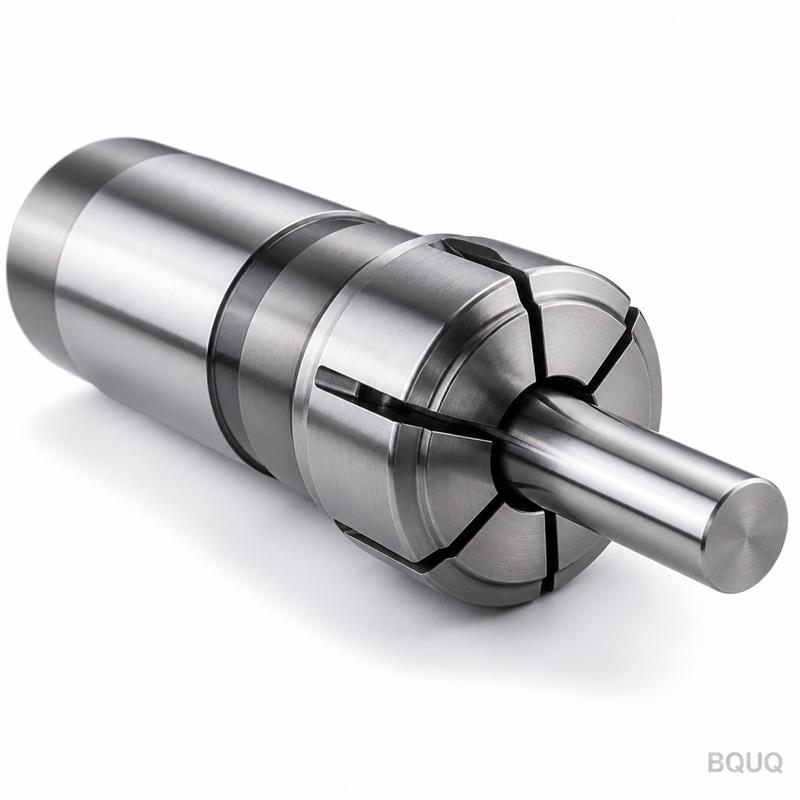
A power chuck is a self-centering chuck that opens and closes under hydraulic or pneumatic pressure instead of by hand, giving a production lathe fast, repeatable part changes with a grip force set by the operator rather than by arm strength. Hydraulic actuation carries the force; pneumatic actuation carries the speed; both exist because manual chucking is the bottleneck nobody budgets for.
On a manual lathe the chuck is a fixture. On a production lathe the chuck is a mechanism — it cycles thousands of times per shift, must grip with a repeatable force, and must not let go when spindle speed and cutting forces fight it. Power chucks automate that cycle. This guide covers how they work, the hydraulic-versus-pneumatic decision, and the grip-force physics that decide whether your parts stay put.
Anatomy of a Power Chuck
A power chuck system has four parts. The chuck body mounts on the spindle nose. Inside it, a mechanism — usually a wedge-hook or lever linkage — converts axial motion into radial jaw movement. The actuator is a hydraulic or pneumatic cylinder mounted behind the spindle, connected by a draw tube through the spindle bore. And the jaws, typically three, carry hardened top jaws or machinable soft jaws that actually touch the part.
The mechanism matters because it defines the chuck's personality. Wedge-hook chucks are the production standard: stiff, accurate, and their grip force can be adjusted by regulating pressure. Lever-type chucks hold force better at speed in some designs because the linkage geometry compensates for centrifugal effects. Scroll chucks are the manual ancestor. For bar work, a through-hole chuck lets stock pass through the spindle; for chucked blanks, a closed center gives more rigidity.
| Chuck type | Actuation | Typical strengths | Typical limits |
|---|---|---|---|
| Wedge-hook power chuck | Hydraulic or pneumatic | Stiff, accurate, adjustable force | Jaw travel limited per size |
| Lever-type power chuck | Hydraulic | Good force retention at speed | More parts, higher cost |
| Scroll chuck | Manual (power versions exist) | Low cost, wide jaw travel | Slower, less repeatable force |
| Through-hole power chuck | Hydraulic/pneumatic | Bar and chucked work on one spindle | Smaller jaw force vs closed center |
Hydraulic vs Pneumatic: The Real Trade
Pneumatic chucks are cheaper and faster to cycle — shop air is everywhere and a pneumatic cylinder strokes quickly. But air is compressible, so pneumatic grip is softer and force falls as the system leaks or the compressor sags. Hydraulic chucks cost more and need a pump and reservoir, but oil is nearly incompressible: grip is stiff, force is repeatable, and the same chuck size can deliver substantially higher grip at the jaws. The choice tracks the workpiece: light alloys and delicate parts run happily on pneumatic; steel and aggressive roughing want hydraulic.
| Factor | Pneumatic | Hydraulic |
|---|---|---|
| Typical supply | Shop air, 6–8 bar | Oil, up to ~70 bar typical |
| Stiffness of grip | Soft (air compresses) | Stiff (oil nearly incompressible) |
| Cycle speed | Fast | Slightly slower but adjustable |
| Typical grip force range (6 in chuck, typical) | ~5–15 kN | ~20–50 kN |
| Cost and maintenance | Low | Higher, oil system to maintain |
Force figures are typical catalog ranges for a mid-size chuck and vary with pressure, jaw weight and design. The pattern to remember: pneumatic wins on speed and price for light work; hydraulic wins wherever grip stiffness and force decide the cut.
Grip Force at Speed: The Physics Nobody Escapes
Here is the number that catches new operators: a chuck's grip force at rest is not its grip force at 4,000 rpm. Jaws are masses on a rotating carrier, and centrifugal force tries to throw them outward, opposing the grip. The bigger and heavier the jaws — soft jaws especially — the more force you lose as speed climbs. A chuck rated for full grip at rest can lose a third or more of that grip at high speed with heavy jaws.
| Spindle speed | Typical grip force retained (illustrative) |
|---|---|
| 0 rpm (static rating) | 100% |
| ~2,000 rpm, light jaws | ~90–100% |
| ~4,000 rpm, light jaws | ~70–85% |
| ~4,000 rpm, heavy soft jaws | ~50–70% |
These are illustrative retention patterns, not a universal curve — every chuck maker publishes a grip-force-versus-speed chart for their model and jaw set, and you should run from any supplier that cannot show one. The operational rules: machine soft jaws light, add a safety factor to grip force for heavy roughing, and never assume the static rating applies at your top speed.
Jaws, Safety and Maintenance
Top jaws come in two philosophies. Hardened top jaws with serrated or pie-shaped inserts are for repeat jobs at fixed diameters. Machinable soft jaws are bored or turned to the exact part contour, which spreads grip over more area — the right answer for thin-wall parts, odd shapes and jobs where marking the workpiece is not acceptable. Whatever the jaw, the grip line should be as low as practical to reduce bending on the part, and grip force should be set for the part, not for the chuck's maximum.
Safety on a power chuck is not optional: pressure loss must fail the chuck closed or be interlocked against spindle start, draw-tube stroke must be verified before the door closes, and grip force should be periodically measured with a force gauge rather than assumed from the pressure gauge. Maintenance is mostly lubrication of the wedge ways and checking jaw serration wear — a chuck that stops re-centering is usually a dirty or dry chuck before it is a worn one. Our collets vs jaw chucks comparison covers when to step down from jaw chucks to collets for small round work, and the 2J collet chuck guide shows the collet alternative for Swiss and auto lathes.
When the job needs a chuck or collet chuck machined to a real tolerance — jaw seats, tapers and locating bores in the 0.005 mm class — BQUQ machines power chucks and Swiss-type chucks plus auto-lathe collets on CNC equipment under one ISO9001 roof in Dongguan. Send your spindle nose, bar or blank sizes and jaw requirements to sc@bquq.com for a quote within 12 working hours.
Email sc@bquq.com or WhatsApp +86 137 1315 7787 with your PDF/DXF/STEP file. An engineer reviews it and replies with price, lead time and DFM notes on working days.
Frequently Asked Questions
Q: How much grip force do I actually need?
A: Enough that the part cannot rotate or pull out under the heaviest cut, with a safety margin — typically 2–3 times the calculated cutting torque requirement. Measure it with a grip force gauge at operating speed rather than trusting the pressure gauge alone.
Q: Is a pneumatic chuck accurate enough for precision turning?
A: Yes, for many jobs — the chuck's centering accuracy is set by its mechanism and jaws, not the fluid. Pneumatic chucks hold their accuracy fine; their limit is softer, less repeatable grip force, which matters more for heavy cuts than for tolerance.
Q: Why does my part slip at high rpm when it held fine at low speed?
A: Centrifugal force on the jaws is fighting your grip, and it grows with the square of speed. Heavy soft jaws lose the most. Check the maker's force-versus-speed chart and either raise pressure, lighten the jaws, or reduce top speed.
Q: How often should I check grip force on a power chuck?
A: Schedule a grip force check at every major job change and at regular intervals — monthly is common for production cells — plus any time you change jaw type or see a quality shift. Force decays with wear and contamination long before the chuck looks bad.
Q: Can I run bar stock through a power chuck?
A: Only through a through-hole chuck with a spindle and draw tube that clear the bar. If bar work is in your future, buy the through-hole version from the start — retrofitting a closed-center chuck to bar work means replacing it.
Authored by the BQUQ Engineering Team. BQUQ is an ISO9001-certified source factory in Dongguan, China, running CNC machining, metal stamping, custom springs, heat sink and collet lines under one roof. Send drawings to sc@bquq.com or WhatsApp +86 13713157787 for a quote within 12 working hours. www.bquq.com