Clamping Pressure for Collets: Air, Hydraulic and Manual
Short answer: Manual collet chucks rely on operator torque — typically 40-80 N·m on an ER nut or drawbar, producing roughly 8-15 kN of axial pull and 2-5 kN of radial grip on a 20 mm bore. Pneumatic (air) closers usually run 0.5-0.7 MPa shop air and deliver 6-12 kN of drawbar force, while hydraulic power chucks run 2.5-6.5 MPa oil pressure for 15-40 kN. Higher pressure means more grip and better resistance to pull-out, but it also loads the collet taper and the workpiece surface. The right number is the lowest pressure that holds the part through the heaviest cut without slipping — not the maximum the pump can produce.
Why clamping pressure is not the same as gripping force
Buyers often ask for "a collet chuck that clamps at 6 bar" as if pressure were a specification. It is not. Pressure is an input; gripping force is the output, and the conversion depends on the actuator's piston area, the mechanical advantage of the wedge or lever, the drawbar thread pitch, and friction losses in the closer.
A pneumatic closer with a 100 mm bore piston at 0.6 MPa produces about 4.7 kN of thrust before any multiplication. A toggle or wedge mechanism with a 3:1 ratio turns that into roughly 14 kN of drawbar pull. A hydraulic cylinder of the same bore at 4 MPa produces about 31 kN — more than six times the air version at the same physical size. That is the core reason hydraulic systems dominate high-metal-removal turning and why air systems dominate lighter work, automation and quick-change setups.
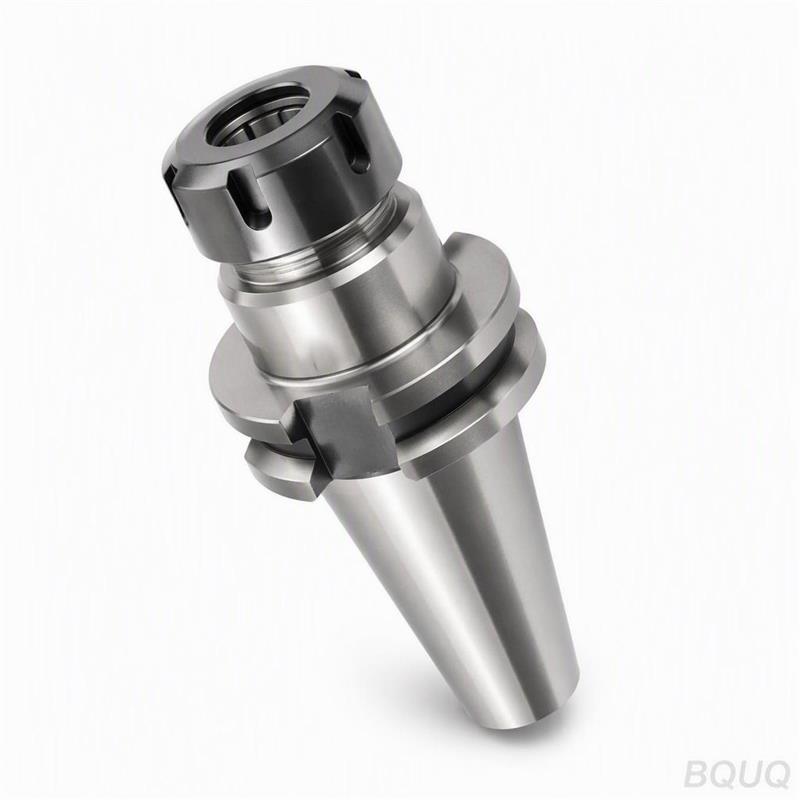
The second conversion step is drawbar pull to radial grip. On a 5C or ER-style collet, the taper angle (commonly 8° or 16°) determines how much of the axial pull becomes radial closing force. A shallow taper multiplies force more aggressively but has a narrower elastic range. This is why collet taper angle matters as much as pressure when you are chasing grip.
The three variables that actually decide holding power
- Axial pull (N) — set by actuator pressure, piston area and mechanical advantage.
- Taper multiplier — set by collet geometry, typically 2-4x axial to radial.
- Friction coefficient — set by bore finish, workpiece material and whether coolant or oil is present.
Multiply the first two, apply friction, and you get the tangential force the collet can resist before the part spins. That number — not the gauge reading — is what you should compare against your cutting force.
Air, hydraulic and manual: side-by-side comparison
The table below gives indicative ranges for 20-25 mm bore collet systems. Exact values depend on the specific closer, so treat these as planning figures and confirm with the chuck supplier.
| Parameter | Manual (nut / drawbar) | Pneumatic (air) | Hydraulic |
|---|---|---|---|
| Input pressure or torque | 40-80 N·m nut torque | 0.5-0.7 MPa air | 2.5-6.5 MPa oil |
| Typical drawbar pull | 8-15 kN | 6-12 kN | 15-40 kN |
| Radial grip on 20 mm bore | 2-5 kN | 2.5-5 kN | 6-15 kN |
| Clamp / unclamp time | 5-30 s manual | 0.3-1.5 s | 0.2-1.0 s |
| Repeatability of clamp force | Poor (operator dependent) | Good | Excellent |
| Best fit | Job shop, low volume, setup work | Automation, light-medium turning | High removal, hard turning, Swiss |
When manual clamping is still the right answer
Manual is not obsolete. For prototype runs, one-off fixturing, and low-volume work where setup flexibility beats cycle time, a torque wrench and a quality collet nut give you full control and zero capital cost. The failure mode to watch is under-torquing: an operator who "snugs" an ER32 nut to 20 N·m instead of the specified 60-80 N·m loses roughly two-thirds of the available grip and will see pull-out on the first heavy pass.
When air wins
Pneumatic closers are the default for automated lathes, bar feeders and any cell where a robot or PLC triggers the clamp. They are clean, cheap to run, and fast. Their limit is force density: to match a hydraulic chuck you need a much larger cylinder, which may not fit the spindle bore or the machine envelope.
When hydraulic is mandatory
Hydraulic power chucks earn their cost when cutting forces are high — interrupted cuts in steel, hard turning above 45 HRC, or heavy boring where the tool pushes the part tangentially. The hard turning workholding guide covers this in detail. Hydraulic also gives the most repeatable clamp force, which matters when you are holding thin-wall parts and cannot afford bore distortion variation between cycles.
How much pressure do you actually need?
Work backwards from cutting force. For a turning operation:
Tangential force (N) ≈ specific cutting pressure (N/mm²) × depth of cut (mm) × feed (mm/rev)
For mild steel, specific cutting pressure is roughly 2000-2500 N/mm². A 2 mm depth of cut at 0.25 mm/rev gives about 1000-1250 N of tangential force. Add a safety factor of 2-3 for interrupted cuts and vibration, and you need the collet to resist 2500-3750 N. With a friction coefficient of 0.15 on a dry steel bore, radial grip must be at least 17-25 kN. That immediately rules out manual and most air systems on a 20 mm bore — you need hydraulic, or you need to reduce depth of cut.
| Cutting condition | Est. tangential force | Minimum radial grip (SF 2.5) | Practical clamping method |
|---|---|---|---|
| Aluminium, 1 mm DOC, 0.2 mm/rev | ~250 N | ~4 kN | Manual or air |
| Mild steel, 1 mm DOC, 0.2 mm/rev | ~450 N | ~7.5 kN | Air (high end) or hydraulic |
| Mild steel, 2 mm DOC, 0.25 mm/rev | ~1100 N | ~18 kN | Hydraulic |
| Alloy steel 45 HRC, 0.3 mm DOC | ~1500 N | ~25 kN | Hydraulic, reduced overhang |
These are indicative. Real numbers depend on tool geometry, rake angle, coolant and rigidity of the whole system.
The over-clamping trap
More pressure is not free. Every extra kilonewton of radial grip elastically deforms the collet bore and, on thin-wall parts, the workpiece itself. Over-clamping a 1 mm-wall aluminium tube at 15 kN will collapse it into a triangle. Over-clamping a hardened collet repeatedly accelerates fatigue at the taper and shortens life. It also makes release harder, which in automated cells causes stuck parts and crashed loaders.
The correct target is the lowest pressure that survives your worst-case cut with a 2-2.5 safety factor. Log it, and put it on the setup sheet.
Pressure, runout and part quality
Clamping pressure interacts with accuracy in ways that surprise buyers. Higher pressure seats the collet more firmly on the taper, which usually improves repeatability — up to a point. Beyond that point, elastic deformation of the collet body and the workpiece starts to dominate, and TIR degrades.
A few practical observations from production:
- A well-made collet at moderate pressure typically holds 0.005-0.010 mm TIR on a ground bore. Pushing to maximum pressure rarely improves this and often makes it worse.
- Uneven clamping — caused by a worn nut, a damaged taper or debris — shows up as runout that changes with pressure. If TIR moves when you change pressure, the problem is the interface, not the pressure.
- Thermal growth during long cycles shifts the effective grip. This is covered in the runout and thermal behaviour article.
Air pressure stability matters more than air pressure level
A shop running 0.6 MPa nominal may actually see 0.45-0.65 MPa depending on compressor cycling, other machines drawing air, and line length. That 30% swing translates directly into a 30% swing in grip force. If you are relying on air clamping for near-limit cuts, install a dedicated regulator and accumulator at the machine. It is cheaper than scrapping parts.
Matching the collet system to the pressure source
Not every collet family tolerates every pressure level. The table below maps common systems to typical clamping methods.
| Collet system | Common clamping method | Typical max drawbar pull | Notes |
|---|---|---|---|
| ER8-ER16 | Manual nut, small air | 3-8 kN | Tool holding, light work |
| ER20-ER32 | Manual nut, air, hydraulic | 8-15 kN | General milling and turning |
| ER40-ER50 | Manual nut, hydraulic | 15-25 kN | Heavy milling, large bores |
| 5C | Manual drawbar, air, hydraulic | 10-20 kN | Lathe work, fixtures |
| Swiss-type collets | Hydraulic / pneumatic | 8-20 kN | Guide bushings, small parts |
| Auto-lathe collets | Pneumatic / hydraulic | 10-30 kN | Bar work, high volume |
For Swiss and automatic lathe work, the auto-lathe collet range is designed around specific closer geometries, so always match the collet to the machine's actuator rather than assuming a generic pressure figure. Similarly, power chucks for Swiss machines are engineered as a system — cylinder, drawbar and collet — and swapping one element without the others usually costs you grip or accuracy.
Choosing between air and hydraulic when both would work
If both options meet the force requirement, decide on:
1. Cycle time — hydraulic is marginally faster but both are sub-2 seconds.
2. Infrastructure — air is already in most shops; hydraulics need a power unit and oil maintenance.
3. Repeatability — hydraulic wins where clamp force variation affects part quality.
4. Footprint — air cylinders are bulkier for the same force.
5. Heat — hydraulic power units add heat to the shop; air is cooler.
For a broader decision framework, see the collet system selection guide.
Practical setup rules that prevent pull-out
- Clean the taper every shift. A 0.02 mm chip on the taper costs more grip than 1 MPa of extra pressure.
- Replace nuts, not just collets. A worn nut thread loses 20-30% of transmitted force.
- Torque to spec. ER32 nuts are typically 60-80 N·m; ER40 100-130 N·m. Use a torque wrench, not feel.
- Verify air line pressure at the machine, not at the compressor.
- Reduce overhang before increasing pressure. Stiffness beats force every time.
- Check TIR at working pressure, not at hand-tight.
- Document the pressure on the setup sheet so the next shift repeats it.
Gauges and verification
Fit a pressure gauge downstream of the regulator on every air closer, and a gauge on the hydraulic manifold. Without a gauge you have no way to detect a failing seal, a clogged filter or a compressor problem until parts start moving. For high-value work, a drawbar force gauge used at setup confirms the whole chain is delivering what the calculation assumed.
How BQUQ supports collet and chuck projects
BQUQ manufactures precision collets, collet chucks and power chuck components in one ISO9001 factory in Dongguan, across four production lines — CNC machining to ±0.005 mm, metal stamping, custom springs and heat sinks. We quote in 12 working hours and work with flexible MOQ, which suits both prototype validation and volume production. If you are specifying a collet system around a known clamping pressure, send us the bore size, taper, actuator type and required grip force, and we will confirm geometry and material.
Frequently Asked Questions
Q: What air pressure do pneumatic collet chucks normally need?
A: Most pneumatic collet closers are designed for 0.5-0.7 MPa (5-7 bar) shop air, with 0.6 MPa being the common nominal figure. Actual grip force depends on piston area and mechanical advantage, so two chucks rated for the same pressure can differ by 2x in drawbar pull. Always confirm the force curve, not just the pressure rating, and install a dedicated regulator at the machine.
Q: Is hydraulic clamping always stronger than pneumatic?
A: For the same physical envelope, yes — hydraulic oil at 4-6 MPa produces far more force than air at 0.6 MPa, often 3-6x more drawbar pull from a comparable cylinder. However, a very large air cylinder can match a small hydraulic one. The real advantage of hydraulic is force density and repeatability, not an absolute rule that hydraulics always wins.
Q: Can I over-clamp a collet and damage the workpiece?
A: Yes. Thin-wall tubes, small-diameter shafts and soft materials deform elastically or permanently under excessive radial grip. A 1 mm-wall aluminium tube can collapse at 10-15 kN of grip. Over-clamping also accelerates collet taper fatigue and makes part release unreliable in automated cells. Use the lowest pressure that holds through your worst cut with a 2-2.5 safety factor.
Q: How do I know if my clamping pressure is too low?
A: The classic symptoms are part pull-out or rotation under load, inconsistent length after a heavy pass, chatter that appears only on roughing cuts, and TIR that changes between light and heavy operations. If you see these, first check taper cleanliness and nut condition, then increase pressure in steps while monitoring TIR. Do not simply raise pressure without checking the interface.
Q: Does higher clamping pressure improve runout?
A: Not reliably. Moderate, consistent pressure seats the collet properly on the taper and usually gives the best repeatability. Beyond that, elastic deformation of the collet body and workpiece starts to dominate and TIR can worsen. If runout changes significantly when you change pressure, the root cause is usually a worn taper, damaged nut or contamination rather than insufficient force.
Related Resources
- About BQUQ and our Dongguan factory: /about/
- Collet and chuck product range: /auto-lathe-collets/
- Power chucks for Swiss-type machines: /power-chucks-swiss/
- Industry trends in workholding and machining: /industry-dynamics/
- Technical articles on collets and CNC: /bquq-blog/
- Frequently asked questions: /faq/
- Case studies: /case/
- Contact our engineering team: /contact/
Authored by the BQUQ Engineering Team. BQUQ (Dongguan) runs CNC machining (±0.005 mm), metal stamping, custom springs, and heat sink production in one ISO9001 factory. Source-direct from Dongguan, China — quote in 12 hours: sc@bquq.com | WhatsApp +86 13713157787 | www.bquq.com