Collet Taper Angle: What the 20 and 30 Degree Difference Means
Short answer: The taper angle sets how much radial force the nut can convert into grip. A 30° cone (TG-style, 0.5 mm collapse range) is more forgiving and grips a wider diameter window; a 20° cone (ER-style, 1.0 mm collapse range) is more self-locking and holds better under heavy side load, but needs tighter nut torque control. Both are ground to the same class of accuracy — typically 0.008–0.015 mm TIR at 3×D — so the angle changes holding power and range, not the base precision. Choose 30° for general milling and tapping, 20° for high-torque or vibration-prone cuts.
Why the taper angle matters at all
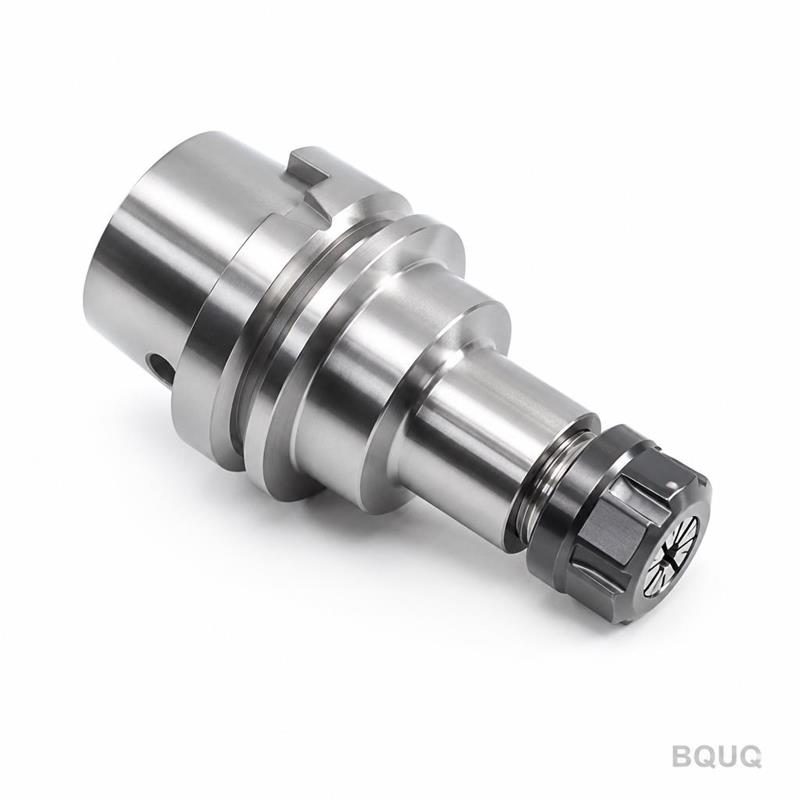
A collet does nothing on its own. It is a slotted, hardened sleeve that only grips when the nut pushes it down a matching cone. That cone is the entire mechanism. Every newton the nut applies axially has to be redirected radially into the bore — and the angle of the cone decides how efficiently that happens.
Think of it as a wedge. A shallow wedge (small angle from the axis) multiplies force more but travels less. A steep wedge travels more but multiplies less. Collets sit in a narrow band of that trade-off, and the two dominant values in metalworking are 20° and 30° included half-angles, depending on how the catalogue measures them.
The practical consequences show up in four places:
- Grip length along the bore — how much of the tool shank is actually clamped.
- Collapse range — how far the collet can close before it bottoms out or distorts.
- Self-locking behaviour — whether the collet releases cleanly or sticks in the nut.
- Runout stability over time — whether accuracy drifts after thousands of tool changes.
If you are selecting a collet system from scratch, the taper is the first decision, not the last. It constrains everything downstream.
How a collet taper converts torque into grip
The nut thread generates an axial pull. That pull is resolved at the cone into a normal force perpendicular to the taper face. The radial component is the gripping force; the tangential component is friction that resists release.
For a cone of half-angle α, the radial force scales roughly with 1/tan α for a given axial load, before friction losses. Smaller α means more radial force per unit of nut torque — which is why 20° systems feel like they bite harder at the same wrench setting.
But that is only half the story. Smaller α also increases the self-locking tendency: the friction angle of ground steel on ground steel is often in the same range as the cone angle itself, so the collet can wedge into the nut and refuse to drop out. That is a real production annoyance, and it is why many shops keep a dedicated release tap or a nut with a built-in extraction ring.
| Property | 20° taper (ER family) | 30° taper (TG / 100-style) |
|---|---|---|
| Collapse range (typical) | ~1.0 mm on diameter | ~0.5 mm on diameter |
| Radial force per unit nut torque | Higher | Lower |
| Self-locking tendency | Moderate to high | Low |
| Release behaviour | Needs clean nut, sometimes a tap | Drops out readily |
| Best for | Heavy side load, high torque, rigid setups | Mixed work, tapping, quick changes |
| TIR at 3×D (typical, quality grade) | 0.008–0.015 mm | 0.008–0.015 mm |
| Nut torque sensitivity | High | Moderate |
The TIR row is deliberately identical. Angle does not make a collet accurate — grinding, slotting, heat treatment and bore concentricity do. Angle makes it strong or forgiving.
20° collets: ER, and why they dominate
The ER family is the most widely used collet in the world, and it is a 20° design. The reasons are practical rather than exotic:
Wide collapse range. A single ER32 collet covers a 1 mm band, so a shop can hold 20 mm and 20.5 mm shanks with the same sleeve. That reduces inventory and tool-change time. For job shops running mixed batches, this alone justifies the choice.
Strong grip under side load. Because more of the nut torque becomes radial force, ER collets resist pull-out well in milling and in interrupted cuts. This is why ER chucks are the default for end mills in a tool holder collet chuck setup.
Forgiving of imperfect shanks. A 20° cone conforms over a longer axial contact length, so a slightly worn or undersized shank still gets meaningful contact area.
The trade-offs are real. ER collets are more sensitive to over-torquing — excess torque distorts the bore and permanently degrades accuracy. They also demand a clean nut and a correctly seated collet, or the collet skews and the runout jumps. Poor seating is one of the most common causes of the runout problems covered in our article on collet accuracy grades.
When 20° is the wrong answer
If your process involves frequent tool changes with operators who will not use a torque wrench, or if you are running small-diameter work where collapse range matters less than repeatability, a 20° system can become a source of variation. It is not the angle's fault — it is the discipline the angle demands.
30° collets: TG and the 100-style family
The TG and 100-style collets use a steeper cone. The steeper angle reduces the radial multiplication but buys three things:
Cleaner release. The collet does not wedge. It drops out of the nut, which matters enormously in automated or high-change-frequency setups.
Lower torque sensitivity. A wider window of acceptable nut torque means less operator-to-operator variation. In a shop with several machinists on the same machine, that consistency is worth more than peak grip.
Better behaviour in tapping. Tapping collets are often steeper because the load is primarily axial and torsional rather than a bending side load. The steeper cone also gives more room for the square-drive feature.
The cost is collapse range. A 30° collet typically covers about half the diameter band of an equivalent 20° collet, so you need more sleeves to cover the same shank range. For a shop with a fixed set of tool shanks, that is a non-issue. For a job shop, it is a real inventory decision.
A note on naming confusion
Catalogue "angle" is not always quoted the same way. Some suppliers list the included cone angle, others the half-angle, and a few quote the angle of the nut's internal face rather than the collet's outer cone. Before comparing two datasheets, confirm which convention is used. A "20°" and a "30°" from different sources may be closer than the numbers suggest — or further apart. If in doubt, ask for a section drawing.
Comparing the two in a real machining decision
Here is how the choice plays out across common operations.
| Operation | Recommended taper | Reason |
|---|---|---|
| End milling, deep axial cut | 20° | Higher radial grip resists pull-out |
| Interrupted / rough milling | 20° | Better damping of side load |
| Tapping (rigid or floating) | 30° | Axial-dominant load, clean release |
| Drilling with small bits | 30° | Fast changes, low torque needed |
| High-mix job shop, many shank sizes | 20° | Wider collapse range per sleeve |
| Automated tool change, many cycles | 30° | Reliable release, less skew risk |
| Swiss-type lathe guide bushing work | Matched to bushing spec | Bushing and collet must pair |
| Precision finishing, light cuts | Either | Accuracy comes from grade, not angle |
Notice that the last row is the one buyers forget. If your cut is light and your shank is nominal, taper angle barely affects the result. Runout, bore finish and nut condition dominate. That is why we separate angle selection from grade selection — they are different decisions, and conflating them leads to over-specifying one and under-specifying the other.
Slot design, pressure and the interaction with taper
Taper angle does not act alone. The slot pattern determines how the collet deflects, and the deflection determines whether the cone contact stays uniform. A collet with poorly cut slots will contact the cone unevenly regardless of angle, producing a tilted grip and elevated runout.
Three interactions are worth knowing:
Slot count and orientation. More slots give more uniform collapse but reduce stiffness. Interrupted slots (alternating from each end) improve flexibility without sacrificing as much rigidity. This is covered in detail in our piece on collet slot design.
Clamping pressure. Higher nut torque does not linearly improve grip — past a point it distorts the bore and the tool shank becomes the weakest link. The relationship is explored in collet clamping pressure.
Cone contact length. A shallow angle spreads contact over a longer axial band, which is more tolerant of minor cone wear. A steep angle concentrates contact, so cone wear shows up faster as runout drift.
For shops running production volumes, the practical answer is to treat the collet, nut and chuck body as one system and qualify them together. A precision collet in a worn nut is a wasted purchase.
Manufacturing tolerances that actually control performance
The taper angle is a nominal value; what matters is how tightly it is held. Two parameters dominate:
- Cone angle tolerance. A deviation of a few arc-minutes across the cone changes contact pattern. Quality collets are ground on taper grinders with in-process gauging.
- Bore-to-cone concentricity. This is the number that shows up as TIR at the tool tip. It is controlled by grinding the bore after heat treatment, in the same setup family as the cone where possible.
At BQUQ, collets are produced on four production lines in one Dongguan factory under ISO9001, with CNC machining held to ±0.005 mm on critical features. Hardened and ground collets are quenched, tempered and finish-ground to restore geometry after heat treatment — a step that is easy to skip and impossible to hide in the finished runout.
For buyers sourcing custom or non-standard collets, the practical checklist is:
1. Specify the taper angle and the measurement convention.
2. Specify the collapse range you need, not just the nominal bore.
3. Specify TIR at a stated distance (3×D is the common convention).
4. Specify the nut interface and thread.
5. State the material and hardness range.
That list turns a vague enquiry into a quotable drawing. It is also why we can return most collet quotations within 12 working hours — the ambiguity is removed up front.
Sourcing custom collets without over-specifying
A common failure mode in procurement is paying for precision that the process cannot use. A 20° collet ground to 0.005 mm TIR in a machine with 0.03 mm spindle error is money spent on nothing.
Work backwards instead:
- Measure the runout your process actually tolerates at the tool tip.
- Subtract the spindle and holder contribution.
- Buy the collet grade that closes the remaining gap.
For Swiss-type work, the collet and the guide bushing must be treated as a matched pair, which is why many shops source power chucks for Swiss machines and collets from the same supplier. Mixing sources across a matched pair is a reliable way to introduce runout you cannot diagnose.
For high-volume turning, auto lathe collets are usually specified with the machine builder's cone geometry, and the taper angle is fixed by the machine rather than chosen. In that case the sourcing question shifts entirely to tolerance control and repeatability batch to batch.
Frequently Asked Questions
Q: Does a 20° collet hold more than a 30° collet?
A: Yes, for the same nut torque, a 20° cone converts more axial force into radial grip, so it resists pull-out better under side load. The advantage is typically 20–40% more radial force before friction losses, depending on nut condition and lubrication. The trade-off is a stronger self-locking tendency, which makes release less clean and increases sensitivity to over-torquing.
Q: Can I use a 30° collet in a 20° nut?
A: No. The cone angles must match. A mismatched pair contacts on a line rather than a face, which concentrates stress, crushes the cone, and produces erratic runout. Even a small mismatch of a few degrees will damage both parts within a few clamping cycles. Always replace collet and nut as a matched set from the same specification.
Q: Which taper angle gives better runout?
A: Neither, by itself. Runout is set by bore-to-cone concentricity, grinding quality and heat-treatment control, not by cone angle. A well-made 30° collet will out-perform a poorly made 20° collet every time. Typical quality-grade collets hold 0.008–0.015 mm TIR at 3×D regardless of angle; the angle affects holding power and release behaviour.
Q: Why do ER collets cover a wider diameter range?
A: ER collets are 20° designs with a nominal 1 mm collapse range on diameter, roughly double the 0.5 mm typical of 30° TG-style collets. The shallower cone allows more axial travel before the collet bottoms out in the nut. That wider range reduces the number of sleeves needed to cover a set of shank sizes, which is a major reason ER dominates job-shop tooling.
Q: How do I specify taper angle on a custom collet drawing?
A: State the angle, the measurement convention (included angle or half-angle), and the reference face the angle is measured from. Add the collapse range, nominal bore, TIR at a stated distance, hardness range and nut thread. Ambiguity on convention is the single most common cause of rejected first articles. A section drawing removes the doubt entirely.
Related Resources
- About BQUQ and our Dongguan production setup: /about/
- Collet and chuck product range: /tool-holder-collet-chucks/
- Swiss-type power chuck options: /power-chucks-swiss/
- Auto lathe collet series: /auto-lathe-collets/
- Industry trends and sourcing shifts: /industry-dynamics/
- Technical articles library: /bquq-blog/
- Frequently asked questions: /faq/
- Case studies: /case/
- Contact the engineering team: /contact/
Authored by the BQUQ Engineering Team. BQUQ (Dongguan) runs CNC machining (±0.005 mm), metal stamping, custom springs, and heat sink production in one ISO9001 factory. Source-direct from Dongguan, China — quote in 12 hours: sc@bquq.com | WhatsApp +86 13713157787 | www.bquq.com