"ER collet sizes ER8 to ER50, runout grades, clamping range and torque for toolholding. BQUQ supplies CNC-made ER collets and collet chucks."
"ER Collets: Sizes, Runout Grades and Choosing the Right One"
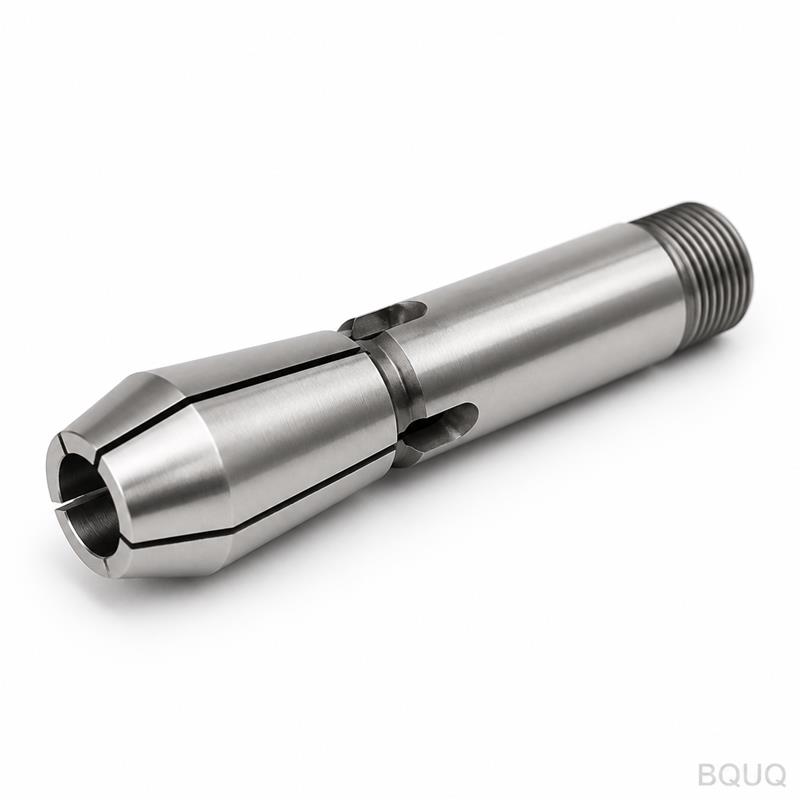
An ER collet is a slotted steel sleeve that grips a cutting tool's shank inside a collet chuck, and it is the world's most common toolholding collet because it is standardized, cheap and good enough for most work. The ER number is the collet's outside diameter in millimeters, the collet's real capacity is its clamping range, and its accuracy class decides whether your holes come out round.
ER collets are everywhere: in milling holders, drill chucks, tapping heads and lathe turrets. The system earned that position by solving the problem that older collets did not — one collet family, standard sizes, quick changeover. But "ER25" tells you only the socket size, not which collet to order. This guide covers the size ladder, what the runout grades promise, and the selection logic that prevents buying the wrong collet twice.
The Size Ladder: ER8 to ER50
ER collets are named by outside diameter: ER8 is 8 mm outside, ER50 is 50 mm outside, and the sizes between — ER11, ER16, ER20, ER25, ER32, ER40 — step up the shank capacity with it. Each collet clamps a range of shank diameters, usually marketed in 1 mm steps, so an ER25 collet marked 10 mm grips a 10 mm shank and collapses about half a millimeter per side to do it.
| ER size | Collet OD | Typical shank capacity | Typical use |
|---|---|---|---|
| ER8 | 8 mm | up to ~5 mm | Small drills, engraving |
| ER11 | 11 mm | up to ~7 mm | Small end mills, drills |
| ER16 | 16 mm | up to ~10 mm | Common on milling spindles |
| ER20 | 20 mm | up to ~13 mm | Medium tooling |
| ER25 | 25 mm | up to ~16 mm | The most common general size |
| ER32 | 32 mm | up to ~20 mm | Heavy general machining |
| ER40 | 40 mm | up to ~26 mm | Large tools, roughing |
| ER50 | 50 mm | up to ~34 mm | Largest ER tooling |
Capacities are typical for standard ER collets. The takeaway: pick the smallest socket that covers your largest shank, because larger collets mean heavier nuts, more mass to balance and slightly more runout contribution. If 90% of your tools are under 16 mm shank, an ER25 system beats an ER40 system for everything except that occasional big holder.
Runout Grades: What the Letters Mean
ER collets are made in accuracy classes, and the class is a promise about runout at the collet nose with a ground test bar. Standard-grade collets typically run to about 0.015 mm; precision grades tighten that to roughly 0.005 mm or better at the nose; between them sits the practical middle used by most shops. The international standard behind the system, ISO 15488 (originally DIN 6499), defines the geometry — the 8-degree taper, slot patterns, and test methods — while grades are a manufacturing quality statement on top of it.
| Grade (typical) | Typical runout at nose | Typical price multiple | Typical application |
|---|---|---|---|
| Standard | ~0.015 mm | 1.0× | General drilling, roughing, most milling |
| Precision | ~0.005–0.008 mm | 1.5–3× | Finishing, tighter holes, longer tools |
| High-precision | ~0.005 mm or better | 3×+ | Ultra-finish and critical features |
These are typical industry figures, not a universal table — every maker publishes its own grade values and test conditions, and the honest question is always "measured how and where?" What the grade never promises: runout at the tool tip (the tool shank adds its own error) or runout after years of nut abuse. Our precision collet grades guide examines what a runout spec really covers.
Slot Patterns and Collapse
Standard ER collets carry slots along their length so the segments can collapse inward. The common design uses six slots, staggered from each end, which lets the collet close evenly around the shank while staying round; some series use fewer, wider slots to gain collapse range at the cost of some evenness. When you tighten the nut, the nut's internal taper pushes the collet into the holder's taper, squeezing the segments onto the tool.
Two selection rules follow from the mechanics. First, order the collet to the shank, not "close enough": a 10 mm collet on a 10 mm shank collapses about half its available range, leaving margin; a 10 mm collet forced onto an 11 mm shank collapses to its limit, loses concentricity and may crack. Second, use the collet within its designed range — "reduced range" or "compact" ER collets exist for shanks that fall between standard steps and give better runout than a full-range collet stretched to the edge.
Torque, Nuts and Practical Selection
The nut does real work: it converts spanner force into the axial pull that collapses the collet. Under-torque and the tool pulls out or vibrates; over-torque and the collet is strained past its collapse range, which shows up as runout. Torque guidance is typically set per size — an ER25 nut commonly goes to roughly 100–120 N·m and an ER40 nut higher — but the number to follow is your holder maker's, not a neighbor's. Use the correct spanner or torque wrench on the correct nut flats; anti-seize on the nut threads keeps readings consistent.
| ER size | Typical nut torque range | Check |
|---|---|---|
| ER11 | ~20–35 N·m | Nut maker spec |
| ER16 | ~40–60 N·m | Nut maker spec |
| ER25 | ~100–120 N·m | Nut maker spec |
| ER32 | ~120–140 N·m | Nut maker spec |
| ER40 | ~140–170 N·m | Nut maker spec |
Typical ranges, and the column on the right is the point: nut design varies, so torque to the holder or nut manufacturer's number. Keep tapers and collets clean — a grain of swarf under a collet is a runout event — and replace collets that show cracked slots, wear steps or rust. ER collets are consumables with a long life, not heirlooms.
When you need collets or the collet chucks that seat them, machined by a source factory that treats the 8-degree taper and locating bores as precision surfaces, BQUQ machines both to a 0.005 mm class on CNC equipment — ER-system work alongside its auto-lathe spring collets under one ISO9001 roof in Dongguan. Send your shank list and holder sizes to sc@bquq.com for a quotation within 12 working hours.
Email sc@bquq.com or WhatsApp +86 137 1315 7787 with your PDF/DXF/STEP file. An engineer reviews it and replies with price, lead time and DFM notes on working days.
Frequently Asked Questions
Q: What does the number in ER25 mean?
A: The collet's outside diameter in millimeters. ER25 is 25 mm outside and clamps shanks up to about 16 mm. The number identifies the socket size and the family, not the shank capacity by itself.
Q: How much can an ER collet collapse?
A: About half a millimeter per side in standard designs, which is why collets are stepped in 1 mm shank sizes. Collapse is a working range — forced collapse beyond it costs concentricity and risks cracking the collet.
Q: Standard or precision ER collets — which do I need?
A: Match the grade to the operation: standard (about 0.015 mm class) for drilling and general milling, precision (about 0.005–0.008 mm) for finishing and tight holes. Grade your critical tools and let standard collets serve the rest.
Q: Why does my ER collet let the tool pull out?
A: Usually under-torque of the nut, a worn or oily collet, or a shank slightly under size. Verify shank diameter, clean the collet and taper, and torque the nut to the maker's value with a torque wrench.
Q: Can one ER collet hold two different shank sizes?
A: Within its 1 mm step, effectively no — a collet is made for one nominal shank size and collapses around it. If your shank falls between standard sizes, use the smaller standard collet or a reduced-range collet made for that exact size.
Authored by the BQUQ Engineering Team. BQUQ is an ISO9001-certified source factory in Dongguan, China, running CNC machining, metal stamping, custom springs, heat sink and collet lines under one roof. Send drawings to sc@bquq.com or WhatsApp +86 13713157787 for a quote within 12 working hours. www.bquq.com