Collet Nut Types: Sealed, Ball-Bearing and Standard
Short answer: There are three collet nut types you will actually specify — standard (plain) nuts, ball-bearing nuts, and sealed nuts. A standard nut is the cheapest and gives roughly 60–70% of rated gripping force at the same wrench torque. A ball-bearing nut converts most of your tightening torque into clamping force instead of friction, typically reaching full rated grip with about 30–40% less input torque. A sealed nut adds a coolant-tight lip around the collet face, so you can run through-tool coolant at 30–80 bar without flooding the taper. Choose by torque budget, runout target and coolant strategy — not by price alone.
If you have ever swapped a plain ER32 nut for a ball-bearing version and watched a 12 mm end mill stop pulling out of the collet, you already know the nut is not a trivial accessory. It is the load path. Every newton-meter you apply to the wrench either becomes clamping force on the collet taper or disappears as friction between the nut thread and the chuck body. The nut design decides how much of that torque survives the trip.
This article breaks down the three families, compares them on the numbers that matter on a shop floor, and explains where each one belongs. BQUQ manufactures collet chucks, collets and nuts in one ISO9001 factory in Dongguan, with four production lines under one roof, so the guidance below reflects how these parts actually behave together rather than how a catalog sheet describes them in isolation.
What does a collet nut actually do?
A collet nut is a precision closure element with three jobs at once:
1. Axial push. As you thread the nut onto the chuck body, its internal angled face bears on the collet's front shoulder and drives the collet back into the chuck's 8° (ER) or 16° (TG/DA) taper.
2. Radial closure. The taper converts that axial push into radial squeeze, collapsing the collet slots onto the tool shank.
3. Concentricity control. The nut's internal geometry — thread pitch diameter, face angle and bore — sets how squarely the collet sits in the taper, which is a direct input to runout.
That third job is why nut quality shows up as TIR (total indicated runout) rather than as a torque reading. A nut with a poorly ground face angle can be perfectly strong and still give you 0.03 mm of runout at 3× diameter.
The friction problem
Thread friction eats torque. In a plain nut, a large share of the wrench input goes into overcoming friction between the nut thread and the chuck body thread, plus friction between the nut face and the collet shoulder. Only the remainder becomes clamping force. Ball-bearing nuts insert a hardened thrust bearing between the nut body and its contact face, which replaces sliding friction with rolling friction and recovers much of that lost torque.
Standard (plain) collet nuts
The standard nut is a single-piece, through-hardened or case-hardened steel nut with a ground internal face angle. It is the default that ships with most collet chucks.
Where it wins:
- Lowest cost per piece, and the most forgiving of dirty shop environments.
- No bearing to seize, no seal to tear — nothing to service.
- Adequate for light finishing passes, drilling, tapping and any application where the tool is not being side-loaded hard.
Where it hurts:
- Higher input torque for the same grip. Operators often under-tighten because the wrench feels "tight enough," which is the most common root cause of pull-out.
- Runout is more sensitive to thread wear. A worn plain nut can drift 0.01–0.02 mm over its life.
- No coolant sealing. Through-tool coolant will migrate past the collet face.
A practical rule: on a plain nut, always tighten with a proper wrench to the chuck maker's stated torque. Hand-tight plus a nudge is not a specification.
Ball-bearing collet nuts
A ball-bearing nut carries a caged thrust bearing between the nut's outer body and the internal pressure face. The bearing decouples rotation from the clamping face, so the nut body spins freely while the face pushes the collet forward.
What changes on the floor:
| Property | Standard nut | Ball-bearing nut | Practical effect |
|---|---|---|---|
| Input torque for rated grip | Baseline | ~30–40% lower (typical) | Smaller wrench, less operator fatigue |
| Achievable gripping force | ~60–70% of rated (typical) | ~95–100% of rated | Fewer pull-outs on heavy cuts |
| Repeatability of clamping | Moderate | High | More consistent TIR part-to-part |
| Runout contribution | Baseline | Often 0.005–0.010 mm better (typical) | Better surface finish on finishing passes |
| Service life | Long, no moving parts | Bearing can wear or seize if contaminated | Needs clean handling |
| Relative cost | Lowest | 2–4× standard (indicative) | Justified where pull-out is expensive |
The bearing is also the failure point. Chips and fine dust that get into the bearing cage will make the nut feel gritty and eventually lock the bearing, at which point it behaves like a very expensive plain nut. Blow the nut out with air and wipe the bearing race during tool changes — this is the single highest-return maintenance habit for ball-bearing nuts.
When a ball-bearing nut pays for itself
- High-helix or high-feed milling where axial pull-out force is significant.
- Any process where a scrapped part costs more than the nut.
- Shops that want a fixed, low tightening torque written into a setup sheet so every operator applies the same clamp.
- Long-reach or extended collet chucks, where the bending moment at the collet face is amplified.
If you are already fighting pull-out, the nut is one lever; tightening discipline is another. Our breakdown of ER collet torque values covers the torque side in detail.
Sealed collet nuts
A sealed nut adds an elastomer lip or a mechanical labyrinth around the collet's front face. The seal closes the gap between the nut bore and the tool shank, so coolant fed through the chuck cannot escape forward past the collet.
Why it matters: in through-tool coolant applications, an unsealed nut lets a large fraction of the coolant volume leak out around the collet instead of reaching the cutting edge. You pay for pump pressure and get a wet chip pile. A sealed nut redirects that flow through the tool.
| Seal type | Coolant pressure (typical) | Best for | Watch out for |
|---|---|---|---|
| Elastomer lip seal | 30–50 bar | General through-tool coolant, drilling | Swells with some oils; replace on schedule |
| Mechanical/labyrinth seal | 50–80 bar | High-pressure coolant, deep-hole drilling | Higher cost, tighter fit tolerance |
| Sealed + ball-bearing combined | 30–80 bar | Heavy roughing with through-coolant | Most expensive; needs clean handling |
Selection notes:
- Seal material must match your coolant chemistry. Some synthetic coolants attack certain elastomers; check compatibility before committing to a production run.
- A sealed nut slightly reduces the collet's effective clamping face area. In practice this is negligible, but on the smallest sizes (ER11, ER16) confirm the grip is still adequate for your cut.
- Sealed nuts are not a substitute for a clean taper. Debris trapped behind the seal can push the collet off-axis.
For a deeper look at how sealing interacts with collet geometry and coolant delivery, see collet seals and coolant.
How do you choose between the three?
Work through the application, not the catalog.
Step 1 — Is coolant going through the tool?
If yes, you need a sealed nut. There is no workaround that performs as well. If coolant is external only, skip the seal and put the money into a ball-bearing nut instead.
Step 2 — How much side load and axial pull?
Roughing, high-feed milling, long-reach work and hard materials all push toward a ball-bearing nut. Finishing passes, drilling with modest feed and light tapping are usually fine on a standard nut.
Step 3 — What is your runout target?
If you need better than about 0.010 mm TIR at the tool, a ball-bearing nut plus a precision collet is the practical combination. Note that runout is a stack-up: chuck taper, collet, nut and tool shank all contribute. A perfect nut on a worn chuck still gives you bad TIR.
Step 4 — What is your torque budget?
If operators are tightening by feel with a short wrench, a ball-bearing nut makes under-tightening far less likely. If you have a torque wrench and a written setup sheet, a standard nut can be perfectly adequate.
Step 5 — What is the total cost of failure?
A pull-out on a finishing pass scraps one part. A pull-out on a deep pocket can scrap the part, the tool and the fixture. Price the nut against the failure, not against the other nut.
Matching nuts to chuck and collet systems
Nut geometry is system-specific. An ER32 nut does not fit an ER25 body, and TG, DA, R8 and 5C systems each have their own nut forms. Two points that trip people up:
- External vs. internal thread. Some systems use nuts that thread onto an external chuck nose; others use internal threads. They are not interchangeable.
- Face angle. The nut's internal pressure face angle must match the collet shoulder. A mismatched angle concentrates load on a line instead of a face, which crushes the collet shoulder and destroys runout.
If you are running Swiss-type lathes with guide bushings and small collets, the nut and bushing fit is a separate precision problem — covered in our article on collet and Swiss guide bushing fit.
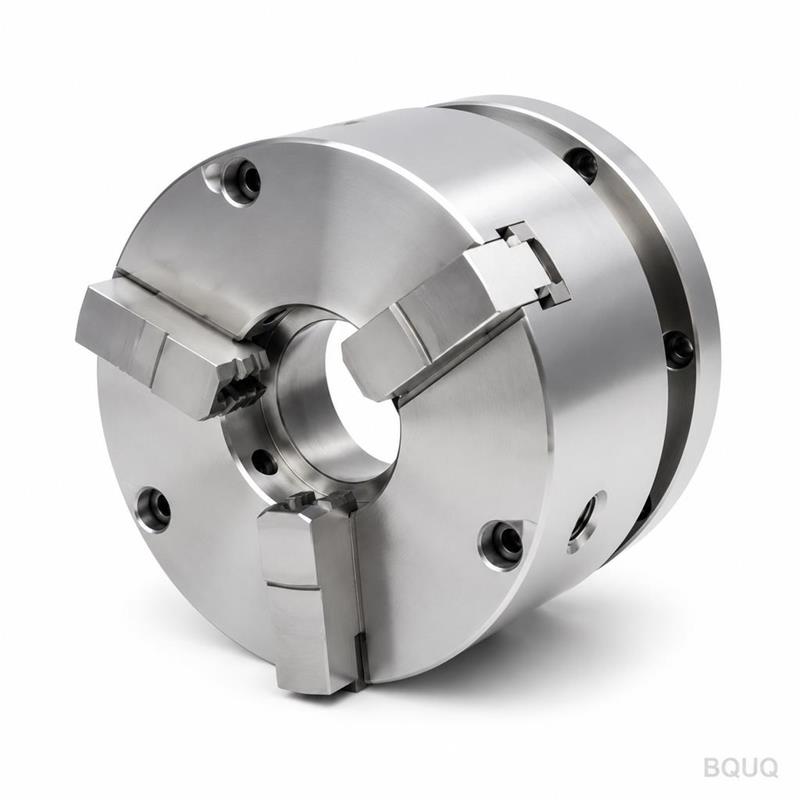
BQUQ produces matching collet chucks, nuts and collets as a set, which removes the mismatch risk. For tool-holder work, see our tool holder collet chucks; for automatic lathe applications, auto lathe collets; and for Swiss platforms, power chucks for Swiss machines.
Maintenance and handling rules that extend nut life
1. Never tighten a nut without a collet inside. The nut face will deform against the empty taper.
2. Clean the thread and the face angle at every tool change. A single chip on the face angle can cost 0.02 mm of runout.
3. Do not over-torque to compensate for a worn collet. Replace the collet.
4. Store nuts off the chuck. Threaded on and left overnight, they collect coolant mist and fines.
5. Replace ball-bearing nuts when the bearing feels gritty, not when it seizes.
6. Replace sealed nuts on a schedule, not on failure. A hardened, cracked lip leaks silently.
Cleanliness drives more of your runout budget than most shops assume. Our note on collet cleanliness covers the practical routine.
Manufacturing tolerances behind a good nut
A collet nut is a small part with tight requirements. At BQUQ, nut bodies are machined on CNC equipment holding ±0.005 mm on critical features, with thread grinding and face-angle grinding as separate operations. Four production lines in one Dongguan factory cover CNC machining, metal stamping, custom springs and heat sink production, which means nut bodies, collet chucks and springs can be produced and inspected as a matched set rather than assembled from three suppliers.
Typical inspection points on a production nut:
| Feature | Why it matters | Typical control |
|---|---|---|
| Thread pitch diameter | Clamping force consistency | Gauge-checked per batch |
| Internal face angle | Runout, collet shoulder life | Optical or profile inspection |
| Bore concentricity | TIR at the tool | Indicative 0.005–0.010 mm |
| Hardness | Thread and face wear life | Case depth and surface hardness |
| Bearing race (ball-bearing nuts) | Smooth rotation under load | Rotation torque check |
| Seal lip (sealed nuts) | Leak-free at rated pressure | Pressure test sample |
MOQ is flexible, so a shop can trial a sealed or ball-bearing nut on one machine before standardizing across a cell. Quotes are returned in 12 working hours.
Frequently Asked Questions
Q: Can I use a ball-bearing nut on any ER collet chuck?
A: Mechanically yes, provided the thread form and face angle match the chuck. Ball-bearing nuts are made for specific systems — ER11 through ER50, plus TG, DA and others — and are not cross-compatible. The real constraint is the chuck body: a ball-bearing nut delivers higher clamping force, which a worn or low-grade chuck taper may not tolerate repeatably. Match the nut to the chuck's rated torque.
Q: Does a sealed nut reduce gripping force?
A: Slightly, because the seal occupies part of the front face area. In practice the reduction is small and rarely the limiting factor on ER20 and larger sizes. On ER11 and ER16, where the collet is already small, confirm that the remaining grip covers your cut. If you need both maximum grip and sealing, specify a combined sealed ball-bearing nut.
Q: How often should a ball-bearing collet nut be replaced?
A: Replace it when the bearing feels gritty, rotates roughly, or develops play — not on a fixed calendar. In clean, well-maintained cells a ball-bearing nut can run for years; in a cast-iron or graphite environment it may degrade in months. Blow out the bearing at every tool change and inspect during scheduled maintenance. A gritty bearing is a warning, not a nuisance.
Q: What torque should I apply to a standard collet nut?
A: Use the chuck manufacturer's rated torque for that size, applied with a calibrated wrench. Because a plain nut loses more input to friction, under-tightening is common and is the leading cause of pull-out. If your operators tighten by feel, either move to a ball-bearing nut, which reaches rated grip at roughly 30–40% lower input torque, or issue a torque wrench and a written setup sheet.
Q: Are sealed nuts worth it for external coolant only?
A: Usually not. A seal earns its cost when coolant is fed through the tool or when you need to keep fines and mist out of the collet taper. With external flood coolant and no through-tool requirement, the money is better spent on a ball-bearing nut for grip and runout. If your process changes later, sealed and combined nuts remain available as a drop-in upgrade.
Related Resources
- About BQUQ and our Dongguan manufacturing footprint: /about/
- Collet chucks, nuts and tool holders: /tool-holder-collet-chucks/
- Automatic lathe collet systems: /auto-lathe-collets/
- Swiss-type power chucks: /power-chucks-swiss/
- Industry trends in precision machining: /industry-dynamics/
- Technical articles and engineering guides: /bquq-blog/
- Frequently asked questions: /faq/
- Case studies: /case/
- Contact the engineering team: /contact/
Authored by the BQUQ Engineering Team. BQUQ (Dongguan) runs CNC machining (±0.005 mm), metal stamping, custom springs, and heat sink production in one ISO9001 factory. Source-direct from Dongguan, China — quote in 12 hours: sc@bquq.com | WhatsApp +86 13713157787 | www.bquq.com