Collet Holders for Live Tooling: Balance and Torque
Short answer: A live tooling collet holder fails in two ways — imbalance and slip. Keep total indicated runout at the collet taper under 0.005 mm, keep the assembled holder balanced to G2.5 at your maximum spindle speed, and match clamping torque to the nut thread so the collet grips the shank instead of spinning on it. For a 20 mm ER32 holder running at 6,000 rpm, that means a nut tightened to the holder maker's torque figure (typically 80–100 N·m for ER32), a shank gripped over at least two-thirds of the collet length, and a holder assembly whose residual unbalance stays inside the ISO 1940-1 G2.5 envelope for that speed.
Live tooling turns a lathe into a light machining centre. The turret or gang plate carries a driven unit, the drive train spins it, and a collet chuck holds the tool. Everything upstream of the cutting edge — gear train, bearings, collet, nut — decides whether the tool cuts cleanly or chatters, walks, and breaks.
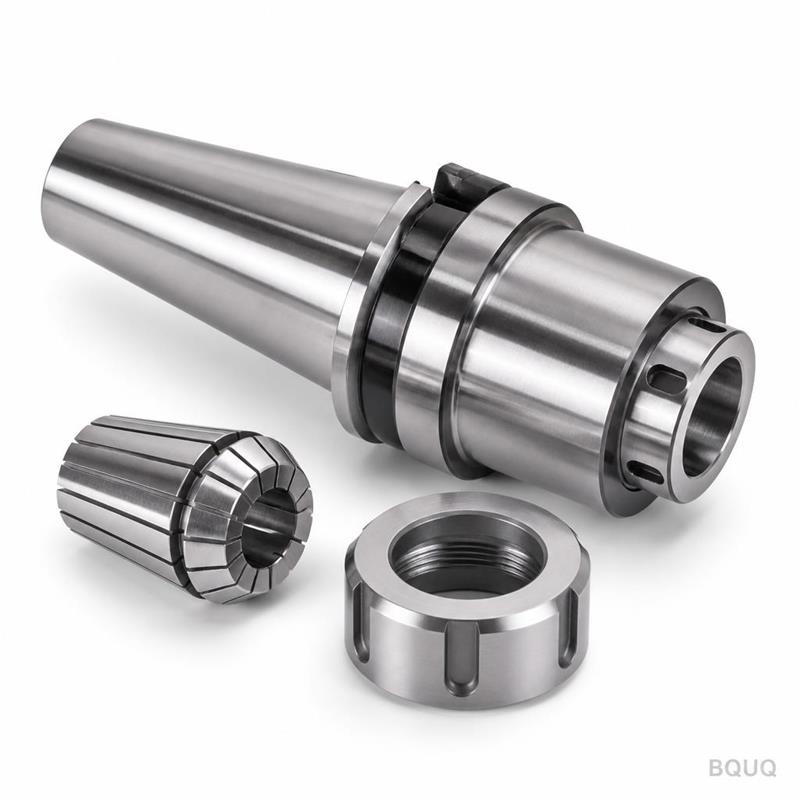
This article covers what actually matters when you specify a collet holder for a driven tool station: balance grade, torque path, runout stack-up, and the setup habits that keep a live tool alive. BQUQ manufactures collet chucks, nuts, and power chucks in one ISO9001 factory in Dongguan, so the numbers below reflect what we see on real production drawings.
Why does balance matter more on live tooling than on a machining centre?
On a vertical machining centre, the spindle is a large, stiff, well-damped assembly. On a lathe turret, the driven tool unit is small, the bearings are compact, and the holder overhangs. A live tool holder is a cantilever: the cutting edge sits far from the bearing pair that supports it.
Unbalance creates a centrifugal force that grows with the square of speed:
F = m · e · ω²
where m is the unbalanced mass, e is the eccentricity, and ω is angular velocity. Double the speed and the force quadruples. At 4,000 rpm a 10 g·mm residual unbalance is a nuisance. At 8,000 rpm the same error is four times the force, and it shows up as a taper on the bore, a wavy finish on a face, or a tool that chips on entry.
Balance grades in practice
| Balance grade (ISO 1940-1) | Typical max speed for a 20 mm holder | Where it is used |
|---|---|---|
| G6.3 | Up to ~4,000 rpm | General turning, short overhang, low value parts |
| G2.5 | Up to ~10,000 rpm | Standard live tooling, most production work |
| G1.0 | Up to ~20,000 rpm | High-speed driven tools, small diameter cutters |
| G0.4 | Above ~20,000 rpm | Precision spindles, not typical turret live tooling |
These speeds are indicative. The real limit depends on holder mass, overhang, and the stiffness of the driven unit. A heavy ER40 holder at long overhang will misbehave at a lower speed than a compact ER16 holder at G2.5.
What unbalances a collet holder
- The nut. A standard nut with a single balance mark is not a balanced assembly. Nuts with drilled balance holes or ground external profiles are matched to the holder body.
- The collet. Slotted collets are inherently asymmetric. A collet that is not seated squarely, or one with a burr on the slot edge, adds unbalance.
- The tool shank. A ground h6 shank is fine. A shank with a flats-ground Weldon face, a whistle notch, or a damaged chamfer is not.
- Chips and dried coolant. The most common cause of a sudden vibration complaint on a machine that ran fine yesterday.
Balance the assembly, not the components. A G2.5 holder with a G6.3 nut is a G6.3 assembly.
How does torque actually travel from the nut to the tool?
Torque transmission in a collet system is friction, not form. The nut pushes the collet into the holder taper. The taper closes the collet. The collet's bore grips the tool shank. Every newton-metre the cutter sees passes through that friction interface.
Two things must hold:
1. The collet must not rotate inside the holder taper. The taper fit is self-locking when clean and correctly loaded. Contamination — a film of oil, a chip, dried coolant residue — reduces the friction coefficient and lets the collet creep.
2. The tool shank must not rotate inside the collet bore. This is the failure most people call "the tool slipped". It is nearly always a clamping-force problem, not a collet-quality problem.
Clamping force and nut torque
| Holder size | Typical nut tightening torque | Typical gripping range | Notes |
|---|---|---|---|
| ER11 | 12–16 N·m | 1.0–7.0 mm | Small driven tools, light cuts |
| ER16 | 25–35 N·m | 1.0–10.0 mm | Common on compact turret units |
| ER20 | 40–50 N·m | 1.0–13.0 mm | Good balance of size and grip |
| ER25 | 60–80 N·m | 1.0–16.0 mm | General live tooling |
| ER32 | 80–100 N·m | 2.0–20.0 mm | Most common live tool size |
| ER40 | 120–160 N·m | 3.0–26.0 mm | Heavy driven tools, long overhang |
Torque figures are typical and vary by manufacturer. Always use the holder maker's number. Over-tightening deforms the nut thread and the collet taper; under-tightening guarantees slip.
The three rules of torque transmission
- Engage at least two-thirds of the collet bore length. A shank inserted only 10 mm into a 40 mm collet has a fraction of the grip area. Mark insertion depth on the shank with a paint pen.
- Never grip on a Weldon flat, a whistle notch, or a threaded section. These interrupt the contact band and concentrate load on a few millimetres of bore.
- Use the correct nut. A bearing nut reduces friction so more of your torque reaches the collet. A plain nut wastes torque on thread friction. Mixing nuts between holder brands is a reliable way to lose grip.
What runout can you realistically hold?
Runout is a stack-up: spindle or drive-unit error, holder taper error, collet error, nut seating error, and tool shank error. Each contributes, and they add vectorially, not linearly.
| Error source | Typical contribution | How to control it |
|---|---|---|
| Drive unit / turret station | 0.002–0.005 mm | Check with a test bar before blaming the holder |
| Holder taper to shank | 0.002–0.003 mm | Ground taper, inspect for dents |
| Collet bore to taper | 0.003–0.008 mm | Use precision or high-precision collets |
| Nut seating | 0.002–0.005 mm | Clean threads, correct torque, quality nut |
| Tool shank | 0.002–0.004 mm | Ground h6 shanks only |
A realistic target for a well-maintained live tool station is 0.005–0.010 mm total indicated runout at the tool, measured 2×D from the nut face. Getting below 0.005 mm requires a precision collet, a matched nut, and a clean taper — and it is worth doing for small drills and reamers where runout directly drives hole size.
For a deeper look at how collet quality shifts this number, see how to choose the right collet system.
Should you use a collet holder or a shrink-fit holder on a live tool?
Shrink-fit gives better balance and lower runout, but it needs a heating unit at the machine and it does not tolerate the small shank variations that turning shops see every day.
| Criterion | Collet holder | Shrink-fit holder |
|---|---|---|
| Runout at 2×D | 0.005–0.010 mm | 0.003 mm or better |
| Balance | G2.5 with a balanced nut | G2.5 easily |
| Tool change time | Seconds, on the machine | Minutes, off the machine |
| Shank tolerance | h6 to h8 acceptable | h6 only, tight band |
| Small drills and taps | Excellent | Good, but limited range |
| Cost per holder | Lower | Higher |
For live tooling on a lathe, the collet holder usually wins on flexibility. Shrink-fit wins where you run one tool for thousands of parts and never change it. The trade-offs are covered in more depth in shrink-fit versus collet holders.
How do you set up a live tool collet holder correctly?
Before the holder goes in the turret
1. Clean the taper. Wipe the holder taper and the collet with a lint-free cloth. Any film reduces friction and shifts runout.
2. Inspect the collet. Look for burrs on the slot edges, a worn bore, or a distorted taper. A collet that has been over-tightened on an undersized shank is scrap.
3. Seat the collet in the nut first. Snap the collet into the nut's eccentric ring, then thread the nut onto the holder. This is the correct assembly order and it prevents the collet from cocking.
4. Insert the tool to depth. Two-thirds of the collet bore minimum.
5. Tighten to the specified torque with a proper wrench or a torque-controlled tightening fixture.
After the holder is in the turret
1. Indicate the tool shank, not the holder body, at 2×D from the nut.
2. Run a warm-up cycle at the intended speed for 30 seconds before the first cut. This settles the collet and reveals gross balance problems before they become scrap.
3. Check the first part, then check again after 20 parts. Collet grip relaxes slightly in the first hour of use.
Maintenance intervals
| Check | Frequency | Action if out of spec |
|---|---|---|
| Taper cleanliness | Every tool change | Wipe; replace holder if pitted |
| Collet bore wear | Every 200–500 tool changes | Replace collet |
| Nut thread condition | Monthly | Replace nut if thread is galled |
| Runout at the tool | Weekly or after any crash | Re-indicate; isolate the source |
| Balance (on a balancing stand) | After any crash or nut change | Rebalance or replace |
Where does the holder itself come from?
A live tooling collet holder is only as good as its taper grind and its nut. The holder body needs a ground taper concentric to the shank within a few microns, a hardened and ground nut, and a collet whose bore and taper are ground in one setup.
BQUQ runs four production lines in one Dongguan factory — CNC machining to ±0.005 mm, metal stamping, custom springs, and heat sink production — all under ISO9001. Collet chucks, nuts, and the mating power chucks for Swiss and turret machines are produced on the same floor, which means tolerances are controlled at the source rather than assembled from mixed suppliers.
You can review the standard ranges here:
- Tool holder collet chucks — ER and TG series bodies, nuts, and spanners
- Power chucks for Swiss-type machines — hydraulic and pneumatic actuation for high-volume turning
- Auto lathe collets — spring collets and guide bushings for Swiss and cam machines
For how the holder interfaces with the machine spindle, see collet spindle interfaces explained.
Frequently Asked Questions
Q: What balance grade should a live tooling collet holder be?
A: G2.5 is the practical standard for most turret live tooling up to roughly 10,000 rpm. Above that, specify G1.0 and confirm the driven unit's own balance contribution. Remember that the grade applies to the assembled holder — body, collet, nut, and tool — not to the body alone. A balanced body with an unmatched nut will not meet G2.5.
Q: Why does my tool slip in the collet even when I tighten the nut hard?
A: Slip is usually a contact-area problem, not a torque problem. Check that the shank is inserted at least two-thirds of the collet bore, that you are not gripping on a Weldon flat or notch, and that the collet and taper are clean. A worn collet or a galled nut thread also reduces grip. Replace the collet before increasing torque.
Q: Can I use the same collet holder for drilling and milling on a live tool station?
A: Yes, within limits. Drilling needs low runout and moderate grip; milling needs maximum grip and better balance because the load is intermittent. For milling, use the largest collet size the station allows, keep overhang short, and check balance after every tool change. For small drilling, prioritise runout over grip.
Q: How often should live tooling collets be replaced?
A: In production turning, 200–500 tool changes per collet is a reasonable planning figure, but the real trigger is measurement. Replace when runout at the tool exceeds your tolerance, when the bore shows a wear band, or when grip force drops noticeably. Collets are consumables; treating them as permanent tooling is how shops end up chasing unexplained taper.
Q: Does a bearing nut really improve grip?
A: Yes. A bearing nut converts more of the applied torque into axial clamping force because it removes most of the friction between the nut and the collet. That means the collet closes harder at the same wrench effort. It also improves repeatability, which matters when several operators tighten the same holder across shifts. Use the nut specified for the holder.
Related Resources
- About BQUQ and our Dongguan production floor: /about/
- Collet chucks, nuts, and tool holders: /tool-holder-collet-chucks/
- Swiss-type power chucks and actuation: /power-chucks-swiss/
- Auto lathe collets and guide bushings: /auto-lathe-collets/
- Industry trends in precision turning: /industry-dynamics/
- Technical articles and engineering guides: /bquq-blog/
- Frequently asked questions: /faq/
- Case studies from production: /case/
- Contact the engineering team: /contact/
Authored by the BQUQ Engineering Team. BQUQ (Dongguan) runs CNC machining (±0.005 mm), metal stamping, custom springs, and heat sink production in one ISO9001 factory. Source-direct from Dongguan, China — quote in 12 hours: sc@bquq.com | WhatsApp +86 13713157787 | www.bquq.com