How to choose collet size: matching bore to stock, stock diameter tolerance effects on grip, runout, sizing vs range collets and changeover strategy.
Choosing Collet Size: Bore, Stock Tolerance and Changeover
Short answer: a collet's bore must match the actual stock diameter within about 0.05-0.13 mm for round bar — and the stock's own diameter tolerance matters as much as the collet's. If your bar is 12 mm ±0.1 mm, a collet sized at exactly 12.05 mm will grip tight bars and slip on loose ones. For precision work, size the collet to the measured stock diameter or use a collet sized in 0.5 mm steps and let the stock tolerance dictate your choice. When one machine runs several diameters, budget for changeover — quick-change collet systems pay for themselves after a few size switches a week.
Collet sizing looks trivial — measure the bar, pick the collet — until the real world shows up with stock that varies, collets that do not close, and parts that run out. This guide covers bore selection, the stock-tolerance interaction, sized versus range collets, and the changeover math that decides whether you need one collet per size or a quick-change system.
Bore vs Actual Stock Diameter
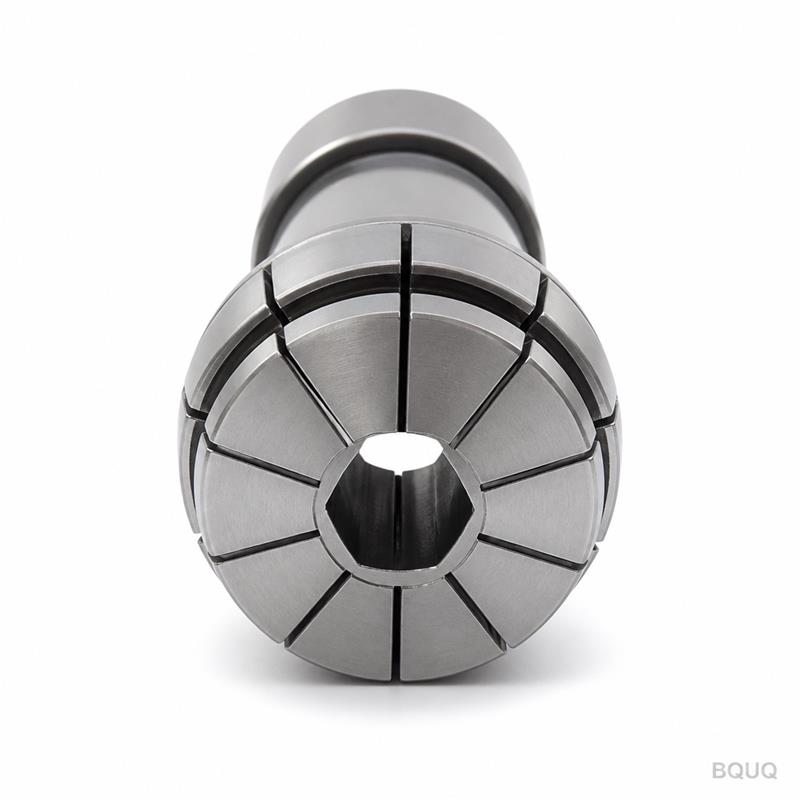
Collet catalogs list nominal bores, but the number that matters is the bore relative to your actual stock. For round bar, the rule of thumb is 0.05-0.13 mm (0.002-0.005 in) of clearance between collet bore and stock diameter. At that clearance the collet closes fully and grips around the whole circumference. Below it, the collet may not close to its working position, causing grip failure or a stuck collet. Above it, grip weakens, stock pushes back under cut force, and runout grows. A 12.00 mm nominal bar generally takes a 12.00-12.07 mm collet bore after measuring what the mill actually delivered — "12 mm" bar can be 11.95-12.10 mm depending on the supplier and whether it is drawn, turned or ground.
Stock Tolerance: The Variable Nobody Controls
Bar stock arrives with its own diameter tolerance, and that tolerance lands inside your collet decision. Ground bar (h6/h7 tolerance, often ±0.01-0.02 mm) is the precision partner: one collet size serves the whole lot with consistent grip. Drawn or extruded bar can run ±0.05-0.1 mm or worse; a fixed-bore collet grips the tight end of the lot firmly and the loose end weakly. Options: split the lot by measured diameter and use two collet sizes; order the collet to the loose end and accept grip variation; or buy a range collet that flexes over a wider band (typically ±0.1-0.25 mm) at the cost of some runout and grip stiffness. If the application holds tight tolerance on turned diameters, ground bar plus a sized collet is the combination that makes the numbers repeatable.
Sized Collets vs Range Collets
| Collet type | Bore flexibility | Runout | Grip | Cost |
|---|---|---|---|---|
| Sized (to exact stock) | Very tight (±0.01-0.02 mm) | Best (2-5 µm typical) | Strongest | Higher per size |
| Step-sized (0.5 mm steps) | Moderate | Good | Good | Standard |
| Range (flexible) | ±0.1-0.25 mm | Acceptable (higher) | Reduced | One per range |
Sized collets are the precision default: they are bored or matched to the exact stock measurement and deliver the best concentricity — critical for Swiss-type work where stock runs through a guide bushing and runout transfers directly to the part. Range collets earn their place on machines that run many diameters and cannot afford a collet per size. The honest trade: if your drawing calls ±0.01 mm on turned features, do not gamble on a range collet with ±0.05 mm runout; size it.
The Changeover Math
Every diameter change means swapping collets, and each swap costs setup time — pulling the old collet, fitting the new, checking runout. On a busy machine running three diameters a week, fixed collets mean three changeovers and repeated runout checks. The break-even for a quick-change collet system (collet chuck with interchangeable pads or a tool-less design) is typically a few size changes per week when you count 10-20 minutes per conventional changeover at shop rate. For high-mix, low-volume production, quick-change is not a luxury; it is how the machine stays cutting. For dedicated high-volume lines running one size for months, a conventional hardened collet is cheaper and just as accurate.
Practical Sizing Checklist
| Step | Action |
|---|---|
| 1 | Measure the actual stock lot (micrometer, several bars, both ends) |
| 2 | Note stock shape and material (round/hex/square; drawn/ground) |
| 3 | Choose bore at actual diameter + 0.05-0.13 mm clearance |
| 4 | Decide sized vs range by runout requirement and changeover frequency |
| 5 | Match collet series to machine (36/46/52/630/643 types, etc.) |
| 6 | Verify actuation (push/pull) against the machine |
| 7 | Order a spare for high-use sizes |
Frequently Asked Questions
Q: What collet size do I need for 12 mm bar?
A: Measure the actual bar — nominal 12 mm stock varies. Choose a collet bore at the measured diameter plus roughly 0.05-0.13 mm clearance, for example 12.05-12.10 mm for a measured 12.00 mm bar. Ground bar lets you size tightly; drawn bar needs more clearance or a range collet.
Q: What happens if my collet is too big for the stock?
A: Grip weakens, the stock can push back under cutting force, and part runout grows. If the collet is far oversize it may not grip at all. Match bore to actual stock diameter and keep clearance within the 0.05-0.13 mm band for round bar.
Q: Should I use a range collet or a sized collet?
A: Use a sized collet when turned-part tolerance matters (typical runout 2-5 µm) and the machine runs dedicated diameters. Use a range collet for high-mix work where flexibility beats runout — but never when the drawing calls tight concentricity on turned features.
Q: How much clearance should a collet have over the bar?
A: About 0.05-0.13 mm for round bar in a conventional spring collet. Too little prevents full closing; too much costs grip and concentricity. Size to the measured stock, not the nominal label.
Q: How do I reduce collet changeover time?
A: Standardize diameters where possible, then consider a quick-change collet chuck or pad-type system if you switch sizes more than a few times a week. Each conventional changeover costs 10-20 minutes of setup plus runout checks — quick-change systems pay for themselves quickly in high-mix production.
Authored by the BQUQ Engineering Team. BQUQ is an ISO9001-certified source factory in Dongguan, China, running CNC machining, metal stamping, custom springs, heat sink and collet lines under one roof. Send drawings to sc@bquq.com or WhatsApp +86 13713157787 for a quote within 12 working hours. www.bquq.com