Cam automatic lathes cut bar in a fixed spindle; Swiss lathes feed bar through a guide bushing. BQUQ builds collets and chucks for both, ISO9001.
Cam Automatic vs CNC Swiss Lathes: How Workholding Differs
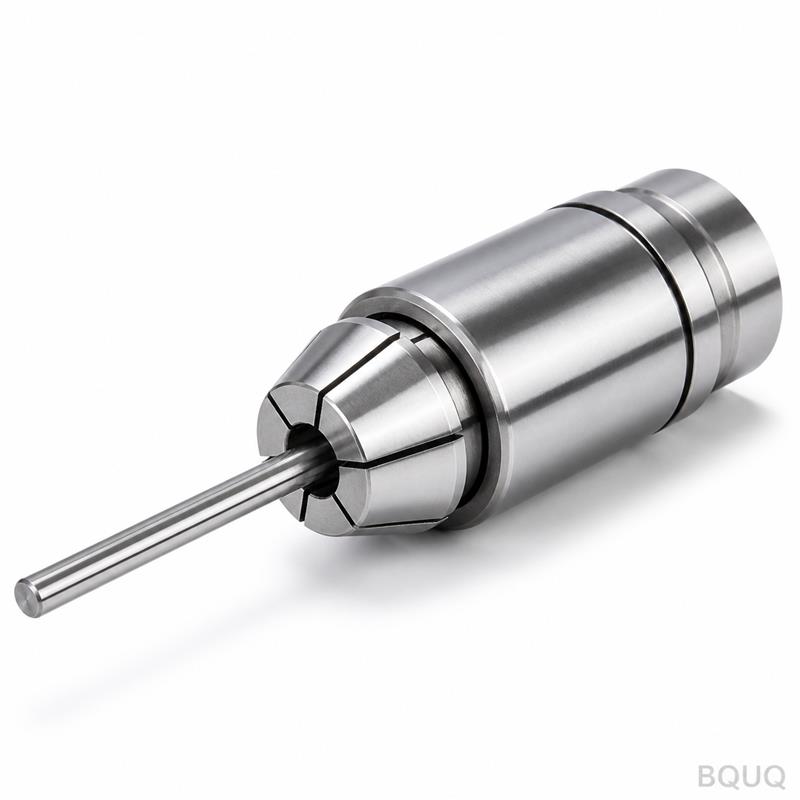
Cam automatic lathes and CNC Swiss lathes both machine parts from bar stock held in spring collets, but they differ in who controls the motion: a cam auto moves its tool slides through mechanical cams while the bar is held in a fixed spindle, and a Swiss lathe feeds the bar and headstock through a guide bushing so tools cut right at the bushing face. The workholding consequence is that cam autos rely on the collet for both grip and length control, while Swiss machines share that job between a collet and a guide bushing.
Both machine types are bar-fed precision producers, and both are the reason spring collets exist in the type families (36, 46, 52, 60, 630, 643) that BQUQ machines. But the workholding architectures are genuinely different, and collets that suit one often do not suit the other. Choosing the machine type — or the collet for an existing machine — starts with understanding where the bar is supported and who decides part length.
The Two Architectures in One Picture
A cam automatic is a single-spindle or multi-spindle machine where mechanical cams on a camshaft drive the tool slides and the collet opening and closing. The spindle holds the bar in a collet at the spindle nose; tools advance and retract as the cams rotate. Part length is controlled by feeding the bar against a stop or by the collet's own indexing, then cutting off.
A CNC Swiss lathe is a sliding-headstock machine. The headstock, gripping the bar in a collet, slides axially on a guideway and feeds the bar out through a fixed or sliding guide bushing. Tools are arranged around the guide bushing and cut the bar as it extends just beyond the bushing. The bar is supported at the cut point, not cantilevered from the spindle.
| Feature | Cam automatic | CNC Swiss lathe |
|---|---|---|
| Slide motion | Mechanical cams | CNC servo axes |
| Bar support at cut | Spindle collet only | Collet + guide bushing |
| Part length control | Feed stop / collet index | Headstock axis position |
| Typical bar diameter | Small to medium | Small, often under ~32 mm class |
| Setup change time | Cam change, hours | Program change, minutes |
| Best part shape | Simple to moderate turning | Long slender parts, complex profiles |
The ranges are typical, not limits — cam autos still run large volumes of simple parts at very low cost per piece, and Swiss machines win wherever parts are long relative to their diameter or need complex milling in the same cycle.
Workholding: The Collet's Job on Each Machine
On a cam automatic the collet is the entire workholding story. It grips the bar for machining, releases for the feed stroke, and its axial behavior interacts with the feed mechanism that pushes fresh bar to the stop. Collet grip must be strong enough to resist cut-off and turning forces, and consistent enough that the fed length does not vary.
On a Swiss lathe the headstock collet grips the bar for feeding and rotation, while the guide bushing — itself often a collet-like element with its own bore — supports the bar right at the tools. The headstock collet in a Swiss machine is a grip-and-feed element; the guide bushing is the accuracy element that decides how straight and vibration-free the extended bar is.
| Function | Cam auto collet | Swiss headstock collet | Guide bushing |
|---|---|---|---|
| Grip bar for cutting | Yes | Yes | No — supports, allows rotation |
| Feed bar between cycles | Yes | Yes (headstock motion) | No — bar slides through it |
| Control bar straightness at tool | Indirect | Indirect | Yes — supports at cut point |
| Wear pattern | Bore and cone | Bore and cone | Bore wear from sliding bar |
Length Control: Where the Two Really Diverge
Length accuracy is the clearest workholding difference. On a cam auto, the fed length is set mechanically: bar feeds to a stop, the collet clamps, and the stop retracts. If the collet grips the bar a few microns earlier or later, or the bar's friction against the feed finger varies, the fed length shifts and the part length drifts. Dead-length collet designs help by not pulling the bar axially when clamping — the difference between pull-back and dead-length collets is one of the first things to check when cam-auto part lengths wander.
On a Swiss lathe the headstock axis is a CNC servo, so part length is a position command, not a friction-dependent event. The collet's axial behavior matters less for length; what matters is that it grips hard enough to push the bar through the guide bushing without slipping, because the headstock literally shoves the bar forward through the bushing between operations.
The practical rule for buyers: if you see length scatter on a cam auto, look at the collet's grip consistency and the feed mechanism before blaming the machine. If you see length scatter on a Swiss lathe, look at the headstock collet for slip under feed thrust and at the guide bushing bore for wear.
Bar Feed and the Collet's Other Partner
Cam autos historically use feed fingers — spring collet-like elements in the bar feeder or the spindle rear — that grip the bar only during the feed stroke, then release so the main collet does the cutting. The feed finger is sized to the bar like a collet, and worn feed fingers cause erratic feed length just as worn collets do.
Swiss machines draw bar from a bar feeder through the headstock and guide bushing continuously. The interface between bar feeder, headstock collet and guide bushing is a chain of bores that must all clear the bar: a liner in the bar feeder tube, the collet bore, and the bushing bore. Each is sized to the bar, and each is a wear point. Our bar feeding and workholding guide covers that chain in detail.
| Bar path element | Cam auto | Swiss lathe |
|---|---|---|
| Bar feeder tube | Feed finger at spindle rear | Liner tube, bar pushed forward |
| Main grip | Spindle collet | Headstock collet |
| Cut-zone support | None (spindle nose) | Guide bushing at tools |
| Bore wear points | Collet, feed finger | Collet, bushing, liner |
Choosing the Collet for the Machine
Both machine types take spring collets from the same family logic: match the type number to the machine's chuck and drawtube interface, then match the bore to the bar. But the emphasis differs. For cam autos, prioritize grip consistency and dead-length behavior — the collet participates in length control. For Swiss machines, prioritize the headstock collet's grip under feed thrust and treat the guide bushing as a precision wear part with its own bore spec and replacement schedule.
Swiss setups add a second element most buyers forget: the guide bushing itself. Fixed bushings run the bar in a plain bearing bore; sliding bushings move with the headstock and eliminate the bar's exposure between the bushing and the cut. Both types need their bores matched to the bar with the same discipline as a collet bore. We break the fixed-versus-sliding choice down in our guide bushing coverage of Swiss collet systems.
What a Factory Should Offer
A collet factory that serves both machine types can quote the right element for each: cam-auto spring collets in the 36/46/52/60/630/643 families, Swiss headstock collets, guide bushing blanks or finished bushings, and the chucks that seat them. BQUQ machines collets and collet chucks from hardened alloy and spring steel on a CNC line holding ±0.005 mm, under ISO9001 control in one Dongguan factory — with spring, stamping, heat sink and CNC lines beside it, the same factory that quotes your collet can quote the parts those machines will make. See the auto-lathe collet range and the Swiss and 2J collet chucks, then send the machine make, model and bar spec to sc@bquq.com for a quote within 12 working hours.
Email sc@bquq.com or WhatsApp +86 137 1315 7787 with your PDF/DXF/STEP file. An engineer reviews it and replies with price, lead time and DFM notes on working days.
Frequently Asked Questions
Q: Do cam autos and Swiss lathes use the same collets?
A: Not usually. The collet family (type number, cone and thread) must match the machine's chuck and drawtube interface, and Swiss headstock collets work with a guide bushing system a cam auto does not have. Always specify the machine make and model.
Q: Why do Swiss lathes hold long slender parts better?
A: The bar is supported by the guide bushing immediately behind the tools, so the cutting zone sees a short, stiff section of bar. A cam auto cuts a cantilevered bar, which deflects and chatters as length grows.
Q: Which machine needs dead-length collets?
A: Cam autos benefit most, because part length is controlled by mechanical feed and any axial pull from the collet shifts it. Swiss machines control length by servo axis position, so grip slip matters more than pull-back behavior.
Q: What wears faster on a Swiss lathe, the collet or the bushing?
A: Usually the guide bushing, because the bar slides through it under full cutting load while the collet only grips and releases. Bushings are precision wear parts — check the bore and replace on schedule before bar wobble ruins parts.
Q: Are cam autos obsolete next to Swiss CNC?
A: No. Cam autos still win on simple parts at high volume with very low cycle cost, and their mechanical simplicity suits long, stable runs. Swiss CNC wins on complexity, quick changeover and slender geometry. Collet needs follow the machine, not fashion.
Authored by the BQUQ Engineering Team. BQUQ is an ISO9001-certified source factory in Dongguan, China, running CNC machining, metal stamping, custom springs, heat sink and collet lines under one roof. Send drawings to sc@bquq.com or WhatsApp +86 13713157787 for a quote within 12 working hours. www.bquq.com