"Coolant-Through Collet Seals: High-Pressure Machining"
Short answer: A coolant-through collet seal is a small elastomer or polymer ring that closes the gap between the collet body, the tool shank and the nut bore so that high-pressure coolant is forced through internal tool channels instead of escaping radially. Typical systems run 30–80 bar (435–1,160 psi); above 100 bar, seals must be specifically rated, and the collet bore, nut and seal must be a matched set. Without a seal, most of the pump energy is lost at the holder face, chip evacuation collapses and tool life drops. BQUQ supplies sealed collet chucks and matched collets from one ISO9001 factory in Dongguan, with quotes returned in 12 working hours.
High-pressure coolant is one of the cheapest productivity upgrades in a machine shop — until it starts leaking out of the tool holder. At 30 bar, water-based coolant will find any radial gap wider than a few microns and turn it into a cutting jet aimed at your spindle taper. The fix is not a bigger pump. It is a properly sealed collet interface.
This article explains how coolant-through collet seals work, which seal geometry suits which holder, what pressure each design realistically survives, and how to specify sealed collets so the coolant goes where it is supposed to.
What problem does a coolant-through collet seal actually solve?
A standard ER, TG or 5C collet is a spring element. It grips the tool shank by elastic deflection, and that deflection leaves a helical gap between the collet segments. Under flood coolant at 3–8 bar, that gap leaks a little and nobody notices. Under 50 bar, the same gap becomes a nozzle.
Three things go wrong when high-pressure coolant escapes at the collet face:
- Pressure loss at the cutting edge. Coolant that leaks at the nut never reaches the tool's internal channels. Effective pressure at the tip can fall by half or more.
- Chip evacuation failure. Deep-hole drilling and pocketing in titanium or stainless depend on coolant to flush chips out of the flutes. Leakage means recutting, and recutting means chipped edges.
- Spindle and bearing contamination. A fine, high-velocity mist of coolant plus fines migrates into the spindle nose, degrading taper contact and eventually bearing life.
A coolant-through collet seal is the barrier that stops all three. It is a consumable, low-cost part doing a high-value job — which is why specifying the right one matters more than specifying a cheap one.
How does a collet seal work in a high-pressure system?
The seal works by converting a radial leak path into a controlled axial flow path.
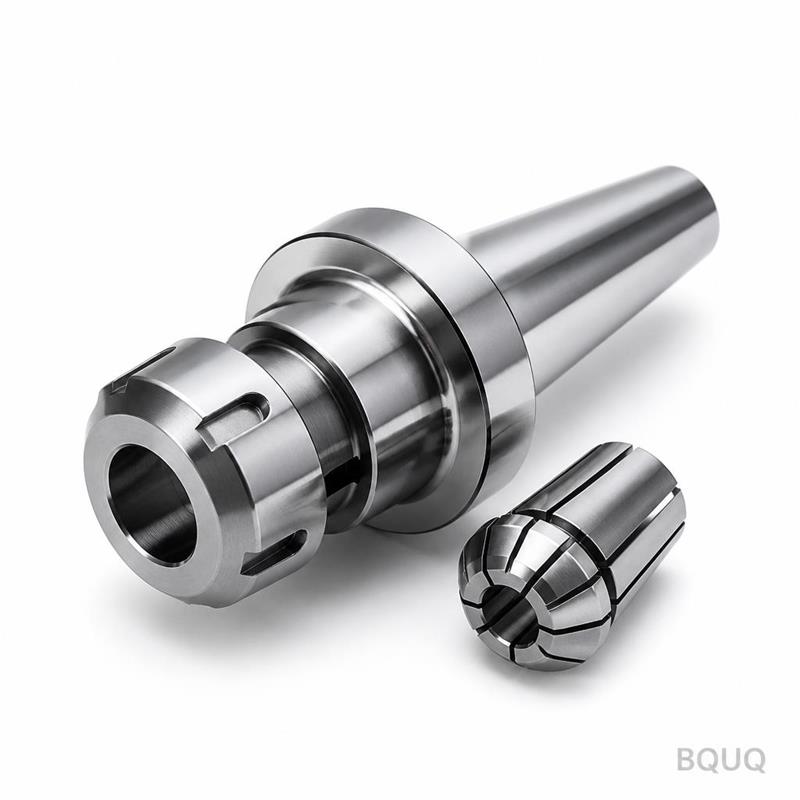
In a sealed assembly, the coolant enters the holder body behind the collet, travels through the collet's internal clearance or a dedicated groove, and is directed into the tool shank's coolant holes. The seal — usually an O-ring, a lip seal, a bonded face seal or a molded polymer collar — sits at one of two locations:
1. Between the collet and the tool shank, sealing on the tool's cylindrical surface.
2. Between the collet and the nut bore / holder face, sealing the outer path.
Most production designs use both, because pressure finds the easier route. The elastomer is compressed a controlled amount when the nut is torqued; the compression is what generates sealing force. This is why seal compression is a torque-dependent variable, not a fixed property — a point covered in more depth in our article on collet clamping pressure.
The pressure balance inside a sealed collet
At 50 bar, the internal pressure acts on the seal in three directions at once: outward against the nut bore, inward against the tool shank, and axially against the collet face. A lip seal uses the first of these to self-energize — higher pressure pushes the lip harder against the sealing surface, which is why lip seals outperform simple O-rings above roughly 40 bar.
O-rings rely purely on squeeze. They are cheap, forgiving on surface finish, and perfectly adequate up to about 30–40 bar. Above that, extrusion into the gap becomes the failure mode.
Seal types and realistic pressure limits
The table below summarizes the common designs found in collet-based tool holders. Figures are typical industry values — confirm against the specific holder and seal supplier before committing to a process.
| Seal type | Typical pressure range | Sealing location | Best suited to | Main failure mode |
|---|---|---|---|---|
| O-ring (NBR) | 10–30 bar | Tool shank | General milling, ER holders | Extrusion, compression set |
| O-ring (FKM/HNBR) | 20–50 bar | Tool shank | Stainless, cast iron, higher temp | Extrusion at gap |
| Lip / U-cup seal | 40–80 bar | Tool shank or nut bore | Deep-hole drilling, high-pressure turning | Lip wear, contamination |
| Bonded face seal | 60–120 bar | Holder face | Dedicated coolant-through holders | Face damage from chips |
| Molded polymer collar | 50–100 bar | Collet body | Compact sealed collets, Swiss holders | Thermal degradation |
Two practical notes. First, the pressure rating of the seal is rarely the limiting factor — the holder and collet rigidity usually is. Above roughly 80 bar, hydraulic expansion and collet distortion start to affect runout. Second, temperature matters: NBR is comfortable to about 100 °C, FKM to about 200 °C. A hot titanium cut with minimal coolant flow can push the seal above its limit.
Sealed vs unsealed collets: what changes in the process
| Parameter | Unsealed collet | Sealed collet |
|---|---|---|
| Effective coolant at tool tip | 40–60% of pump pressure | 85–95% of pump pressure |
| Chip evacuation in deep holes | Marginal | Reliable |
| Tool life in Ti / stainless | Baseline | Typically 20–50% longer |
| Runout (indicative) | Same collet class | Same collet class, if seal is concentric |
| Maintenance interval | Long | Seal replacement at 500–2,000 h (indicative) |
| Cost per holder | Lower | Higher by the seal and groove machining |
The runout row is the one buyers worry about most. A correctly molded seal adds no measurable runout because it sits outside the gripping zone. A poorly molded seal, or one that is over-compressed, can push the collet off-axis by several microns — enough to matter on a ±0.005 mm feature.
Which collet systems support coolant-through sealing?
Not every collet family has a sealing option. The table below maps the common systems to their sealing practicality.
| Collet system | Coolant-through sealing | Notes |
|---|---|---|
| ER11 / ER16 / ER20 | Limited | Small nut bore; low pressure only |
| ER25 / ER32 / ER40 | Yes | Most common sealed milling setup |
| ER50 | Yes | Large nut bore, good seal real estate |
| TG100 / TG150 | Yes | Rigid, well suited to 70 bar+ |
| 5C | Yes (special) | Sealed 5C collets used in Swiss and turret work |
| R8 | Rare | Mostly manual machines, low pressure |
| Swiss-type collets / guide bushings | Yes | Sealed guide bushings are standard in high-pressure Swiss work |
For Swiss-type machining, sealing is not optional — the guide bushing and collet sit within millimetres of the cut, and a leak there floods the work zone. BQUQ produces auto-lathe collets and matched guide bushings for exactly this environment, alongside power chucks for Swiss machines where the coolant path runs through the chuck body rather than the collet.
The nut is half the sealing system
A sealed collet is useless with the wrong nut. Coolant-through nuts have a relieved bore and a seal seat; a standard nut will crush the seal or leave it unseated. The geometry differences are subtle and easy to miss in a drawing review — our breakdown of collet nut types covers the bore profiles and where each one is appropriate.
How do you specify a sealed collet correctly?
Specification comes down to five numbers and one material decision.
1. Operating pressure — the maximum your pump delivers at the holder, not the rated pump pressure.
2. Coolant type and concentration — neat oil, emulsion, or MQL. Oil swells some elastomers; high-concentration emulsions can attack others.
3. Temperature at the holder face — measure it, do not estimate it.
4. Tool shank tolerance and surface finish — a seal needs a smooth, round, consistent shank. Worn or ground-down shanks leak.
5. Collet class and runout requirement — sealing must not compromise concentricity.
Then choose the elastomer: NBR for general work, FKM for temperature and chemical resistance, HNBR or polyurethane for abrasion resistance where fines are heavy.
Installation and torque discipline
Seals fail more often from installation than from pressure. Three rules:
- Torque to the holder maker's figure, not by feel. Under-torque leaves the seal uncompressed; over-torque extrudes it into the gap.
- Keep the seal path clean. A single chip trapped under a lip seal creates a permanent leak path. Cleanliness discipline is the same discipline that keeps collet bores accurate — see collet cleanliness.
- Replace seals on a schedule, not on failure. A weeping seal is a symptom you notice too late.
For shops running sealed holders across many spindles, a simple log of seal replacement hours per holder pays for itself quickly.
Where does BQUQ fit into a coolant-through collet program?
BQUQ is a Dongguan source factory running four production lines under one ISO9001 system: CNC machining to ±0.005 mm, metal stamping, custom springs, and heat sink production. For collet work, that means the collet body, the seal groove, the nut and the mating holder can all be produced and inspected against one drawing set rather than assembled from four vendors.
Practically, that matters for three reasons:
- Groove geometry control. Seal grooves are micron-level features. Producing them on the same CNC line that turns the collet taper keeps concentricity intact.
- Matched sets. Sealed collet, sealed nut and holder shipped as a verified set removes the "which part is leaking" conversation.
- Flexible MOQ. Trial quantities for a new process are possible before committing to production volumes.
We supply tool holder collet chucks for milling and drilling applications, and quote in 12 working hours from a drawing or sample. If you are still selecting a holder family, our guide to collet system selection is a sensible starting point.
Frequently Asked Questions
Q: What pressure can a coolant-through collet seal handle?
A: It depends on seal type. A standard NBR O-ring is comfortable to about 30 bar; FKM O-rings to roughly 50 bar; lip and U-cup seals to 80 bar; bonded face seals and molded polymer collars to 100–120 bar in well-controlled conditions. Above 80 bar, holder rigidity and collet distortion usually become the limiting factors before the seal itself does. Always confirm against the specific holder and seal supplier's rating.
Q: Can I retrofit coolant-through sealing to an existing ER collet chuck?
A: Sometimes. If the nut has a relieved bore and the collet has a seal groove, a sealed collet and matching nut will work. If the nut is a standard closed-bore design, it will crush or mis-seat the seal. In that case you need a coolant-through nut, and often a holder with an internal coolant path. Retrofitting is usually cheaper than replacing the holder, but check the nut first.
Q: Does a collet seal reduce clamping force or accuracy?
A: A correctly designed seal does not. It sits outside the gripping zone and adds no measurable runout. Problems appear when the seal is over-compressed by excessive torque, or when a low-quality molded seal is not concentric — either can push the collet off-axis by a few microns. On a ±0.005 mm part, that is enough to matter, so buy sealed collets and nuts as a matched set.
Q: How often should coolant-through collet seals be replaced?
A: Indicatively, every 500–2,000 operating hours depending on pressure, coolant chemistry and contamination level. High-pressure neat-oil systems at 70 bar plus run toward the short end; low-pressure emulsion systems run longer. Replace on schedule rather than on failure, because a weeping seal contaminates the spindle long before it becomes obvious at the cut. Keep a per-holder log of replacement hours.
Q: What coolant should I use with sealed collets?
A: Neat oil gives the best seal life and lubrication but needs fire-safety controls. Water-based emulsions at 6–10% concentration are the common compromise; higher concentrations can swell some elastomers, so match the elastomer to the chemistry. Avoid running abrasive fines through the seal path — filtration quality affects seal life as much as pressure does. Confirm elastomer compatibility with your coolant supplier before committing.
Related Resources
- About BQUQ and our Dongguan manufacturing footprint: /about/
- Collet chucks, nuts and sealed tool holders: /tool-holder-collet-chucks/
- Auto-lathe and Swiss collets: /auto-lathe-collets/
- Industry trends in high-pressure machining: /industry-dynamics/
- Technical articles on collets and workholding: /bquq-blog/
- Frequently asked questions: /faq/
- Case studies: /case/ — Contact our engineering team: /contact/
Authored by the BQUQ Engineering Team. BQUQ (Dongguan) runs CNC machining (±0.005 mm), metal stamping, custom springs, and heat sink production in one ISO9001 factory. Source-direct from Dongguan, China — quote in 12 hours: sc@bquq.com | WhatsApp +86 13713157787 | www.bquq.com