Collet Chucks in Gang Tooling and Turrets
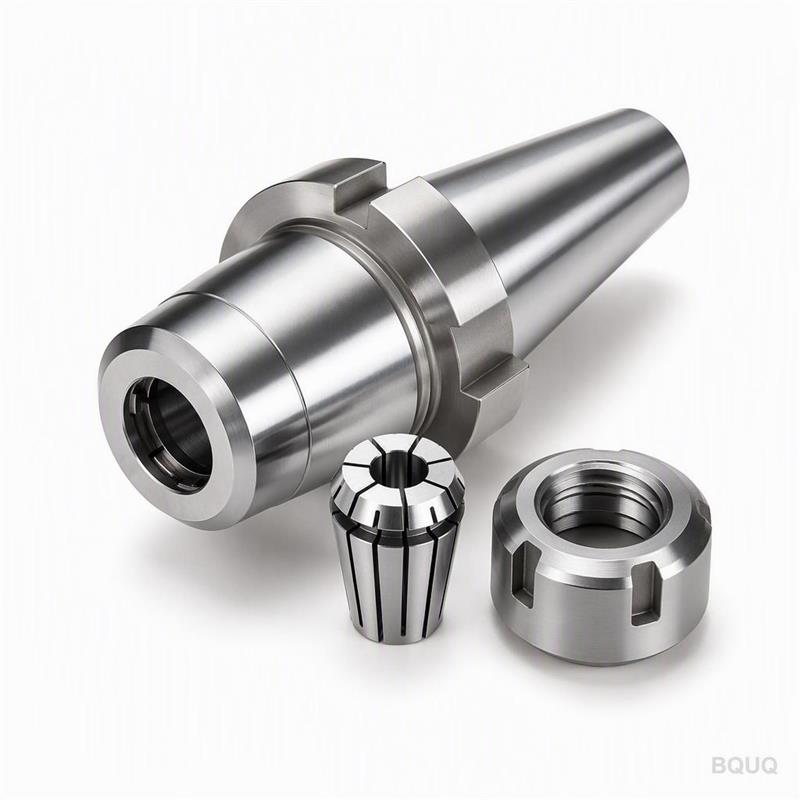
Short answer: In gang tooling, collet chucks mount directly on the slide plate and index by moving the X/Z axes, so they must be short, light, and repeatable to within 0.005–0.010 mm; in a turret, the same collet chuck sits in a driven or static station and must survive indexing shock plus coolant. ER and TG collet chucks dominate both because they hold ±0.005 mm TIR on a good spindle, accept a 1–20 mm shank range, and cost far less than hydraulic or shrink holders. Choose ER16–ER32 for most gang work, ER25–ER40 for turrets, and verify nut torque, taper cleanliness, and runout before blaming the machine.
Why collet chucks dominate gang tooling
A gang tool lathe does not index a turret. It mounts every tool on one cross-slide plate, then moves the plate in X and Z to bring the right tool to the part. That architecture rewards tools that are compact, light, and predictable. A collet chuck is all three.
The physics matter. Every gram on the slide plate is mass the servo must accelerate and decelerate thousands of times per shift. A 1 kg ER32 collet chuck accelerates faster and settles cleaner than a 3.5 kg hydraulic holder of equivalent grip. On a gang machine running 8-second cycles, that difference shows up in surface finish and tool life, not just cycle time.
Gang tooling also crowds tools together. Spacing between adjacent holders can be 20–40 mm. A collet chuck with a slim nut and a short body fits where a bulky power chuck cannot. That is why small-part turning — connectors, pins, watch components, medical screws — is overwhelmingly collet-based.
The trade-off is grip diameter range and torque transmission. Collets clamp by elastic collapse, so they cannot match a 3-jaw or 4-jaw chuck on interrupted heavy cuts. In gang tooling that is rarely the constraint, because the parts are small and the depths of cut are modest.
What the slide plate demands from a holder
- Low mass. Keep the assembly under roughly 1.5 kg where possible.
- Short gauge length. Less overhang means less deflection under radial load.
- Repeatable seating. A tool that seats differently after each change destroys offsets.
- Coolant routing. Through-tool or directed nozzles beat flooding on small parts.
- Crash tolerance. Gang tools are close to the work; a light, replaceable holder is cheaper to lose than a spindle.
How collet chucks behave in a turret
A turret adds two loads a gang plate never sees: indexing shock and station-to-station variation. When the turret indexes, the holder experiences a rotational jolt. Any looseness in the nut, taper, or mounting interface converts that jolt into runout drift.
Static stations are straightforward. A collet chuck in a static OD or ID station behaves like any lathe holder, provided the mounting interface — VDI, BMT, or bolt-on — is seated and torqued correctly. Runout measured at the collet face should stay within 0.010 mm for general turning and 0.005 mm for finishing.
Driven stations are harder. A driven collet chuck spins at 3,000–8,000 rpm on many turrets, which means balance and taper concentricity become the limiting factors, not grip. Above roughly 6,000 rpm, an unbalanced ER nut will vibrate, polish the taper, and slowly lose clamping force.
Turret station selection guide
| Station type | Typical holder | Collet series | Speed limit (indicative) | Best use |
|---|---|---|---|---|
| Static OD turning | Bolt-on or VDI block | ER25–ER40 | N/A | Shaft turning, facing |
| Static ID boring | Boring bar holder | ER16–ER25 | N/A | Small bores, back work |
| Driven milling | Driven tool holder | ER16–ER20 | 4,000–8,000 rpm | Flats, slots, cross holes |
| Driven drilling | Driven tool holder | ER11–ER16 | 6,000–8,000 rpm | Cross holes, off-axis drilling |
| Sub-spindle pickoff | Collet chuck or power chuck | ER20–ER32 | N/A | Back-side turning |
These are indicative ranges. Actual limits depend on the turret builder, holder balance grade, and part geometry. Always derate for long tools.
Runout, clamping force, and the numbers that actually matter
Two numbers decide whether a collet chuck works in gang or turret service: total indicated runout (TIR) and clamping force retention.
TIR is measured at the collet bore with a ground test bar, not at the holder body. A holder with 0.003 mm body runout can still show 0.015 mm at the bar if the taper is dirty or the nut is worn. BQUQ machines collet chuck bodies to ±0.005 mm on CNC equipment, and the taper is ground, not turned, because the taper is the only surface that transfers both concentricity and grip.
Clamping force depends on nut torque and taper condition. Under-torque and the collet slips; over-torque and you deform the nut and eventually the collet. ER nuts have a specified torque — commonly 80 N·m for ER32, 130 N·m for ER40 — and that number assumes a clean, unlubricated taper.
| Collet series | Bore range | Typical nut torque | Typical TIR (new holder) | Common gang/turret role |
|---|---|---|---|---|
| ER11 | 0.5–7 mm | 20–25 N·m | 0.005–0.010 mm | Micro drilling, small end mills |
| ER16 | 1–10 mm | 40–45 N·m | 0.005–0.010 mm | Driven milling, small boring |
| ER20 | 1–13 mm | 60–70 N·m | 0.005–0.010 mm | General driven work |
| ER25 | 1–16 mm | 80–100 N·m | 0.005–0.010 mm | Static OD, sub-spindle |
| ER32 | 2–20 mm | 100–136 N·m | 0.005–0.010 mm | Main static turning |
| ER40 | 3–26 mm | 130–176 N·m | 0.008–0.015 mm | Larger shafts, heavy static |
Torque values are typical published figures and vary by nut design. Treat them as starting points, not absolutes.
A note on TG and DA series
TG100 and TG150 collets carry more grip than ER at the same bore because of their steeper taper and thicker wall. They are common in turret stations doing heavier milling. DA collets appear in older gang setups and in drill chucks. If you are specifying new tooling, ER is usually the better-supported choice; if you are matching an existing machine, match what the turret already takes.
Setup practice that prevents most failures
Most "collet chuck problems" in gang and turret work are setup problems. The holder is blamed for what a dirty taper, a worn nut, or a wrong-length tool caused.
Clean the taper every change
A 0.01 mm chip on the taper translates to roughly 0.02–0.04 mm of bar runout. Wipe the taper and the collet with a lint-free cloth and a light oil film. Do not use grease. Do not use abrasive paper on the taper.
Torque the nut properly
Use a torque wrench or a proper collet chuck spanner, not a shop-made bar. Seat the collet in the nut before threading the nut onto the body — this is the single most common assembly error and it damages the taper.
Keep overhang short
In gang tooling, overhang is the dominant deflection variable. A tool held 40 mm out deflects roughly eight times more than the same tool at 20 mm, because deflection scales with the cube of length. If you must reach, use a collet chuck extension bar rather than a longer tool.
Match the collet to the task
- Round bore collets for drills and reamers.
- Pin-slot or hex-bore collets for form tools and hex stock.
- Sealed collets for through-coolant or chip-heavy operations.
- Mirror-polished collets where chip evacuation matters.
For more on matching holder to operation, see how to select a collet system.
When to move beyond a standard collet chuck
Collet chucks are not always the answer. Three situations push you elsewhere.
High-volume tool changes. If operators change tools dozens of times per shift, a quick-change collet chuck system cuts setup time substantially. See quick-change collet systems for the trade-offs.
Very high grip on large diameters. Above roughly 30 mm, or where you need to transmit high torque on a short grip length, a power chuck or hydraulic power chuck wins. Swiss-type machines often use a power chuck on the main spindle and collets on the guide bushing. Our power chucks for Swiss machines cover that combination.
Multi-process parts. On multitasking machines, the holder has to survive milling, turning, and sometimes B-axis motion. That changes the stiffness requirement. See collet chucks on multitasking machines.
Gang and turret collet chuck checklist
| Check | Target | Why it matters |
|---|---|---|
| Body runout | ≤0.005 mm | Sets the floor for bar runout |
| Taper condition | No scoring, no fretting | Transfers grip and concentricity |
| Nut thread | Free, no galling | Prevents false torque readings |
| Collet fit | Full-length contact | Prevents point loading and slip |
| Assembly mass | Under ~1.5 kg in gang | Servo response and finish |
| Balance (driven) | Matched to rpm | Vibration and taper wear |
| Coolant path | Sealed collet if through-tool | Chip ingress destroys tapers |
Sourcing collet chucks for gang and turret machines
Gang and turret tooling is a volume business with tight tolerances, which is exactly the profile of a source-direct factory. BQUQ (Dongguan) runs CNC machining to ±0.005 mm, metal stamping, custom springs, and heat sink production across four production lines in one ISO9001 factory. Collet chuck bodies, nuts, and spanners are machined and ground in-house, so the taper and the nut thread are controlled as one assembly rather than sourced separately.
For buyers, three practical points:
1. Send the machine interface, not just the collet size. VDI 30, BMT 45, bolt-on patterns, and straight-shank gang mounts all need different bodies. A drawing or a photo of the existing holder saves a revision.
2. Specify taper tolerance and nut torque together. A tight taper with a soft nut still slips.
3. Ask for a runout report. A ground test bar measurement at the collet bore is the only meaningful acceptance number.
Standard ER collet chucks and auto-lathe collets are stocked profiles; custom bodies, extended lengths, and special nut designs are quoted to drawing. MOQ is flexible, and quotes come back in 12 working hours. Explore tool holder collet chucks and auto-lathe collets for the standard range.
Frequently Asked Questions
Q: Can I use the same collet chuck in gang tooling and in a turret?
A: Sometimes, but not always. A straight-shank or bolt-on holder suited to a gang plate usually lacks the VDI or BMT interface a turret needs. If the turret accepts a straight shank in a clamping block, the same holder can work, provided it is balanced for driven stations. For static stations, the mounting interface is the only real difference.
Q: What runout should I expect from a new ER collet chuck?
A: A quality ER collet chuck should hold 0.005–0.010 mm TIR at the collet bore with a ground test bar, measured with a clean taper and correct nut torque. Values above 0.015 mm usually indicate a dirty taper, a worn nut, or a damaged collet rather than a defective holder. Re-measure after cleaning before rejecting the part.
Q: How much nut torque do ER collet chucks need?
A: Typical figures are 20–25 N·m for ER11, 40–45 N·m for ER16, 80–100 N·m for ER25, 100–136 N·m for ER32, and 130–176 N·m for ER40. These are indicative published values and vary by nut design. Always use a torque wrench or the correct spanner, and never over-torque to compensate for a slipping collet — fix the taper instead.
Q: Why does my collet chuck lose grip after a few hours?
A: The usual causes are a contaminated taper, a stretched or galled nut, a collet worn beyond its elastic range, or thermal growth in a driven station. Inspect the taper for fretting, check nut thread condition, and confirm the collet is not being used outside its stated bore range. Sealed collets help where chips and coolant are present.
Q: Are TG collets better than ER for turret milling?
A: TG100 and TG150 collets generally provide higher grip and stiffness than ER at a comparable bore, which suits heavier turret milling. ER remains more widely supported and cheaper to replace. If your turret already uses TG, stay with TG; if you are specifying new tooling, choose based on grip requirement rather than availability alone.
Related Resources
- About BQUQ and our Dongguan factory: /about/
- Tool holder collet chucks and standard ER bodies: /tool-holder-collet-chucks/
- Auto-lathe collets for Swiss and cam machines: /auto-lathe-collets/
- Power chucks for Swiss-type main spindles: /power-chucks-swiss/
- Industry trends in precision workholding: /industry-dynamics/
- Technical articles and engineering guides: /bquq-blog/
- Frequently asked questions: /faq/
- Case studies and application notes: /case/
- Contact the engineering team: /contact/
Authored by the BQUQ Engineering Team. BQUQ (Dongguan) runs CNC machining (±0.005 mm), metal stamping, custom springs, and heat sink production in one ISO9001 factory. Source-direct from Dongguan, China — quote in 12 hours: sc@bquq.com | WhatsApp +86 13713157787 | www.bquq.com