This is a Customized Non Standard Compression Spring built for engineers who cannot find the right geometry in a catalog. We machine, grind, and heat-treat each spring to your exac
Customized Non Standard Compression Spring | BQUQ Precision Manufacturing Made in China
This is a Customized Non Standard Compression Spring built for engineers who cannot find the right geometry in a catalog. We machine, grind, and heat-treat each spring to your exact print, holding wir
Get a Fast Quote for This Part
Send us your drawing / quantity / material — reply within 24h.
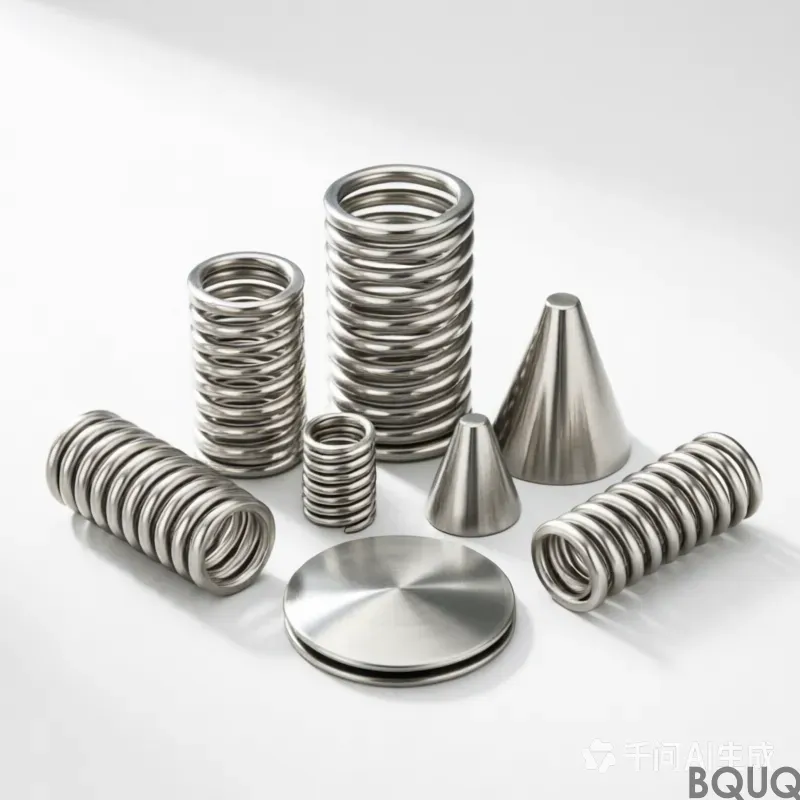
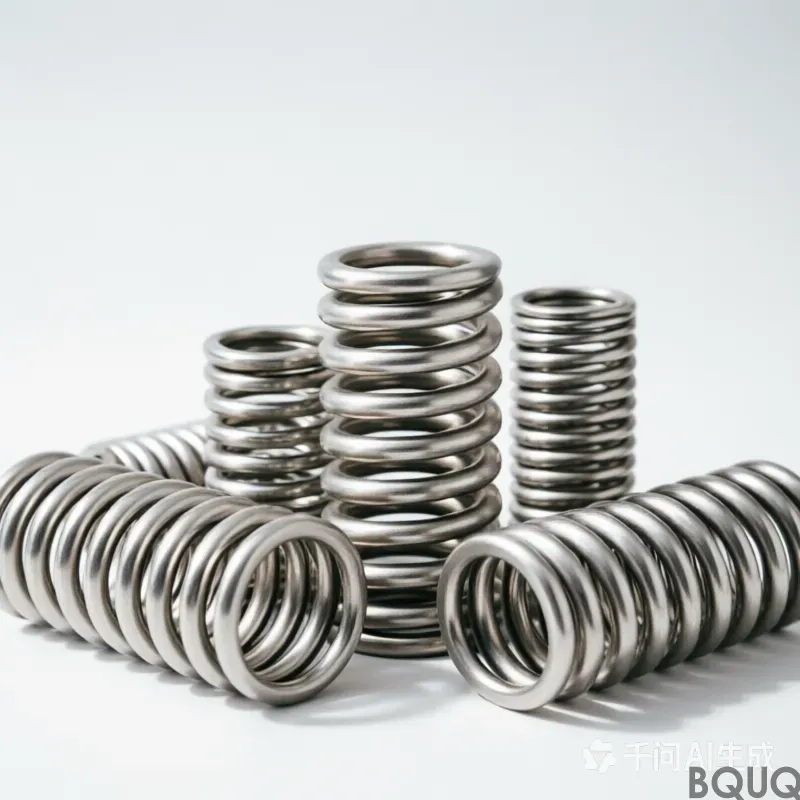
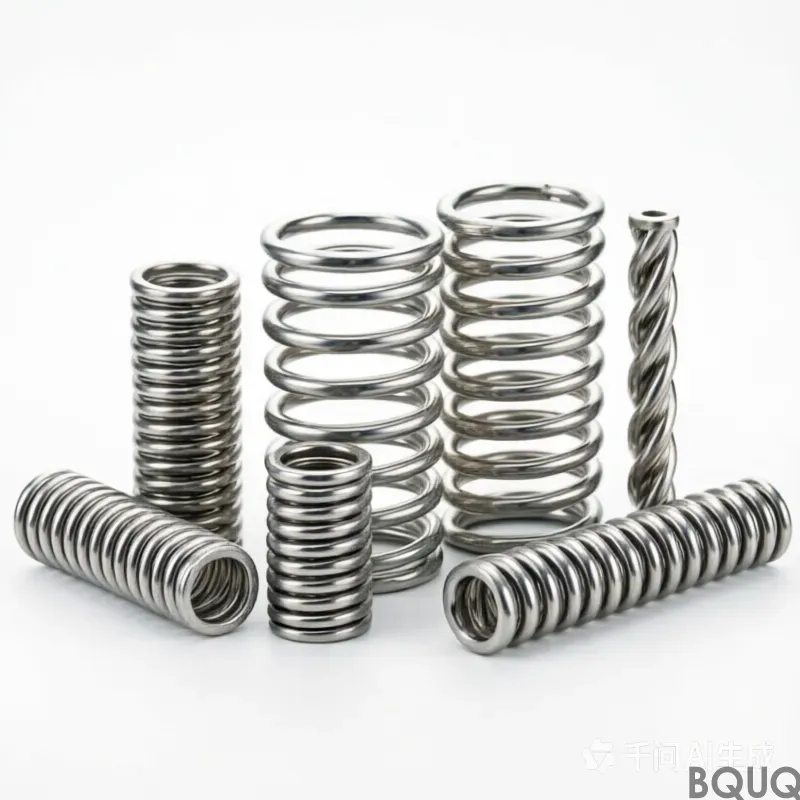
This is a Customized Non Standard Compression Spring built for engineers who cannot find the right geometry in a catalog. We machine, grind, and heat-treat each spring to your exact print, holding wire diameter tolerance at ±0.01 mm and free length at ±0.05 mm. The concrete benefit: you get a spring with 45–52 HRC hardness, total runout under 0.02 mm, and a 7-day lead time for prototypes, all from our 20-year-old factory in Dongguan.
How We Eliminate Buckling in Non-Standard Compression Springs
Non-standard springs fail most often by buckling sideways under load. We prevent that by controlling the slenderness ratio (free length divided by mean diameter) during the design review. For ratios above 2.6, we recommend a guide rod or a square-ground end. Our CNC coiling machines hold pitch uniformity at ±2%, so the load deflection curve stays linear within 5% of your calculated rate. We also grind both ends flat and parallel to 0.01 mm, which stops the spring from tilting on its seat and keeps the force vector perfectly axial.
Materials and Heat Treatment for 45–52 HRC
We stock three wire grades for Customized Non Standard Compression Springs: oil-tempered chrome silicon (ASTM A401), stainless steel 302 (ASTM A313), and Inconel X-750 for high-temperature service up to 600°C. After coiling, we stress-relieve at 400°C for 30 minutes to remove residual coil stress. For chrome silicon, we quench and temper to a final hardness of 45–52 HRC, which gives a fatigue life of over 1 million cycles at 80% of the maximum stress. Stainless springs get a passivation treatment to maintain corrosion resistance above 500 hours in salt spray. Every heat lot is traced with a material certificate, and we verify hardness on a Rockwell tester before any grinding step.
Grinding and Surface Finish Targets for Long Fatigue Life
Surface defects are the number one killer of compression springs. We shot-peen all springs with a controlled intensity of 0.15–0.20 mmA to introduce compressive residual stress on the surface. This step alone increases fatigue life by 30% compared to unpeened springs. Then we grind the end coils on a double-disc grinder, holding surface roughness Ra at 0.8 µm. The active coils remain as-coiled, which is correct for spring performance, but we deburr all edges to prevent stress risers. Our runout check uses a V-block and a dial indicator; we reject any spring where total indicated runout exceeds 0.02 mm.
Inspection Before Every Shipment
We do not ship a single Customized Non Standard Compression Spring without a full dimensional and functional report. Each spring is measured on a digital caliper for wire diameter, free length, and solid height. Load is verified on a compression tester at 25%, 50%, and 75% of the specified deflection, and the measured rate must match your target within ±5%. We check the spring index (mean diameter divided by wire diameter) to ensure it stays between 4 and 16; outside that range, we flag it for your approval before production. A copy of the material certificate and hardness test result is attached to every packing list. For critical applications, we can add a 100% eddy current crack detection for an extra 2 days of lead time.
CNC Coiling and Grinding Capabilities for Odd Geometries
Our CNC coiling machines handle wire diameters from 0.3 mm to 12 mm, with a maximum free length of 300 mm. We can produce closed ends, open ends, ground ends, or a mix — for example, one end closed and ground, the other open. We also handle conical, barrel, and hourglass shapes, which are common in non-standard designs. The coiling machine sets the pitch and number of active coils automatically from your CAD data, so there is no manual setup error. After coiling, we use a CNC grinder for end grinding, which holds flatness to 0.01 mm. This is the same equipment we use for precision CNC machining parts, so you get the same quality control standards as our aerospace and medical clients. If you are also designing the mating tooling, check our CNC cutting tool selection guide to ensure your spring seat and guides are machined correctly.
Customized Non Standard Compression Spring Specifications We Guarantee
Parameter
Our Capability
Standard Tolerance
Wire diameter
0.3 – 12 mm
±0.01 mm
Free length
Up to 300 mm
±0.05 mm
Outside diameter
Up to 100 mm
±0.10 mm
Spring index (D/d)
4 – 16
±0.5
Hardness (chrome silicon)
45 – 52 HRC
±2 HRC
Surface roughness (ground ends)
Ra 0.8 µm
Max Ra 1.2 µm
Total runout
≤ 0.02 mm
On request
End flatness
0.01 mm
On request
Prototype lead time
7 days
Expedite available
Production MOQ
No MOQ
Any quantity
When You Need a Spring That Can Handle Side Loads or High Temperature
Standard catalog springs are designed for pure axial compression. Your non-standard spring might see side loads, dynamic impact, or elevated temperatures. We handle these cases by adjusting the material and geometry. For side loads, we increase the wire diameter or add a reduced coil at one end to act as a damper. For temperatures above 250°C, we switch to Inconel X-750, which retains 80% of its room-temperature strength at 550°C. For high-speed cycling (over 10 Hz), we grind the ends and shot-peen the active coils to prevent surface fatigue. We also calculate the critical frequency of your spring — if it is below the operating frequency, we will recommend a heavier wire or a second spring in parallel. This engineering review is free and included with your quote.
How to Get a Firm Quote Without a Full Drawing
You do not need a finished 2D drawing to start. Send us a sketch, a 3D model, or even a sample spring you want to replicate. Our engineers will reverse-engineer the dimensions and provide a free design review within 24 hours. We will confirm the spring rate, solid height, and stress levels before we quote. This is standard practice for our precision manufacturing made in China — we treat every inquiry, even a one-off prototype, with the same rigor as a million-piece order. If you are still setting tolerances, our CNC machining tolerances guide explains what is achievable on standard equipment and what will cost you extra.
What is the MOQ for Customized Non Standard Compression Springs?
We have no MOQ — we will make a single prototype or a 100,000-piece production run at the same unit price logic, with no setup fee for the first order.
Can you match a sample spring I already have?
Yes, send us the physical sample by courier and we will measure wire diameter, free length, OD, and rate on our test equipment, then send you a matching drawing for approval before production.
How do you guarantee quality on small orders?
Every order, regardless of quantity, goes through the same inspection gate: 100% dimensional check on free length and OD, plus a load test on 10% of the batch unless you request 100% testing.
What is the fastest lead time for a custom spring?
For a spring under 2 mm wire diameter, we can ship a prototype in 5 days using express courier; for larger diameters, the standard is 7 days because heat treatment and grinding take longer.
Send us your drawing or sample today for a firm quote within 12 hours. Email sc@bquq.com or WhatsApp +86 13713157787. We will reply with a full technical review, a firm price, and a confirmed delivery date — no obligation, no MOQ.