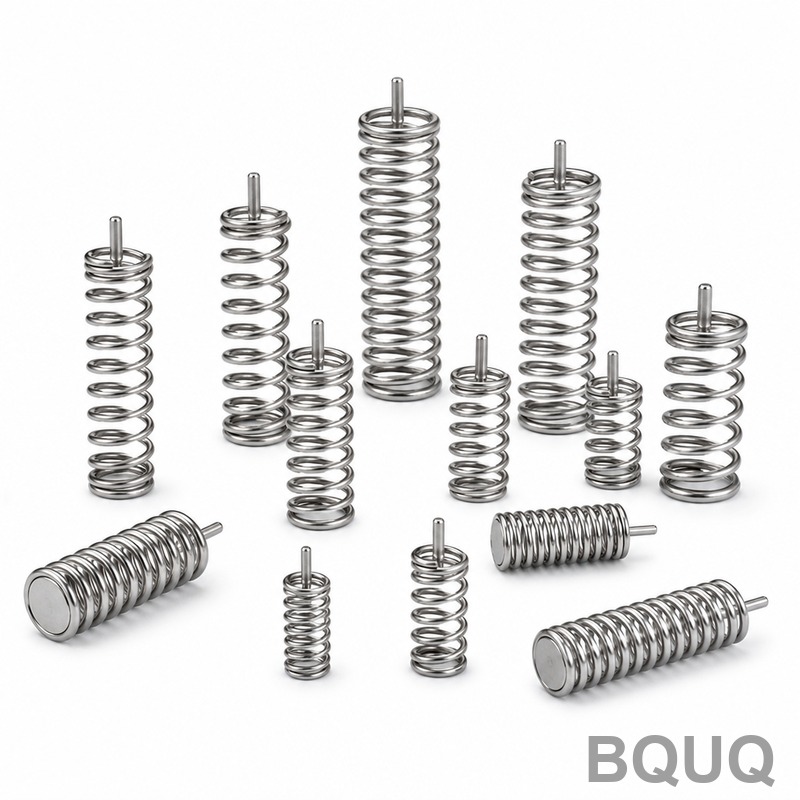
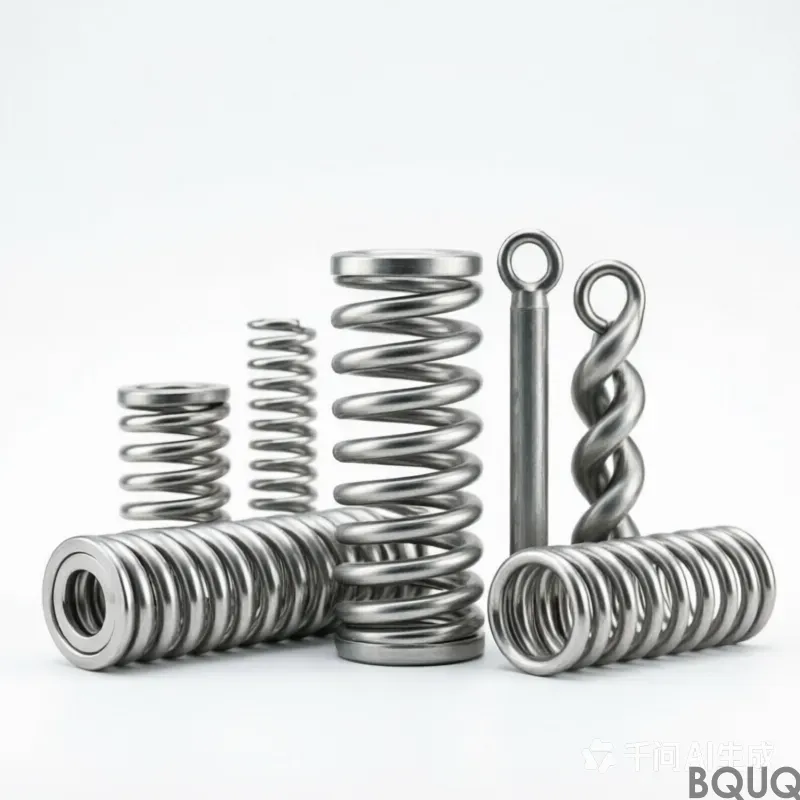
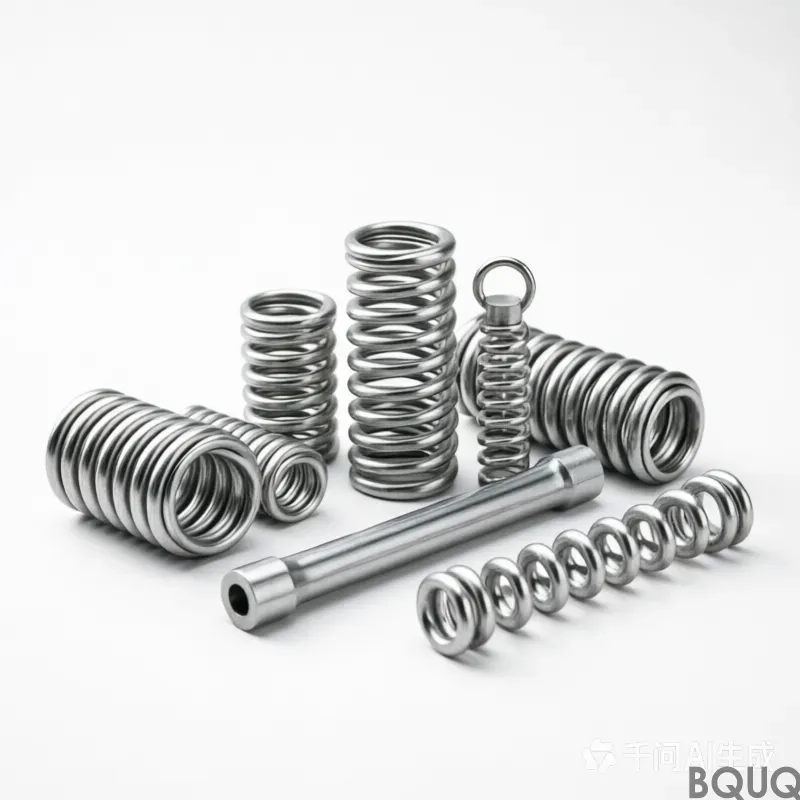
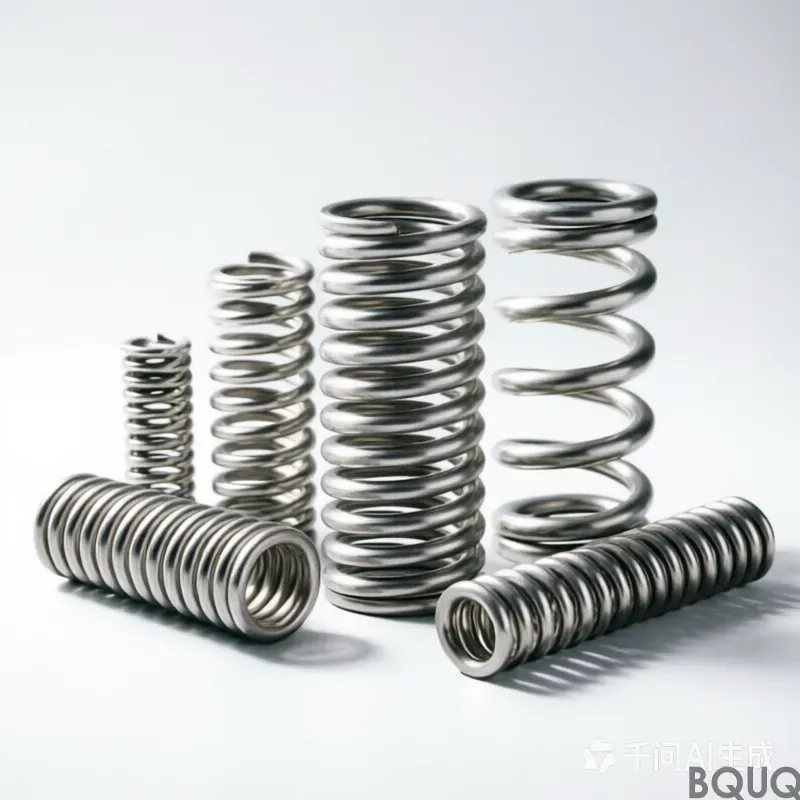
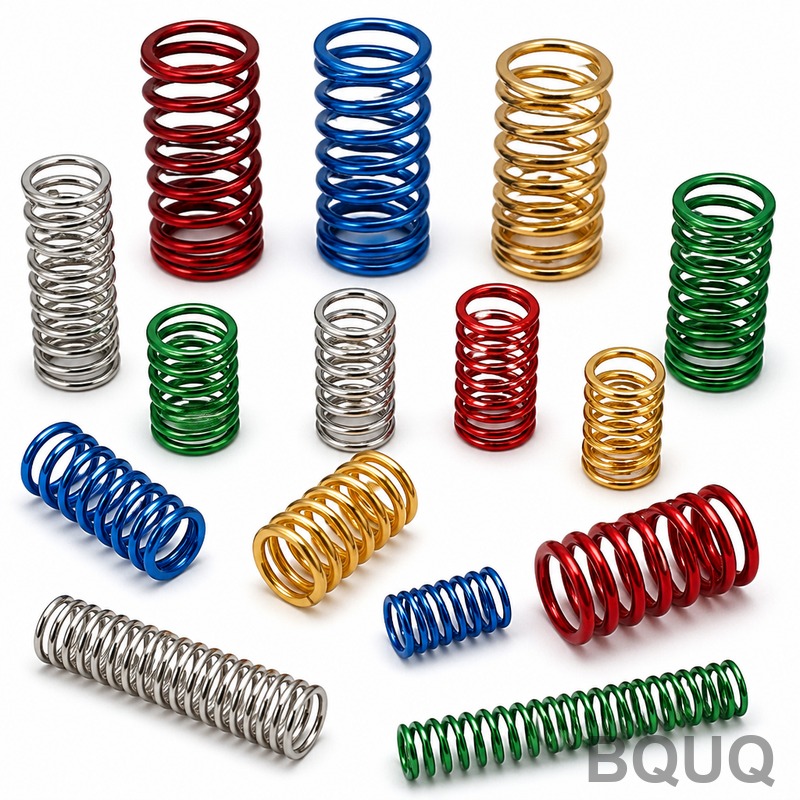
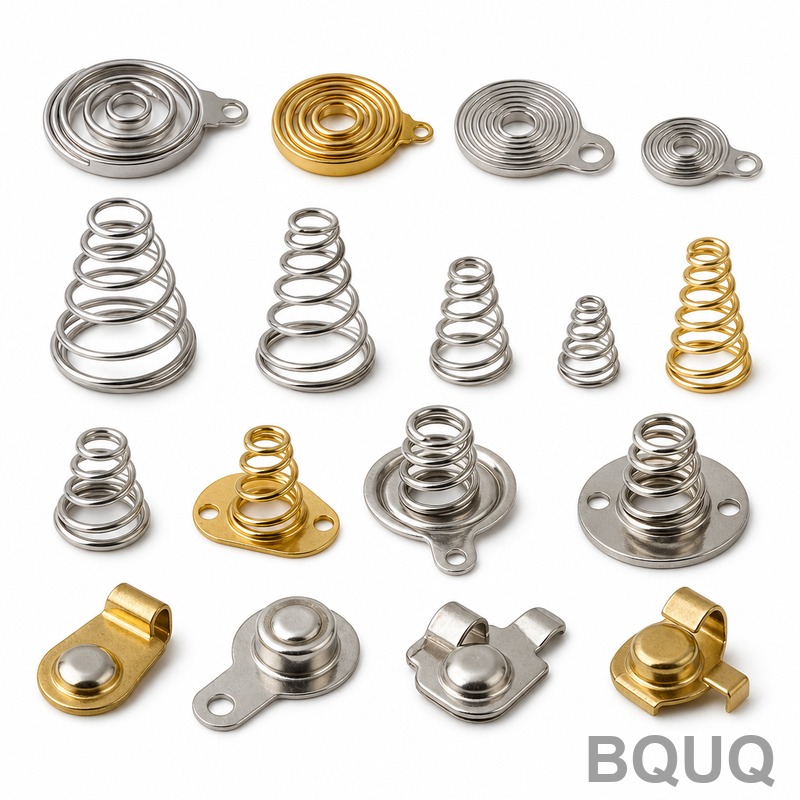
This is a collection of stainless steel touch springs for capacitive and mechanical contact assemblies. We hold tolerances to 0.01 mm, runout to 0.02 mm, and achieve hardness o
Stainless Steel Touch Spring Collection | BQUQ Precision Manufacturing
This is a collection of stainless steel touch springs for capacitive and mechanical contact assemblies. We hold tolerances to ±0.01 mm, runout to ≤0.02 mm, and achieve hardness of 42–48 HRC on stand
Get a Fast Quote for This Part
Send us your drawing / quantity / material — reply within 24h.
This is a collection of stainless steel touch springs for capacitive and mechanical contact assemblies. We hold tolerances to ±0.01 mm, runout to ≤0.02 mm, and achieve hardness of 42–48 HRC on standard parts. Typical lead time is 5 working days for small batches, and we offer no MOQ for this product line.
What Defines a Touch Spring vs. a Standard Compression Spring
A touch spring is not just a coil. It is designed with a specific end geometry — flat closed ends, a tapered tip, or a domed contact point — to make reliable electrical or mechanical contact under repeated compression. Standard springs often have open ends and inconsistent pitch, which causes intermittent contact. Our touch springs use closed, ground ends as standard, with pitch accuracy of ±0.005 mm per coil. This gives you a stable contact force of 0.15 N to 3.5 N, depending on wire diameter and free length.
Materials and Heat Treatment We Use
We start with SUS 301, SUS 304, and SUS 316L stainless steel wire, drawn to our own specification. For high-cycle applications, we use SUS 302 with a tensile strength of 1800–2100 MPa. After coiling, every spring goes through a stress-relief bake at 350°C for 30 minutes. If you need a higher hardness for wear resistance, we can add a precipitation-hardening step (condition C) to reach 42–48 HRC. We do not use low-grade 201 stainless for this collection — it fails in salt spray and loses tension quickly.
How We Achieve Runout Under 0.02 mm
Runout is the killer of touch springs in miniature assemblies. If the spring axis wobbles, the contact point drifts, and the switch or sensor fails. We control runout at two stages. First, our CNC wire-forming machines use a servo-driven feed system that holds wire straightness to 0.01 mm per 100 mm length. Second, we use a centerless grinding step for the spring's outer diameter after coiling. This removes any coil-to-coil eccentricity. The result: total indicated runout (TIR) of ≤0.02 mm measured on a V-block with a digital indicator.
Surface Finish Options for Low Contact Resistance
Raw stainless steel has an oxide layer that raises contact resistance. For touch springs used in low-voltage circuits (under 5 V), we offer three finishes. Standard: bright annealed, Ra 0.8 µm. Optional: electropolished, Ra 0.4 µm, which removes the oxide layer and reduces contact resistance to below 50 mΩ. Optional: gold-plated (0.2 µm minimum) for corrosion-critical or high-frequency applications. We do not recommend zinc plating on stainless — it creates galvanic corrosion.
Inspection Before Every Shipment
Every batch of touch springs passes a 100% dimensional check on a profile projector. We measure free length, outer diameter, and end flatness on 30% of parts. For critical dimensions like pitch and coil count, we use a CNC optical comparator with a resolution of 0.001 mm. A load test is done on 5% of parts for force-at-length verification. We provide a certificate of conformance with each shipment, including material mill test certificates and hardness readings. If you need a full PPAP, we can do that on request.
Custom End Geometries and Wire Forms
We do not limit you to catalog shapes. Send us a drawing of a conical touch spring, a double-start coil, or a spring with a bent leg for PCB mounting. Our wire-forming machines can bend, cut, and coil wire from 0.1 mm to 3.0 mm diameter in the same setup. Minimum bend radius is 1.0 times the wire diameter. We can also add a welded or brazed tip if you need a hard contact point (e.g., silver-nickel alloy). For free-length tolerances tighter than ±0.01 mm, we use a CNC grinding fixture after forming.
Pricing, MOQ, and What Affects Lead Time
Our standard no MOQ applies to any spring under 20 mm free length and 0.5 mm wire diameter. For larger springs, the MOQ is 100 pieces — still low. Tooling cost is zero for standard end geometries. If you need a custom mandrel or a special tip form, the tooling charge is $150–$400, waived on orders above 2,000 pieces. Lead time is 5 working days for up to 10,000 pieces. Above that, add 3 days per additional 10,000 pieces. Prototype samples are shipped in 48 hours via DHL Express.
| Parameter | Value / Range | | --- | --- | | Materials | SUS 301, SUS 302, SUS 304, SUS 316L | | Wire diameter | 0.10 mm – 3.00 mm | | Free length | 1.0 mm – 100 mm | | Outer diameter | 0.5 mm – 25 mm | | Hardness (standard) | 42–48 HRC (condition C) | | Tolerance (free length) | ±0.01 mm | | Tolerance (OD) | ±0.02 mm | | Runout (TIR) | ≤0.02 mm | | Surface finish (Ra) | 0.4 µm (electropolished) or 0.8 µm (bright annealed) | | Contact resistance | ≤50 mΩ (electropolished) | | Lead time (standard) | 5 working days | | MOQ | No MOQ (under 20 mm length) |
FAQ: Minimum Order Quantity
We operate with no MOQ for this collection if the free length is under 20 mm and wire diameter is under 0.5 mm; for larger parts, the MOQ is 100 pieces.
FAQ: Customization of Dimensions and Material
You can change any parameter — wire diameter, coil count, end shape, or material grade — and we will produce a prototype within 48 hours for your approval.
FAQ: Quality Control and Certifications
We perform 100% dimensional inspection on critical dimensions and provide a certificate of conformance with material traceability for every batch.
FAQ: Lead Time for Large Orders
Standard lead time is 5 working days for up to 10,000 pieces; for larger quantities, we add 3 days per additional 10,000 pieces, and we can expedite to 3 days for a 15% rush fee.
We are a precision manufacturing factory in Dongguan, China, with 20 years of CNC machining and wire-forming experience. Our Stainless Steel Touch Spring Collection is built for engineers who need repeatable contact force and low runout. Send your drawing or a simple sketch with dimensions — we will reply with a firm quote within 12 hours, including tooling costs and lead time.