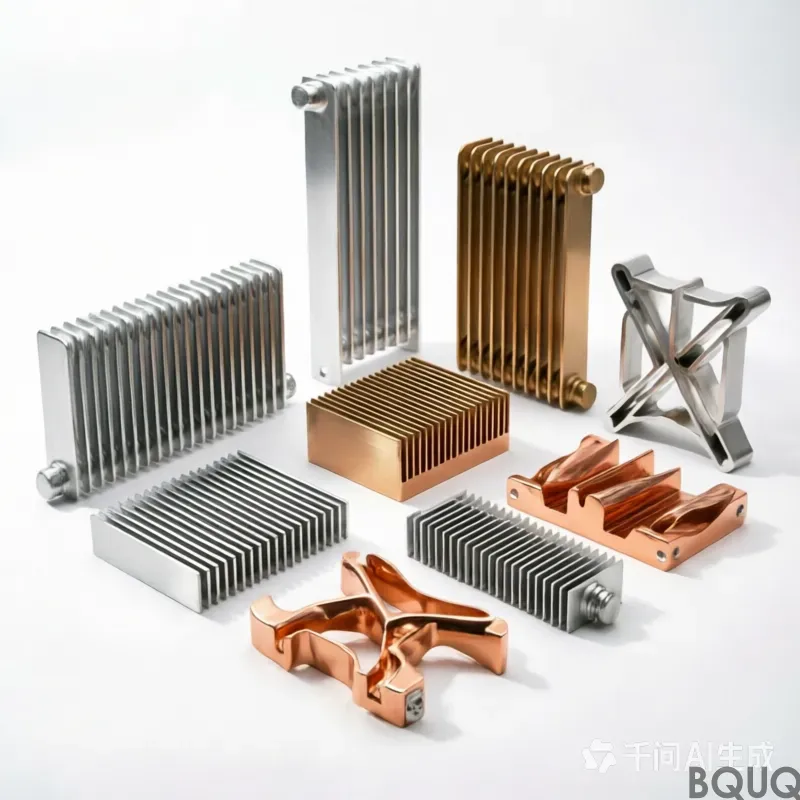
How heat sinks are packed to survive export, why fin damage is the main loss driver, freight options by size, and what DDP actually includes.
Heat Sink Packaging, Shipping and DDP Terms
Direct answer: Heat sinks are packed in individual bubble bags or EPE foam, then in double-wall cartons on a pallet, because crushed fins are the dominant transport loss. Sea freight is cost-effective above roughly 1 cubic metre; air freight is used for samples and urgent small batches. DDP means the seller delivers duty paid to your door, and it is the term most likely to hide a cost you did not price.
Packaging standard by heat sink type
| Heat sink type | Packaging | Why |
|---|---|---|
| Small machined heat sink under 100 mm | Individual bubble bag, 50-100 per double-wall carton, carton on pallet | Prevents fin-to-fin abrasion and anodising scratches |
| Extruded heat sink 100-300 mm | EPE foam end caps, individual bag, 10-20 per carton | End caps protect the extrusion ends where fins are most vulnerable |
| Large heat sink over 300 mm | Foam-separated layers, plywood crate above 20 kg per unit | Cartons crush under stack load at this size |
| Thin-fin heat sink, fin under 1 mm | Full foam surround, "this side up" marking, no stacking | Thin fins deform permanently under a 30 cm drop |
| Anodised black, cosmetic visible parts | PE film plus foam, individual partitions | Black anodising shows handling marks more than clear |
| Cold plate or heat pipe assembly | Foam surround, port caps, desiccant | Prevents port contamination and internal corrosion |
| Assembled units with thermal interface applied | Release liner protected, flat orientation only | Interface material creeps if stored on edge |
Why fin damage is the main loss driver
Fins are the most fragile feature and the most functionally important. A bent fin reduces surface area locally, disrupts airflow and, in a dense-fin natural convection design, can cost measurable thermal performance. It is also the most common inspection rejection on arrival.
Three practical controls:
- Specify a drop test. A carton drop test per ISTA 1A or 3A, depending on parcel or pallet shipment, is inexpensive and it converts a vague argument into a pass or fail.
- Specify the pallet pattern. Heat sinks should be stacked on their base, never on their fins. If the carton design does not enforce this, the warehouse will not either.
- Specify how many units per carton and the carton weight limit. A 25 kg carton of heat sinks is handled by two people; a 32 kg carton is dropped. Cap it at 20-25 kg.
Freight options compared
| Mode | Typical transit | Best for | What to watch |
|---|---|---|---|
| Air express (DHL / FedEx / UPS) | 3-7 days door to door | Samples, urgent batches up to roughly 200 kg | Volumetric weight: a boxy heat sink is charged on volume, not mass |
| Air freight, consolidated | 7-12 days plus customs | 200-1,000 kg when express is too expensive | You arrange import clearance unless DDP is agreed |
| Sea LCL | 25-40 days port to port | 1-15 cubic metres | Multiple handling points increase damage risk; consolidation delays |
| Sea FCL 20ft | 25-40 days port to port | Above roughly 15 cubic metres | Cheapest per unit; container loading plan matters for heavy aluminium |
| Rail to Europe | 18-25 days | Europe-bound, between sea and air on cost | Schedule reliability varies; not suitable for tight delivery windows |
Aluminium is heavy relative to its volume, so heat sinks often ship on actual weight rather than volumetric weight, unlike most consumer goods. Check both before assuming air is unaffordable.
What DDP includes, and the three places it bites
Under DDP (Delivered Duty Paid), the seller is responsible for export clearance, main carriage, import clearance, duties and taxes, and delivery to the named place. For the buyer this is the simplest term: the price you see is the price at your door.
The complications:
- VAT and import tax timing. The seller pays, but the cost is inside the price. Ask for a DDP quote with the duty and tax lines shown separately if you want to see what you are paying. In the EU, the import VAT alone can be 19-25% of the goods value.
- Customs valuation disputes. If customs in your country challenges the declared value, the seller carries that risk under DDP, which is why DDP prices carry a buffer. A buffer is not dishonesty; it is risk pricing. Where the goods value is high and the classification is clear, FOB or CIF plus your own broker is often cheaper.
- Who is the importer of record. Under DDP the seller is nominally the importer. In some jurisdictions the buyer must be the importer of record for tax deduction purposes, which makes DDP impractical. Check before you contract on DDP.
Incoterms compared for a heat sink order
| Term | Seller pays to | Buyer handles | When it fits |
|---|---|---|---|
| EXW | Factory only | Everything including China export clearance | Only if you have a Chinese forwarder; rarely worth it |
| FOB | Loaded on vessel at named port | Main carriage, import clearance, duty, inland | The default for experienced importers; cleanest cost visibility |
| CIF | Freight and insurance to destination port | Import clearance, duty, inland delivery | Simple, but you inherit the seller's insurance terms |
| DAP | Delivered to your address, duty unpaid | Import clearance and duty | Good middle ground: landed logistics, your own duty handling |
| DDP | Delivered to your address, duty and tax paid | Nothing | Samples, small buyers, or where you cannot reclaim import VAT |
Documentation that must match
For a heat sink shipment, customs cares about classification and value. HS code choice depends on the function: aluminium heat sinks for electronics are typically classified as parts of the machines they serve, and extruded aluminium profiles cut to length can be classified as aluminium articles instead, which carries a different duty rate and, in some markets, an anti-dumping exposure.
This is a real risk. Antidumping duties on aluminium extrusions exist in several markets and can change the landed cost by a large multiple. Ask your broker to confirm classification before the first shipment, and ask the supplier what HS code they intend to declare. Mismatched declarations between supplier and broker is one of the most common causes of customs delay.
Frequently asked questions
Is DDP always more expensive?
Not always, but it is less transparent. For small quantities DDP is usually convenient and competitively priced. For large orders, FOB plus your own forwarder gives better visibility and often a lower total.
Who pays if the parts arrive damaged?
Depends on the Incoterm and the insurance. Under CIF the seller arranges minimum-cover insurance, which may not pay a claim for crushed fins without evidence. Photograph the carton before opening and keep the packaging, or the carrier will reject the claim.
Can heat sinks ship in the same container as other parts?
Yes, and it is often cheaper. The constraint is load distribution: aluminium is dense, so heavy heat sink cartons must sit low and centred, not on top of lighter goods.
How much does sea freight add to lead time?
25-40 days port to port for Europe and North America, plus 3-7 days each end for inland and clearance. Plan 6-8 weeks door to door for a sea shipment.
Tell us the destination and quantity and we will quote FOB, DAP and DDP side by side so you can see exactly what each term costs.
Heat sink sourcing guides
- Aluminum Heat Sink Price per kg: 2026 Cost Breakdown
- Custom Heat Sink MOQ and Lead Time by Process
- Heat Sink Extrusion Die Cost and Tooling Amortisation
- Heat Sink RFQ: What to Send for an Accurate Quote
- Heat Sink Tolerance and Flatness: What to Specify
- Heat Sink Surface Finish Options and Cost Impact
- Heat Sink RoHS, REACH and UL Compliance Explained
- Heat Sink Volume Pricing: How Breakpoints Really Work
- Heat Sink Prototype and Sample Service: What to Expect
- Heat Sink Supplier Audit and Second Sourcing
- Heat Sink Thermal Test Report: What the Data Package Contains