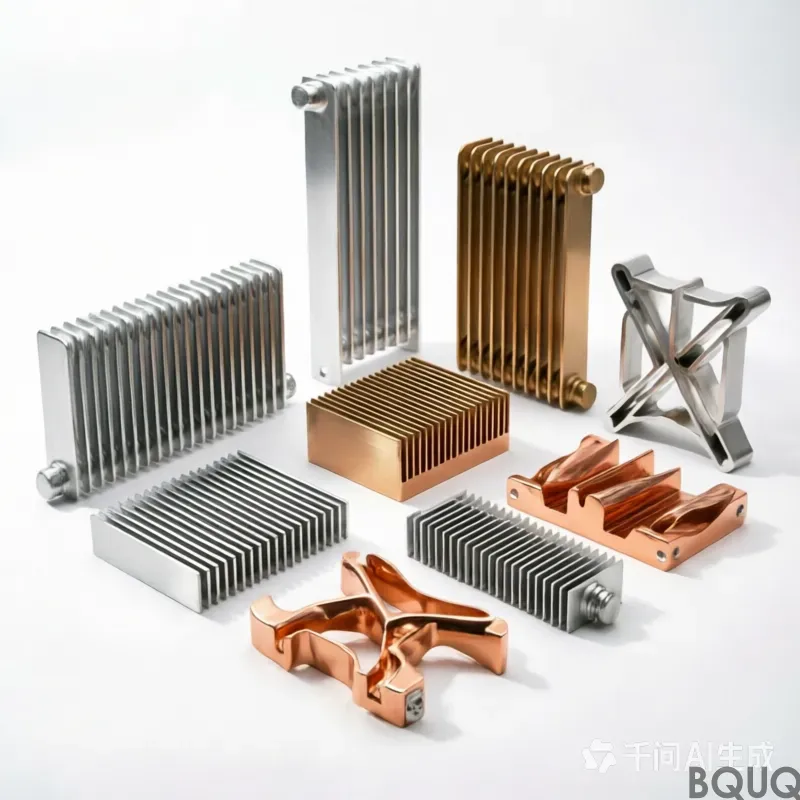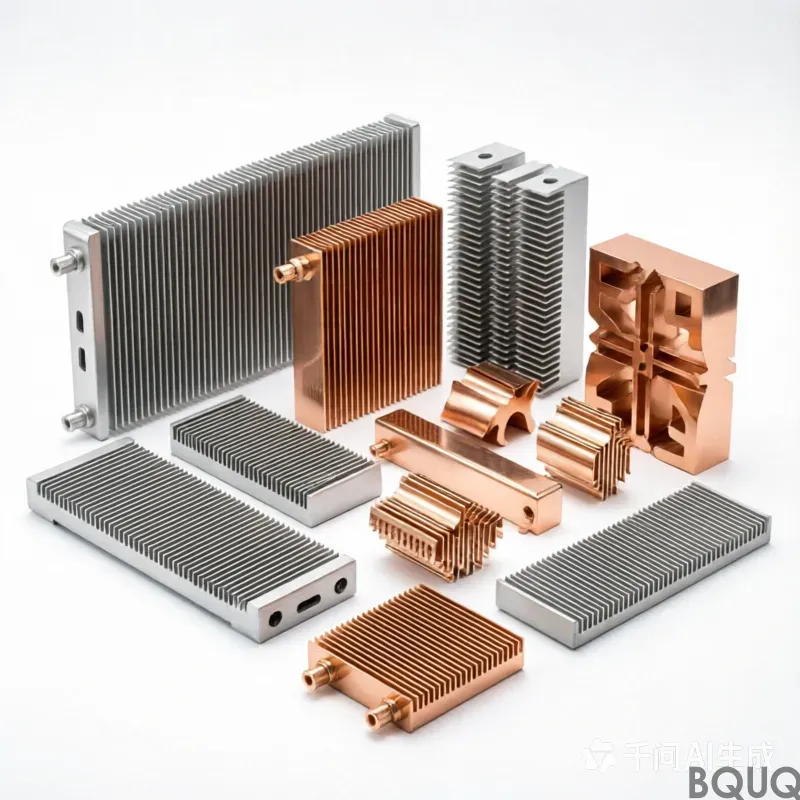
The eight items a heat sink supplier needs to quote accurately: STEP file, GD&T drawing, alloy, finish, quantity, thermal target, environment and Incoterm.
Heat Sink RFQ: What to Send for an Accurate Quote
Direct answer: To get an accurate heat sink quotation in one round instead of five, send eight things: a 3D model in STEP format, a 2D drawing with GD&T, the alloy and temper, the surface finish and colour, the order quantity and annual volume, the critical tolerance callouts, the working environment including cooling method and ambient temperature, and the required Incoterm. Missing any one of these typically adds one round trip of 1-3 days to the quotation.
The eight-item checklist
| Item | Why the supplier needs it | What happens if it is missing |
|---|---|---|
| STEP 3D model | Drives CNC programming and fixturing; a STEP is unambiguous where a PDF is not | Supplier models it themselves, guesses a feature, and the quote is for a different part |
| 2D drawing with GD&T | Carries flatness, perpendicularity and tolerance class, which a 3D model usually does not | Flatness is assumed at a loose default and the part fails on arrival |
| Alloy and temper | 6063-T5, 6061-T6 and 1050 behave differently in extrusion and machining | Supplier quotes the cheapest alloy and thermal conductivity is lower than assumed |
| Surface finish and colour | Anodising class, black vs clear, masking and laser marking all carry cost | Finish is added later as a variation, at variation pricing |
| Quantity and annual volume | Determines process choice: CNC vs extrusion vs die casting | Supplier quotes the wrong process and the price is either wrong or uncompetitive |
| Critical tolerances | Identifies which features need extra attention and inspection | The part is quoted as standard and one critical dimension drives cost and scrap later |
| Environment and cooling method | Natural convection, forced air, liquid cold plate or potted assembly change geometry and finish | Geometry is proposed for the wrong regime and thermal performance is wrong |
| Incoterm and destination | FOB, CIF and DDP differ by freight, duty and customs handling | Quotes are compared on different bases and the cheapest one is not actually cheapest |
What a good drawing for a heat sink looks like
Most rejected or mispriced heat sink RFQs share the same drawing faults. Fix these five and the first quotation is usually usable:
- Flatness is called out on the mounting face, not implied. "Base flatness 0.05 mm over the contact area" is quotable. A note saying "flat base" is not. Base flatness is the most expensive single callout on a heat sink, so state it deliberately and only where the interface requires it.
- Fin thickness and pitch are given as a range with a minimum. "1.0 mm +/- 0.1 mm fin, 3.0 mm pitch" tells the die designer what the extrusion has to achieve. A nominal only forces the supplier to assume a tolerance.
- Hole callouts include thread class and depth. M3 x 0.5, 6 mm deep, tapped through is quotable. "M3 holes" is not.
- Anodised or masked areas are marked. If the mounting face must stay bare for thermal contact, say so. Masking is a real cost and a real quality risk.
- The revision and date are on the drawing. Suppliers quote from the file they receive. Without a revision block, an updated model silently invalidates the quote.
Do you need to send a thermal target?
You do not have to, but it changes the quality of the answer. A supplier who knows the target thermal resistance and the airflow can propose a geometry instead of quoting yours. That is often worth more than a price. If you have a target junction temperature, dissipated power and airflow, send them; if not, send the enclosure constraints and the supplier can work backwards.
Be aware that a supplier quoting purely to your drawing is quoting manufacturing cost, not thermal adequacy. The drawing is your responsibility. If you want the supplier to take thermal responsibility, that has to be stated and usually priced as an engineering service.
Response times you should expect
| Request type | Reasonable response |
|---|---|
| Standard profile from stock, clear finish | 24 hours |
| New CNC machined heat sink from plate | 1-3 working days |
| New extrusion profile with die | 2-4 working days, including DFM notes |
| Die cast heat sink with tooling | 3-6 working days, including tooling proposal |
| Assembly with heat pipes or cold plate | 4-7 working days |
If a supplier answers a complex RFQ in two hours with a firm price, they are not costing it. Expect either a revision or a surprise later.
How to compare quotes that arrive on different bases
Normalise before you compare. Put every quote into the same six columns: unit price at your actual quantity, tooling cost and ownership, finish included, inspection included, Incoterm and destination, and lead time from PO to departure. A quote that looks 12% higher often wins once tooling amortisation and finish scope are aligned.
Also ask each supplier to state what is excluded. Freight, duty, certification testing, third-party inspection and packaging upgrades are the usual exclusions, and they are where the apparent gap between quotes actually lives.
Frequently asked questions
Can you quote from a PDF only?
Yes, but expect a slower and less accurate answer, because the profile has to be re-modelled. A STEP plus a PDF drawing is the fastest combination.
What if I only have a photo of an existing heat sink?
A photo alone cannot be quoted. Send the photo plus the overall dimensions, the mounting hole pattern and the fin geometry, and it can usually be reverse-engineered into a quote, with a note that the result is an approximation.
Do you sign an NDA?
Yes, and it is reasonable to ask. Send the NDA before the drawing, not after.
How many parts can be combined in one RFQ?
Send the full BOM. Grouping heat sinks with similar alloy, finish and quantity band in one RFQ usually improves pricing because setup and freight are shared.
Send the STEP file, drawing, quantity and destination and you will get a costed reply with the assumptions stated, so nothing changes after the PO.
Heat sink sourcing guides
- Aluminum Heat Sink Price per kg: 2026 Cost Breakdown
- Custom Heat Sink MOQ and Lead Time by Process
- Heat Sink Extrusion Die Cost and Tooling Amortisation
- Heat Sink Tolerance and Flatness: What to Specify
- Heat Sink Surface Finish Options and Cost Impact
- Heat Sink RoHS, REACH and UL Compliance Explained
- Heat Sink Volume Pricing: How Breakpoints Really Work
- Heat Sink Prototype and Sample Service: What to Expect
- Heat Sink Packaging, Shipping and DDP Terms
- Heat Sink Supplier Audit and Second Sourcing
- Heat Sink Thermal Test Report: What the Data Package Contains