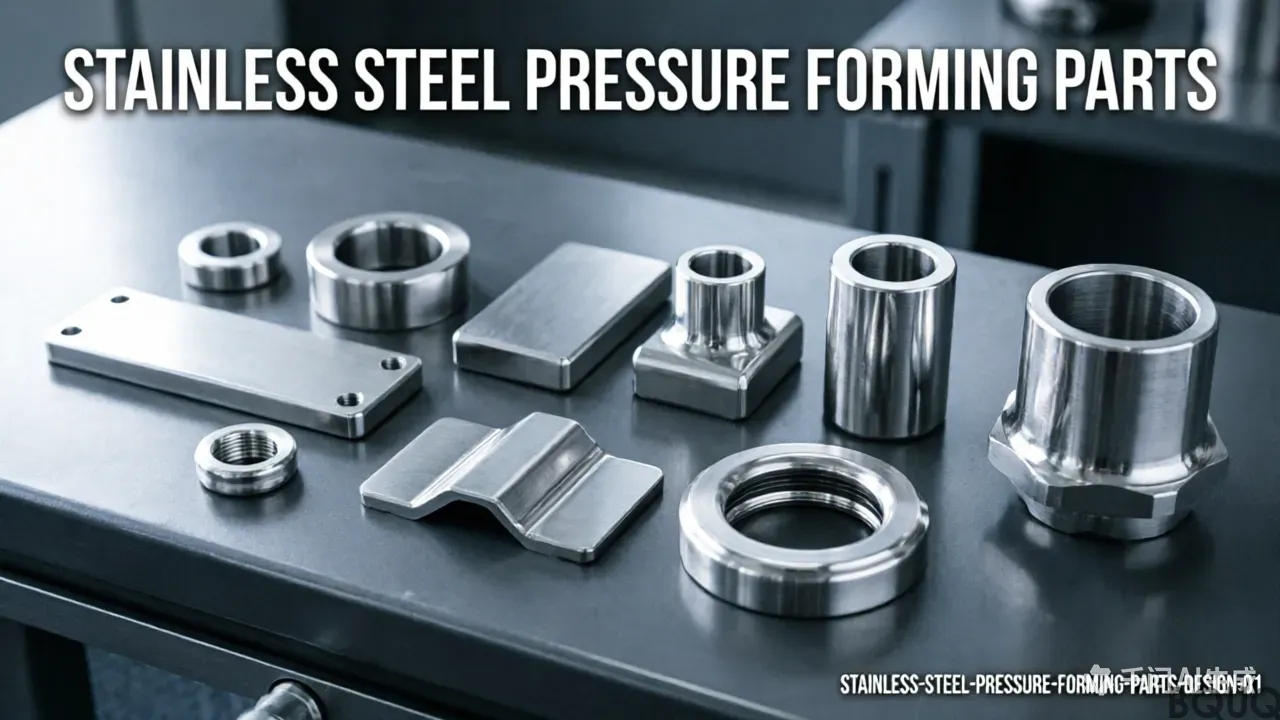
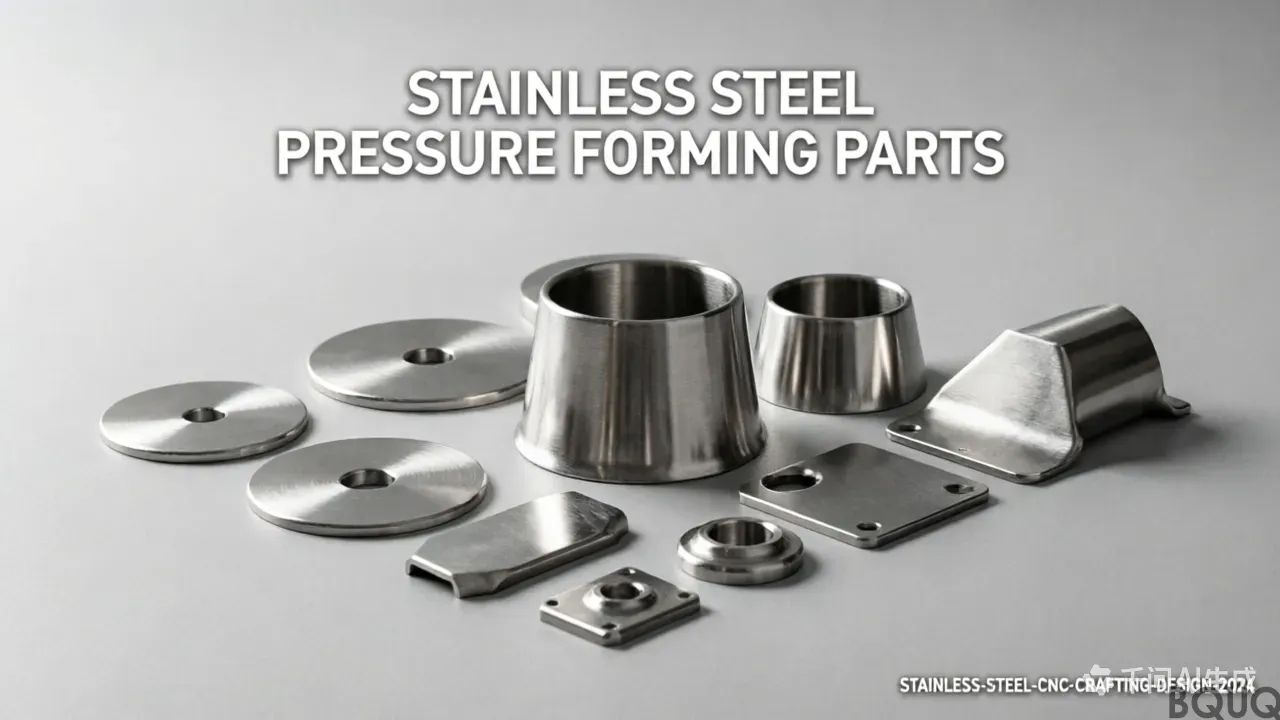
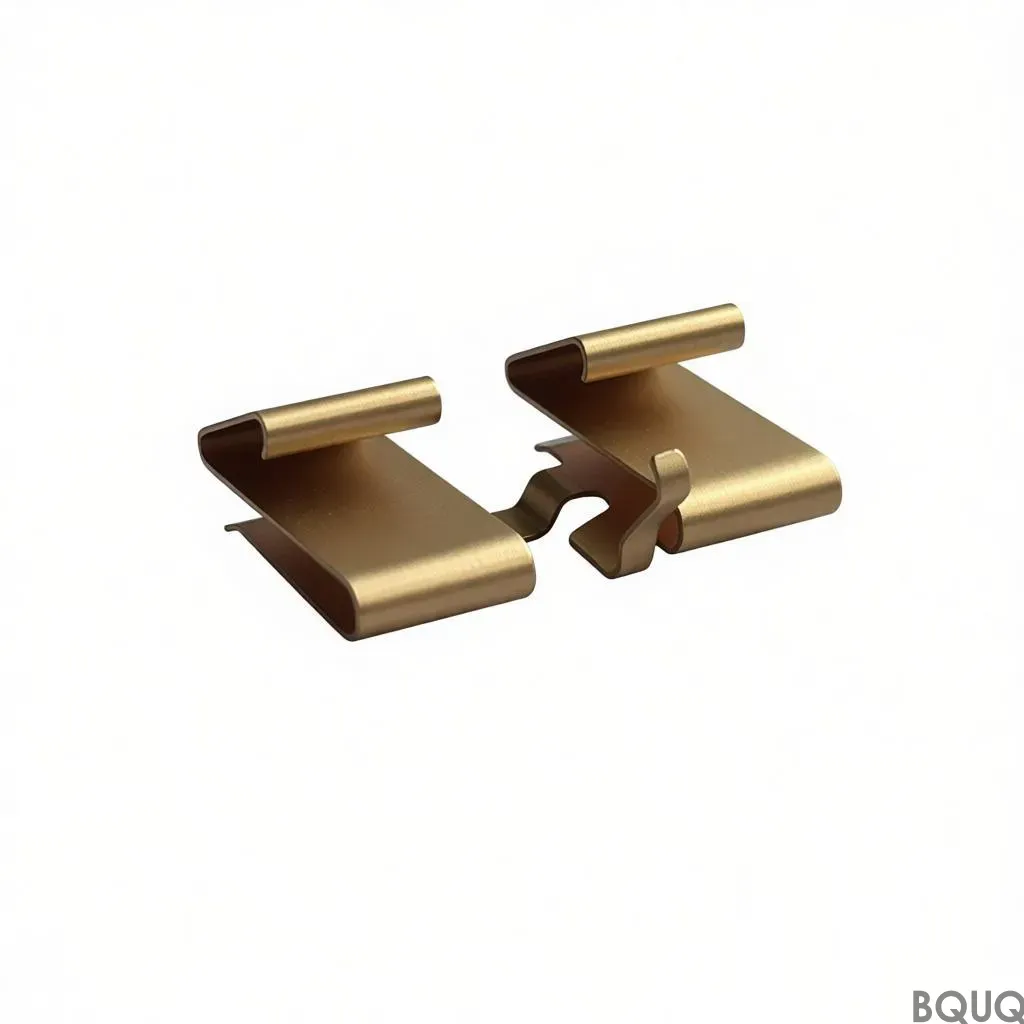
The minimum order quantity (MOQ) for custom metal stamping parts typically ranges from 500 to 5,000 pieces for progressive die stamping, while prototype and short-run stamping can
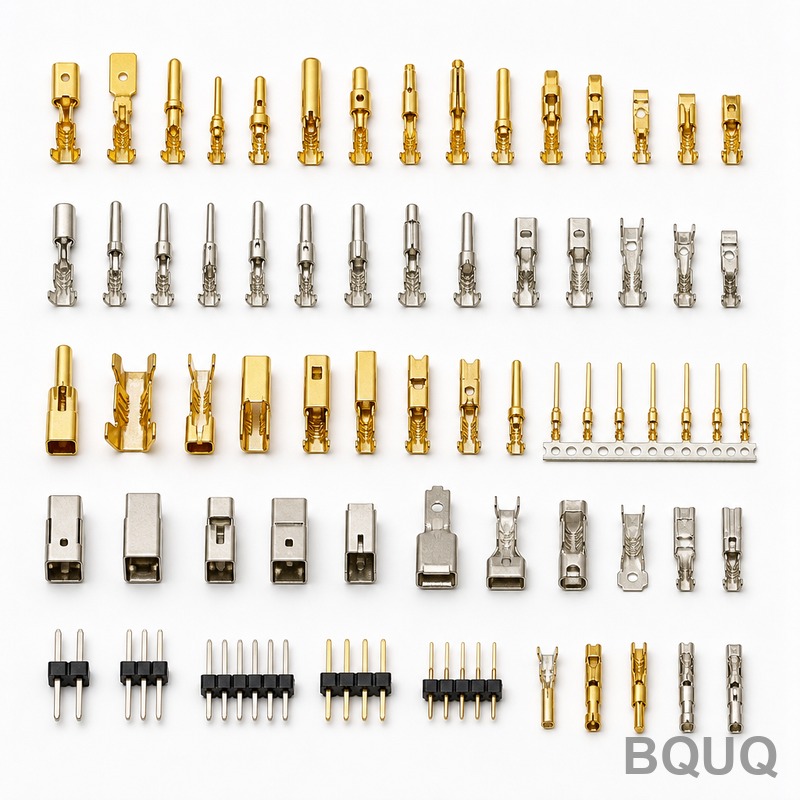
What Is the Minimum Order Quantity for Custom Metal Stamping Parts?
The minimum order quantity (MOQ) for custom metal stamping parts typically ranges from 500 to 5,000 pieces for progressive die stamping, while prototype and short-run stamping can start at just 1 to 100 pieces. For high-volume production using compound or transfer dies, MOQs often exceed 10,000 pieces to amortize tooling costs effectively. However, the exact MOQ depends on material thickness, part complexity, die type, and whether you accept higher per-unit pricing for lower quantities.
How Does Die Type Affect the MOQ for Metal Stamping?
Die type is the primary driver of MOQ because it dictates tooling cost and production speed. Progressive dies, which perform multiple operations (cutting, bending, coining) in a single press stroke, typically require a MOQ of 3,000 to 5,000 pieces to justify the $3,000 to $15,000 tooling investment. Compound dies, which cut and form in one stroke, have a lower MOQ of around 1,000 to 3,000 pieces because tooling costs range from $1,500 to $8,000. For prototype or soft tooling made from aluminum or 3D-printed inserts, MOQs can drop to 100 pieces or less, though unit prices increase by 30% to 50% compared to hard tooling.
What Is the MOQ for Prototype and Low-Volume Metal Stamping?
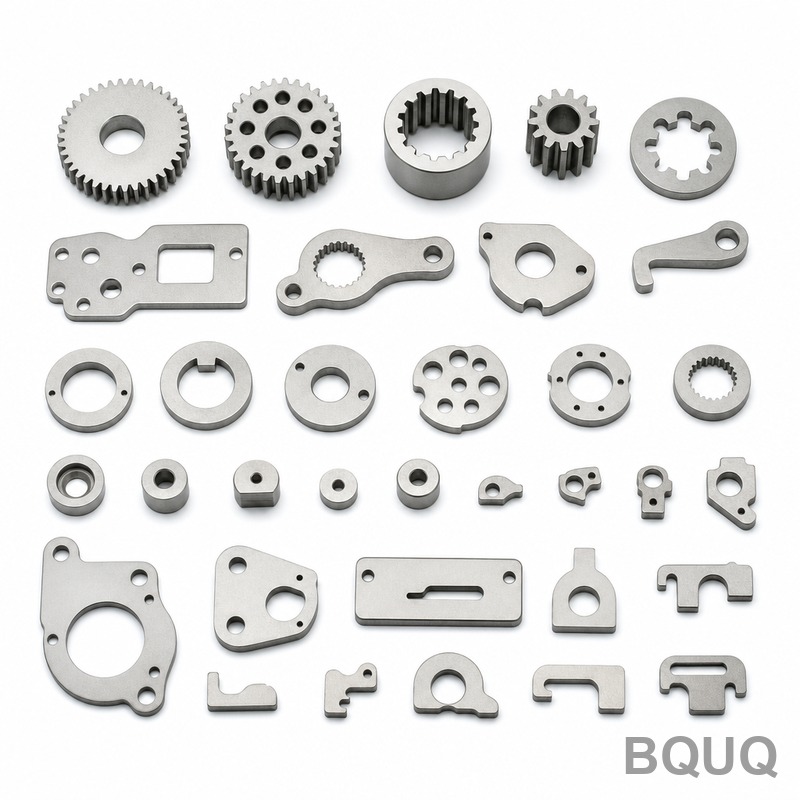
For prototype and low-volume runs, BQUQ offers MOQs as low as 1 piece using CNC-machined soft tooling or laser-cut blanks with secondary forming. These methods are ideal for design validation and functional testing, with lead times of 3 to 7 days for simple parts. A typical low-volume run of 100 to 500 pieces uses hardened steel tooling with simplified geometry, costing $800 to $3,000 for the die and yielding per-part prices of $0.50 to $3.00 depending on material (e.g., 0.5 mm stainless steel 304 versus 2.0 mm aluminum 5052). If your annual demand is under 5,000 pieces, we recommend low-volume tooling to avoid the high cost of a full progressive die.
Why Do High-Volume MOQs Exist for Custom Metal Stamping?
High-volume MOQs exist because the fixed cost of a progressive die must be spread across enough parts to achieve a competitive unit price. For example, a progressive die for a 25 mm by 25 mm bracket in 1.5 mm cold-rolled steel costs $8,000 and produces 60 parts per minute. At a MOQ of 10,000 parts, tooling amortization is $0.80 per part; at 1,000 parts, it jumps to $8.00 per part, which is often higher than the material and labor cost combined. Therefore, we set high-volume MOQs at 10,000 to 50,000 pieces for parts with tight tolerances (plus/minus 0.05 mm) or multiple forming steps, ensuring you pay less than $0.20 per part for simple geometries.
How Much Does Tooling Cost and How Does It Relate to MOQ?
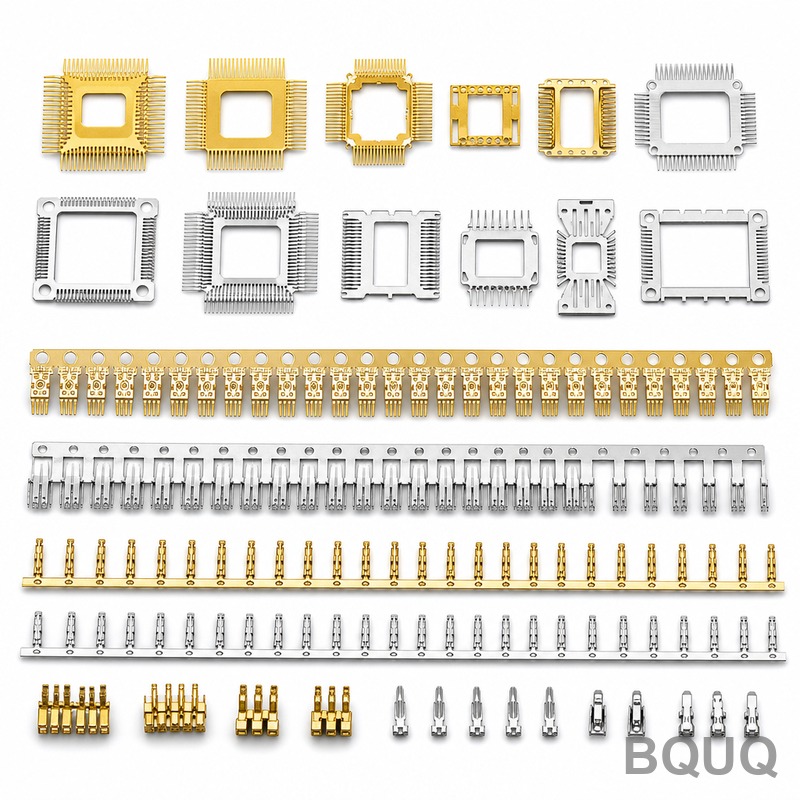
Tooling costs for custom metal stamping range from $500 for a simple blanking die to $25,000 for a multi-station progressive die with sensors and in-die tapping. The MOQ is inversely proportional to tooling cost: a $1,500 compound die supports a MOQ of 2,000 pieces, while a $12,000 progressive die requires 5,000 pieces minimum. At BQUQ, we amortize tooling into the piece price only if you order above the MOQ; otherwise, we charge a separate tooling fee and offer a lower MOQ of 500 pieces. For example, a heat sink clip in 0.8 mm spring steel (C75S) with a $2,800 die has a standard MOQ of 5,000 pieces, but with a $2,800 tooling fee, the MOQ drops to 1,000 pieces at $0.35 each.
Which Materials and Tolerances Influence the MOQ?
Material type and tolerance requirements affect MOQ because harder materials (e.g., stainless steel 301 full-hard) wear dies faster, requiring more expensive tool steel and higher quantities to justify the cost. Parts with tolerances tighter than plus/minus 0.03 mm need precision dies with guide pins and ground inserts, increasing tooling cost by 40% and raising the MOQ to 10,000 pieces. In contrast, parts with tolerances of plus/minus 0.1 mm can use standard dies with a MOQ of 2,000 pieces. Material thickness also matters: stamping 0.1 mm beryllium copper requires slower press speeds (20 strokes per minute versus 120 for 1.0 mm steel), reducing output and increasing the break-even MOQ to 15,000 pieces.
Can You Reduce the MOQ for Custom Metal Stamping Parts?
Yes, you can reduce the MOQ by accepting one of three trade-offs: paying a separate tooling fee, relaxing tolerances, or choosing a simpler part design. If you pay a tooling fee of $1,500 to $5,000 upfront, BQUQ can set the MOQ to 500 pieces or even 100 pieces for pilot runs. Relaxing tolerances from plus/minus 0.05 mm to plus/minus 0.15 mm allows us to use a lower-cost die with a MOQ of 1,000 pieces instead of 5,000. Simplifying the part by removing a lancing or coining operation reduces die stations from 6 to 4, cutting tooling cost by 25% and lowering the MOQ to 2,500 pieces.
What Is the Typical MOQ for Springs and Heat Sinks Produced by Stamping?
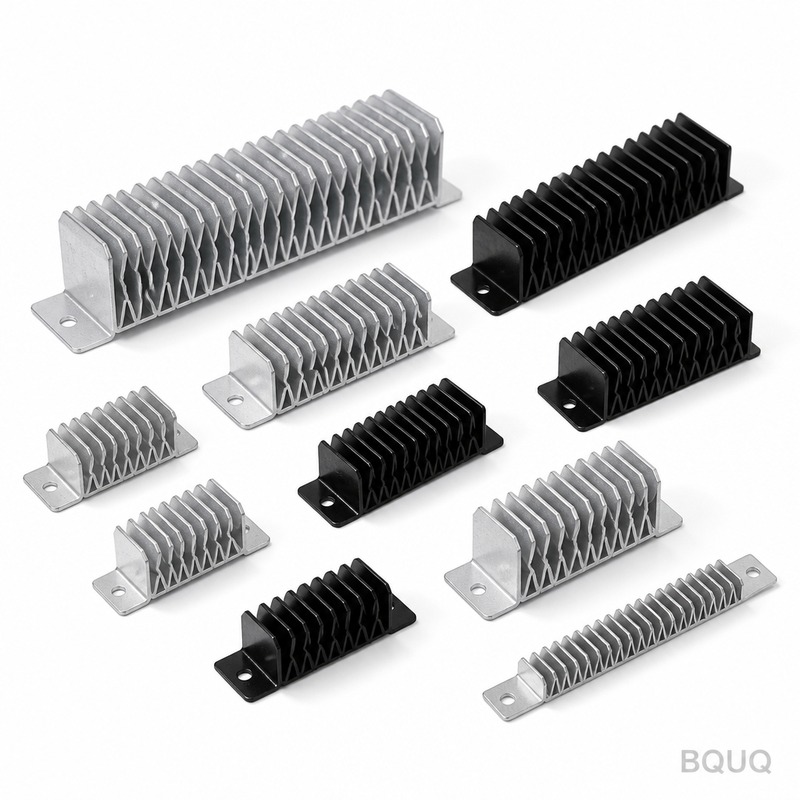
For stamped springs, such as flat springs and leaf springs in 0.3 to 1.5 mm spring steel, the typical MOQ is 5,000 to 20,000 pieces because heat treatment and stress relief are batch processes. A batch of 5,000 springs can be heat-treated at 400 degrees Celsius for 30 minutes in a mesh belt furnace, but running 500 pieces wastes energy and increases cost per part by 60%. For stamped heat sinks, typically made from 0.5 to 3.0 mm aluminum 6061 or copper C1100, the MOQ ranges from 2,000 to 10,000 pieces. Smaller heat sinks (under 30 mm) with simple fin patterns can be stamped at 2,000 pieces, while larger heat sinks with deep drawn fins require progressive dies and a 10,000-piece MOQ.
| Part Type | Material Thickness | Typical MOQ (pieces) | Tooling Cost (USD) | Unit Price at MOQ (USD) |
| Flat Spring | 0.3 mm C75S steel | 5,000 | $3,200 | $0.18 |
| Heat Sink Clip | 0.8 mm 301 stainless | 5,000 | $2,800 | $0.35 |
| Bracket | 1.5 mm CRS | 3,000 | $1,800 | $0.12 |
| Heat Sink (30 mm) | 2.0 mm Al 6061 | 2,000 | $4,500 | $0.85 |
| Deep Drawn Housing | 0.5 mm Cu C1100 | 10,000 | $15,000 | $1.20 |
| Prototype Bracket | 1.0 mm Al 5052 | 100 | $1,200 (soft) | $2.50 |
Which Factors Should You Consider Before Committing to a MOQ?
Before committing to a MOQ, evaluate your annual demand, inventory holding cost, and design stability. If your part design is not yet frozen, order a prototype run of 100 pieces at $2.50 each rather than committing to 5,000 pieces at $0.18 each, because a design change after hard tooling is made will cost $1,000 to $3,000 in die modifications. Also consider that stamping parts in batches of 5,000 to 10,000 reduces per-unit logistics costs by 15% if you have warehouse space. For parts with a projected annual volume below 2,000, we recommend CNC machining or laser cutting instead of stamping, as the tooling cost cannot be amortized.
How Do Lead Times Vary with MOQ in Metal Stamping?
Lead times for custom metal stamping scale with MOQ and tooling complexity. Prototype runs of 100 pieces with soft tooling ship in 5 to 7 business days. Low-volume runs of 500 to 2,000 pieces with compound dies ship in 10 to 15 business days, including die making and sample approval. High-volume runs of 5,000 to 50,000 pieces with progressive dies ship in 15 to 25 business days, assuming raw material (e.g., 1.2 mm galvanized steel coil) is in stock. For orders above 100,000 pieces, we recommend a scheduled release of 20,000 pieces per month to maintain a 10-day lead time per batch.
FAQ
Can I Order 10 Pieces of a Custom Metal Stamping Part for Testing?
Yes, you can order 10 to 50 pieces for testing using CNC-machined soft tooling or wire-cut dies, with a lead time of 3 to 7 days and a unit price of $5 to $15. This is not cost-effective for production but is ideal for fit, form, and function validation before committing to a full MOQ.
What Is the Difference Between MOQ and Annual Volume Commitment?
MOQ is the minimum number of parts you must order in a single purchase order, typically 500 to 5,000 pieces, while an annual volume commitment is a contract to buy a total quantity over 12 months. We offer annual volume pricing with lower unit costs if you commit to 50,000 pieces or more, even if individual orders are below the standard MOQ.
Does a Higher MOQ Always Mean a Lower Unit Price?
Yes, but only up to a point, because material cost and press time are fixed. For example, a bracket at 5,000 pieces costs $0.12 each, but at 50,000 pieces it drops to $0.09 each; at 500,000 pieces, it drops to $0.08 each due to bulk material discounts. The tooling amortization becomes negligible above 50,000 pieces, so the price reduction flattens.
Are There Any MOQ Exceptions for High-Value Materials Like Copper or Beryllium?
Yes, for high-value materials such as beryllium copper (C17200) or phosphor bronze, we can reduce the MOQ to 500 pieces because the material cost dominates the total price, making tooling amortization less significant. For a 0.2 mm beryllium copper spring, the material cost is $0.40 per piece, so a $2,000 die adds only $4.00 per piece at a 500-piece MOQ, which is acceptable.
How Should I Calculate the Total Cost Including Tooling and MOQ?
To calculate total cost, multiply the unit price by the MOQ and add the tooling fee if quoted separately. For example, a 5,000-piece order at $0.12 per piece plus a $1,800 tooling fee totals $2,400, or $0.48 per piece for the first run. For subsequent runs without new tooling, your cost drops to $0.12 per piece.
When Should I Choose Metal Stamping Over CNC Machining or Laser Cutting?
Choose metal stamping when your annual volume exceeds 5,000 pieces and the part geometry is suitable for high-speed blanking, bending, or coining. For volumes under 2,000 pieces or parts with complex 3D features, CNC machining or laser cutting is more economical despite higher per-unit costs, because there is no tooling investment.
Can BQUQ Help Me Reduce My MOQ Without Sacrificing Quality?
Yes, BQUQ can reduce MOQ by using modular dies, which allow you to stamp one part configuration at a time with a shared die base, lowering tooling cost by 20% and MOQ to 1,000 pieces. We also offer a consignment inventory program where we produce the full MOQ but store parts at our factory, shipping on demand, so you avoid holding inventory.
Conclusion
For custom metal stamping parts, the MOQ is not a fixed number but a function of die type, material, tolerance, and your willingness to pay tooling fees. Prototype runs can start at 10 pieces, while production runs typically require 1,000 to 5,000 pieces for economical pricing. At BQUQ, with 20 years of experience in CNC machining, metal stamping, springs, and heat sinks, we help you balance MOQ, tooling cost, and lead time to optimize your total cost of ownership. Send us your part drawing and annual volume forecast, and we will recommend the lowest-cost MOQ strategy. For a rapid quote within 12 hours, contact us at Email: sc@bquq.com, WhatsApp: +86 13713157787, or visit www.bquq.com.
Related Articles
- Intelligent online inspection and closed-loop quality control: creating a zero-defect production line for stamped parts
- Stamping digital factory and simulation-driven design: from virtual prototype to digital twin operation
- High-speed precision stamping and in-die microforming technology: from electronic connections to micromotor cores