CAT40 and CAT50 tool holders remain the dominant choice for general-purpose CNC machining due to their balance of cost, rigidity, and pull-stud compatibility, but BT and HSK system
How Do CAT40 and CAT50 Tool Holders Compare With BT and HSK Systems?
CAT40 and CAT50 tool holders remain the dominant choice for general-purpose CNC machining due to their balance of cost, rigidity, and pull-stud compatibility, but BT and HSK systems offer specific advantages in high-speed and high-precision applications. For a typical VMC or HMC, CAT tooling provides a taper accuracy of AT3 (0.0002-inch radial runout) and costs 30-50% less than equivalent HSK holders, while HSK delivers superior axial repeatability (0.00004-inch) and is better suited for spindle speeds above 15,000 RPM. The selection hinges on your spindle design, torque requirements, and whether you prioritize tool-change speed (BT) or static rigidity (HSK).
What Are the Core Dimensional Differences Between CAT, BT, and HSK Tool Holders?
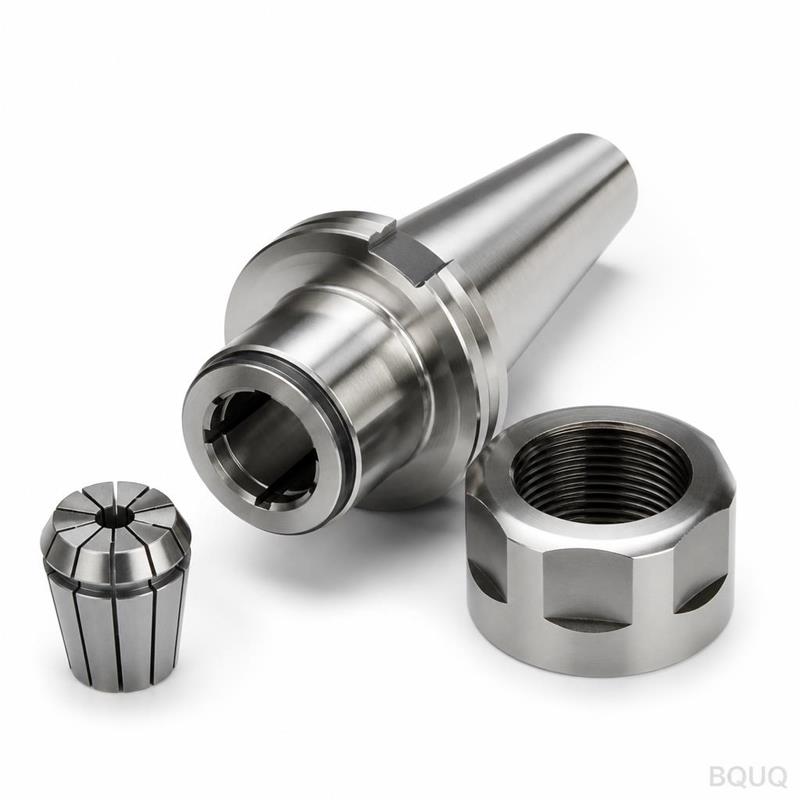
The fundamental difference lies in the taper geometry and retention mechanism. CAT and BT use a 7/24 steep taper (16.5 degrees included angle) with a threaded pull stud at the top, relying on the taper friction and the drawbar to hold the tool. HSK uses a 1/10 hollow shank taper (approximately 11.4 degrees) that expands under drawbar force, creating a dual-face contact (taper and flange) with the spindle.
Dimensional data for a CAT40 holder: taper large diameter is 44.45 mm (1.75 inches), gauge line length is 68.40 mm (2.693 inches), and typical overall length is 100-150 mm depending on projection. HSK-A63 has a flange diameter of 63 mm and a taper length of 48 mm. BT40 is identical in taper dimensions to CAT40 (44.45 mm) but uses a different flange groove position and pull-stud thread (MAS BT-403 standard), making them non-interchangeable without modification. HSK’s hollow taper allows for lighter weight (about 30% less than CAT of similar size) and higher axial stiffness (2-3 times greater than CAT at the flange face).
How Does Spindle Speed Capability Compare Between CAT, BT, and HSK?
HSK is the clear winner for high-speed machining because it eliminates the "bell-mouthing" effect common to steep tapers. At 10,000 RPM, centrifugal force expands the CAT and BT spindle nose, causing the tool holder to seat deeper and lose axial positioning; the pull stud can also stretch, reducing clamping force. HSK’s hollow taper expands radially outward in sync with the spindle, maintaining constant face contact.
Real-world limits: CAT40 and BT40 are generally rated for a maximum of 12,000 to 15,000 RPM with balanced holders (G2.5 at 15,000 RPM). CAT50 and BT50 are limited to 8,000 to 10,000 RPM due to their larger mass (typically 4-6 kg). HSK-A63 can run at 25,000 RPM safely, and HSK-E32 (smaller size) is used up to 50,000 RPM. For a 20,000 RPM spindle on a die-mold CNC, HSK-A63 is the standard choice. If you attempt to run a CAT40 holder at 20,000 RPM, tool pull-out force drops by 20-30%, and runout increases to 0.0005 inches or more.
Which Tool Holder System Offers Higher Static and Dynamic Rigidity?
HSK provides superior bending and torsional rigidity because the flange face contacts the spindle nose directly. Static bending stiffness for HSK-A63 is approximately 250 N/µm, versus 180 N/µm for CAT40 and 190 N/µm for BT40 (measured at 50 mm gauge length). Dynamic stiffness (resistance to chatter) is also 25-40% higher for HSK because the dual-face contact reduces the overhang effect.
CAT50, however, has an advantage in pure torque transmission due to its larger taper diameter (69.85 mm). A CAT50 holder can transmit up to 1,200 N·m of torque, while HSK-A63 transmits about 500 N·m and HSK-A100 transmits 1,500 N·m. For heavy roughing in steel (e.g., 12 mm depth of cut at 0.2 mm/tooth feed), CAT50 on a BT50 spindle is preferable because the larger taper resists deflection better than a smaller HSK size. BT40 and CAT40 have identical taper stiffness, but BT’s shorter pull-stud engagement (10 mm thread vs 12 mm for CAT) can lead to 5-10% lower drawbar force retention under side load.
What Are the Cost and Tool-Change Time Differences?
Cost per holder is a critical factor for job shops. A standard CAT40 ER32 collet chuck (Chinese-manufactured, precision grade) costs $25-40 USD; a similar BT40 costs $28-45 USD; an HSK-A63 ER32 costs $60-90 USD. For CAT50, prices range $50-80 USD, while HSK-A100 is $120-180 USD. The gap grows with high-balance or shrink-fit versions: HSK shrink-fit holders can exceed $200 USD.
Tool-change time also varies by magazine and spindle design. CAT and BT use a pull-stud retention knob, which requires a two-step release (unclamp taper, then push out). Typical tool-to-tool change time on a 30-tool magazine is 2.5 to 4.0 seconds. HSK uses a collet-style clamping mechanism that releases in one motion; on modern machines, HSK tool change time is 1.2 to 2.5 seconds. However, CAT’s standard pull-stud design allows for simpler, cheaper automatic tool changers, which is why many 3-axis mills still use CAT.
How Do Accuracy and Repeatability Compare in Real Machining Conditions?
Precision is where HSK excels. Axial repeatability (tool tip position after clamping) for CAT and BT is typically 0.0002 to 0.0003 inches (5-8 µm) due to pull-stud seating variations. HSK achieves 0.00004 to 0.0001 inches (1-3 µm) because the flange face provides a positive stop. Radial runout at the gauge line is similar (0.0002 inches for AT3 grade), but HSK maintains this runout at higher speeds and after multiple clamp cycles.
For a boring operation requiring a hole tolerance of ±0.0005 inches, CAT40 will produce acceptable results with a pre-set boring head, but thermal growth can shift the tool by 0.0003 inches after 30 minutes of cutting. HSK’s face contact reduces this thermal drift by 50% because heat dissipates through the flange. In a test on a 10,000 RPM spindle, HSK-A63 holders maintained 0.0001-inch radial runout after 1,000 tool changes, while CAT40 degraded to 0.0003 inches due to taper wear.
Which Application Scenarios Favor CAT, BT, or HSK?
Choose CAT40 or BT40 for general 3-axis milling, drilling, and tapping on machines with 8,000-12,000 RPM spindles, where cost per part is more important than micron-level precision. CAT50 is ideal for heavy roughing in mold bases, large aerospace frames, and cast iron machining where torque and rigidity dominate. BT is primarily used in Japanese-made machines (Fanuc, Makino, Okuma) and offers a slightly shorter gauge length, which improves rigidity by 5% over CAT for the same projection.
HSK is mandatory or strongly recommended for: 5-axis machining with long-reach tools (because the hollow taper reduces tool overhang), high-speed milling of aluminum (above 15,000 RPM), and micro-machining (tool diameters under 1 mm) where runout must stay below 0.0001 inches. For example, a medical device manufacturer machining titanium implants will use HSK-A63 to ensure surface finish below Ra 0.4 µm. If your machine has a 30,000 RPM spindle and you use CAT, you will face premature spindle bearing wear and tool pull-out failures.
What Is the Tool Holder Selection Data Table?
The table below summarizes key comparative data for common sizes. Values are based on industry-standard measurements from holder manufacturers (e.g., BIG Kaiser, Kennametal) and independent testing.
| Parameter | CAT40 | BT40 | CAT50 | HSK-A63 | HSK-A100 |
| Taper angle (degrees) | 16.5 | 16.5 | 16.5 | 11.4 | 11.4 |
| Gauge line diameter (mm) | 44.45 | 44.45 | 69.85 | 63 | 100 |
| Max spindle speed (RPM) | 12,000 | 12,000 | 8,000 | 25,000 | 15,000 |
| Axial repeatability (inches) | 0.0003 | 0.0003 | 0.0004 | 0.0001 | 0.0001 |
| Static bending stiffness (N/µm) | 180 | 190 | 350 | 250 | 600 |
| Torque capacity (N·m) | 300 | 300 | 1,200 | 500 | 1,500 |
| Typical cost (ER32 collet, USD) | 35 | 40 | 65 | 80 | 150 |
| Tool change time (seconds) | 3.0 | 3.0 | 4.0 | 2.0 | 2.5 |
Why Does Tool Holder Balance Matter for High-Speed Machining?
Unbalanced holders cause vibration, poor surface finish, and accelerated spindle bearing wear. CAT and BT holders are commonly supplied with a balance grade of G6.3 at 10,000 RPM, which means the center of mass is offset by about 0.00004 inches. For speeds above 12,000 RPM, you must specify G2.5 balance, which requires adding balance screws or using hydraulic or shrink-fit chucks. HSK holders are often balanced to G2.5 at 20,000 RPM from the factory because the hollow taper allows more symmetrical material removal.
A practical rule: if your spindle speed exceeds 12,000 RPM, use HSK or a balanced CAT holder (add 20-30% cost). Unbalanced CAT40 at 15,000 RPM can produce a force of 50 N at the tool tip, which is enough to cause chatter on a 6 mm end mill. For a job shop running aluminum parts at 18,000 RPM, switching from CAT40 to HSK-A63 reduced tool wear by 35% and improved surface finish from Ra 0.8 µm to Ra 0.5 µm in a documented case.
What Are the Maintenance and Compatibility Considerations?
Retention knobs (pull studs) on CAT and BT must be checked for wear every 500 tool changes; a worn pull stud increases taper seating error. HSK requires no pull stud, but the hollow taper must be kept clean of chips because any debris prevents full face contact. HSK spindles also require specialized clamping units, which are 20-30% more expensive to repair than CAT drawbars.
Compatibility is a major decision factor. CAT40 tooling fits machines from Haas, Mazak (except BT), and most Taiwanese VMCs. BT40 fits Fanuc Robodrill, Makino, and Okuma. HSK is standardized but has many variations (A, B, C, E, F); HSK-A is for general machining, HSK-B is for heavy cutting, HSK-E is for high speed. If you have an older machine with a CAT40 spindle, you cannot convert to HSK without replacing the entire spindle cartridge, which costs $8,000-15,000.
FAQ
Can I Use a BT40 Tool Holder in a CAT40 Spindle?
No, they are not interchangeable because the flange groove position and pull-stud thread differ. The taper is identical, but the retention knob thread is different (MAS BT for BT40, ANSI/ISO for CAT40), and the drawbar will not engage correctly. Attempting to use a BT40 holder in a CAT40 spindle can cause tool pull-out and spindle damage.
How Much Does It Cost to Switch from CAT to HSK Tooling?
Switching costs include 20-50 new holders (at $80-200 each), a new retention system for the spindle (if retrofitted), and potential spindle modification. For a 10-tool setup, expect $2,000-5,000 in tooling and labor. Retrofit kits for the spindle cost $5,000-10,000, making the total investment $10,000-20,000 for a single machine.
Which Tool Holder Is Best for a 15,000 RPM Spindle?
HSK-A63 is the best choice for 15,000 RPM because it maintains axial accuracy and balance without extra cost. CAT40 can work if balanced to G2.5 and limited to 12,000 RPM, but at 15,000 RPM you risk taper expansion and tool pull-out. For a 15,000 RPM spindle, use HSK-A63 exclusively.
How Often Should I Replace Tool Holders?
Replace CAT/BT holders when taper runout exceeds 0.0003 inches or if the pull-stud threads are damaged, typically after 5,000-10,000 tool changes. HSK holders last longer (10,000-15,000 changes) but must be inspected for face wear. Annual calibration is recommended for all holders in high-precision work.
What Is the Difference Between HSK-A and HSK-B?
HSK-A is the general-purpose standard with a single drive slot and is suitable for milling, drilling, and boring. HSK-B has a larger flange with additional drive slots and is designed for heavy torque applications like turning and large-diameter boring. HSK-B is not interchangeable with HSK-A because the flange dimensions differ.
Why Do Japanese Machine Tools Prefer BT Over CAT?
Japanese standards (JIS B 6339) define BT with a shorter overall length and different pull-stud position, which allows for a more compact spindle nose and slightly higher rigidity at the gauge line. Japanese machine manufacturers like Makino and Fanuc standardized on BT to reduce tool change time and improve accuracy for their high-speed applications. However, most Western machines use CAT, and the performance difference is minimal at low speeds.
Can HSK Tool Holders Be Used on a CAT Spindle with an Adapter?
No, adapters are not practical because the taper angles are completely different (16.5 degrees vs 11.4 degrees), and there is no room for a mechanical adapter without adding significant overhang. Adapters would introduce excessive runout and reduce rigidity, defeating the purpose. You must change the spindle or machine to use HSK.
Conclusion
For a factory like BQUQ with 20 years of CNC machining experience, the choice between CAT40, CAT50, BT, and HSK must be based on spindle speed, torque, and tolerance requirements. CAT40 remains the most economical for general work up to 12,000 RPM, CAT50 is unbeatable for heavy roughing, and HSK is essential for high-speed and high-precision applications above 15,000 RPM. BT is a regional variant that offers no performance advantage over CAT at comparable speeds. Contact our engineering team for a free tooling audit and quote.
For a detailed quote on custom tool holders or CNC machining projects, send your drawings to sc@bquq.com or WhatsApp +86 13713157787. We respond within 12 hours with pricing and DFM feedback. Visit www.bquq.com for our full capabilities.