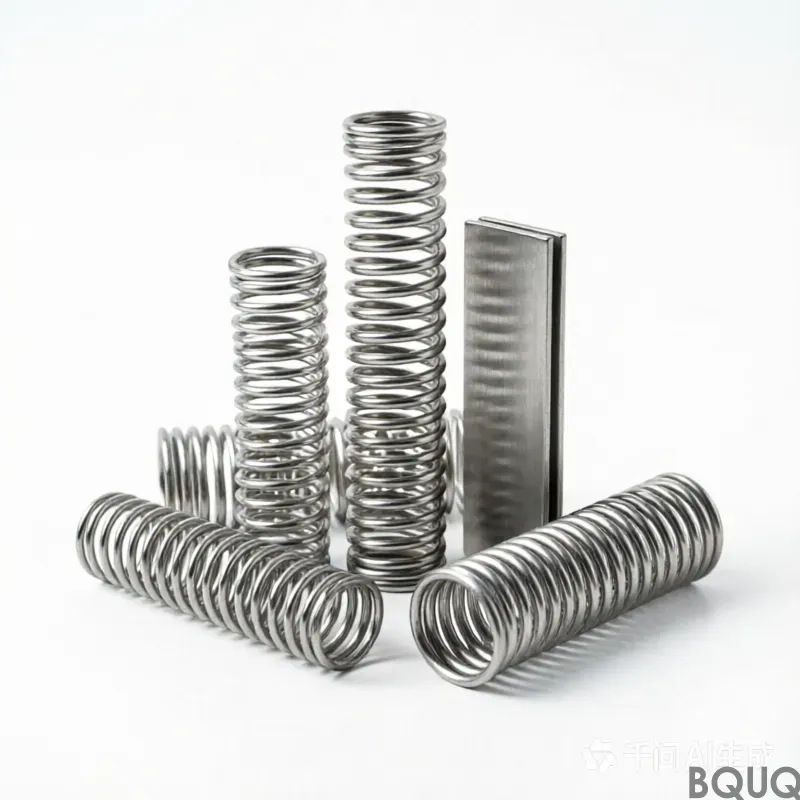
BQUQ is a professional metal spring manufacturer, please send us drawings, and our company will quote you within 12 hours.
In-depth analysis of technology and process in the hardware spring industry in 2026: a full-dimensional interpretation of high stress, functional integration and engineering certification
Introduction
Hardware springs are one of the most widely used components in industrial basic parts systems, and they are widely used in industrial equipment, consumer electronics, automotive chassis, medical electronic instruments, and various electromechanical systems. In engineering practice, once the spring fails, it is not a simple part damage, but may cause system chain failure and even cause major safety accidents. Taking automobile suspension springs as an example, the longest single test period can reach 70 days (10 weeks) in the test standard of the host manufacturer. The reason is that the suspension spring working under high stress conditions will cause corrosion fatigue failure once the surface is subjected to stress corrosion. If the broken spring port punctures the tire, it may cause major safety and personal accidents.
From 2025 to 2026, the market structure and technical direction of the global spring industry are undergoing profound changes. China's spring market revenue has reached $1.49 billion in 2024, and it is expected to grow to $2.11 billion by 2030, with a compound annual growth rate (CAGR) of 6.1%. Among them, Helical Spring is the largest revenue contributor category, and it is also the fastest growing sub-category. At the same time, the industry competition landscape is also changing - there are more than 4,000 spring manufacturers in the country, but less than 200 have the qualification of first-class suppliers of OEMs. The structural contradiction between low-end overcapacity and high-end dependence on imports remains prominent. Driven by the three trends of intelligence, greening and integration, the role of traditional springs is accelerating into "functional modular electromechanical components".
This paper will focus on four aspects: material engineering, process standards, application scenario innovation, and supplier quality certification system, and provide a complete, in-depth, and direct technical interpretation of the hardware spring industry.
This article is mainly targeted at the population
Product design engineer (requires knowledge of spring selection methods and failure modes)
Manufacturing/process engineer (requires in-depth knowledge of coiling, heat treatment, shot peening parameters)
Purchasing and SQE Supplier Quality Engineer (to screen suppliers according to certification standards)
Industry researchers and strategic planners (who understand market dynamics and technology frontiers)
The core value of this article
According to the "technical parameters + failure cases + engineering experiment standards" provided in the full text, practical operation guidelines are provided.
Assist in the comprehensive QCDS (Quality, Cost, Delivery, Service) review of spring suppliers across all dimensions.
Reduce the "trial and error" of spring selection, and reduce the cost of R & D and after-sales failure.
The first dimension: materials engineering - selection logic from alloy grades to extreme service
The upper limit of mechanical properties and safety performance of hardware springs depend first on the choice of raw materials and heat treatment system. The requirements for spring materials in different application scenarios vary significantly, and the wrong selection will directly lead to early fatigue failure.
1.1 Mainstream spring material system
The following are the most mainstream types of spring materials in the current industry and their core engineering parameters:
Carbon spring steel (e.g. 65Mn, 60Si2MnA): high elastic limit, good cold formability, low cost, but poor corrosion resistance, suitable for general industrial machinery, such as agricultural machinery, chassis shock absorption, low-voltage switches, etc.
Alloy spring steel (such as 50CrVA, 55CrSi and other SUP series): Added chromium, vanadium and other alloying elements, excellent high temperature resistance and relaxation resistance. Strength up to 2,200 MPa or more, suitable for heavy cycle conditions such as valve springs and high-performance suspensions.
Austenitic stainless steel (SUS304, SUS301, SUS316): highly resistant to corrosion, but the strength after cold drawing is relatively low compared to alloy steel, generally between 800 and 1,400 MPa, suitable for medical apparatus, food equipment, marine engineering and other highly corrosive environments.
Precipitation hardening stainless steel (e.g. 17-7PH, 631): High strength and good corrosion resistance are obtained by precipitation hardening after heat treatment, suitable for aerospace and high-end fastening systems.
Nickel-based superalloys (Inconel X-750, Inconel 718): maintain elasticity and creep resistance at high temperatures (> 500 ° C) and in corrosive environments, and are core materials in nuclear power, aerospace, and combustion chamber environments.
Titanium alloy (Ti-6Al-4V): high specific strength, low density, but low modulus of elasticity (about 110 GPa), suitable for aerospace, medical implants, and other fields that pursue extreme lightweighting, such as electric formula racing.
1.2 Engineering personnel selection logic matrix
In the selection stage, comprehensive consideration must be given to: working temperature (-50C~ 600C), corrosive medium (salt spray, electrolyte, chemical corrosion), fatigue cycle number (≥10 times), assembly space constraints, cost constraints, etc. A sound selection report should include limit stress calculation, surface integrity design allowance, temperature rise and relaxation effect compensation calculation.
Experience summary: In high-temperature or strong corrosive environments, stainless steel and nickel-based alloys are essential; under high-stress and high-cycle conditions, alloy spring steel with precision shot peening is a golden combination; carbon steel is only suitable for low-stress, dry, room temperature environments; titanium alloys only have engineering economy in scenarios where the demand for lightweight is extremely urgent.
The second dimension: physical depth and engineering standards for shot peening, a key manufacturing process
Among all spring strengthening processes, Shot Peening is the most technical and directly affects the reliability of the product. It uses high-speed projectiles to impact the metal surface of the spring to form a residual compressive stress layer to counteract the tensile stress during service.
2.1 Engineering technical indicators
The core quantitative indicators of shot peening effect are as follows:
Good shot peening surface stress: ≥ -600 MPa;
At a depth of 50 μm from the surface: residual compressive stress ≥ -800 MPa;
Surface stress of stress peening (peening under prestressed conditions): ≥ -800 MPa, up to -1,200 MPa at 50 μm from the surface.
At present, mainstream factories generally use multiple shot peening processes: first use larger diameter pellets for coarse spraying, and then use smaller diameter pellets for fine spraying to establish the optimal compressive stress layer at different depth levels. The process parameters also cover: Almen intensity arc height value (used to monitor shot peening strength), coverage (≥100% or 200%), pellet hardness and size distribution. Suspension spring production lines generally use continuous anti-roll frame strengthening equipment, which is transported by a suspended conveyor chain. Multiple rounds of shot peening are carried out at three shot blasting stations according to the set time and angle. The production capacity of a single unit can reach 500 pieces/hour.
For helical springs, due to their helical geometry, the strengthening operation is more complex than for flat-surface leaf springs - the spring needs to be driven by roller roll while rotating, ensuring that the high-speed shot flow passes between the spring rings and hits the metal surface inside the inner ring where the stress is most concentrated. For applications with high stress fatigue requirements, the industry has introduced multi-nozzle combinations on basic shot blasting equipment to achieve "targeted strengthening" of the specific stress concentration area of the circular spring.
2.2 Typical failure modes for shot peening failure
One-sided abrasion of the spring, early brittle fracture - uneven shot peening coverage leads to incomplete compressive stress layer;
Corrosive fatigue fracture - no compressive stress protection in high stress areas, can crack after a few months of service.
Engineering Recommendation: For high stress springs, shot peening process parameters (pellet type, Almen strength, coverage) must be used as key characteristics of process control (PQC, Production Quality Characteristic), with regular sampling and complete traceability records maintained. Suppliers must clearly define these parameters in the Control Plan and demonstrate compliance with customer standards with actual reports.
The third dimension: application scenarios and functional innovation - a new paradigm of spring engineering driven by new energy and intelligence
Hardware springs are undergoing a profound transformation from "standard elastic components" to "electromechanical functional modules", which has spawned many innovations, especially in the fields of new energy and medical care.
3.1 Conductive springs in new energy vehicle battery packs
In the new energy vehicle battery pack, the spring is no longer just a mechanical element. The patented technology points out that the spring conductive element that can be elastically deformed can be used to connect the end electrodes of multiple planar electrochemical batteries with the support member through the spring conductive element to achieve the integrated function of stable contact pressure and effective conduction. In some designs, the conductive spring is in a stretched state, and the second conductive member is pulled towards the first conductive member through its elastic force, which not only ensures electrical conduction but also buffers vibration shocks.
This mechanical-electrical integrated design requires engineers to take into account: contact resistance (< 0.5 mΩ), contact pressure stability (within ±10%), vibration and shock resistance (ISO 16750-3 standard), long-term electrochemical corrosion suppression (such as Fretting Corrosion Control) and other multi-dimensional technical indicators.
3.2 Miniaturization and ultra-high reliability of medical and humanoid robots
In the field of medical electronics and precision robotics, the miniaturization of springs (wire diameter 0.01-0.5 mm) and the billions of cycle life requirements have brought new technological challenges. For example, miniature springs for heart valve holders need to pass 380 million durability tests, which is equivalent to opening and closing 50,000 times a day and working continuously for 20 years; nickel-titanium shape memory alloy springs for intracranial vascular guides have a wire diameter of only 0.008 mm and need to be stable in complex environments for more than ten years.
Key engineering points: The manufacturing of miniature springs requires the use of precision progressive dies and ultra-high-precision CNC spring coils, which are strictly limited in terms of cleanliness control (such as ISO 16232 particle contamination standards) and fatigue test frequency control (to avoid thermal effects affecting test results).
Fourth Dimension: Supply Chain Certification System - International Automotive Industry Quality Standards and Supplier Access
For OEMs and large industrial customers, the technical audit of the supplier is the core checkpoint before the spring is delivered.
4.1 Core qualification certification
IATF 16949 (International Automotive Industry Quality Management System): "Certificate of Entry" into the automotive supply chain, emphasizing process methods and continuous improvement.
ISO 13485 (quality management system for medical apparatus): for medical spring suppliers, including sterilization verification and biocompatibility testing of implant grade springs.
AS9100D (Aerospace Quality Management System): Certification that aviation spring suppliers must pass, involving First Piece Inspection (FAI) and critical characteristic traceability.
ISO 14001 (Environmental Management System): Responding to increasingly stringent environmental regulations around the world.
4.2 Supplier technical capability evaluation indicators (enterprise actual combat reference)
The following table summarizes the common quantitative evaluation metrics for spring manufacturers during the supplier selection process for the reference of engineering and procurement teams:
Key metrics and checkpoints for evaluating dimensions
Material control Whether it has XRF and other spectrometers for material incoming verification; whether there is a material traceability system, and whether it can be traced back to the furnace number/smelting batch number
Coil spring accuracy CNC spring machine Actual accuracy (diameter tolerance ±0~ 0.05mm); force value test and process capability index (Cpk ≥ 1.33)
Heat treatment control continuous mesh belt furnace temperature uniformity test report; real-time temperature monitoring and over-limit alarm mechanism
Shot peening Almen strength and coverage test; equipment periodic calibration and process verification records
Surface coating neutral salt spray test (NSS) grade; coating thickness and adhesion test method
Fatigue life test with spring-specific high-frequency/low-frequency fatigue testing machine; can third-party certification test report be provided?
Whether intelligent detection/SPC automatically detects force value, load and stiffness online; whether to establish statistical process control and quality digital traceability system
Can the control of hazardous substances provide RoHS and REACH reports issued by accredited testing institutions?
It is recommended that procurement and SQE use the above checklist to check on a case-by-case basis during site visits, rather than relying solely on paper compliance with the quality system certificate.
Compliance and environmental trends: The European Union REACH regulations and the RoHS directive put forward clear test report requirements for harmful substances (such as lead, mercury, hexavalent chromium, polybrominated biphenyls, etc.) in spring materials. Spring suppliers supplying to the global market must provide customers with the analysis report of harmful substances issued by an accredited third-party testing agency, especially for specific process pollution that may be caused by nickel, chromium, arsenic, etc.
New trend of intelligent detection: Around 2025, leading enterprises in the industry have begun to introduce fully automatic force value detection and AI visual defect screening systems online. Online 100% detection of spring size, stiffness, free length and other parameters, combined with statistical process control (SPC) system, will intercept early failures in the factory, and the failure rate can be controlled below 0.01%.
conclusion
Hardware springs have evolved from "invisible basic parts" to key functional components that determine system performance and safety. With the continued expansion of the global market at a compound annual growth rate of around 6%, and the rapid development of new energy vehicles and medical electronics, spring companies with high-end manufacturing processes (especially shot peening and online intelligent testing) and complete supplier quality systems will have a significant competitive advantage.
For engineers and manufacturing enterprises, grasping the full chain of material selection, precision manufacturing, functional integration, and supplier certification is not only a necessary measure to ensure product quality, but also a key foundation for future competition in the industry.
BQUQ is a professional metal spring manufacturer, please send us drawings, and our company will quote you within 12 hours.
Frequently Asked Questions
What is the market size and growth forecast for China's spring industry?
China's spring market revenue reached $1.49 billion in 2024 and is expected to grow to $2.11 billion by 2030, with a compound annual growth rate (CAGR) of 6.1%. Helical Spring is the largest and fastest-growing revenue category in this market.
How many spring manufacturers are qualified as first-tier OEM suppliers in China?
There are more than 4,000 spring manufacturers in China, but fewer than 200 have the qualification to be first-class suppliers to OEMs. This highlights a structural contradiction between low-end overcapacity and high-end dependence on imports.
What is the typical test duration for automotive suspension springs?
The longest single test period for automotive suspension springs can reach 70 days (10 weeks) in host manufacturer test standards. This is because suspension springs working under high stress can suffer corrosion fatigue failure if the surface undergoes stress corrosion, potentially causing major safety accidents.
What are the key trends transforming the traditional spring industry?
The spring industry is being driven by three trends: intelligence, greening, and integration. These trends are accelerating the transformation of traditional springs into 'functional modular electromechanical components', changing both the market structure and technical direction of the industry from 2025 to 2026.