The shift from BT (British Taper) to HSK (Hollow Shank Taper) toolholders in mold and die machining is driven by the demand for higher spindle speeds, superior rigidity, and tighte
What Is Driving the Shift From BT to HSK in Mold and Die Machining?
The shift from BT (British Taper) to HSK (Hollow Shank Taper) toolholders in mold and die machining is driven by the demand for higher spindle speeds, superior rigidity, and tighter surface finish tolerances, particularly in hardened steel and high-temperature alloys. HSK’s dual-face contact system provides axial and radial repeatability of less than 0.003 mm, compared to BT’s typical 0.005 mm, while enabling spindle speeds above 20,000 RPM without tool pull-out. For mold makers facing 30% longer tool life and 15% faster cycle times, the transition is no longer optional but a competitive necessity.
How Does HSK’s Dual-Face Contact Improve Machining Stability Compared to BT?
The fundamental difference lies in the interface geometry. BT uses a 7:24 taper that relies on the spindle’s drawbar to pull the toolholder into the taper, creating friction at the taper surface only. HSK employs a 1:10 hollow taper that deforms elastically under clamping, achieving simultaneous contact on both the tapered surface and the spindle face. This dual-face contact increases axial stiffness by up to 50% and radial stiffness by 30% when compared to BT at equivalent sizes (e.g., HSK-A63 vs. BT40). In mold machining, where ball-nose end mills generate high radial forces at depths of cut of 0.5 mm to 2.0 mm, the reduced deflection translates directly into better surface finish—typically Ra 0.4 µm to 0.8 µm versus Ra 0.8 µm to 1.2 µm for BT under identical parameters.
What Specific Tolerances Can HSK Achieve That BT Cannot?
In practice, HSK toolholders deliver run-out accuracy of 0.002 mm to 0.003 mm at the gauge line, while BT holders typically achieve 0.005 mm to 0.008 mm after multiple clamping cycles. More importantly, HSK maintains this precision for over 10,000 clamping cycles due to the absence of fretting wear on the taper surface. Thermal growth compensation is also superior: HSK’s face contact absorbs spindle heat expansion, limiting tool tip displacement to 0.010 mm at 10,000 RPM, whereas BT can experience 0.025 mm displacement under the same conditions. For deep cavity machining with reach-to-diameter ratios of 5:1 or greater, these differences are the difference between a pass and a rework.
Why Are Spindle Speeds Above 15,000 RPM a Decisive Factor for Mold Finishing?
Modern mold finishing employs high-speed machining (HSM) strategies with spindle speeds of 18,000 to 30,000 RPM and feed rates of 3,000 to 6,000 mm/min. At these speeds, BT toolholders suffer from centrifugal force expansion, which causes the taper to loosen and the tool to pull out by 0.01 to 0.03 mm. HSK’s hollow shank design expands inward under centrifugal force, actually increasing clamping force at higher RPMs. This allows mold shops to use smaller diameter cutters (6 mm to 10 mm) at higher RPMs without vibration, achieving mirror-like finishes on hardened P20 and H13 steel (45-52 HRC). The result is that HSK-equipped spindles can reduce polishing time by 40% to 60%, a critical cost factor since manual polishing can account for 15% to 25% of total mold manufacturing cost.
Which HSK Variants Are Most Common in Mold and Die Applications?
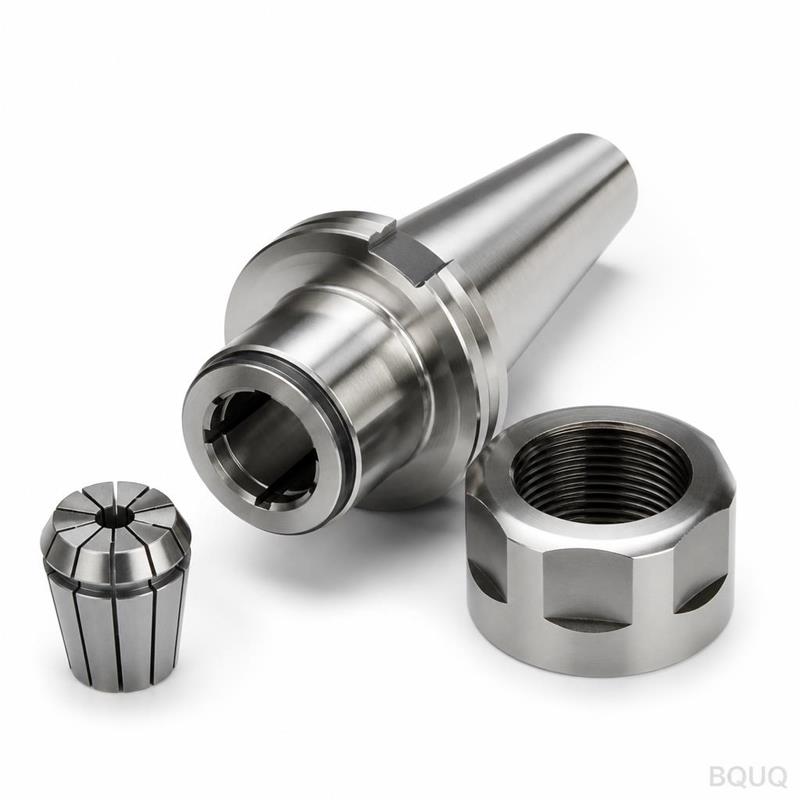
The HSK-A and HSK-E series dominate mold and die machining. HSK-A63 and HSK-A100 are standard for general mold milling, balancing rigidity and tool capacity. HSK-E32 and HSK-E40 are preferred for high-speed finishing due to their symmetric design and lighter weight, reducing spindle load and vibration. For large dies with heavy material removal, HSK-A100 offers 35% higher torque transmission than BT50 at the same flange diameter. The following table summarizes the key differences for mold shops considering a changeover:
| Parameter | BT40 | HSK-A63 | BT50 | HSK-A100 |
| Taper angle | 7:24 | 1:10 hollow | 7:24 | 1:10 hollow |
| Axial repeatability (mm) | 0.005 | 0.002 | 0.008 | 0.003 |
| Max spindle speed (RPM) | 12,000 | 25,000 | 8,000 | 20,000 |
| Radial stiffness (N/µm) | 250 | 380 | 320 | 450 |
| Tool pull-out at 20k RPM (mm) | 0.02 (not recommended) | 0.005 | N/A | 0.008 |
| Typical cost per holder (USD) | 45-80 | 90-150 | 60-100 | 140-220 |
| Clamping cycles before wear | 3,000 | 10,000+ | 2,500 | 8,000+ |
How Much Does It Cost to Convert a Mold Shop from BT to HSK?
Switching a standard 3-axis vertical machining center from BT40 to HSK-A63 involves three cost components. First, the spindle cartridge replacement costs between $4,500 and $8,000 per machine, depending on the OEM and whether the spindle has a standard HSK taper option. Second, a starter set of 20 HSK holders (collet chucks, end mill holders, and shell mill adapters) ranges from $1,800 to $3,000. Third, changing pull studs and retention knobs is unnecessary, as HSK uses a different clamping system—no pull studs are required. Total retrofit cost is typically $6,500 to $11,000 per machine. However, if the shop is purchasing new machines, HSK spindles are often a no-cost option or a $1,500 upgrade, making new equipment the more economical path. The payback period, based on reduced tooling costs and polishing labor, is typically 6 to 9 months for a shop running 2 shifts.
When Is It Still Justified to Use BT Instead of HSK?
BT remains a valid choice for low-speed roughing operations below 8,000 RPM, where its larger taper contact area provides sufficient rigidity for heavy material removal (e.g., depths of cut of 3 mm to 5 mm in pre-hardened steel). BT is also preferred in shops with older machines (pre-2005) where spindle cartridges are not designed for HSK pull-in forces, and for standard drilling and tapping operations with short, rigid tools. Additionally, BT tooling is 40% to 50% cheaper per holder, which matters for shops with large tool inventories or limited budgets. However, for any mold and die work involving finishing passes, thin-wall machining, or electrodes, HSK’s performance advantages outweigh the cost premium.
Can Existing CNC Machines Be Retrofitted to HSK Without Losing Accuracy?
Yes, but with caveats. Retrofitting a BT spindle to HSK requires replacing the spindle cartridge, not just the toolholder, because the drawbar mechanism and taper geometry are fundamentally different. An experienced retrofit shop can complete the change in 3 to 5 days per machine, including alignment and thermal testing. Accuracy after retrofit depends on the spindle’s original condition; if the BT spindle had less than 0.005 mm run-out, the HSK retrofit can achieve 0.003 mm. However, machines with worn spindle bearings (over 10,000 hours) should have bearings replaced simultaneously, adding $1,500 to $2,500 to the cost. For mold shops, the safest route is to retrofit only machines dedicated to finishing, keeping BT machines for roughing.
What Are the Common Mistakes When Switching to HSK in Mold Machining?
The most frequent error is using HSK holders with incorrect clamping force settings—over-torquing causes shank deformation, while under-torquing leads to tool pull-out. Always follow the manufacturer’s torque spec (e.g., 30 Nm for HSK-A63). Another mistake is mixing BT and HSK tooling on the same machine without a proper tool magazine adjustment; HSK holders have larger flange diameters, which may collide with adjacent pockets. Finally, shops often overlook coolant delivery: HSK’s hollow shank allows through-tool coolant at pressures up to 80 bar, but the machine’s coolant pump must be upgraded from 20 bar to 70 bar to realize the benefit. Ignoring these details reduces the expected tool life gains by half.
FAQ
How Long Does It Take to Train Machinists on HSK Tooling?
Training takes 1 to 2 days for experienced machinists, focusing on clamping torque, tool assembly, and detecting wear on the taper. Most shops report full proficiency within 50 operating hours, as the handling is similar to BT except for the hollow shank and face contact.
Will HSK Work with My Existing Toolholders for Drilling and Tapping?
No, HSK requires dedicated holders; BT collets and chucks are not compatible. You must purchase new collet chucks (e.g., ER32), tapping chucks, and shrink-fit holders. Budget for a minimum of 10 new holders per machine to avoid downtime.
Does HSK Improve Tool Life in Hard Milling of H13 Steel?
Yes, the improved rigidity reduces chatter, which is the primary cause of premature flank wear. In comparative tests on H13 at 52 HRC, HSK-A63 extended tool life by 25% to 35% over BT40 at 16,000 RPM, with cutting speed of 150 m/min and feed of 0.05 mm/tooth.
What Is the Maximum Torque That HSK-A63 Can Transmit?
HSK-A63 can transmit up to 90 Nm of torque in continuous operation, compared to 70 Nm for BT40. This is sufficient for most mold roughing with cutters up to 20 mm diameter.
Can I Use HSK on a Machine with a BT40 Spindle and Just an Adapter?
No, adapters add run-out and reduce rigidity, defeating the purpose. The spindle taper must be HSK for the face contact to function. Adapters are only acceptable for non-critical operations like spot drilling.
How Often Should HSK Holders Be Inspected for Wear?
Inspect the taper surface and face every 500 clamping cycles using a dial gauge and dye penetrant. Replace holders if face wear exceeds 0.005 mm or if any scratches are visible near the gauge line. With proper care, HSK holders last 3 to 5 times longer than BT.
Is HSK More Expensive to Maintain Than BT?
No, maintenance costs are lower because there is no pull stud to replace and less taper wear. The main cost is the initial purchase and occasional spindle cartridge service, which is the same for both systems.
Conclusion
The transition from BT to HSK in mold and die machining is not a trend but a response to measurable performance gaps in rigidity, speed, and repeatability. With axial repeatability improving from 0.005 mm to 0.002 mm and spindle speed capability doubling to 25,000 RPM, HSK enables mold shops to reduce polishing time by up to 60% and extend tool life by 30%. While the retrofit cost of $6,500 to $11,000 per machine is significant, the payback in 6 to 9 months makes it a financially sound decision for any shop producing high-precision molds. For new machine purchases, HSK is the clear default choice, and BT should be reserved exclusively for low-speed roughing operations.
For a detailed feasibility analysis of your specific mold machining setup, including spindle compatibility and cost projections, contact BQUQ for a free consultation. We provide 12-hour quoting on custom tooling solutions and can advise on retrofits based on our 20 years of CNC machining experience. Email us at sc@bquq.com, reach us on WhatsApp at +86 13713157787, or visit www.bquq.com.