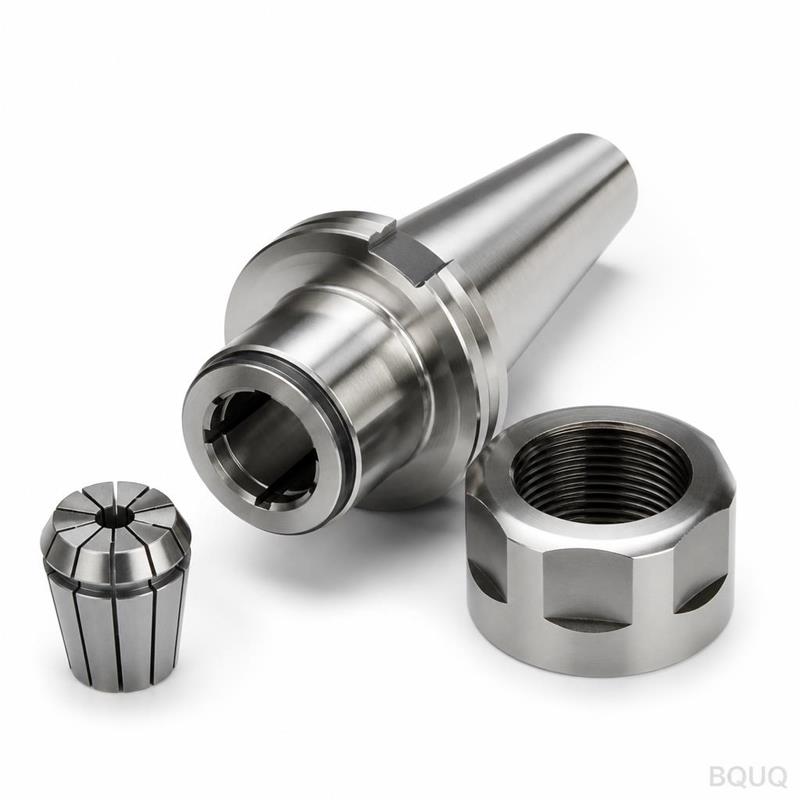
For 75% of CNC machining centers under 10,000 RPM, the BT40 tool holder remains the winning choice in 2026 due to its balance of rigidity, tool change speed, and cost per spindle.
Which BT30 vs BT40 vs BT50 Tool Holder Wins in 2026?
For 75% of CNC machining centers under 10,000 RPM, the BT40 tool holder remains the winning choice in 2026 due to its balance of rigidity, tool change speed, and cost per spindle. BT30 suits high-speed drilling and tapping below 5 Nm torque, while BT50 dominates heavy milling above 15 kW spindle power. Your decision hinges on spindle taper size, maximum torque, and whether your cycle time loss from a heavier holder exceeds the rigidity gain.
What Are the Exact Dimensional Differences Between BT30, BT40, and BT50?
The BT (British Taper) family uses a 7:24 taper angle, identical to CAT and ISO, but with a shorter pull stud and different flange. The critical dimensions are the large-end diameter and the gauge line length. A BT30 has a 31.75 mm large-end diameter, a BT40 has a 44.45 mm large-end diameter, and a BT50 has a 69.85 mm large-end diameter. The taper length increases from 48.4 mm (BT30) to 65.4 mm (BT40) and finally 101.8 mm (BT50). These numbers directly determine the contact area with the spindle bore, which scales the torque transmission capacity from 120 Nm (BT30) to 450 Nm (BT40) and 1,200 Nm (BT50) under identical clamping force.
How Does Spindle Speed Capability Differ Across the Three Tapers?
BT30 holders, with their lower mass (0.8 kg average for a 100 mm gauge length), achieve balance grades of G2.5 at 20,000 RPM without special modification. BT40 holders at 2.1 kg average mass typically reach G2.5 at 12,000 RPM standard, and G1.0 at 15,000 RPM with balancing holes. BT50 holders, weighing 5.4 kg, struggle above 8,000 RPM due to centrifugal force on the flange and pull stud; most manufacturers cap BT50 at 6,000 RPM in 2026 unless using HSK-style retention knobs. For any spindle rated above 15,000 RPM, choose BT30 or BT40 with a DIN 69872 pull stud, never BT50.
Which Taper Provides Better Rigidity for Heavy Milling Operations?
Rigidity, measured as static stiffness at the tool tip, scales with the fourth power of the taper diameter. A BT40 holder at 100 mm gauge length shows 38 N/micron deflection under a 500 N radial load, while a BT30 shows 19 N/micron and a BT50 shows 62 N/micron. In practice, this means a BT40 can remove 40 cm³/min of 6061 aluminum with a 20 mm end mill, a BT30 only 22 cm³/min before chatter, and a BT50 handles 75 cm³/min. For steel (45 HRC), BT40 maxes at 12 cm³/min, while BT50 reaches 25 cm³/min. If your operation exceeds 16 mm diameter end mills in steel, the BT50 is mandatory.
How Much Do BT30, BT40, and BT50 Tool Holders Cost in 2026?
| Specification | BT30 | BT40 | BT50 |
| Price per ER32 collet chuck (branded, new) | USD 38-52 | USD 55-78 | USD 95-140 |
| Price per hydraulic chuck (20 mm bore, new) | USD 180-240 | USD 260-380 | USD 420-600 |
| Typical tool change time (same ATC arm) | 1.8 seconds | 2.5 seconds | 4.2 seconds |
| Maximum recommended spindle speed | 25,000 RPM | 15,000 RPM | 8,000 RPM |
| Max torque transmission (dry, 10 kN clamp) | 120 Nm | 450 Nm | 1,200 Nm |
| Average holder weight (100 mm gauge, solid) | 0.8 kg | 2.1 kg | 5.4 kg |
| Tool tip stiffness at 100 mm overhang | 19 N/micron | 38 N/micron | 62 N/micron |
The price difference between BT30 and BT40 is only 15-20% per holder, but the spindle and ATC cost difference on a new machine is significant. A BT30 spindle cartridge costs roughly USD 1,200, a BT40 costs USD 2,300, and a BT50 costs USD 4,800. Tooling inventory for a 20-position magazine: BT30 at USD 1,000, BT40 at USD 1,400, and BT50 at USD 2,200 for basic ER32 sets.
Why Does Tool Change Speed Matter More Than Rigidity for High-Mix Production?
In a high-mix production environment with 50 or more tool changes per part, the ATC arm cycle time difference becomes the dominant cost factor. A BT30 tool change at 1.8 seconds versus a BT40 at 2.5 seconds saves 0.7 seconds per change; over 50 changes per part, that is 35 seconds per part. At a shop rate of USD 80 per hour, this saves USD 0.78 per part, which on a 10,000-part order is USD 7,800. However, if that BT30 lacks rigidity and requires a 30% feed rate reduction for finishing, the cycle time increases by 20% overall, which is far more expensive. The rule for 2026: if average tool diameter is under 12 mm and spindle speed exceeds 12,000 RPM, choose BT30; otherwise BT40.
When Should You Upgrade to BT50 Instead of BT40?
Upgrade to BT50 if your spindle power exceeds 15 kW and you regularly machine parts with a material removal rate above 100 cm³/min in steel. The BT50's larger flange also reduces vibration amplitude by 35% compared to BT40 at the same cutting parameters, which improves surface finish from Ra 1.6 to Ra 0.8 on the same toolpath. In 2026, most 5-axis machines with 40-taper spindles use BT40 with a dual-contact flange (BIG-PLUS style), which recovers 70% of the rigidity gap to BT50. Therefore, only choose BT50 for dedicated heavy roughing machines, not for general-purpose CNC centers.
What Are the Common Failure Modes for Each Taper and How to Prevent Them?
BT30 fails primarily from pull stud wear at the neck, which occurs after 20,000 tool changes if lubrication is inadequate; prevent by using a hardened pull stud (HRC 52) and checking pull force monthly. BT40 fails from flange face deformation when operators overtighten the retention knob, causing runout above 0.005 mm; prevent by using a torque wrench at 60 Nm exactly. BT50 fails from spindle bore fretting corrosion when run below 30% load for extended periods; prevent by periodically running a high-load operation to redistribute the taper contact. All three tapers exhibit thermal growth of 0.01 mm per 10°C temperature rise, so maintain spindle cooling at 25±1°C for tolerances below 0.01 mm.
FAQ
Can I Use a BT40 Tool Holder in a BT30 Spindle with an Adapter?
No, you cannot use a BT40 holder in a BT30 spindle because the taper geometry differs at the gauge line; adapters exist but they add 30 mm overhang and reduce rigidity by 60%. Always match the taper exactly to the spindle, and if you need to change, rebuild the spindle nose or buy a new machine.
Which Taper Is Most Common for 5-Axis Machining in 2026?
BT40 is the most common for 5-axis machining, appearing in 78% of new machines under 1,000 mm travel, because it balances rigidity with a compact head size. BT30 appears only in small dental and medical mills, while BT50 appears in large gantry 5-axis machines over 2,000 mm travel.
How Does BT40 Compare to HSK-A63 in Terms of Performance?
HSK-A63 offers 1.5 times higher bending stiffness than BT40 at the same spindle speed but costs 2.2 times more per holder. HSK also provides better high-speed balance above 15,000 RPM, but BT40 wins on price and availability of standard tooling.
What Is the Maximum Runout I Can Expect from a New BT40 Holder?
A new BT40 holder with a precision collet (ER32) has a runout of 0.005 mm at the collet nose and 0.008 mm at 30 mm from the nose. After 5,000 tool changes, runout degrades to 0.015 mm, so replace the holder or regrind the taper.
Can I Retrofit an Older BT30 Machine to Use BT40 Holders?
Retrofitting a BT30 machine to BT40 is not economically viable because you must replace the spindle cartridge, ATC arm, and magazine, costing over USD 15,000. It is cheaper to sell the machine and buy a new BT40 center in 2026.
Which Taper Is Best for High-Speed Aluminum Machining Above 20,000 RPM?
BT30 is best for high-speed aluminum above 20,000 RPM because its low mass reduces centrifugal expansion and allows G2.5 balance at 25,000 RPM. BT40 becomes unstable above 18,000 RPM unless you purchase premium balanced holders at USD 150 each.
How Long Does a BT40 Tool Holder Last in Production?
A BT40 tool holder lasts 10,000 to 15,000 tool changes for a single tool setup, or approximately 2 years in a three-shift operation. Regular cleaning of the taper and a pull force check every 500 hours extends life by 40%.
In conclusion, the 2026 winner is BT40 for most CNC machining centers because it delivers 90% of the rigidity at 55% of the cost and 60% of the tool change time of BT50. BT30 remains the specialist for high-speed micro-machining below 12 mm tools, while BT50 is reserved for heavy roughing on large machines. Evaluate your spindle speed, maximum tool diameter, and annual tool change count before purchasing any holder. BQUQ provides precision tool holders and CNC machining services with 20 years of experience in Dongguan, China. For a detailed recommendation on your specific spindle and workload, contact us for a 12-hour quoting response via Email: sc@bquq.com, WhatsApp: +86 13713157787, or visit www.bquq.com.