5-axis CNC machining explained for buyers: true vs 3+2, when 5-axis cuts cost and lead time, tolerance effects, and parts that justify it. BQUQ ISO9001 Dongguan.
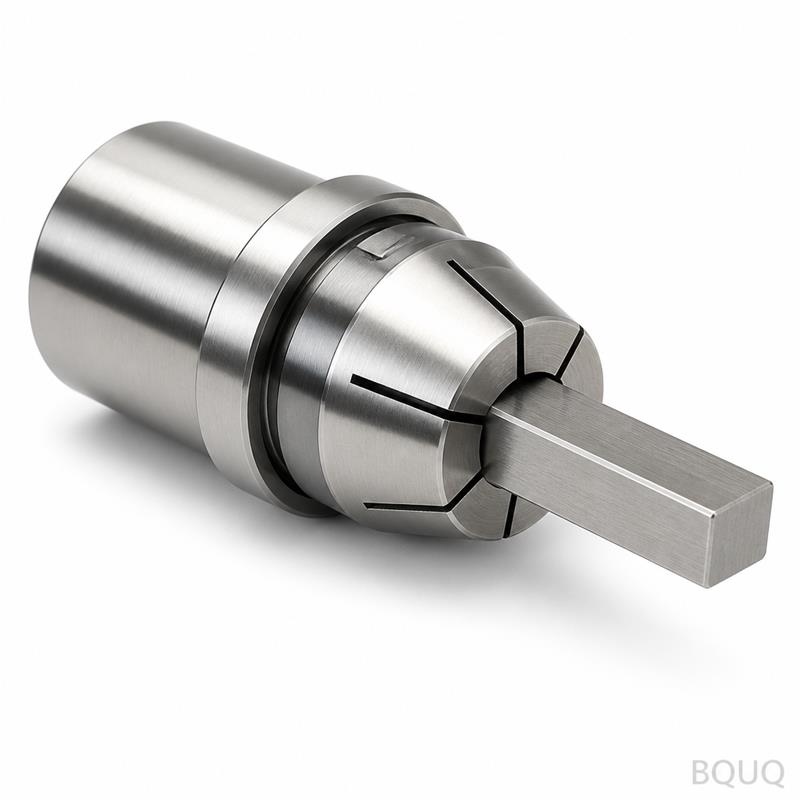
5-Axis CNC Machining: What It Actually Changes for Your Parts
Short answer: five-axis machining means the cutter can approach the part from five sides in one setup — either by tilting the table between operations (3+2) or moving all five axes simultaneously (full 5-axis). What it changes for you: complex parts finish in one fixturing instead of three, surfaces that need a ball-nose cutter at a steep angle come out smoother and faster, and tolerance stacks between setups disappear. It is not cheaper per hour — it is cheaper per finished complex part, and it is the difference between "we can quote it" and "we cannot make it" on impellers, turbine blades, medical implants and deep-cavity molds.
Five-axis machines carry a reputation for being expensive and exotic. The reality for buyers is simpler: 5-axis is a tool-approach strategy. If your part has undercuts, angled holes, contoured surfaces, or features on five sides, a 5-axis cell usually wins on total cost even though its hourly rate is 30–60% above a 3-axis VMC. This guide explains the two flavors of 5-axis, where each pays, and how to write an RFQ that gets you an honest quote instead of a cautious one.
True 5-Axis vs 3+2: Know Which You Are Buying
"Five-axis" covers two very different capabilities and the price difference is real. 3+2 positioning (also called 5-axis positional) tilts the table to a fixed angle, machines that face, tilts again, machines the next face. Full simultaneous 5-axis keeps the part and cutter moving together through complex contours, which is what sculpted surfaces actually need.
| Capability | 3+2 (positional) | Full simultaneous 5-axis |
|---|---|---|
| What moves | Table indexes to fixed angles between cuts | All five axes move during the cut |
| Best for | Prismatic parts, angled holes, multi-face work | Sculpted surfaces, impellers, blades, molds |
| Setup reduction | One setup replaces 2-4 manual re-fixtures | One setup for geometry impossible otherwise |
| Surface finish on slopes | Good (flat-end mills at fixed angle) | Smooth (ball-nose at controlled angle) |
| Programming cost | Moderate | High (CAM time, simulation, post-processor care) |
| Machine cost | +30-50% over 3-axis | +60-120% over 3-axis |
Most "5-axis" production parts in medical, robotics and automation are 3+2 jobs. True simultaneous cutting is reserved for freeform surfaces. Quote both paths separately if you are unsure — an honest shop will tell you which one your part needs.
What 5-Axis Actually Changes for Your Part
The visible benefits come down to four. First, fewer setups: a part that needed three fixtures on a 3-axis machine (top, bottom, side) machines complete in one program, which removes the risk of a part being re-clamped slightly differently and losing datum. Second, better tool geometry: a 3-axis machine cutting a deep pocket or a sloped wall often has to use a long tool that deflects; a 5-axis machine tilts the head or table so a short, rigid tool does the work — better finish, tighter tolerance, longer tool life. Third, shorter effective cycle time on complex geometry because the tool always works in its sweet spot. Fourth, access: undercuts and back-drafted features that are simply unmachinable on 3-axis become regular jobs.
When 5-Axis Is Worth the Higher Rate
| Part type | Why 5-axis wins | Typical industries |
|---|---|---|
| Impellers, rotors, blisks | Twisted blades need continuous 5-axis | Aerospace, pumps, turbochargers |
| Medical implants and instruments | Anatomical contours, one-piece geometry | Orthopedics, dental |
| Mold inserts and electrodes | Deep cavities, steep walls, good finish | Injection molds, dies |
| Valve bodies and manifolds | Ports at compound angles | Fluid power, hydraulics |
| Robot joints and housings | Multi-face precision, fewer datums | Robotics, automation |
| Optics and enclosures | Angled mounting faces, tight fit | Photonics, defense |
If your part is mostly 2.5D — flat pockets, drilled hole patterns, square shoulders — 5-axis adds cost without benefit. A prismatic bracket that fits in one 3-axis setup should stay on a 3-axis machine. The crossover appears when the part would otherwise need two or more setups, or when a critical surface cannot be reached with a rigid tool.
Tolerance and Finish Reality
A well-run 5-axis cell holds the same per-feature tolerances as good 3-axis work — ±0.01 mm on machined features, ±0.005 mm on short supported diameters — but with better consistency across the whole part, because there is no re-fixturing error between faces. Where 5-axis really wins is surface finish on contoured surfaces: a ball-nose cutter engaged at a constant favorable angle leaves a more uniform scallop than the same cutter dragged across a slope on a 3-axis machine. Expect to specify finish in Ra and verify with a profilometer; do not expect "5-axis" alone to guarantee a mirror polish — that is a separate finishing operation.
RFQ Tips for 5-Axis Work
Send the model file (STEP preferred), a PDF drawing with the critical dimensions and datums clearly marked, and a note on which surfaces are functional. State target quantity and whether the design is frozen — 5-axis programming is expensive to redo after every revision. Ask the shop three questions: is this 3+2 or full 5-axis work, what tolerance do they hold on the datum structure, and what inspection equipment verifies the contoured surfaces (CMM with scanning, or a vision system). A shop that answers with concrete machine and inspection names, rather than "we can do it," is the one to trust. Our engineering team gives DFM feedback before quoting, so send the model and let us tell you honestly whether 5-axis earns its rate on your part or a 3-axis setup with a smart fixture plan is the cheaper route.
Frequently Asked Questions
Q: Is 5-axis CNC machining worth the extra cost?
A: For parts with features on multiple faces, angled holes, or contoured surfaces, yes — 5-axis eliminates re-fixturing, improves finish and reduces tolerance stacks, so the finished part is usually cheaper despite the higher hourly rate. For simple prismatic parts it is wasted capability; quote both and compare total cost per good part.
Q: What is the difference between 3+2 and full 5-axis machining?
A: 3+2 (positional) tilts the table to fixed angles and machines each face separately — it replaces multiple setups. Full simultaneous 5-axis moves part and cutter together through the cut, which is required for sculpted shapes like impeller blades and complex molds. Most production parts only need 3+2.
Q: What tolerance can 5-axis machining hold?
A: ±0.01 mm on machined features and ±0.005 mm on short supported diameters is realistic production capability, with better part-to-part consistency than multi-setup 3-axis because there are no re-clamping errors. Verify with CMM data rather than promises.
Q: When should I NOT use 5-axis machining?
A: When the part is flat-featured and fits in one or two 3-axis setups, or when quantity is tiny and programming cost dominates. For such parts 5-axis raises cost with no benefit — a standard VMC or mill-turn with good fixturing is the economical answer.
Q: How do I get an accurate quote for a 5-axis part from China?
A: Send the STEP model plus a PDF drawing with datums and critical tolerances, state the quantity and whether the design is frozen, and ask whether the job is 3+2 or full 5-axis and how contoured surfaces will be inspected. Concrete answers on machines and CMM scanning identify the shops that actually run 5-axis well.
Authored by the BQUQ Engineering Team. BQUQ is an ISO9001-certified source factory in Dongguan, China, running CNC machining, metal stamping, custom springs, heat sink and collet lines under one roof. Send drawings to sc@bquq.com or WhatsApp +86 13713157787 for a quote within 12 working hours. www.bquq.com