BQUQ, an ISO9001 Dongguan factory, covers automotive stamped parts: terminals, connector shells and EMI shields — alloys, plating, tolerance and temperature duty.
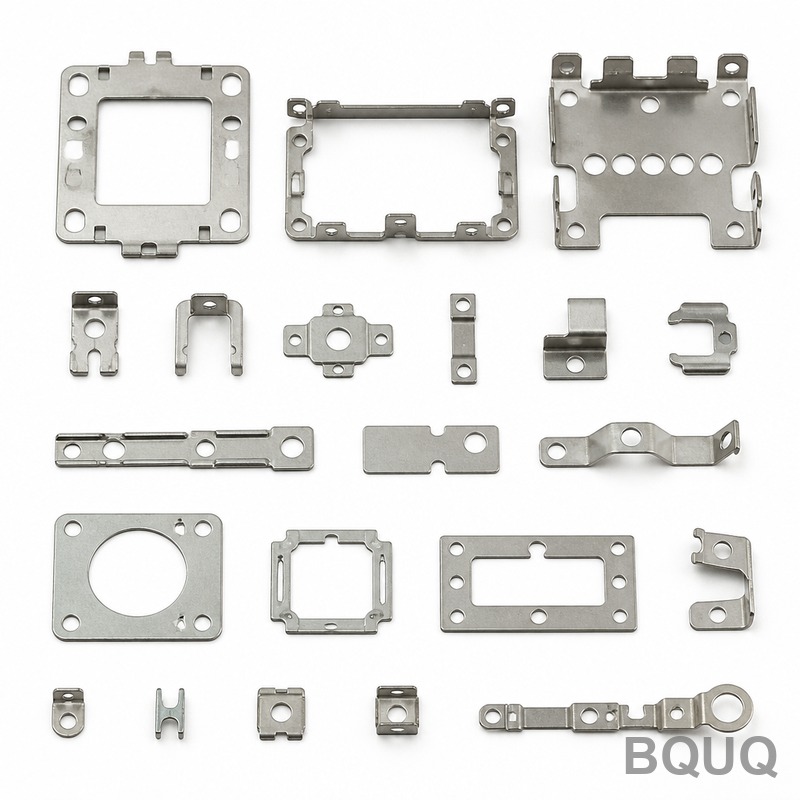
Stamped Components for Automotive Electronics: Terminals, Connectors and EMI Parts
Short answer: automotive electronics ride on stamped parts — connector terminals, header pins, EMI shield cans, ground clips, busbars, and heat-sink clips — and they are specified harder than consumer parts: service temperatures of −40°C to +125°C (up to 150°C+ near the engine), vibration up to 20–30 g in some mounting zones, lives of 10–15 years, and plating systems chosen so micro-current signal contacts never fail. That translates into copper-alloy strips like CuNiSi or phosphor bronze for terminals, tin plating for most power and signal contacts with gold or palladium-nickel where voltages drop below roughly 0.5 V, stamped shields from tin-plated steel or nickel-silver for EMI, and PPAP-style documentation on every new tool. Getting these parts right is a material, plating, tolerance, and documentation problem — in that order.
A modern car contains thousands of stamped metal parts that the driver never sees: the terminals locking into every connector under the dash, the shield can over the ECU's processor, the clip grounding a camera module, the busbar feeding a 48 V system. They must survive engine-bay heat, road vibration, salt, and fifteen years of service, and they are made in volumes that justify serious tooling. This guide explains how stamped components for automotive electronics are specified and sourced, from the perspective of a Dongguan factory that produces precision stamped parts for export customers.
The Environment Drives Every Choice
Automotive electronics components are graded by where they live in the vehicle, and the grade decides material, plating, and testing. Under-hood parts see the worst combination: sustained heat, thermal cycling, oil and salt exposure, and vibration from the engine. Interior and body parts are gentler but still far harsher than a living room, with wide temperature swings and sunlight aging. The classic temperature classes — roughly 85°C for interior comfort electronics, 105–125°C for passenger-compartment power electronics, and up to 150°C for engine-adjacent — should be written on the drawing, because they determine whether a tin-plated brass terminal survives or creeps into failure.
| Vehicle zone | Typical ambient range | Vibration character | Dominant risks for stamped parts |
|---|---|---|---|
| Interior infotainment, cockpit | −40 to +85°C | Low, steady | Fretting at connectors, corrosion in humid cabins |
| Body electronics, doors, seats | −40 to +105°C | Moderate, intermittent | Wiring-harness connector terminal wear |
| Underhood, engine bay | −40 to +125/150°C | High, wide-band | Stress relaxation, tin whisker risk, plating oxidation |
| EV battery pack and drive unit | −40 to +125°C, thermal cycling | Moderate, plus coolant exposure | Creep corrosion, galvanic pairs with aluminum busbars |
Three failure modes dominate in automotive stamped parts. Stress relaxation: a terminal beam holding contact force slowly loses it at sustained temperature — the reason spring-tempered copper alloys, not brass, are specified for loaded contacts. Fretting corrosion: micro-movement between mated contacts in a vibrating car rubs tin surfaces, producing insulating oxide debris — the reason connector makers add lubrication or switch contact finishes for high-cycle locations. And plating migration at temperature, where tin grows whiskers or intermetallic layers that change contact behavior over a 15-year life. Each of these is managed by grade and plating selection before the die is ever cut.
Terminals and Connector Parts: Alloy and Plating Logic
Connector terminals are the highest-volume stamped parts in a vehicle — a single car can hold several hundred terminals in its harness connectors, plus hundreds more inside ECUs and sensors. The terminal alloy must carry signal or power current, generate contact force as a stamped beam, survive crimping onto wire, and hold its spring at temperature. That is why the industry long ago moved past plain brass for loaded contacts toward phosphor bronze, and increasingly toward high-strength, high-conductivity copper alloys such as CuNiSi (C7025-type) that hold force at 125–150°C while carrying more current than bronze.
| Terminal type | Typical strip | Typical plating | Design driver |
|---|---|---|---|
| Signal terminal, low current | CuNiSi alloy or phosphor bronze | Tin, or gold/palladium-nickel below ~0.5 V | Contact force retention at temperature |
| Power terminal, 10–100 A | High-conductivity copper alloy, sometimes brass tab | Tin (matte or reflowed), silver for high-current | Current density, crimp integrity, low resistance |
| Ground terminal and stud | Brass or steel, nickel or tin plated | Nickel or tin over nickel underplate | Corrosion in wet zones, galvanic compatibility |
| Header pin / blade | Brass C2600 or CuNiSi | Tin, selective gold where required | Coplanarity, straightness after plating |
Plating is where automotive signal reliability is won or lost. Tin is the default finish — solderable, cheap, corrosion-adequate — but tin's oxide is an insulator at low voltage, so terminals switching micro-current signals (airbag squibs, sensor signals) commonly use gold or palladium-nickel with a gold flash, often selectively plated only at the contact area to control cost. The underplate matters as much as the finish: nickel underplate stops copper diffusing through the gold and forming resistive oxide at the surface. If the terminal carries high current, silver plating appears because silver oxide stays conductive; if it must survive salt, the plating system has to be thicker or the base metal upgraded. The full selection logic between base metal and finish is covered in our contact plating guide.
EMI Shields, Cans and Ground Clips: The Quiet Enforcers
The second big family of automotive stamped electronics parts exists to control electromagnetic interference, which has grown harsher as powertrain electronics, inverters, and high-current switching have multiplied under the hood. Shield cans over processors, stamped fence-and-cover assemblies, grounding clips that tie shields to chassis, and spring fingers that wipe against enclosure lids are all stamped parts, and all of them are judged by conductivity of the interface, not just the metal.
Material logic for shields: tin-plated steel (often called SPCC with tin plating) gives the cheapest effective shield with good solderability for board-level cans; nickel-silver and brass appear where the shield must also spring, as in grounding clips and finger stock; aluminum is rare for stamped shields because its oxide insulates at the mating edges — the reason shield designers add plated fingers rather than bare aluminum wipe contacts. Ground clips specifically need spring alloy behavior plus a corrosion-stable surface, because a corroded ground interface is an antenna, not a shield. If your assembly also needs heat management near the same electronics — shielded power stages run hot — the thermal side of the design is usually solved separately from the EMI side, and both parts can come from one factory. Our EMI shielding contact guide covers the spring-contact geometry and plating detail.
Tolerances, Coplanarity and the Quality Paperwork
Automotive stamped parts get inspected harder than consumer parts, and the drawing tolerances reflect it. Connector terminals specify coplanarity of tails (often within 0.05–0.10 mm so all tails touch the PCB in a press-fit or solder joint), terminal-to-terminal pitch held tight across a strip of many cavities, and plating thickness verified at the contact point. Shields need flat edges for lid seating and consistent can height. These are all achievable in a well-built progressive die, but they require carbide tooling, in-die forming stations, and measurement on optical and CMM equipment rather than calipers.
The paperwork is a design input, not an afterthought. Automotive customers commonly request PPAP-style submissions — process flow, FMEA-style risk review, control plan, dimensional results, material certificates, and capability studies — plus part-level traceability by batch. If you are the tier supplying a Tier 1, agree the documentation level before tooling starts: a full PPAP on a simple clip is wasted money, but missing material traceability on a safety-adjacent terminal can stop a line. A direct factory that has shipped automotive-grade stamping knows the drill; the practical question is matching submission depth to your customer's real requirement. Our PPAP and FAI guide lists what each level actually contains.
Sourcing Automotive Stamped Parts From a Source Factory
Sourcing automotive stamped parts from China works best when the buyer treats the factory as a partner in the documentation, not just the stamping. Send the drawing with the temperature class, the current and voltage at the contact, the vibration zone, the plating spec (type, thickness, underplate), and the documentation level required. If the grade is not finalized, send the duty and let the factory's engineers recommend the alloy — a source factory that also machines and makes springs has no incentive to oversell. Confirm die ownership, material certification flow, and plating partner qualifications before the tooling order. Then validate with samples from the tryout tool, review the FAI report against your own measurements, and only then release production tooling. Send the drawing and duty description to sc@bquq.com or WhatsApp +86 13713157787 and get a quotation within 12 working hours. Expect tryout samples with the FAI report within a few weeks of drawing approval, and use those samples for your own insertion-force, plating-thickness, and salt-spray checks before you release the production tool — automotive failures are cheapest when they are caught on ten parts, not ten thousand.
Frequently Asked Questions
Q: What is the most common stamped part in automotive electronics?
A: Connector terminals — a modern car contains several hundred in the wiring harness alone, plus terminals inside every ECU and sensor. Signal and power terminals, header pins, and crimp contacts are the highest-volume stamped parts in the vehicle.
Q: Why can't I use standard brass for automotive connector terminals?
A: Loaded brass beams relax under sustained stress, and heat accelerates it — an engine-bay terminal that grips at 25°C may lose contact force at 125°C. Automotive terminals that must generate force use phosphor bronze or CuNiSi-type alloys with better relaxation resistance.
Q: When does a terminal need gold instead of tin plating?
A: When the switched voltage is very low — below roughly 0.5 V — because tin oxide is an insulator at those levels and fretting can block the signal. Gold or palladium-nickel with a gold flash, over a nickel underplate, is the standard answer for sensitive signal terminals.
Q: What tolerances do automotive stamped terminals hold?
A: Typically ±0.05 mm on formed features, with coplanarity of terminal tails held within 0.05–0.10 mm so every tail seats in its PCB hole. Flat blanked features can run tighter. Call out coplanarity explicitly — it is the dimension that makes or breaks press-fit assembly.
Q: Do you provide PPAP documentation for automotive stamped parts?
A: Yes — we support PPAP-style submissions including process flow, dimensional results, material certificates, and capability studies on request. The factory is ISO9001 certified; agree the required documentation depth with us before tooling so the submission matches your customer's level.
Related Resources
- Stamped terminals and contacts: progressive-die production of automotive-grade terminals and EMI parts.
- PPAP and FAI for stamping: what each documentation level actually contains.
- About BQUQ: an ISO9001-certified source factory running stamping, CNC, spring and heat sink lines under one roof.
- Contact us: send the drawing for a quote within 12 working hours.
Authored by the BQUQ Engineering Team. BQUQ is an ISO9001-certified source factory in Dongguan, China, running CNC machining, metal stamping, custom springs, heat sink and collet lines under one roof. Send drawings to sc@bquq.com or WhatsApp +86 13713157787 for a quote within 12 working hours. www.bquq.com