Collets for Small Diameter Work: Below 1 mm
Short answer: Below 1 mm, the collet is no longer just a holder — it is the accuracy system. Use a precision ER11 or ER8 collet (or a Swiss-type collet with a matched guide bushing) with total indicated runout held under 0.005 mm, bore tolerance matched to the bar to within 0.01 mm, and clamping pressure kept low enough to avoid crushing thin walls. Below 0.5 mm, expect to run reduced depth of cut, higher spindle speed, and a coolant-fed or air-blast setup to clear chips. BQUQ machines sub-1 mm features daily on four production lines in one Dongguan factory, quoting in 12 working hours.
Why does small diameter work fail at the collet, not the tool?
Most sub-1 mm turning and milling problems trace back to the interface between the part and the collet, not to the cutting edge. At 0.8 mm diameter, a 0.02 mm runout error is 2.5% of the diameter. At 0.3 mm, the same error is nearly 7%. The tool does not cut a cylinder anymore — it cuts a taper, then a lobe, then a broken part.
There are three failure modes specific to small diameter work:
- Crushing. A collet sized for 1.0 mm clamping a 0.8 mm pin closes on two or three points instead of the full circumference. Thin walls collapse or the pin shears.
- Slip and pull-out. Under-tightened collets let the bar creep during peck drilling or parting. The part length drifts, and the finished dimension is wrong by the time you notice.
- Whirl and chatter. A collet with poor concentricity lets a small end mill or drill deflect. At 0.5 mm, tool deflection is often larger than the chip load itself.
The fix is not a bigger chuck. It is a collet system whose bore, taper, and nut are all sized for the diameter you are actually holding.
What collet sizes actually cover sub-1 mm?
Standard ER collets are made in 0.5 mm or 1 mm collapse ranges, which means an ER11 collet marked "1.0 mm" can hold roughly 0.5–1.0 mm if it is a true spring collet with slotted relief. That range is too wide for precision work below 1 mm. You want a collet whose nominal bore is within 0.01 mm of the bar.
| Collet family | Typical bore range | Best use below 1 mm | Notes |
|---|---|---|---|
| ER8 | 0.5–5 mm | 0.5–1.0 mm end mills, drills | Smallest common ER; low clamping force |
| ER11 | 0.5–7 mm | 0.6–1.0 mm bar and tools | Widely stocked; good balance of size and grip |
| ER16 | 1–10 mm | 1.0 mm and above | Overkill below 1 mm, but stable |
| 5C | 0.5–26 mm (by bore) | 0.5–1.0 mm with dedicated bore | Rigid; needs a dedicated collet per size |
| Swiss-type collet | 0.5–10 mm | 0.5–1.0 mm bar in sliding headstock | Must be paired with a matched guide bushing |
| TG100 / TG150 | 0.5–10 mm | Small drills in milling spindles | Higher gripping force than ER at same size |
The practical rule: below 1 mm, buy a collet with a dedicated bore, not a collapsing range. A 0.8 mm dedicated collet holds 0.8 mm bar to a fraction of the runout of a 0.5–1.0 mm spring collet.
For Swiss-type machines, the guide bushing and collet must be a matched set. Mixing brands or wear states between the two introduces a runout stack that no amount of tool tuning will fix.
How tight should runout be for sub-1 mm parts?
Total indicated runout (TIR) at the collet face is the single number that decides whether a 0.6 mm part comes out round. The table below gives working targets, not guarantees — your machine, spindle, and material all shift the result.
| Part diameter | Target TIR at collet face | Acceptable bore mismatch | Practical consequence if exceeded |
|---|---|---|---|
| 1.0 mm | ≤ 0.010 mm | ±0.01 mm | Visible taper, poor finish |
| 0.8 mm | ≤ 0.008 mm | ±0.01 mm | Ovality, drill wander |
| 0.5 mm | ≤ 0.005 mm | ±0.005 mm | Breakage on entry, chatter |
| 0.3 mm | ≤ 0.003 mm | ±0.005 mm | Not viable on standard ER; use Swiss guide bushing |
These are typical values for a clean, well-maintained setup. A worn collet, a scored nut, or chips in the taper will add 0.01–0.03 mm instantly. That is why sub-1 mm work demands a clean collet bore before every run, not every shift.
BQUQ holds ±0.005 mm on CNC machining work, and for sub-millimeter features that tolerance is achieved through collet selection and inspection discipline rather than through the machine alone.
Which collet type fits which small-part process?
The right collet depends on whether you are holding the part or holding the tool.
Holding the workpiece (bar or blank)
- Swiss-type collet + guide bushing. The standard for sub-1 mm bar. The bar is supported within microns of the cutting zone, so deflection is minimal. Requires matched collet and bushing, and bar straightness matters more than diameter tolerance.
- 5C collet with dedicated bore. Good for short, rigid sub-1 mm pins on a conventional lathe. Less support than Swiss, but simpler to set up.
- Auto-lathe collet (15-type, 25-type). Used on cam and auto lathes for high-volume small pins. Bore sizes down to 0.5 mm are available. See the auto-lathe collet range for the standard series.
Holding the tool (drill, end mill, reamer)
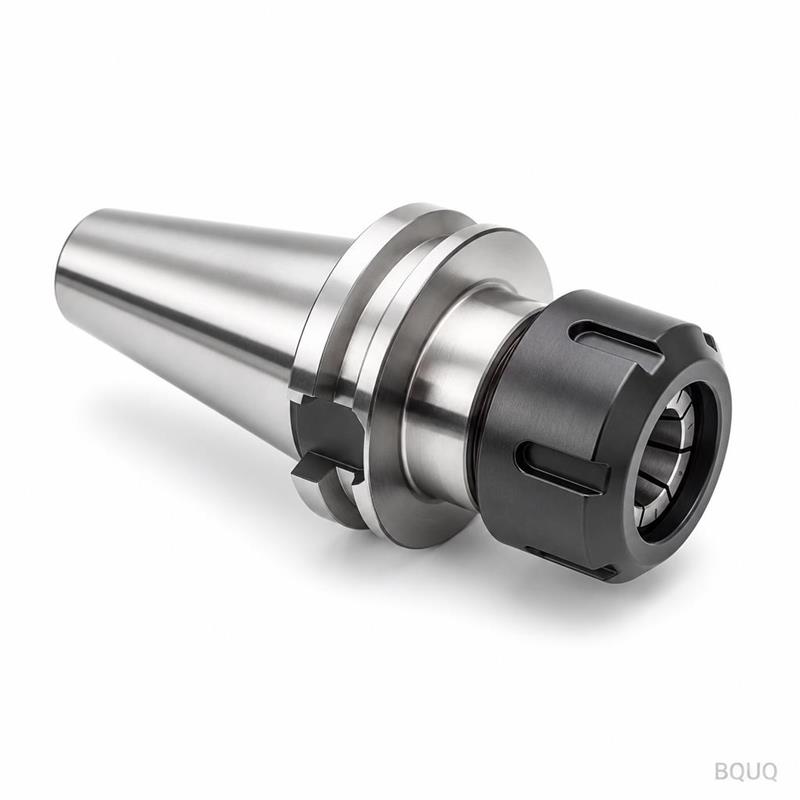
- ER11 or ER8 collet chuck. The default for micro end mills. Keep the nut clean and torque to spec — over-torque distorts the collet and adds runout.
- TG100 collet. Higher grip for small drills where pull-out is a risk.
- Hydraulic or shrink-fit holder. Best runout available, but limited to shank sizes above roughly 3 mm. Not applicable below 1 mm in most shops.
For micro milling on a machining center, a balanced tool holder collet chuck with an ER11 or ER8 collet is the practical choice. Balance matters more as spindle speed rises past 20,000 rpm.
What clamping pressure is safe below 1 mm?
Clamping pressure is where most sub-1 mm setups fail. A collet that grips a 12 mm bar comfortably will crush a 0.8 mm thin-wall tube at the same torque.
Guidelines that hold in practice:
- Thin-wall tubes and bushings below 1 mm wall: reduce clamping force to the minimum that prevents slip. Use a dedicated bore collet, not a collapsing one, so the load spreads around the circumference.
- Solid pins and bar: standard torque is usually fine, but check for witness marks after the first part. If you see flats, the collet is too large or too tight.
- Brittle materials (glass-filled plastics, some ceramics): use a soft-jaw or split-sleeve adapter inside the collet. The sleeve distributes load and prevents point contact.
- Swiss guide bushing: set to a light sliding fit on the bar. Too tight and the bar seizes; too loose and the bar whips.
If you are running soft or thin materials, the approach in collet workholding for soft materials applies directly — the same logic scales down to sub-1 mm.
How do you set up a sub-1 mm job without scrapping the first ten parts?
Setup discipline matters more than any single component. A repeatable sequence:
1. Clean the taper and collet bore. Wipe with lint-free cloth and check under magnification. A single chip at 0.5 mm is a 1% diameter error.
2. Measure the bar. Confirm diameter at three points along the length. Bar tolerance is often wider than the collet bore tolerance.
3. Seat the collet in the nut before inserting the bar. ER collets must snap into the nut's eccentric ring; inserting the bar first distorts the collet.
4. Torque to the holder manufacturer's spec. Not more. Over-torque is the most common cause of sub-1 mm runout.
5. Indicate the bar, not the collet. Measure TIR on the bar 5–10 mm from the collet face.
6. Run one part and inspect before committing. Measure diameter, roundness, and length. Adjust pressure or speed before running the batch.
7. Re-check after 20 parts. Thermal drift and chip buildup change runout over a run.
This sequence is the same one used for medical turning work, where sub-millimeter features and burr-free edges are routine.
What about speed, feed, and chip control?
Below 1 mm, chip control is a bigger risk than tool wear. Chips that would be swept away at 10 mm diameter will wrap, recut, and break a 0.5 mm tool.
Typical starting points for sub-1 mm turning and milling (indicative, not prescriptive):
- Spindle speed: high — often 8,000–24,000 rpm for micro milling, and Swiss lathes commonly run bar feed at several thousand rpm.
- Depth of cut: radial engagement of 2–5% of tool diameter for micro end mills.
- Feed per tooth: 0.002–0.01 mm for tools under 1 mm.
- Coolant: high-pressure or air-blast to clear chips. Flood coolant can push chips back into the cut at this scale.
- Peck drilling: short pecks with full retract to clear the flutes.
The collet standard numbers guide is useful when you need to match a collet to a specific machine spindle or tool shank before you start cutting.
When should you move to a Swiss-type setup?
If your part is below 1 mm in diameter and longer than about 3× diameter, a Swiss-type machine with a matched collet and guide bushing is usually the only reliable route. The guide bushing supports the bar at the cut, so deflection stays inside tolerance even at long length-to-diameter ratios.
For high-volume sub-1 mm pins, the decision is economic as much as technical: Swiss-type tooling costs more up front but holds tolerance and cycle time better than a conventional lathe with a 5C collet. BQUQ runs both approaches, and the choice is made per part, not per customer.
If you are also holding small parts in a power chuck for secondary operations, the power chuck and Swiss workholding range covers the options that pair with a sub-1 mm primary process.
Frequently Asked Questions
Q: Can a standard ER11 collet hold 0.5 mm bar accurately?
A: Yes, but only if it is a dedicated 0.5 mm bore collet, not a 0.5–1.0 mm collapsing type. Dedicated bores hold runout under 0.005 mm when clean and correctly torqued. Collapsing collets at that size introduce 0.01–0.02 mm of error, which is too much for a 0.5 mm part.
Q: What is the smallest diameter a collet can reliably hold?
A: Production work is practical down to about 0.3 mm with a Swiss-type collet and matched guide bushing. Below that, the bar itself becomes difficult to feed and straighten, and handling damage dominates. Most shops draw the line at 0.5 mm for conventional collets and 0.3 mm for Swiss.
Q: How do I stop a sub-1 mm part from slipping in the collet?
A: First, match the bore to the bar within 0.01 mm. Second, torque to the holder spec — under-torque is the usual cause. Third, check for oil or chips on the bar and collet bore. If slip continues, move to a higher-grip collet such as TG100 or a dedicated Swiss collet rather than increasing torque.
Q: Does collet material matter for small diameter work?
A: Yes. Hardened and quenched spring steel holds bore tolerance longer under repeated clamping. Mirror-polished bores reduce friction and marking on soft materials. For sub-1 mm work, bore wear is the limiting factor, so a quality quenched collet outlasts a soft one by a wide margin.
Q: Can BQUQ quote sub-1 mm collet work quickly?
A: Yes. BQUQ quotes in 12 working hours, with flexible MOQ for prototype and low-volume sub-1 mm parts. Send drawings, material, and target quantity to sc@bquq.com or WhatsApp +86 13713157787. Four production lines in one Dongguan factory cover CNC machining, stamping, springs, and heat sinks under one ISO9001 system.
Related Resources
- About BQUQ and our Dongguan factory: /about/
- Auto-lathe collet series and bore options: /auto-lathe-collets/
- Power chucks and Swiss workholding: /power-chucks-swiss/
- Tool holder collet chucks for micro milling: /tool-holder-collet-chucks/
- Industry trends in precision manufacturing: /industry-dynamics/
- Technical articles on collets and workholding: /bquq-blog/
- Case studies and contact: /case/ | /contact/
Authored by the BQUQ Engineering Team. BQUQ (Dongguan) runs CNC machining (±0.005 mm), metal stamping, custom springs, and heat sink production in one ISO9001 factory. Source-direct from Dongguan, China — quote in 12 hours: sc@bquq.com | WhatsApp +86 13713157787 | www.bquq.com