Collet Grip Range: What One Collet Can Actually Hold
Short answer: A standard ER collet holds a range of about 1 mm total (0.039 in), meaning roughly ±0.5 mm around its nominal bore — an ER32 10 mm collet grips about 9.5–10.0 mm, not 8–12 mm. 5C collets are far tighter, typically +0.000/-0.015 mm on the nominal size, so one 5C collet holds essentially one diameter. Swiss-type collets sit between the two, often 0.1–0.5 mm of usable collapse depending on the headstock design. Grip range is a compromise: the wider the collapse, the worse the concentricity and the shorter the collet life.
Why a collet cannot hold "any size near 10 mm"
A collet is not a chuck jaw. It is a slotted, hardened steel (or sometimes beryllium copper, bronze, or carbide-lined) sleeve that is squeezed by a tapered seat. The slots are what allow the bore to shrink. When you close a collet, every segment between two slots bends inward, and the bore becomes a slightly polygonal shape rather than a perfect circle.
That geometry is the entire story of grip range. A collet with 8 slots closes into 8 arcs. The more you collapse it, the more the arcs flatten and the more the contact pattern shifts from "full-circle grip" to "line contact at the slot edges." Contact area drops, clamping force per unit area rises, and the workpiece or tool shank starts to see point loading.
There are three practical consequences:
1. Concentricity degrades. The collet no longer sits symmetrically on the taper, so TIR grows.
2. Grip force becomes uneven. Some segments bite, others barely touch.
3. Collet life shortens. Fatigue cracks start at the slot roots, and once a collet has been over-collapsed, it never returns to its original bore.
This is why every serious collet standard — DIN 6499 for ER, ISO 15488, the 5C specification, and the various Swiss-type standards — defines a nominal bore plus a small collapsible window, not a wide size band.
What is the actual grip range of common collet types?
The table below gives typical values. Treat them as indicative engineering guidance, not as a substitute for your collet manufacturer's drawing.
| Collet type | Nominal bore example | Typical collapse range | Usable grip window | Notes |
|---|---|---|---|---|
| ER8 / ER11 | 3 mm | ~0.5 mm total | 2.75–3.0 mm | Small collets collapse less in absolute terms |
| ER16 / ER20 | 6 mm | ~1.0 mm total | 5.5–6.0 mm | Standard DIN 6499 collapse |
| ER25 / ER32 | 10 mm | ~1.0 mm total | 9.5–10.0 mm | Most common shop floor size |
| ER40 / ER50 | 20 mm | ~1.0 mm total | 19.0–20.0 mm | Larger body, same nominal collapse |
| 5C round | 12 mm | ~0.015 mm | essentially nominal only | Hardened, minimal elastic range |
| 5C emergency (soft) | any | 0.5–1.0 mm | machined to size | Bore it yourself, then it is nominal |
| Swiss-type (guide bushing) | 5 mm | 0.1–0.5 mm | depends on headstock | Carbide-lined versions grip tighter |
| TG100 / TG150 | 12 mm | ~1.0 mm | 11.0–12.0 mm | Higher gripping force than ER |
Two things stand out. First, ER collets of every size share roughly the same absolute collapse — about 1 mm — regardless of body diameter. Second, 5C collets are not really "collapsible" in the ER sense at all; they are spring-tempered to grip one nominal diameter with a few microns of compliance.
The 1 mm rule for ER collets
DIN 6499 defines ER collets as collapsing approximately 1 mm total on the nominal bore. In practice, most manufacturers recommend using only the upper half of that window — roughly 0.5 mm — for any application where runout matters. If you need to hold 9.0 mm in an ER32, buy the 9 mm collet, not the 10 mm one squeezed down.
A useful rule of thumb: the collet bore should be within 0.5% of the workpiece diameter for precision work, and within 2% for general work. For a 10 mm shank, that is 9.95–10.0 mm for precision and 9.8–10.2 mm for general machining.
Why 5C behaves differently
5C collets are hardened and ground to a nominal bore with a very small elastic range. The classic 5C specification allows the collet to close on the nominal diameter and grip it, but it does not tolerate being used as a "range" collet. If you need to hold 11.8 mm, you buy an 11.8 mm 5C collet — or you buy a soft (emergency) 5C and bore it to size.
This is a feature, not a limitation. Because the collet is dimensioned to the part, the TIR can be held to a few microns, and the grip is uniform around the full circumference. That is why 5C remains the default for precision second-operation work on lathes.
How does grip range affect runout and accuracy?
Runout and grip range trade off directly. A collet used at its nominal bore sits symmetrically in the taper and grips on a full circle. A collet collapsed by 0.8 mm sits slightly off-axis and grips on a reduced contact band.
| Collapse from nominal | Typical TIR impact | Contact pattern | Recommended use |
|---|---|---|---|
| 0 mm (nominal) | Best achievable, e.g. ≤0.005 mm | Full circle | Precision turning, grinding, inspection |
| 0.1–0.3 mm | Slight increase, often ≤0.01 mm | Near full circle | General CNC milling and drilling |
| 0.3–0.5 mm | Noticeable, 0.02–0.05 mm | Reduced band | Roughing, non-critical work |
| >0.5 mm | Poor and unpredictable | Edge/line contact | Avoid where accuracy matters |
These figures are typical for a good-quality, quenched and ground collet in a clean, undamaged taper. Your numbers will depend on the chuck nut, the taper condition, and the spindle.
If you are chasing single-digit-micron TIR, the collet is only one link in the chain. The taper, the nut, and the shank all matter. Our guide to collet TIR and what actually drives it breaks that chain down, and the comparison of collet versus 3-jaw chuck tolerance shows where a collet wins and where it does not.
How do you choose the right collet for a given diameter?
The decision is simpler than most people make it. Work through these steps:
1. Measure the actual shank or workpiece diameter. Not the nominal. A "10 mm" drill shank is often 9.95 mm; a "10 mm" bar stock can be 9.90 mm.
2. Pick the collet whose nominal bore is equal to or slightly larger than the measured diameter.
3. Check the collapse. If the difference exceeds 0.5 mm for ER, step to the next size down.
4. Check the chuck's own range. A collet chuck with a nut has a defined clamping range; exceeding it damages the nut and the taper.
5. For high-volume or high-precision work, go custom. A dedicated bore matched to your part removes the compromise entirely.
For Swiss-type lathes, the same logic applies to the guide bushing, but the tolerances are tighter and the bushing is usually carbide-lined. The collet nose diameter guide covers how nose geometry interacts with the bar feed and the guide bushing.
When to buy a custom collet instead of squeezing a standard one
Custom bores make sense when:
- The part diameter is non-standard (e.g. 7.42 mm) and volume justifies a dedicated collet.
- The part is thin-walled and cannot tolerate point loading from an over-collapsed collet.
- The material is soft (aluminium, brass, plastics) and you need maximum contact area to avoid marking.
- You are running a Swiss-type or auto-lathe where the collet is part of the machine's accuracy stack.
BQUQ manufactures round-bore, hex-bore, square-bore, and special-profile collets, including mirror-polished and quenched variants, in a single Dongguan factory. Custom bores are quoted from a drawing in 12 working hours, and MOQ is flexible — one piece is possible for a prototype, with pricing stepping down at volume.
What about spring collets and auto-lathe collets?
Spring collets (also called spring collet chucks or auto-lathe collets) are a different family from ER and 5C. They are used on automatic lathes and Swiss-type machines, and they are designed around a specific bar diameter with a defined collapse range built into the machine's cam or hydraulic actuation.
| Family | Typical grip window | Actuation | Where used |
|---|---|---|---|
| Auto-lathe collet (15 type) | 0.1–0.3 mm | Cam / lever | Small-diameter automatic lathes |
| Auto-lathe collet (25 type) | 0.1–0.5 mm | Cam / lever | Mid-size auto lathes |
| Auto-lathe collet (36–46 type) | 0.2–0.8 mm | Cam / lever | Larger bar work |
| Swiss-type collet | 0.1–0.5 mm | Hydraulic / pneumatic | Swiss CNC lathes |
| Guide bushing | 0.01–0.05 mm | Fixed or rotating | Swiss bar support |
The key difference is that auto-lathe and Swiss collets are designed to be actuated repeatedly at high cycle counts, so the collapse range is a function of the machine's stroke, not just the collet's elasticity. Pushing beyond the designed stroke cracks the collet at the slot roots.
Our auto-lathe collets range covers the common 15, 25, and 36–46 type bodies, and the power chucks for Swiss machines page covers the hydraulic and pneumatic actuation side.
How does collet chuck design limit grip range?
A collet is only half the system. The chuck body, the taper angle, the nut, and the closing mechanism all set the real limit.
- Taper angle. ER uses a 8° taper (16° included). The angle determines the mechanical advantage and the self-locking behaviour. A worn taper changes the effective collapse.
- Nut design. A standard nut vs. a bearing nut changes how much torque reaches the collet. Bearing nuts allow higher clamping force at the same wrench effort.
- Closing stroke. Power chucks and hydraulic chucks have a defined stroke. Exceeding it over-collapses the collet.
- Taper condition. Dirt, dents, or fretting in the taper cause the collet to sit off-axis, which eats into the usable range.
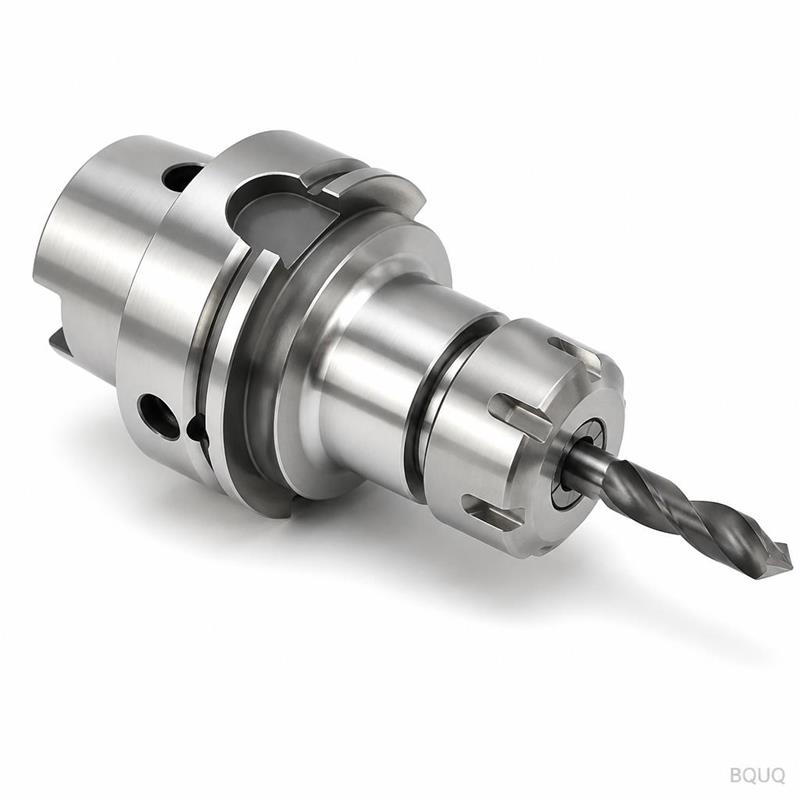
For tool-holding applications, the tool holder collet chucks range covers ER, TG, and DA bodies with matched nuts. For workholding, a collet chuck with nut gives the most predictable grip because the nut controls the axial pull directly.
Maintenance that preserves grip range
A collet that has been over-collapsed will not spring back. To keep the range usable:
- Never close a collet without a workpiece or tool inside it.
- Clean the taper and the collet slots before every change.
- Store collets in their original bores or in a rack, not loose in a drawer.
- Replace collets that show slot-root cracking, discolouration, or a bore that no longer matches its nominal size.
- Torque the nut to the manufacturer's specification — under-torque causes slip, over-torque crushes the collet.
Frequently Asked Questions
Q: Can I use a 10 mm ER32 collet to hold a 9 mm drill?
A: Only for rough work. That is 1 mm of collapse, which is the full DIN 6499 range and well past the 0.5 mm recommended for accuracy. TIR will grow and the drill may slip. Buy the 9 mm collet, or a 9–10 mm set, and keep the 10 mm collet for nominal 10 mm shanks. The cost of the correct collet is far lower than the cost of a scrapped part.
Q: Is a wider grip range always worse?
A: Not always — it depends on the application. For rough drilling, tapping, or holding a bar in a second-operation lathe, a wider collapse is convenient and the accuracy penalty does not matter. The problem appears when you need concentricity, surface finish, or repeatability. Then the widest usable range is about half the nominal collapse, and a dedicated bore is better still.
Q: How much can a 5C collet actually collapse?
A: A hardened 5C round collet has only a few microns of elastic range — effectively it grips one nominal diameter. Soft or emergency 5C collets can be bored to any size within the body's wall thickness, after which they behave as nominal collets. If you need a range, 5C is the wrong family; use ER or a spring collet instead.
Q: Does grip range change with collet material?
A: Yes. Hardened spring steel gives the standard collapse but is prone to fatigue cracking if over-collapsed. Beryllium copper and bronze collets tolerate more collapse and are used where corrosion resistance or non-magnetic properties matter. Carbide-lined Swiss guide bushings hold tighter tolerances but have almost no collapse range. Material choice follows the application, not the other way round.
Q: How do I know if my collet is over-collapsed?
A: Check the bore with a micrometer or pin gauge against its nominal size — a worn collet will read oversize and will not close evenly. Look for cracks at the slot roots, polished bands on the taper, or a workpiece that no longer repeats its TIR after re-chucking. Any of these means the collet has lost its elastic range and should be replaced rather than re-used.
Related Resources
- About BQUQ and our Dongguan factory: /about/
- Auto-lathe collets and spring collet ranges: /auto-lathe-collets/
- Power chucks for Swiss-type machines: /power-chucks-swiss/
- Tool holder collet chucks (ER, TG, DA): /tool-holder-collet-chucks/
- Industry trends in precision manufacturing: /industry-dynamics/
- Technical articles and engineering guides: /bquq-blog/
- Frequently asked questions: /faq/
- Case studies: /case/
- Contact our engineering team: /contact/
Authored by the BQUQ Engineering Team. BQUQ (Dongguan) runs CNC machining (±0.005 mm), metal stamping, custom springs, and heat sink production in one ISO9001 factory. Source-direct from Dongguan, China — quote in 12 hours: sc@bquq.com | WhatsApp +86 13713157787 | www.bquq.com