Ordering custom heat sinks: thermal spec, DFM review, quote, sample test and approval, with checklists. BQUQ (ISO9001, Dongguan) quotes in 12 hours.
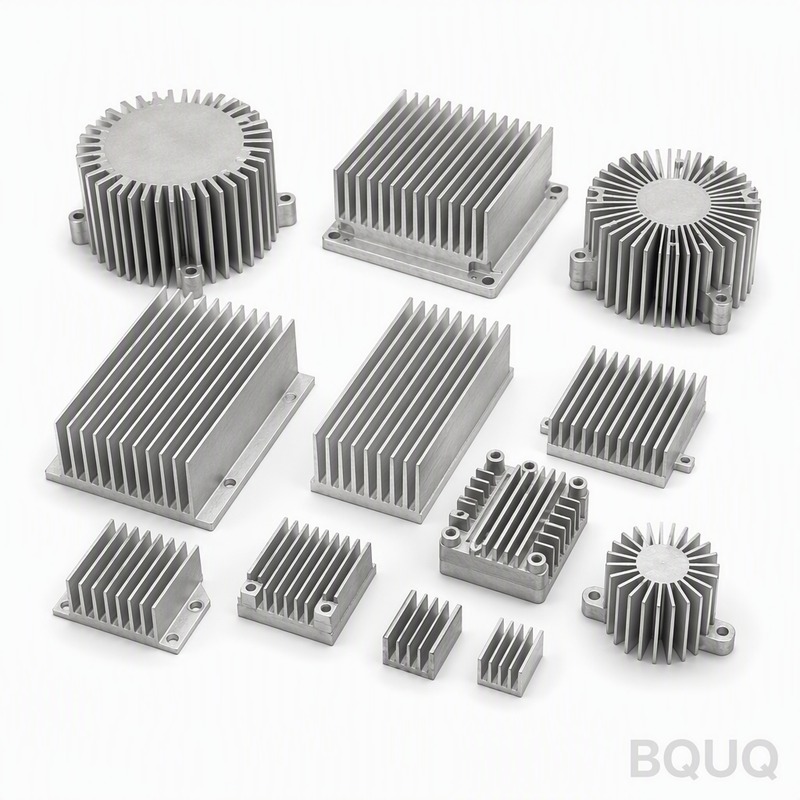
Ordering Custom Heat Sinks: The Drawing-to-Sample Workflow
Ordering a custom heat sink runs through six gates: send a complete thermal and mechanical spec, get a DFM review of the construction route, receive a quote with the tooling split out, approve a sample against a written thermal and dimensional test, release production with inspection data, and keep the documentation for repeat orders. The gate that decides everything is the first one — a spec that says "about 50 W, keep it cool" cannot be quoted, only guessed at.
Custom heat sinks fail on the drawing-to-sample journey in predictable ways: thermal requirements arrive as vague phrases, mechanical drawings omit the base flatness that makes the TIM work, and nobody writes down the pass criteria before the sample arrives. This workflow is the one we use at BQUQ on the extruded heat sinks and CNC-machined heat sinks lines — it is deliberately boring, and it is boring because it works.
Gate 1: The Thermal and Mechanical Spec
The inquiry package needs five thermal numbers and a mechanical drawing. The five numbers are: dissipated power at worst case (measured, not datasheet typical), maximum allowed case or junction temperature, worst-case ambient, airflow (velocity or fan model, or the words "still air"), and the envelope the sink must fit. The drawing adds the mechanical truth: mounting hole pattern, component footprint, clearance for clips or screws, and any features the sink must clear on the board.
| Spec item | Example value | Why it matters |
|---|---|---|
| Dissipated power | 28 W measured worst case | Sets the whole budget |
| Max case temperature | 95 °C | The pass/fail line |
| Worst ambient | 55 °C | What the delta-T is measured from |
| Airflow | Still air, or 2 m/s ducted | Changes geometry completely |
| Envelope | 120 × 90 × 45 mm max | What will physically fit |
| Base flatness need | ≤ 0.1 mm over 100 mm | Decides machining vs extrusion |
Takeaway: missing thermal numbers force the factory to assume, and assumptions get priced as margin — you pay for the guess either way. A complete spec gets a straight quote; a vague one gets a defensive one. If the power is not yet measured, say so and add margin at that step instead of leaving it silent.
Gate 2: DFM Review — Which Construction Route?
With the spec in hand, the factory should tell you which process makes the part, not ask you which one you want. The route depends on quantity, geometry, and the precision of the mounting face. If the fins are straight, the volume justifies a die or an existing profile fits, extrusion wins. If the base needs pockets and tight flatness at low volume, machining wins. If the geometry has fins in two directions, machining is the only option regardless of volume.
| Design signal | Route the DFM should pick |
|---|---|
| Straight fins, existing profile fits, any volume | Extrusion, cut to length |
| Straight fins, custom profile, 500+ pcs/year | Extrusion with new die |
| < ~300 pcs, or complex base features | CNC machined from solid |
| Fins in two directions, pin fins, radial fins | CNC machined |
| Very high volume, thin fins, sheet metal economy | Stamped or folded fin |
| Big power module, needs base flatness + fins | Hybrid: extruded fins, machined base |
Takeaway: a DFM review that names a construction route and defends it with your quantity is engineering; a quote that silently assumes one process is a sales document. Ask which process was priced and what the alternative would cost — at BQUQ the answer comes from one factory running extrusion, CNC, and stamping, so the recommendation is not protecting a single machine.
Gate 3: The Quote — Tooling Must Be a Separate Line
Every custom quote should split the one-time costs from the per-part costs. For an extrusion that means the die; for machining that means programming and first-article time. Seeing the split tells you the quantity math: divide the tooling by your real annual volume and you will know whether the route survives contact with your forecast. The quote should also name alloy, finish, and tolerance assumptions, because each one moves the price.
| Quote line | What it covers | What to check |
|---|---|---|
| Tooling (die or setup) | One-time cost | Amortizes over your real volume |
| Material and process | Per-part extrusion or machining | Matches the DFM route |
| Secondary operations | Cutting, milling, drilling, tapping | Could any be combined or deleted? |
| Finish | Anodize type and coverage | Black for passive, clear under fan |
| Inspection/documentation | Batch reports, material certs | Agreed before ordering |
Takeaway: if the quote has no tooling line, either no tooling is needed (machined route) or the die cost is hidden in the per-part price — ask which. The heat sink cost factors guide shows how each layer of the stack is priced so the quote reads as a map rather than a number.
Gates 4–5: Sample, Test, and Approve Against Written Criteria
The sample is where the spec becomes physics, and it only means something if the pass criteria were written at Gate 1. Approve the sample on four checks: dimensions against the drawing (mounting holes, base flatness, envelope), the thermal test (case temperature at rated power after equilibrium, using the production TIM), the finish (color, coverage, no masking misses), and assembly fit in the real product. Write the results down — the sample approval document is what production and the next order both reference.
| Sample check | Method | Pass example |
|---|---|---|
| Base flatness | Straightedge/feeler or CMM | ≤ 0.1 mm over 100 mm |
| Mounting features | Gauge pins, calipers, CMM | Holes on position per drawing |
| Thermal performance | Thermocouple + power test | Case ≤ 95 °C at 28 W, 55 °C ambient |
| Assembly fit | Mount in the actual product | No interference, even TIM squeeze |
| Finish | Visual + thickness check | Uniform black anodize, no bare spots |
Takeaway: the thermal test on the sample is the only number that proves the drawing was right, so run it with the production interface material — testing with a different TIM or no TIM validates nothing. Approve in writing, and keep the record; when the first production batch arrives, the same four checks at incoming inspection close the loop.
Gate 6: Production and Repeat Orders
Production is a repeatability problem. The order should restate the approved sample's spec, the factory should run the same process with the same inspection points, and the batch should ship with dimensional inspection data so incoming QC can verify without re-engineering the part. ISO9001 process control covers the paperwork side; your side is keeping the approved drawing, the test record, and the correspondence together so the next order — and the next engineer who touches the product — has the full thermal story. That documentation is also what makes a price increase reviewable and a second-source comparison honest. Send the complete package to sc@bquq.com and the quote returns within 12 working hours; the heat sink selection workflow article shows the engineering steps that feed Gate 1 if the thermal budget is not yet written down.
Email sc@bquq.com or WhatsApp +86 137 1315 7787 with your PDF/DXF/STEP file. An engineer reviews it and replies with price, lead time and DFM notes on working days.
Frequently Asked Questions
Q: What information does a factory need to quote a custom heat sink?
A: Dissipated power, maximum case or junction temperature, worst-case ambient, airflow (or "still air"), the envelope, and a drawing with the mounting features. Thermal numbers and mechanical drawing together let the factory size, process-select, and price the part in one pass.
Q: How long does a custom heat sink sample take?
A: CNC-machined samples typically ship within days because no tooling is needed; extruded samples with a new die usually take 2–4 weeks including die making and first pressings. Existing profiles cut and machined to length fall between the two.
Q: Should the extrusion die cost be a separate quote line?
A: Yes. Tooling is a one-time cost that should be visible so you can divide it by your real volume and check the economics. A quote with hidden die cost makes the per-part price look wrong and the comparison against machining impossible.
Q: What should I test on a heat sink sample before approving?
A: Dimensions (base flatness, mounting holes, envelope), thermal performance at rated power after equilibrium with the production TIM, finish coverage, and assembly fit in the real product. Approve in writing against the criteria set before the sample was ordered.
Q: What documents should ship with a production heat sink batch?
A: Dimensional inspection reports covering the drawing's critical features, material/alloy certificates, and the finish verification. For custom parts, keep the approved sample record and thermal test on file — they are the reference for every repeat order.
Related Articles
- heat-sink-selection-workflow — More from the BQUQ Thermal Management engineering series.
- heat-sink-cost-factors — More from the BQUQ Thermal Management engineering series.
- heat-sink-thermal-testing — More from the BQUQ Thermal Management engineering series.
Data Sources and Verification
Tolerances, cycle times and price ranges in this guide come from BQUQ production records at our Dongguan plant, where CNC machining (±0.005 mm), stamping, custom springs and heat sinks run under one roof. BQUQ is an ISO 9001:2015 certified factory; the certificate and batch inspection reports are available on request with every quotation.
Related Resources
- About BQUQ: an ISO9001-certified source factory in Dongguan running four production lines under one roof.
- Heat sinks and thermal parts: extruded, CNC-machined and stamped options from the thermal line — extruded heat sinks, CNC-machined heat sinks, stamped heat sinks.
- Industry trends: manufacturing, material market, and sourcing analysis for buyers.
- Technical articles: engineering guides and process comparisons — more where this article came from.
- FAQ hub: quick answers on CNC, stamping, springs, and heat sinks.
- Case studies: real parts and real numbers from projects we engineered and delivered.
- Contact us: send your drawing and get a quote within 12 working hours.
Authored by the BQUQ Engineering Team. BQUQ is an ISO9001-certified source factory in Dongguan, China, running CNC machining, metal stamping, custom springs, heat sink and collet lines under one roof. Send drawings to sc@bquq.com or WhatsApp +86 13713157787 for a quote within 12 working hours. www.bquq.com